
The private chat platform for your AI agents
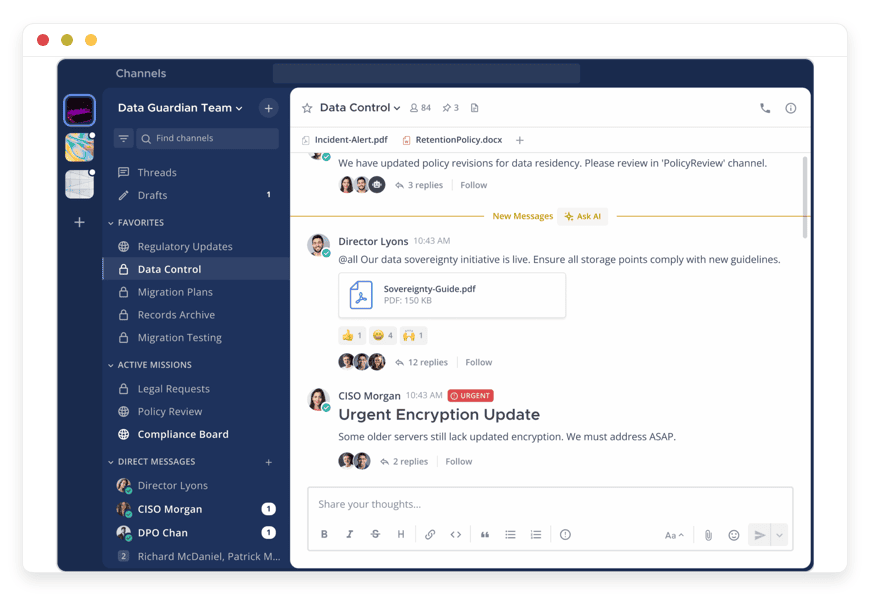
You connected an AI agent to a chat app, and a detailed map of your work now sits on somebody else's servers. The agent reads your files, drafts your emails, holds your API keys, and summarizes the projects you cannot discuss in public. Every one of those messages lands in a database owned by a company whose business model is attention, ads, or enterprise upsell. There is a cleaner architecture: give the agent its own channel, on a server you control, and talk to it there. Below: why the channel decision matters as much as the agent choice, how Hermes Agent, OpenClaw and Pi each connect to a self-hosted Mattermost instance, and what the whole setup costs to run.
TL;DR
- The chat channel is where your agent transcripts, file drops and approvals live. On Discord, Slack, WhatsApp, Telegram or Teams, that record sits with the vendor and its processors, under policies you do not write.
- Hermes Agent ships a native Mattermost channel. OpenClaw ships an official Mattermost plugin. Pi has a community bridge. Mattermost itself has a built-in agent bot and an MCP server.
- Self-hosted Mattermost means the message database is yours: your retention policy, your backups, your export, no ads, no model training on your content.
- Migration is not a trap: Slack imports directly, Discord and Telegram history exports convert, and the full PostgreSQL database is yours to walk away with.
- Managed Mattermost Team Edition runs at danian.co/mattermost for €9 per month, free to try for 7 days without a card, in any of 21 datacenter regions.
Why the channel matters as much as the agent
An AI agent is a very talkative colleague. It logs every instruction you give it, every file you attach, every command it runs on your behalf, and every draft it hands back. Run that conversation through a consumer chat app and you have moved a complete map of your work onto infrastructure run for advertising or engagement metrics. The agent itself may run on your own hardware, exactly as privacy-conscious setups intend, and the channel quietly undoes the whole arrangement.
The problem is structural, not scandalous. Discord, Slack, WhatsApp, Telegram and Microsoft Teams are multi-tenant services. Your messages sit in their databases, accessed by their staff and their vendors, under terms that change when their roadmap changes. An agent conversation is the most sensitive chat log you will ever produce, because it concentrates everything: credentials, documents, plans, mistakes, and the reasoning you would never put in an email thread.
The fix is to flip who hosts the conversation. A self-hosted Mattermost instance gives every agent in your life a permanent home: channels for projects, threads for long tasks, direct messages for one-off requests, and a searchable history that lives in a PostgreSQL database you control. The agents stay where they are. Only the conversation moves.
What the big channels do with your data
Fair questions deserve precise answers, so here is what each platform's own documents say, checked in November 2026. None of these companies calls itself a spy. All of them operate data pipelines you should understand before you point an agent at them.
| Channel | Who holds the transcripts | Trains models on your content | Ads built in | You can export everything |
|---|---|---|---|---|
| Discord | Discord and its processors | No, per policy, but sponsored-content profiling uses third-party data | Yes, Quests sponsored content | No full archive for server owners |
| Slack | Salesforce | Global ML models yes, unless you email an opt-out | No | Admin exports on paid plans |
| Meta companies | Meta AI training, opt-out offered in some regions | Meta ad ecosystem | Per-account chat export only | |
| Telegram | Telegram, plus cloud chats on their servers | No | Yes, ads expanded under the 2026 policy update | Per-account export |
| Microsoft Teams | Microsoft, US jurisdiction | No for commercial Copilot, per their FAQ | No | Admin eDiscovery |
| Mattermost, self-hosted | You | No, there is no vendor to train anything | No | Yes, full database and bulk export |
Slack. Slack's privacy principles state that customer content helps train its global machine-learning models unless you opt out, and the documented opt-out path is an email to feedback@slack.com with your workspace URL and the subject line "Slack Global model opt-out request". Generative AI training is separate and needs your affirmative opt-in, which is worth acknowledging. The default position for the predictive models, though, is train first, ask never. If your real question is which chat platform a whole team should adopt, the open-source Slack alternatives comparison covers that decision in depth.
Discord. The August 2025 policy updates describe a growing sponsored-content business, and the accompanying FAQ says plainly that Discord may acquire data from third parties to understand user interests for personalizing that sponsored content. Text chats are not end-to-end encrypted; the DAVE protocol Discord promotes covers voice and video calls, not messages. And in October 2025 the company disclosed that a third-party customer-service vendor breach exposed support conversations and IP addresses, plus government-ID photos belonging to roughly 70,000 users. Discord does state that it does not sell personal information or allow AI training on your messages. The structural point stands anyway: the data, the policy pen, and the vendor chain belong to them.
WhatsApp. The privacy policy opens by placing WhatsApp among the Meta companies and describing how information is shared across them. For an agent channel there is a second problem: there is no personal-account bot API, so agent bridges ride on the QR-code web pairing meant for phones, which sits in a gray zone of the terms.
Telegram. Credit where due: Telegram offers a proper bot API, which is why so many agent tools default to it. The trade-offs are metadata, since the policy documents IP addresses and phone numbers tied to accounts, and the business direction: an August 21, 2026 privacy-policy update added language describing advertising tools and how ads are displayed.
Microsoft Teams. The Copilot FAQ says commercial data is not used to train the model, an honest point in Microsoft's favor. The concerns are jurisdiction and dependency. A US provider sits under the CLOUD Act, which lets US authorities compel data from US companies regardless of where the servers are, and the 2026 Microsoft outage showed what happens to your channel when one vendor's cloud has a bad day.
None of this makes these tools evil. It makes them poor custodians for the richest data stream you now generate.
The architecture: host the channel, connect the agents
The pattern that works is a gateway. Modern agent frameworks speak to chat platforms through bot accounts, and Mattermost is unusually good at being the platform side of that connection: a clean REST API, WebSocket events for real-time response, incoming and outgoing webhooks, custom slash commands, and personal access tokens for bots. One server becomes the permanent address for every agent you run, today and in the projects you have not started yet.
Think of it as three boxes. Your agents run wherever they already run, on your laptop, a home server, or a small cloud instance. Mattermost runs on infrastructure you choose, in a region you choose. Your phone and laptop reach Mattermost through its native apps, exactly like any other chat tool. The conversation thread that ties you to your agents lives entirely in boxes one and two. No third box gets a copy.
This shape also gives you an audit trail worth having. Every command an agent ran on your behalf, every approval you granted, is a message you can search months later. When something goes sideways, the forensics sit in your database, not in a vendor's support queue.
Hermes Agent: a native Mattermost channel, done properly
Hermes Agent, the open-source agent from Nous Research, treats Mattermost as a first-class platform. The messaging gateway in Hermes connects to twenty platforms from one background process, and Mattermost is on the list alongside Telegram, Discord, Slack, WhatsApp, Signal, Matrix, Microsoft Teams, Email, SMS and more. The adapter talks to Mattermost's REST API v4 and listens on WebSocket for real-time events, with no external library needed.
In practice, you create a bot account in Mattermost, hand Hermes the token and URL, and the agent appears in your workspace. Direct messages get answered without a mention, each DM holding its own session. In channels, you @mention the agent when you want it. Threads work, so a long research task stays out of the main flow. File attachments and images go through, with inbound media capped and limited to senders the gateway authorizes.
Security lines up with what you would want before letting an agent loose on your infrastructure. Hermes layers user authorization with allowlists and DM pairing, human approval for dangerous commands, write sandboxes for file operations, optional container isolation, credential filtering for MCP subprocesses, and prompt-injection scanning over context files. You get an agent with real capabilities talking through a channel with real walls.
OpenClaw: one plugin command
OpenClaw, the open-source assistant gateway that runs on everything from a Mac mini to a Raspberry Pi, ships an official Mattermost plugin. Installation is a single command, openclaw plugins install @openclaw/mattermost, followed by a bot token and your server URL. The plugin handles channels, private channels, group DMs and direct messages, with a pairing policy you control for who the agent responds to.
Because OpenClaw's channel layer runs through its gateway, the Mattermost connection behaves like every other channel it supports. Bring your own model, keep the agent on hardware you own, and let the conversation happen where the data policy is one you wrote for yourself.
Pi, and everything else that beeps
The Pi coding agent from pi.dev takes the opposite approach to size: a minimal agent harness you extend yourself. Even here, the ecosystem meets Mattermost. A community bridge package, @whonixnetworks/pi-mattermost, exposes Pi coding sessions as Mattermost channels with slash commands and real-time streaming, so an agent that normally lives in a terminal can be steered from your phone through your own server.
And then there is Mattermost's own AI story, which keeps growing. The built-in Mattermost Agents feature, the successor to the Mattermost Copilot plugin, gives you a bot backed by a language model your administrator chooses, which can be a self-hosted model on your own GPU box. On a server without a commercial license you get one agent in direct messages, which is enough to try the pattern. The official Mattermost MCP server extends the idea: any agent that speaks the Model Context Protocol can read and search your workspace inside the permissions each user already has, with content creation part of the licensed tier. Automation platforms plug into the same surface, including n8n, which ships a Mattermost node and community templates for routing DevOps requests and investigating CI incidents with an agent in the loop. If a tool can send a webhook or answer a slash command, it can live in your Mattermost.
Privacy that is structural, not a promise
A fair question at this point: Mattermost does not end-to-end encrypt your messages by default, so why call it private? Because privacy in a self-hosted stack comes from custody, not from cryptography alone. The messages live in your PostgreSQL database, on a server you chose, in a region you chose. There is no vendor database, no ad-targeting pipeline, no third-party data acquisition, and no model training, for the simple reason that there is no vendor in the middle of the conversation. Transport is TLS. Encryption at rest is available and documented. Retention is a policy you set in the admin console, from keep-forever to aggressive pruning.
Custody also changes what a breach means. The 2025 Discord incident happened inside a support vendor's systems, and users found out from a press release. When you host the channel, the attack surface is your server, the blast radius is your server, and the incident response is yours to run, with logs you can read for yourself.
Leaving is allowed: migration without hostages
The strongest privacy feature is the exit. Mattermost's own docs cover the built-in Slack importer: feed it a Slack export and it pulls your users, channels and history across. Discord servers have well-maintained export tools in the community (we compared open-source Discord alternatives for communities separately), and Telegram builds a JSON export into every account, both of which convert cleanly into Mattermost imports. Going the other way, the bulk export tool emits your entire workspace, and because Team Edition is an MIT-licensed open-source build with no proprietary lock on your data, the PostgreSQL database itself is a complete, documented copy of everything you ever typed.
Run what advocates of open source call the exit test: before adopting any platform, describe how you would leave it. For the big consumer channels the honest answer involves export limits, admin gatekeeping, or nothing at all. For a self-hosted Mattermost the answer is a command and a database dump. That asymmetry, more than any feature list, is what the absence of lock-in looks like in practice.
What you give up, said plainly
This setup is not for everyone, and the trade-offs deserve blunt treatment. Team Edition, the MIT-licensed build, is aimed at teams of up to 250 activated users, and the v11 release lowered the ceiling from the old 1,000 while removing the bundled GitLab SSO. Bigger organizations, or ones needing SSO, advanced compliance exports and granular admin roles, land in Mattermost's commercial editions, which is a different purchase. If your threat model demands end-to-end encryption for every message, a federated network or Signal does that job better; Mattermost's guarantee is custody of plaintext on hardware you control, within the perimeter you define. And if federation, the ability to message users on other servers, is the requirement, Matrix is the protocol built for it. The Mattermost bet is simpler: one workspace, one database, your rules.
What running it yourself really takes
Self-hosting the DIY way is a real option and an honest one to weigh. In production it means tuning PostgreSQL past the toy sizes, keeping SPF, DKIM and DMARC correct so notification emails arrive, renewing TLS certificates, running backups that restore when tested, and tracking Mattermost's monthly minor and quarterly major releases plus their security bulletins. None of it is hard once. All of it is forever.
The managed path exists for the space between. Managed Mattermost Team Edition at DANIAN runs the server for you: automated updates and security patches, daily encrypted off-site backups with one-click restore, uptime monitoring, firewall and DDoS protection, SSL and custom domains, terminal and file-manager access if you want to look under the hood, and engineers who answer by email. You keep every property that matters: your data, your export, your region choice, and the right to pack the database and leave any day. Agencies running Mattermost for clients have a separate set of economics, covered in the reselling managed Mattermost walkthrough. The Mattermost guides in the knowledge base cover setup, integrations and the questions that come up after launch.
Price and geography, without the per-seat math
Consumer chat looks free until you read the policy pages above. The self-hosted alternative has a real price, and it is a flat one: €9 per app per month on DANIAN pricing, with no seats, no tiers and no surprise upgrades. That covers the compute unit, 30 GB of disk, a terabyte of monthly traffic, plus updates, backups, monitoring and human support. A workspace where you, three colleagues, two Hermes agents, an OpenClaw gateway and an n8n instance all share channels costs the same €9 as one with a single user.
Geography is a privacy feature too, so it is a first-class choice: 21 datacenter regions, including Germany, Finland and the Netherlands for teams that want the bytes to stay in Europe, alongside the UK, Sweden, the United States, Canada, Singapore, Japan, Australia, Brazil, South Africa and more. You pick the region per app at deploy time. The 7-day free trial needs no credit card, cancellation is a button, and resources are never changed or charged without your explicit consent.
Getting started, end to end
The whole path from zero to a private agent channel fits in an afternoon. Start the 7-day Mattermost trial and pick a region close to you. Create a bot account in the system console and copy its access token. Point your agent at the server: Hermes needs the token and URL in its channel config, OpenClaw installs its plugin in one command, Pi loads the bridge package. Mention the agent in a channel, watch it answer, and move over the conversations that never belonged anywhere else. Stay past the trial and the price is the flat €9. Leave instead, and the export tool hands you the whole workspace on the way out.
Questions people ask before moving
Can I run Hermes Agent through Mattermost?
Yes, and it is native rather than a hack. Hermes ships a Mattermost channel in its messaging gateway, connecting through the REST API v4 and WebSocket events. Direct messages, channel mentions, threads, file attachments and slash commands all work, and the gateway holds a separate session per conversation. See the Hermes Mattermost docs for the config fields.
Does OpenClaw work with Mattermost?
Yes, through an official plugin. Running openclaw plugins install @openclaw/mattermost adds the channel, after which a Mattermost bot token and your server URL complete the setup. The plugin supports channels, private channels, group DMs and direct messages, documented at docs.openclaw.ai.
What about other agents like Pi or my own scripts?
Pi has a community bridge, @whonixnetworks/pi-mattermost , that maps Pi coding sessions to Mattermost channels with slash commands and streaming. Anything else that speaks HTTP can use incoming webhooks, slash commands or bot accounts, and anything that speaks the Model Context Protocol can use the official Mattermost MCP server. Automation tools like n8n ship a native Mattermost node.
Is Mattermost private if it is not end-to-end encrypted?
The privacy comes from custody. Messages live in your own PostgreSQL database on hardware you chose, wrapped in TLS in transit, with encryption-at-rest options and a retention policy you set. There is no vendor copy, no ad pipeline and no model training, because no third party sits in the middle. If you need end-to-end encryption for every message, Signal or a federated Matrix server fits better.
Does Slack train AI on my messages?
For the global predictive models, yes by default: Slack's privacy principles say customer content helps train global models unless you opt out, and the documented opt-out is an email to feedback@slack.com with your workspace URL. Generative AI training is different and requires affirmative opt-in. The precise terms are in Slack's privacy principles, linked in the sources below.
Is Discord safe for AI agent conversations?
Judge from its own documents: the 2025 policy update builds out sponsored content and says Discord may acquire third-party data to profile interests; text chats are not end-to-end encrypted, since the DAVE protocol covers calls; and in October 2025 a vendor breach exposed support conversations, IP addresses and about 70,000 users' ID photos. Discord states it does not sell personal information or allow AI training on messages. The transcripts still live on their servers, under their policies.
Can I use WhatsApp or Telegram as the agent channel instead?
Telegram works well on the technical side thanks to its official bot API, with the trade-offs of documented IP and phone metadata plus the advertising expansion in its 2026 policy update. WhatsApp has no personal-account bot API, so agent bridges ride the QR web pairing, which lives in a gray zone of the terms, and the policy shares information across the Meta companies.
Where are my messages physically stored?
In the datacenter region you pick per app at deploy time. There are 21 regions, including Germany, Finland and the Netherlands for keeping data in Europe, plus the UK, Sweden, the United States, Canada, Singapore, Japan, Australia, Brazil and South Africa among others. The messages never leave the server you chose.
How do I move a team from Slack to Mattermost?
Yes, with the importer Mattermost ships. A Slack export feeds the built-in import tool, bringing across users, channels and message history. The walk-through lives in the Mattermost administration docs.
Can I migrate from Discord or Telegram?
Both export in formats that convert. Discord has mature community export tools, and Telegram builds a JSON export into every account. Converters for both are part of the Mattermost ecosystem, so the old archive follows you into the new workspace.
How do I get my data out if I cancel?
Yes, and that is deliberate. The bulk export tool emits the full workspace as structured data, and because the whole thing runs on PostgreSQL with an MIT-licensed server build, a database dump is a complete copy. No support ticket, no ransom, no waiting period.
What does it cost?
€9 per app per month, flat. That includes the hardware unit with 30 GB storage and 1,000 GB traffic, daily encrypted backups, updates and migrations, monitoring, SSL, custom domains and human support. No seats, no tiers, no per-agent fees. A shared workspace with multiple agents costs the same as one with a single user.
Is the free trial really zero cost and zero risk?
The trial runs seven days, asks for no credit card, and cancellation is self-serve. Nothing is charged and no resources change without your explicit consent, so the worst case is you export nothing, cancel, and walk away having spent an afternoon.
Do I need a Mattermost license on top?
Not for this use case. The MIT-licensed Team Edition covers channels, threads, calls, boards, file sharing, search, webhooks, bots and slash commands for teams up to 250 activated users. Enterprise editions matter when you need SSO, advanced compliance exports, granular admin roles or high availability at organizational scale.
Is it hard to self-host Mattermost without a managed service?
It is a well-documented stack, and a real operations job in production: PostgreSQL tuning, email deliverability with SPF, DKIM and DMARC, TLS renewal, restorable backups, and a release cadence of monthly minors and quarterly majors with security bulletins to track. If you enjoy that work, the DIY path is legitimate. If not, that is what the managed option is for.
Can multiple agents share one Mattermost instance?
Yes, that is the natural shape of it. Each agent gets its own bot account, channels and permission boundaries, while you keep one workspace, one history and one app on your phone. Hermes, OpenClaw, Pi bridges, n8n workflows and the built-in Agents bot can coexist on the same server. For the two flagship agents compared head to head, see theHermes Agent vs OpenClaw guide.
What is MCP and why does it matter for a chat channel?
The Model Context Protocol is an open standard for connecting AI applications to external systems. Mattermost ships an official MCP server that lets agents read and search workspace content within each user's existing permissions, free at every license level, with content creation part of the licensed tier, so a growing pool of agents can work inside your channel without custom integration code.
How do I judge whether any chat platform collects my data?
Ask four questions. Who hosts the database, them or me? Does the policy mention model training, ad personalization or third-party data acquisition? Can I export the complete archive without permission? What jurisdiction can compel disclosure? Consumer channels answer in ways that should worry you for agent transcripts. A self-hosted instance answers in one line: you host it.
Is there a mobile app?
Mattermost ships native apps for iOS and Android plus desktop clients for Windows, macOS and Linux, alongside the web app. Agents appear as ordinary colleagues you message from anywhere, with push notifications when a task finishes.
What happens if I outgrow the 250-user Team Edition?
You export and move up. The v11 line caps Team Edition at 250 activated users, after which the commercial Entry and Enterprise editions take over with SSO and organizational features. Your history lives in a database you own, so the upgrade involves no hostage negotiations.
Try managed Mattermost hosting for 7 days
Sources
- Hermes Agent documentation, Messaging Gateway (platform list including Mattermost)
- Hermes Agent documentation, Mattermost channel
- Hermes Agent documentation, Security
- Hermes Agent, open source and self-hosting
- OpenClaw documentation, Mattermost channel plugin
- Pi package registry, @whonixnetworks/pi-mattermost bridge
- Mattermost documentation, AI Agents
- Mattermost, Introducing the Mattermost MCP Server
- Mattermost documentation, Editions and Offerings
- Mattermost forum, v11 changes in free offerings
- Slack, Privacy Principles: Search, Learning and Artificial Intelligence
- Discord, Important Policy Updates (2025)
- Discord, Update on a Security Incident Involving Third-Party Customer Service
- BBC News, ID photos of 70,000 users may have been leaked, Discord says
- WhatsApp Privacy Policy
- Telegram Privacy Policy (August 2026 update)
- Microsoft, Copilot in Microsoft Teams FAQ
- CLOUD Act overview
- n8n, Mattermost integrations
- DANIAN pricing


