Hermes Agent vs OpenClaw: the complete comparison
Ask the internet to compare Hermes Agent and OpenClaw and you will find a dozen posts that tested neither. This one works from different material: the comparison pages each project publishes about the other, both pinned to dates and source revisions, plus the official channel documentation both projects maintain, read from the operator's seat of the Mattermost layer both agents plug into, which is the half we run. The result is a comparison with a spine: every claim below traces to a named source, the two vendors' self-favoring pages are read against each other, and the question gets answered at the level where it genuinely gets decided, which is not feature lists but how differently the two agents think about rooms, sessions, trust and memory.
TL;DR
- Both are MIT-licensed, self-hostable, and mature. They differ in center of gravity: Hermes is a platform (CLI, gateway, desktop app, plugin system, optional hosted cloud); OpenClaw is a messaging-first personal assistant with a deep channel layer.
- On Mattermost, Hermes answers as a mention-gated assistant with per-channel prompts and deny-by-default user gating. OpenClaw answers through configurable chat modes, DM pairing codes, streaming previews and interactive buttons.
- Migration between them is a first-class concern: Hermes ships a dedicated migrate-from-OpenClaw command that previews persona, memory, skills, providers and platforms before writing anything.
- The official comparisons disagree in emphasis exactly where you would expect: each project grades its own architecture highest. Reading both is the honest method, and this guide does.
- On one Mattermost server, you do not have to choose. Both connect as separate bots with their own rooms, and built-in loop protection keeps them from talking to each other forever.
What each project is
Hermes Agent comes from Nous Research, per its own comparison page venture-backed and shipped as a free, open-source agent: a CLI, a messaging gateway that holds many platform connections at once, a desktop app, and a plugin marketplace the same page says lists more than a thousand entries. A paid option exists at the platform level, not the license level: hosted Hermes Cloud agents arrive with Nous Portal plans, always on, with the agent's files, memory and configuration in a persistent cloud workspace.
OpenClaw is the older project under a new name: it began as Warelay, became Clawdbot, then Moltbot, and took the OpenClaw name on January 30, 2026, a lineage the Hermes comparison page's own FAQ confirms. It is governed by an independent foundation, funded by donations, with no paid tier, no hosted service and no token, per its documentation. The design center is the gateway: one persistent process holding your chat channels, with agents, skills and automations hanging off it. Where Hermes spreads across surfaces, OpenClaw deepens the one surface it cares about, the conversation.
The table that matters
The OpenClaw documentation maintains a detailed comparison of the two projects, pinned to a reviewed source revision, and the Hermes site publishes its own, updated November 2026. Condensing both, with their disagreements visible:
| Dimension | Hermes Agent | OpenClaw |
|---|---|---|
| License and governance | MIT; Nous Research, venture-backed | MIT; independent foundation, donation-funded |
| Shape | Platform: CLI, gateway, desktop, plugins | Messaging-first gateway with agents and skills |
| Hosted option | Hermes Cloud with paid Portal plans | None, per its README |
| Code execution | Python child or configured backend | JavaScript Code Mode on Node or QuickJS |
| Memory model | Curated store, searchable sessions, approval-gated self-written skills | Markdown memory with scheduled consolidation, tracked session origins |
| Upgrades | Git fast-forward with syntax-check rollback | Four release channels, immutable package versions |
| Audit trail | Session attribution, tracing, optional pruning | Metadata ledger with bounded query window |
| Plugin runtime | In-process, declaration-based consent | In-process, manifest validation, trust checks |
One row deserves its own sentence: vendor runtimes. OpenClaw runs Codex, Copilot and Claude Code as native engines inside its gateway; Hermes takes a curatorial approach, an opt-in Codex loop with steering and a bridge that exposes its tools to external clients while excluding the ones that need its own running loop. If your team already standardizes on one vendor's tooling, this row may decide the comparison before any other does, and it is the row the SEO comparisons never mention.
Two honesty notes, because the vendors grant them to each other. The OpenClaw review is pinned to a source revision from late August 2026 and says so; details move under active development. And the Hermes page is written by Hermes, the OpenClaw page by OpenClaw; each grades its own architecture kindest. The disagreements are themselves informative: OpenClaw emphasizes its structural policy enforcement and release discipline; Hermes emphasizes breadth, the marketplace, and the hosted option. Both characterizations are true at once.
How each thinks about memory
The comparison pages disagree most productively here, so take both descriptions, each labeled as its author's. The Hermes page describes a curated memory: a store the agent writes to, searchable sessions, and skills the agent writes for itself behind an approval gate, so a growing competence that you sign off on piece by piece. The OpenClaw review describes markdown memory with scheduled consolidation, the project's word for background processing that reorganizes what has been learned, with tracked session origins and attributable purge records, an audit-shaped lineage from fact to source. In practice the difference reads as two theories of trust: approval at write time versus provenance at read time. Both work; a team that wants to inspect what the agent believes will lean one way, a team that wants to steer what it becomes the other.
How they meet Mattermost differently
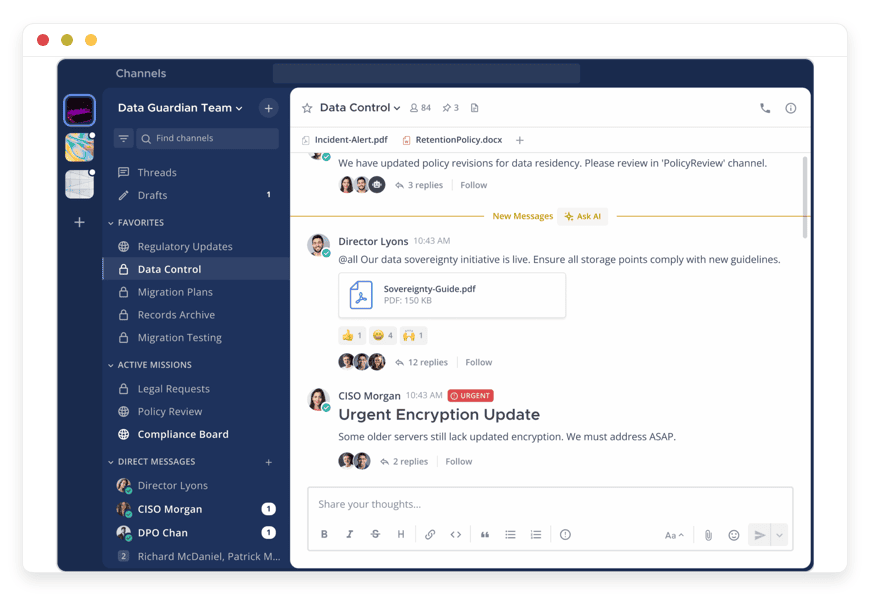
This is the layer the feature tables never reach, and the layer our cluster lives in. Both projects connect to a self-hosted Mattermost as a bot account, and past that opening sentence almost nothing works the same way.
The connection. Hermes ships Mattermost support natively in its gateway: one interactive setup command, a bot token, the server URL, and the adapter talks REST API version 4 over a WebSocket stream. OpenClaw installs an official plugin with one command from the npm registry and configures a bot token and base URL. Functionally equivalent; structurally, one is built-in, one is a managed extension that applies changes to a running gateway.
When the agent listens. Hermes defaults to mention-gated responses in channels, with direct messages always answered, and relaxes per channel through explicit settings. OpenClaw formalizes the choice as chat modes: mention-only by default, every-message as an opt-in, or a trigger prefix, with per-channel overrides on top and a week of thread-participation memory that keeps a conversation flowing without re-mentioning. Hermes offers precision; OpenClaw offers a dial.
Who may talk to it. Hermes denies all users by default until their IDs are listed, and an optional channel allowlist pins it to chosen rooms. OpenClaw gates direct messages through pairing codes, approved per person by the owner, and channel access through an allowlist policy that is mention-gated. The philosophies rhyme, deny first, but the mechanisms differ: stable user IDs versus human-handled pairing requests.
Sessions and threads. Hermes gives each direct-message conversation its own session, and channels either share one conversation or split into per-user sessions by configuration. OpenClaw routes by reply mode: channel conversations can stay flat or move thread-first with thread-scoped sessions, and threaded direct messages can each start a fresh, independent session. For a busy shared room, the two models produce visibly different experiences.
Behavior per channel. Hermes maps channel IDs to ephemeral system prompts, injected every turn, never persisted: the same agent runs as a researcher in one room and a code reviewer in the next. OpenClaw's equivalent expression is the chat mode plus its bot-interaction settings, governing when and how rather than who. Prompts shape what the agent is; modes shape when it speaks.
What arrives in the channel. OpenClaw streams: a preview post that edits in place while the agent thinks, finalizing as the answer, with progress and block modes for different rooms, plus opt-in slash commands and clickable buttons verified by HMAC. Hermes replies in flat messages or threads per its reply mode, with a home channel where scheduled output files itself. One assistant that presents; one that reports.
A worked example makes the differences concrete. The same research question lands in three rooms. In the Hermes front-door channel, a member mentions the bot; the answer arrives as a complete reply, in a thread if the room is in thread mode, and a second room with a different channel prompt would have produced a differently-shaped answer from the same memory. In an OpenClaw oncall room, the mention opens a preview post that grows while the agent works and finalizes as one message; in its prefix-mode ops room, nobody mentions anything, the agent simply answers messages that start with the trigger. Later, the Hermes home channel files a scheduled digest of what happened across both, while the OpenClaw side could have delivered the same summary to any channel or user by name through its outbound targets. Nothing in this paragraph says which is better. It says the two agents feel different in the hand, and the hand is where the decision happens.
Scale. One Hermes instance runs multiple profiles, each with its own platforms and configuration; one OpenClaw instance serves multiple Mattermost servers through separate accounts. Different axes of multiplication: personas versus servers.
Security posture, side by side
Both documentation sets describe layered defenses, and the OpenClaw comparison page catalogs the pair in unusual depth, from trust boundaries to secrets handling to audit ledgers. The compressed read: Hermes enforces through its approval pipeline, hardline and configured denials reviewed before commands run on host-reaching backends, with cron and single-query contexts defaulting to denial; OpenClaw enforces structurally, tool policies denied by code with sandboxed execution options off by default. Each project's page flags the other's historical items, a user-posted audit of an older Hermes release among them, and each flags them with the caveat that they are historical reports, not current-state verdicts. The fair conclusion for a buyer: both take defense seriously, document it in public, and disagree about where the boundary should sit, parent-enforced versus gateway-enforced, which is a design disagreement, not a maturity gap.
The documented specifics reward a closer look, because they are where the two philosophies show their seams. Secrets: OpenClaw keeps them as reference objects with protected store values and egress sentinels, and an ingress authentication failure stops startup rather than degrading; Hermes draws on environment and vault credentials with scoped profile resolution and an optional Docker token-injection proxy. Email: Hermes treats it as a conversation adapter, sender-authorized by default with per-sender conversations; OpenClaw treats it as an automation trigger, routing authenticated inbound mail into an isolated reader session whose tool policy the operator configures. Upgrades: OpenClaw ships four release channels with immutable package versions and schema guards; Hermes fast-forwards a selected branch and rolls back automatically when critical-file syntax checks fail. Neither set of choices dominates; together they sketch two coherent, defensible engineering cultures.
For the Mattermost context specifically, both inherit the same property that matters most: the transcripts, the pairing lists and the allowlists live on your server, and both agents keep their memory and session state on the hardware you run them on.
Migration, both directions of the question
The teams overlap enough that switching is a supported path, not a betrayal. Hermes ships a migrate-from-OpenClaw command that previews persona, memory, skills, providers, platforms and MCP servers before committing, with an optional flag to carry allowlisted secrets. The existence of the command tells you the target audience: people who started with one assistant and are evaluating the other with their history intact. Evaluate both against your own rooms, not against feature lists, and let the migration command remove the switching cost from the decision.
Which one fits which team
Neither agent wins. Each wins a set of jobs, and the sets overlap less than the marketing suggests.
- Choose Hermes if the agent is infrastructure: many platforms at once, per-channel personas, scheduled reporting into a home channel, a marketplace of plugins, and the option to hand hosting to the maker's cloud while keeping the self-hosted path open.
- Choose OpenClaw if the agent is a presence: always-on rooms with mode dials, pairing-gated personal access, streaming answers that grow in place, buttons and commands in the channel, one assistant quietly watching everything.
- Choose both if the jobs differ, because on one Mattermost server they coexist as separate bots, and the loop budget that stops bots talking to each other forever is built in.
The half we run
Whichever agent you run, its chat half has to stay up, stay patched and sit where you choose. That is our lane: managed Mattermost Team Edition, deployed to any of 21 datacenter regions for a flat monthly rate, backups and monitoring included, a trial week with no card, and export on demand so the door opens both ways. The three deep guides in this cluster cover each occupant: Hermes Agent on Mattermost, OpenClaw on Mattermost, and the Pi coding agent. The platform-level argument for the whole setup lives in the private chat platform guide.
Questions people ask about this comparison
Are Hermes Agent and OpenClaw both open source?
Yes, both under the MIT license. Hermes is developed by venture-backed Nous Research; OpenClaw by a donation-funded independent foundation.
Is OpenClaw the project formerly called Clawdbot?
Yes. It began as Warelay, was renamed Clawdbot, then Moltbot, and became OpenClaw on January 30, 2026, per the history its counterpart's comparison FAQ records.
Is either agent locked behind a paid plan?
Both agents run free and self-hosted. The paid options sit around them: Hermes Cloud agents arrive with Nous Portal plans; OpenClaw has no paid tier or hosted service.
Which is easier to connect to Mattermost?
Both are one bot token away. Hermes configures its built-in channel in an interactive setup; OpenClaw installs its official plugin with one command. The differences start after the connection, in modes and policies.
Which handles channel permissions better?
Differently. Hermes denies all users until listed, with an optional channel allowlist. OpenClaw gates DMs through approved pairing codes and channels through a mention-gated allowlist policy. Both default closed.
Can they reply in threads?
Both can. Hermes switches reply modes between flat and threaded. OpenClaw routes thread-first with thread-scoped sessions, including fresh sessions per threaded direct message.
Do answers stream while the agent works?
OpenClaw streams by default, editing a preview post into the final answer, with modes for progress and blocks. Hermes delivers complete replies, flat or threaded, with a home channel for scheduled output.
What is the memory difference in practice?
Per the vendors' own pages: Hermes keeps a curated store with searchable sessions and approval-gated self-written skills; OpenClaw uses markdown memory with scheduled consolidation and tracked origins.
Can multiple agents share one Mattermost server?
Yes. Each connects as its own bot account with its own rooms, and OpenClaw's loop protection counts bot-to-bot exchanges and silences runaway conversations automatically.
Can I move from OpenClaw to Hermes with my setup?
There is a supported path: the Hermes migration command previews persona, memory, skills, providers, platforms and MCP servers before writing, and can carry allowlisted secrets.
Which is more mature?
Both are production-used and actively released. OpenClaw is the older codebase under its current name since early 2026; Hermes is newer with a large marketplace and a commercial backer. Maturity arguments between them mostly reduce to taste.
Do they support the same chat platforms?
Both cover the majors. Their catalogs differ at the edges, unusual networks and email approaches among them, and both vendors caution that raw counts mislead. Check each project's current channel list for the one integration you cannot live without.
Which is safer to give shell access?
Both gate host-reaching commands, by approval review in Hermes and by structural tool policy in OpenClaw, per their documentation. The honest answer is configuration: defaults matter, review them, and grant the least that works.
Where do the conversations and memory live?
On your infrastructure when self-hosted: chat history in your Mattermost database, agent memory on the machine each runs on. The hosted Hermes Cloud option keeps its workspace with the vendor instead.
Does the choice of agent affect the hosting bill?
The chat side does not care: one Mattermost server hosts any mix of bots for the same flat rate on our side. The agents' own compute is separate, and both are light enough for modest hardware.
Why trust this comparison over the others ranking for it?
Because of its method: every claim cites a dated primary source, both vendors' self-published comparisons are quoted against each other, and the channel-level detail comes from the official documentation of both projects.
Try managed Mattermost hosting for 7 days
Sources
- OpenClaw documentation, OpenClaw and Hermes Agent (source-pinned comparison, August 2026 review)
- Hermes Agent, the official comparison with OpenClaw (updated November 2026)
- Hermes Agent documentation, migrate from OpenClaw
- Hermes Agent documentation, Mattermost channel
- OpenClaw documentation, Mattermost channel
- DANIAN, the Hermes Agent deep guide
- DANIAN, the OpenClaw deep guide
- DANIAN, the private chat platform for AI agents
- DANIAN, managed Mattermost Team Edition