Open-source Discord alternatives for communities
Open-source alternatives to Discord for small communities in 2026 — Matrix, RocketChat, HumHub, Mattermost
TL;DR
- Discord is free, polished, and still the right pick for many communities — its voice and video stack is meaningfully ahead of every open-source option, especially for gaming groups and live audio.
- The cost of free is moderation autonomy, archive permanence, and identity ownership. Discord's September 29, 2025 Community Guidelines update reminded operators that the platform writes the enforcement rules.
- Four open-source platforms cover most non-gaming community shapes: Matrix + Element (federation, sovereign, end-to-end encrypted), RocketChat (Discord-like UX, MIT-licensed), HumHub (social-network-style spaces), Mattermost (workplace shape, viable for technical communities).
- Self-hosting any of them lands at roughly €100–280/month once you include a production-class VPS plus the few hours a month of patching, backups, and on-call time. DANIAN runs the same apps for €9 per app per month, zero operations work on the customer's side.
- Voice-first communities — raiding guilds, live podcasts, weekly D&D tables — should think hard before switching. Text-first and asynchronous communities can move today.
Why people are leaving Discord in 2026
Discord still has the polish, the network effects, and the voice quality that built its category. None of that is in dispute. What changed in late 2025 and through 2026 is the buyer's read of the trade-off. The platform that hosts your community also writes the rules, owns the archive, controls the identity layer, and decides which servers continue to exist.
Three things compounded.
The September 29, 2025 Community Guidelines update. Discord clarified its policies and the enforcement actions that follow them — content removal, user bans, server shutdowns, and law-enforcement engagement. The clarifications themselves were reasonable. The reminder underneath was structural. A community operator on Discord runs at the platform's discretion, not their own. Server takedown precedents go back years, from the 2017 alt-right server removals to ongoing enforcement against any community that crosses the line Discord draws.
The Arc Raiders SDK incident, March 2026. A security researcher discovered that Discord's software development kit, integrated into a popular game, was logging private conversations and credentials to an unencrypted local file. If the game crashed, that file could be transmitted to the game developers. Discord patched and disclosed. The story landed badly with privacy-attentive moderators. Not because Discord acted irresponsibly, but because the surface area of a closed platform is wider than most operators realised.
The compounding economics of Server Boosts and Nitro. Discord's free tier covers text, voice, and video for the basic case at $0 per month. Nitro for the operator is $9.99/month or $99.99/year. Nitro Basic is $2.99/month. Server Boosts cost $4.99 each — fourteen boosts to reach Level 3 perks, totalling roughly $70/month flowing from your community to Discord. That money pays for features Discord controls, on infrastructure Discord owns, under moderation Discord writes. The community ends up renting a private space it can lose at any time.
For many groups, the trade is still worth it. Gaming guilds with thirty players in voice every night get a stack of features no open-source competitor matches today. The communities asking the harder question are different. Fan communities, OSS projects, podcasts with discussion forums, NGOs, learning groups, federated networks. For them, the value of owning the rules, the archive, and the member relationship has started to exceed the convenience of Discord's defaults.
What Discord still does well — the honest concession
Before listing the open-source paths, name what they don't replace.
Discord's voice channels remain the smoothest casual-voice experience in this market. Low-latency, push-to-talk done right, Krisp noise suppression on by default, server-wide audio defaults, and a screen-share that just works. The mobile clients are excellent. The notification model is tuned for community use. Activities, Stage Channels, and the bot ecosystem give moderators dozens of small tools that no self-hosted equivalent has stitched together yet.
None of the four open-source options below match all of that. Matrix Element Call is workable but not equivalent. RocketChat's Jitsi integration is fine for meetings and less fluid for casual hang-out audio. HumHub treats voice as a module, not a centerpiece. Mattermost calls fit a workplace context. If your community's reason for existing is voice — playing together, streaming together, hanging out together — the case to switch is weaker. Acknowledging that up front is what separates an honest comparison from a sales pitch.
What “alternative” actually means here
“Alternative to Discord” splits into three operational paths, not one.
Stay on Discord and accept the trade-off. This is the right answer for many gaming communities and any group that depends heavily on Discord's voice stack. A worse open-source platform that members refuse to use is not an improvement. If your community is voice-first and growing, weigh the switch carefully before moving.
Self-host an open-source platform. Pick the app that matches your community's shape — chat, federation, social network, or workplace-style. Rent a production-class VPS at roughly $24/month. Add object-storage backup at $5/month and monitoring at around $15/month. Budget a few hours per month for patching, certificate renewal, backup verification, and on-call. Priced at standard sysadmin rates of €60–120/hour, the total lands in the €100–280/month range. This path is genuinely good if you have someone in-house who enjoys the work.
Pay a managed host. Same open-source app, same control over moderation and data, but somebody else runs the server. DANIAN charges €9 per app per month. That covers hardware, security patching, daily off-site backups, 24/7 email and ticket support, and the per-container access you need when you want to dig in. Customer time on operations: zero hours per month. Browse the DANIAN catalog to see which community platforms are available.
The four apps below cover the four shapes a community usually takes. Pick by shape first, then by feature. The wrong shape is the most common reason a migration fails.
The shortlist — four open-source community platforms
Matrix + Element — the federated, sovereign option
Matrix is an open protocol for decentralized real-time communication.
Think SMTP for chat. Synapse, the leading homeserver, lives at element-hq/synapse under AGPL-3.0 with around 4,200 stars on its current repository. The older matrix-org/synapse repository, now archived, carries 12,100 stars from years of contributions.
Element is the leading client. The protocol is governed by The Matrix.org Foundation, with Element — founded by Matrix's creators — leading commercial development.
The federation story is the headline difference. A community on Matrix can run its own server, federate with other servers, and let users from different homeservers join shared rooms. A Gmail user can email a Fastmail user without either company owning the other. Matrix works the same way for chat. End-to-end encryption is on by default for private rooms.
The institutional trust signal is unusual for an open-source comms tool. Matrix is used by NATO, Space Force, the French government, the German Bundeswehr, and several other European public-sector deployments. None of those organisations would adopt a platform that did not survive a security review. The same protocol underneath their networks is what your community would run.
Voice and video work via Element Call and the Matrix 2.0 protocol, released in late 2024. Calls are reliable. The join flow, the spatial audio, and the gaming-overlay polish still trail Discord. For a voice-first community, this matters. For a text-first community that occasionally hops on a call, it is fine.
DANIAN runs managed Matrix + Element hosting at €9 per app per month, hardware and operations included.
RocketChat — the closest UX swap from Discord
RocketChat is open-source team communication built on TypeScript, Node.js, and MongoDB.
The Community Edition is MIT-licensed.
The main repository carries roughly 45,000 stars. The Community Edition is free to self-host, capped at 100 concurrent users and 10,000 push notifications per month. Enough for small and mid-size communities. Not enough for a thirty-thousand-member fan server.
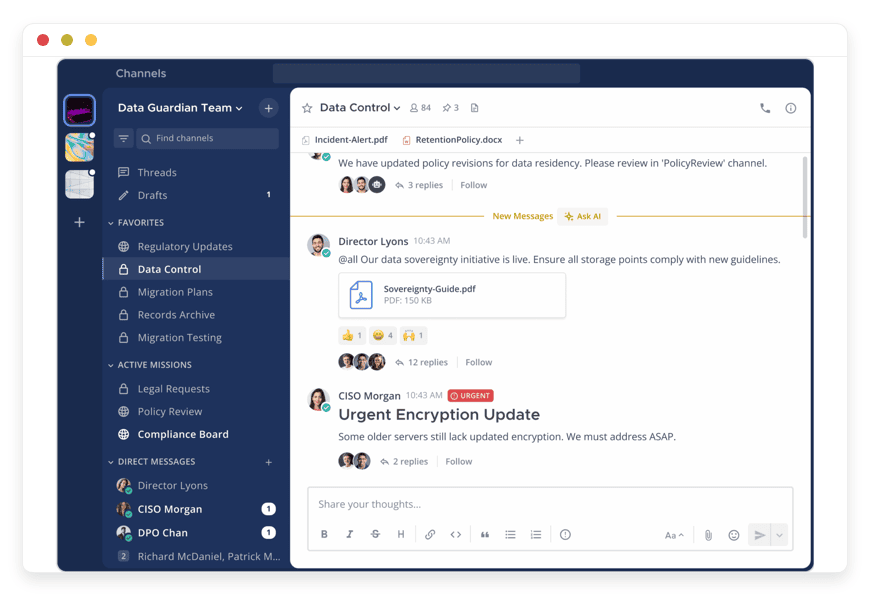
The shape closely mirrors Discord and Slack. Channels, threads, direct messages, file sharing, customizable roles, mentions, and a built-in marketplace for integrations. Voice and video work via Jitsi and BigBlueButton, both included in the Community Edition. The migration story is the easiest of the four — members who lived on Discord recognise where everything is within minutes of arriving.
The 2026 pricing structure changed in April. The Pro tier was retired for new customers, replaced by a free Starter plan capped at 50 users and a custom-quoted Enterprise plan above it. For a self-hosted community that stays inside the Community Edition limits, the only cost is the server. RocketChat also supports Matrix federation as a bridge, which gives an interesting hybrid path for groups that want Discord-like UX with optional reach into the wider Matrix network.
DANIAN runs managed RocketChat for communities at €9 per app per month, including the daily backup discipline that catches a bad upgrade before it eats your history.
HumHub — a community shaped like a social network
HumHub is an open-source social network platform written on the Yii PHP framework by HumHub GmbH in Munich.
The Community Edition is AGPL-3.0 licensed.
The repository has roughly 6,600 stars and an active module ecosystem with marketplace add-ons for groups, wiki, polls, calendars, and more.
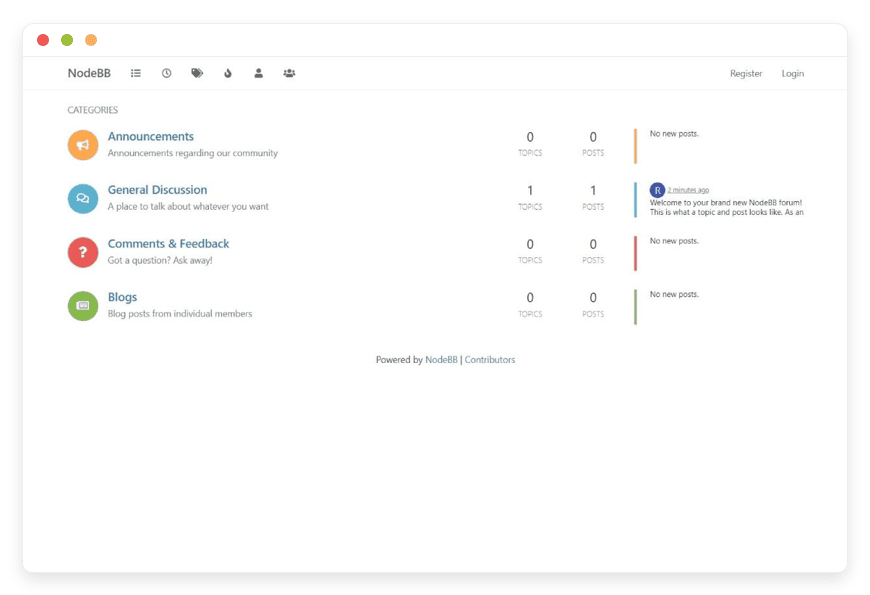
The shape is different from the other three. HumHub feels more like Facebook than Discord. Spaces (group areas), posts on a timeline, comments, likes, wiki pages, shared files, task lists, and event calendars. NGOs, alumni groups, learning communities, non-profit boards, and fan communities that run more on discussion than real-time chat often fit better here than Discord ever fit them. The members who never adopted Discord's channel-and-voice model are usually the ones HumHub serves well.
Real-time chat exists as a module but is not the centerpiece. If your community runs on long-form posts, scheduled events, shared documents, and asynchronous discussion, HumHub is the platform to evaluate first. Permissions are granular — you can run a public-facing community with private working spaces inside it, or a fully private network where members only see what they have been admitted to.
DANIAN runs HumHub for social-network-style communities at €9 per app per month, with the database backed up daily off-site.
Mattermost — workplace shape, viable for technical communities
Mattermost is an open-core collaboration platform that started life as a Slack alternative for engineering teams.
The compiled Team Edition binary is released monthly on the 16th under the MIT license.
The uncompiled source is AGPLv3. The repository carries around 15,500 stars. The architecture is a single Linux binary plus PostgreSQL, which keeps the operational footprint small.
Mattermost is less typical for community use than the other three on this list. It leans corporate. The defaults assume a workplace, the UI calls them “teams” not “communities”, and the integrations bias toward developer tooling — Jenkins, GitLab, Jira, CI/CD bots, Git hooks. For a technical community where the workplace shape is a feature rather than a bug, it works well. Open-source project contributor chats, developer-led collectives, internal engineering groups operating like small open communities — these fit Mattermost naturally.
For a fan community or a podcast audience, RocketChat or HumHub will fit more naturally than Mattermost. Knowing which shape your community is matters more than the specific feature checklist. DANIAN can host Mattermost at the same €9/month if the workplace shape is what your community needs.
Comparison at a glance
| Feature | Discord | Matrix + Element | RocketChat | HumHub | Mattermost |
|---|---|---|---|---|---|
| License | Proprietary | AGPL-3.0 (Synapse / Element) | MIT (Community) | AGPL-3.0 (Community) | MIT (compiled Team Edition) |
| GitHub stars (lead repo) | — | ~4,200 (current) + 12,100 (archived) | ~45,000 | ~6,600 | ~15,500 |
| True federation | No | Yes — only one of the four | Limited (Matrix bridge) | No | No |
| End-to-end encryption | No | Yes, by default for private rooms | Optional, per channel | No | Optional, paid tier |
| Voice + video parity with Discord | Strongest in this set | Workable, UX lags | Workable, via Jitsi | Module, basic | Workable, via plugin |
| Closest community shape | Gaming, voice-first | Federated, sovereign, encrypted | Discord-style chat | Social network | Technical / workplace |
| Cost (operator) | $0 base + Server Boost economy | €9/month managed | €9/month managed | €9/month managed | €9/month managed |
The Discord row is the honest comparison. For voice-first gaming communities, Discord still wins. For everything else on the right side of the table, the open-source paths trade convenience for ownership.
What ownership actually looks like, day to day
“Own your community” is a marketing phrase until you can name what changes. Three things change in practice.
The archive is yours. Every post, every message, every uploaded file lives in a database you can back up, export, and migrate. If the platform you use today raises prices, ships a moderation policy you can't accept, or simply disappears, you carry the content with you. A Discord export gives you a JSON archive that no other platform reads natively. A Matrix, RocketChat, HumHub, or Mattermost database is portable to a different host running the same software.
The moderation rulebook is yours. Discord's Community Guidelines apply on top of whatever rules a server owner writes. On a self-hosted platform, the only rules are the ones you write. That cuts both ways — you carry the responsibility for what your community publishes. For most operators of small communities, the trade is fair. For large public communities, the responsibility is significant and worth thinking about explicitly.
The member identity is yours. On Discord, members log in with a Discord account, attached to a Discord profile, recoverable through Discord's flow. If Discord bans an account, the member's history in your community is lost to them. On a self-hosted platform, member accounts live on your server. You can offer SSO, password reset, or whatever auth flow you want. The identity belongs to the community, not to a third party that can revoke it.
How to pick — three questions to ask yourself
1. What is the dominant medium in your community? If it is voice — daily voice channels, weekly streams, raid nights, table-top sessions — Discord is the safer pick. The voice stack of Element Call, RocketChat with Jitsi, or Mattermost calls is workable but not equal. If your community is primarily text or asynchronous, the open-source paths fit. The shape of the medium is the first filter.
2. Do you need federation, or a single owned instance? Matrix is the only one of the four with multi-server federation in the Mastodon sense. A user on one Matrix homeserver can join rooms hosted on a different homeserver, the same way email crosses providers. If you want your community to belong to a wider network, or to give members the option of bringing their own homeserver, Matrix is the only choice. If you want one instance that you own, RocketChat, HumHub, and Mattermost are simpler to reason about.
3. Do you want Discord's shape, or a different shape entirely? If members will arrive expecting channels, threads, and DMs, RocketChat is the lowest-friction switch. If your community runs better on long posts, shared documents, events, and discussion threads — HumHub. If you are a developer-led technical group — Mattermost. If you are running a federated, encrypted, multi-server network — Matrix. The wrong shape is the most common reason a migration fails. Pick by shape first.
A pragmatic move: start a 7-day trial on one of the four through DANIAN. Deploy a small test community, see how members react over a couple of weeks before announcing the broader move. We patch, monitor, back up, and stay on call so the test stays focused on whether the platform fits, not on whether the server stays up.
Frequently asked questions
Is Discord really moderation-free for community operators?
No. Server owners run their own rules on top of Discord's Community Guidelines, but the Guidelines themselves are enforced by Discord. Content removals, server takedowns, and account bans happen at Discord's discretion. If you want to write the only rulebook that applies to your community, you need a platform you operate.
Can I migrate my Discord server history to one of these?
Partially. Discord exports user data on request, but the archive format is not directly importable into Matrix, RocketChat, HumHub, or Mattermost. Most communities that switch announce the move, freeze the Discord server as a read-only archive for reference, and start fresh on the new platform. Importers exist but rarely produce clean results.
Will my members actually move?
Mixed. Communities that succeed at switching share two traits: a clear reason members understand — an enforcement event, a privacy concern, a moderation conflict — and a chosen platform that matches the community's shape. Communities that try to migrate without naming the reason tend to lose roughly half their active members. The trigger matters more than the destination.
How does voice and video really compare to Discord?
Discord is meaningfully ahead. Element Call improved with the Matrix 2.0 protocol in late 2024, but the join flow and spatial audio still trail. RocketChat's Jitsi is solid for meetings, weaker for casual hang-out voice. If your community lives in voice, weigh carefully — a worse voice experience that members refuse is the most common migration failure.
What does self-hosting cost compared to paying DANIAN?
A production-class VPS at around $24/month plus backup at $5 and monitoring at $15 lands at $44/month in infrastructure. Add a few hours per month of patching and on-call at standard sysadmin rates, and the total typically lands in the €100–280/month range. DANIAN charges €9 per app per month with zero operational time on your side.
Which of the four is the safest first pick for a community that has never left Discord?
RocketChat. The shape, the UX language, and the channel-and-thread structure mirror Discord closely enough that members find their way without a tutorial. Voice via Jitsi is workable. The MIT license keeps you free of obligations to publish modifications. Federation, encryption, and social-network shapes become easier conversations once members are comfortable.
What is Matrix federation, and why does it matter for a community?
Federation means your Matrix server talks to other Matrix servers as peers, the way email servers talk to each other. Members on different homeservers can join the same room. If your managed host ever disappeared, your community could move to another Matrix host and keep its identity intact. None of the other three offer this.
Does RocketChat support voice channels like Discord's always-on rooms?
Sort of. RocketChat ships Jitsi-backed voice and video, which works well for scheduled calls and meeting-style rooms. The lobby pattern where members hang out in voice all evening is weaker — Jitsi assumes you join, talk, and leave. For a community that lives in casual voice, this is the real gap to test before committing.
Is HumHub a good fit for a community under 100 members?
Yes, with one caveat. HumHub is built around profiles, spaces, posts, and a feed — a social-network shape rather than a chat-room shape. Small communities that want forum-style discussion, member directories, and persistent posts fit cleanly. Communities that want rapid back-and-forth chat will find HumHub heavier than RocketChat or Matrix.
Can Mattermost work for a community that isn't all developers?
Possible, but uphill. Mattermost was built for engineering teams and shows it — channel-first, dense, terminal-friendly. Non-technical members can use it, but the UI signals “workplace tool” rather than “community space”. Pick it when your community is mostly developers, security folks, or sysadmins. For mixed audiences, RocketChat or HumHub will land softer.
What changed in Discord's September 29, 2025 Community Guidelines update?
Discord broadened categories around hateful conduct, sexualised content involving minors, and coordinated inauthentic behaviour, and tightened enforcement around appeals and repeat-offender accounts. For server owners, the practical change is that more posts trigger automated review and more accounts get actioned without warning, including bystanders inside a thread that gets flagged.
Did the March 2026 Arc Raiders SDK incident expose Discord data?
Yes, in a narrow way. A bug in the Arc Raiders Discord SDK wrote plaintext logs of private conversations to local disk on affected machines. The exposure was client-side, not a Discord server breach, but it underscored the recurring pattern: Discord's stack is large enough that local edge cases keep surfacing without the community having any control.
Which of the four supports end-to-end encrypted direct messages?
Matrix, by default. Matrix has shipped end-to-end encryption since 2020 using the Olm and Megolm protocols, on by default for direct messages. RocketChat offers optional E2EE on selected room types. Mattermost and HumHub do not offer end-to-end encryption — they encrypt traffic in transit, but the server operator can read message contents at rest.
Do these platforms have mobile apps as polished as Discord's?
Element ships iOS and Android apps that handle most of what Discord's mobile app does. RocketChat ships native mobile apps that feel close. HumHub has a mobile app on both stores. Mattermost has solid mobile apps oriented around channels and threads. None match Discord's mobile gloss exactly, but the gap is smaller than it was in 2023.
Can I run bots and webhooks the way I do on Discord?
Yes, on all four. Matrix exposes bot APIs and a large ecosystem of bridges to IRC, Slack, and Telegram. RocketChat ships webhooks, slash commands, and an app marketplace. HumHub uses modules for extensions. Mattermost provides slash commands and plugins. The Discord bot ecosystem is larger, but the building blocks for the bots most communities actually need are present.
How many active members can each platform handle on a single server?
Matrix scales to tens of thousands of users per homeserver with sufficient resources; the public Matrix.org homeserver carries hundreds of thousands. RocketChat Community Edition is capped at 100 concurrent connections, useful for communities up to roughly 500 members. HumHub and Mattermost both handle a few thousand members per server before tuning becomes meaningful.
What are the largest known organisations running each of these four?
Matrix powers Mozilla, KDE, Wikimedia, and NATO communications, alongside several national governments. RocketChat is used by the German government and the US Navy. HumHub powers internal networks at universities, NGOs, and a number of European municipalities. Mattermost runs at large engineering organisations including Samsung, Mercedes-Benz, and the US Air Force.
Are there hidden costs beyond DANIAN's €9 per app per month?
Three to watch. Domain registration if the community wants a custom one (€10–15/year). An email-sending service for high-volume notifications (often free at low tiers, paid above). And any third-party integrations the community chooses to add. Storage beyond the included quota and SMS-based notifications are the two most common surprises after launch.
What happens to my community data if I leave DANIAN later?
Each of the four supports export. Matrix and RocketChat can export rooms, users, and message history in machine-readable formats. HumHub exports content per-space. Mattermost has a built-in bulk export command. Because the deployment is yours, the database and uploaded files come with you to any other host running the same software.
How long does it take to set up a working community space?
The platform itself comes ready, so the time is community configuration — adding moderators, creating channels or spaces, inviting members, setting branding, choosing rules. Most communities are usable within a single working session. Self-hosting on a VPS adds a day or two of system setup before that configuration work begins.
Is open-source software safe to host for a non-technical community admin?
On managed hosting, yes. The admin uses a dashboard much like a Discord admin's — invites, channels, roles, moderation tools. The underlying server, patches, backups, and TLS certificates are handled by the host. Open-source means the code is auditable and the data is portable, not that the admin needs to touch a terminal.
What to do this week
Pick one of the four and stand up a test community on it. Match the platform to your shape — RocketChat for Discord-like chat, HumHub for social-network discussion, Matrix for federated and encrypted comms, Mattermost if your community runs on developer tools. Move a small subset of members across — moderators and the most active ten — and let them use the new space for two weeks before announcing the broader move.
If you want to skip the operational setup, start the trial on DANIAN.
€9 per app per month, 7-day free trial, no credit card required.
We patch, monitor, back up daily off-site, and stay on call when something needs a human.
Email support@danian.co if you want a hand picking which of the four fits your community shape.