Open-source stack for localization agencies 2026
The localization agency's open-source stack in 2026 — TMS, machine translation and QA you own
A localization agency in 2026 usually runs on rented seats: a translation management system, a machine-translation API, a grammar checker, cloud storage, a code host, an automation tool. Six bills — and client text passing through each vendor's servers. Six open-source tools replace that stack. Managed on DANIAN, they run at €9 per app, per month, and the client's text stays inside apps the agency controls.
The six are Weblate, LibreTranslate, LanguageTool, Nextcloud, Gitea, and n8n. This guide covers what each one does, where it earns its place, how they fit into one pipeline, and what the set costs against the SaaS bundle it replaces. It also names the honest trade, because there is one.
TL;DR
- Six open-source tools cover the whole localization pipeline: Weblate for translation management, LibreTranslate for machine translation, LanguageTool for grammar QA, Nextcloud for file exchange, Gitea for version control, and n8n for automation.
- Managed on DANIAN, the full stack costs six apps at €9 each, or €54 per month, flat. A comparable SaaS bundle starts near $300 a month and climbs with seats and translation volume.
- The pipeline is owned: source text, translation memory, and machine-translation models run inside the agency's own apps, not a third-party vendor's.
- LibreTranslate trails DeepL and Google on raw quality for many language pairs. The trade is control over where client text is processed.
- Weblate is the hub. n8n moves work between the tools — new strings, machine pre-translation, grammar QA, then human review.
Who this stack is for (and who it isn't)
This stack fits a small or mid-sized localization agency that handles client text and wants to stop sending it to translation and grammar SaaS vendors. It suits teams of roughly 2 to 25 people. It is not the right fit for an agency that needs DeepL-grade output on every string with no human pass.
It works when someone on the team is comfortable reviewing a configuration once and thinking through a workflow. It rewards agencies that already post-edit machine translation, because that habit covers LibreTranslate's quality gap. It suits shops that want a flat monthly cost instead of per-seat and per-word bills that rise with every client.
It is the wrong fit in three cases. An agency that needs the highest raw machine-translation quality on every pair, untouched, is better served by a DeepL or Google API, and should keep paying for it. A team doing occasional one-off jobs will not get value from standing up six apps, and a shop with no one willing to look at a config screen even once will find the SaaS path simpler. Naming those cases is fairer than pretending the stack suits everyone.
The six tools, one by one
Weblate — the translation management hub
Weblate is a web-based translation management system with tight version-control integration, and translators work in the browser. It tracks translation memory, glossaries, and review state. It also syncs strings to and from a Git repository, so translation follows the content instead of lagging behind. It is libre software under the GPL-3.0 license, used by more than 2,500 projects across 165 countries.
For an agency, Weblate replaces a seat-based platform like Crowdin or Lokalise. On DANIAN it runs at €9 a month, and it is the hub the rest of the stack connects to. It fits teams from a couple of translators up to a few dozen. Switching effort is moderate: you import existing translation files, connect a repository, and set up review rules.
The honest limitation: self-hosting Weblate has real operational weight — a database, a cache, background workers, and machine-translation model handling. The managed version removes that work. What it does not remove is Weblate's learning curve; the interface is dense, and the project ships releases often, so there is more to keep current than with a simpler tool.
Run managed Weblate as the TMS hub and the operational side is handled for you.
LibreTranslate — machine translation you host
LibreTranslate is a free and open-source machine-translation API built on the Argos Translate engine. It runs entirely on your own server, offline-capable, with no text sent to an outside service. It covers roughly 40 to 55 language pairs depending on the models installed, and it is licensed under AGPL-3.0.
It replaces a paid machine-translation API such as the DeepL API or Google Cloud Translation. On DANIAN it runs at €9 a month. The reason to choose it is not output quality — it is that the translation happens inside an app the agency controls, so client text is never sent to a third-party model.
The honest limitation, stated plainly: LibreTranslate trails DeepL and Google on raw quality for many language pairs, with Google now covering far more languages and DeepL stronger on the major pairs it supports. LibreTranslate is best used for a first-pass pre-translation that a human translator post-edits, not for publish-ready output. An agency that already post-edits will absorb this; one expecting finished translations from the machine will not.
Use LibreTranslate for private MT as the draft layer, with a human pass after it.
LanguageTool — grammar and style QA
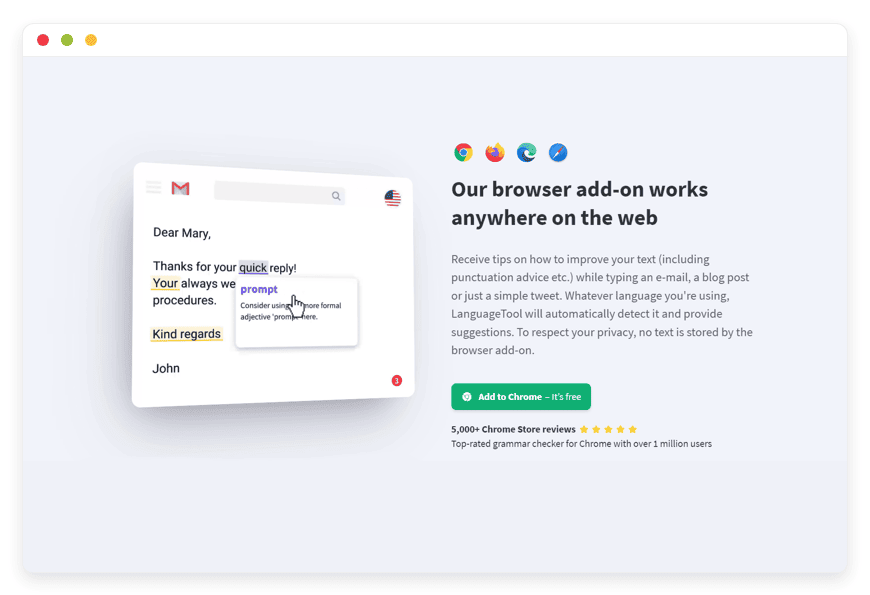
LanguageTool is an open-source proofreading server that checks grammar, punctuation, and style across more than 25 languages, catching errors a simple spell-checker misses. The core server is licensed under LGPL-2.1 or later. It runs as a service the agency hosts, with its own checks applied to the agency's text.
It replaces Grammarly for the QA step. On DANIAN it runs at €9 a month. In the pipeline, it flags grammar and style issues on machine-translated and human-edited strings before they go to final review. It fits any team size and adds little operational burden once it is running.
The honest limitation: the LanguageTool server core is open and self-hostable, but the official browser extensions are closed-source. The LibreOffice and Office integrations and the API are open, so the self-hosted path works well inside a document and editor workflow, less so as a drop-in browser checker. Its strongest coverage is the most widely used languages, and it does not push tone rewrites the way Grammarly's AI features do.
Run LanguageTool for QA against your own server and the checks stay in-house.
Nextcloud — client file exchange
Nextcloud is an open-source file sync and share platform: folders, shared links, version history, and access controls, available in 60 languages. It is licensed under AGPL-3.0 and runs as the agency's own storage rather than a consumer cloud account. For a localization agency, it is where client source files arrive and finished deliverables go out.
It replaces Dropbox for the file-handoff line. On DANIAN it runs at €9 a month. The advantage over a SaaS storage seat is that the files sit in an app the agency runs, with per-folder access the agency sets, so a client's unreleased material is not stored on a third-party drive. It fits any team size.
The honest limitation: Nextcloud is a large platform, and for pure file exchange it is more than the job strictly needs. Its add-on ecosystem varies in quality, so it pays to keep the deployment focused on files and sharing rather than turning on every module. For an agency that wants one place to receive and deliver client files under its own control, it consolidates the storage line cleanly.
See managed Nextcloud at €9 a month.
Gitea — version control for content
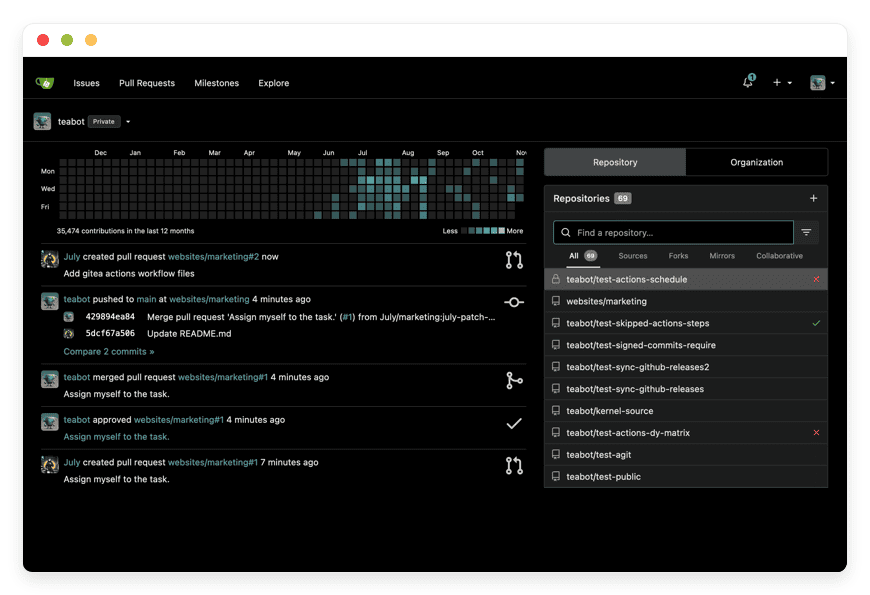
Gitea is a lightweight Git forge — repository hosting, pull-request review, and issue tracking — that runs as a single Go binary with modest memory needs. It is licensed under the permissive MIT license, and sits at roughly 53,600 GitHub stars. For localization, it matters because source strings and translation files belong in version control.
It replaces GitHub as the place the content repository lives. On DANIAN it runs at €9 a month. Weblate syncs translations to and from a Git repository; keeping that repository on Gitea means the source strings and their full history sit on infrastructure the agency runs, beside the rest of the stack, rather than on a third-party host. It fits any team size.
The honest limitation: Gitea is deliberately lighter than GitHub. It has fewer ecosystem integrations and a smaller marketplace, and its built-in continuous-integration option, Gitea Actions, is newer than GitHub's. For hosting content repositories and reviewing translation changes, that lightness is a feature; for a large engineering org with heavy integration needs, GitHub does more.
Run managed Gitea at €9 a month and the content history stays under your control.
n8n — the automation that ties it together
n8n is a workflow automation platform with more than 400 integrations, a visual builder, the option to drop into code, and native AI features. It is distributed as fair-code under the Sustainable Use License — source-available and self-hostable, though not an OSI-approved open-source license, which is worth stating directly. In this stack it is the glue between the other five tools.
It replaces Zapier for workflow automation. On DANIAN it runs at €9 a month. Its job is to move a string through the pipeline without anyone copy-pasting between dashboards: detect new source strings, send them for machine pre-translation, run grammar QA, open them for human review, and post a notification when work is ready.
The honest limitation: n8n's license is fair-code, not classic open source, so it carries usage terms a fully open project does not. Building reliable flows takes setup time and testing, and n8n is the automation layer, not a translation tool — it orchestrates the others rather than replacing any of them.
Run managed n8n at €9 a month as the pipeline's connective layer.
How the six fit together — one pipeline
On their own, six tools are six logins. The point is the pipeline. Weblate is the hub for translation work, Gitea holds the source content, and n8n moves a string through the stages — pre-translation, grammar QA, human review — so the agency runs one repeatable flow instead of copying text between vendor dashboards.
The flow runs like this. Source content lives in a Gitea repository: the strings and the translation files. Weblate connects to that repository and pulls new or changed strings as they land, so translation tracks the content instead of waiting for a hand-off. When new strings appear, n8n triggers a first-pass machine translation through the agency's own LibreTranslate instance.
n8n then runs the draft through LanguageTool for grammar and style flags. The pre-translated, QA-flagged strings open in Weblate for a human translator to post-edit and approve. Approved translations commit back to the Gitea repository, and n8n posts a notification — and, when a deliverable is ready for a client, drops it into a Nextcloud folder the client can reach.
Through the whole loop, the text moves between the agency's own apps. It is not sent to a translation or grammar SaaS vendor's models. One point stays honest throughout: the machine pre-translation is a starting point, not a finished translation. LibreTranslate's output needs a human pass — which is how a careful agency works regardless of the tools.
Deploy managed Weblate and connect the stack from there.
The stack at a glance
The six tools, what each replaces, the license, the DANIAN price, and the team size each suits. Every app is €9 per month, billed per app, with no per-seat charge.
| Tool | Replaces | License | DANIAN price | Team-size fit |
|---|---|---|---|---|
| Weblate | Crowdin / Lokalise | GPL-3.0 | €9/month | 2–25+ |
| LibreTranslate | DeepL / Google Translate API | AGPL-3.0 | €9/month | 2–25+ |
| LanguageTool | Grammarly | LGPL-2.1+ | €9/month | 2–25+ |
| Nextcloud | Dropbox | AGPL-3.0 | €9/month | 2–25+ |
| Gitea | GitHub | MIT | €9/month | 2–25+ |
| n8n | Zapier | Fair-code (Sustainable Use License) | €9/month | 2–25+ |
Each app deploys in the region you choose, across 21 datacenter regions on six continents. Pick the region closest to the client whose work runs through it.
What it costs against the SaaS bundle
Six managed apps at €9 each is €54 per month, flat, with no per-seat math. The SaaS tools they replace bill per seat, per word, or per task. A small agency's comparable bundle starts near $300 a month and rises as seats and translation volume grow.
| What you run | SaaS tool and plan | Typical monthly cost |
|---|---|---|
| Translation management | Crowdin Team | about $150 |
| Machine translation | DeepL API Pro | $5.49 base, plus about $25 per million characters |
| Grammar and style QA | Grammarly, 3 seats | about $45 |
| Client file exchange | Dropbox Business Standard, 3 seats | about $45 |
| Content version control | GitHub Team, 5 seats | about $20 |
| Workflow automation | Zapier Professional | about $49 |
| SaaS bundle total | — | from about $300 a month, scaling up |
| The same stack on DANIAN | 6 apps × €9 | €54 a month, flat |
The math is worth reading honestly. Crowdin's Team plan runs around $150 a month; an agency on Lokalise's Growth plan pays closer to $499. The DeepL or Google translation bill scales with characters, so a few million characters a month is real money, and it grows with every client added. Grammarly and Dropbox bill per seat, so both climb as the team grows.
DANIAN's €54 does not move with seats. It moves only if the agency adds another app or needs more resources for one — and DANIAN will not upgrade resources or change the bill without the agency's consent. The fair caveat in the other direction: the SaaS tools buy convenience, and DeepL buys higher raw translation quality. The open-source stack buys a flat cost and an owned pipeline, at the price of running a human post-edit step and accepting LibreTranslate's quality ceiling.
Start a 7-day free trial — no card.
The pitch to your clients — an owned pipeline
For a localization agency, where client text goes is part of the sell. On the SaaS stack, a client's unreleased copy passes through a translation API, a grammar vendor, and a US cloud drive. On this stack, that text moves between apps the agency runs, and the agency can tell a client exactly where their words are processed.
Clients hand over text they have not published — product launches, marketing copy, contracts, support content. On the rented stack, that material is sent to DeepL or Google for translation, to Grammarly for checking, and stored on Dropbox. Each is a separate vendor with its own data handling, and the agency is asking the client to trust all of them.
On the open-source stack, the translation runs on the agency's own LibreTranslate instance. The grammar check runs on the agency's own LanguageTool server. The files sit in the agency's own Nextcloud. The text is processed by the agency's apps rather than shipped to a translation or grammar SaaS vendor's models.
Be precise about what this is and is not: the apps run on managed infrastructure, and the agency picks the region each app runs in. DANIAN operates the servers; the agency owns the apps and the data inside them. The point a client can verify is simple: their words are not sent to a third-party translation or grammar service. That is a position an agency can put in a proposal — a translation pipeline it controls end to end — without overstating it as anything more than where the text is processed.
How to start
Do not stand up all six at once. Start with the tool that removes the most third-party exposure for the least disruption, run it for two weeks on live work, then add the next. Each app is €9 a month with a 7-day free trial, so the cost of trying one is small.
Start with Weblate. It is the hub; once translation work runs through it, the rest of the stack has somewhere to connect. Point Weblate at a Gitea repository so the source content and its history live on infrastructure you control from the start. Add LibreTranslate next and wire a first-pass pre-translation, treating its output as a draft for a human to post-edit rather than a finished translation.
Add LanguageTool for QA after that, then bring in n8n once you want the steps to run on their own instead of by hand. Use Nextcloud for the client-facing file handoff last, when the internal pipeline is settled. Give each tool a real two-week trial on a live project before committing. Apps activate within a short window; a complex setup sometimes needs a hand.
FAQ
Is LibreTranslate as good as DeepL or Google?
No, not on raw quality for many language pairs. Google now covers far more languages, and DeepL is stronger on widely used pairs such as German, French, and Spanish. LibreTranslate's value is that translation runs on your own server. Use it for a first pass that a human translator post-edits, not for publish-ready output.
Can I keep using DeepL or Google alongside this stack?
Yes. Nothing stops you keeping a paid API for the pairs where its quality matters most. n8n can route those strings to DeepL or Google and send the rest to your own LibreTranslate. You decide which work leaves your servers and which stays in-house.
How many languages does LibreTranslate cover?
LibreTranslate covers roughly 40 to 55 language pairs, depending on the models installed on your instance. You add or remove language models to match the pairs your agency works in. Coverage is narrower than Google's, which is the trade for running translation on your own server.
Can I improve LibreTranslate's translations?
Treat its output as a first draft, not a finished translation. Quality comes from the human post-edit step in Weblate, where translators correct the machine pass. Weblate's translation memory then reuses approved translations, so repeated phrasing improves over time. The machine pass shortens the work; it does not replace the translator.
Do I have to use all six tools?
No. The stack works one tool at a time. Start with Weblate as the hub, run a live project through it, then add LibreTranslate, LanguageTool, Gitea, n8n, and Nextcloud as you need them. Each app is €9 a month, so you only pay for what you run.
When is this stack the wrong choice?
It is the wrong fit in three cases. An agency that needs the highest raw machine-translation quality on every string, with no human pass, should keep a paid API. A team doing rare one-off jobs will not get value from six apps. And a shop with nobody willing to look at a config screen will find the SaaS path simpler.
What does the whole stack cost on DANIAN?
Six apps at €9 each is €54 per month, flat, with no per-seat charges. A comparable SaaS bundle — a translation platform, a machine-translation API, a grammar tool, storage, a Git host, and an automation tool — starts near $300 a month and rises with seats and translation volume.
Does the price go up as my agency adds translators?
No. DANIAN bills €9 per app, per month, with no per-seat charge. Adding translators to Weblate does not change the bill. The price moves only if you add another app or need more resources for one — and not without your consent.
Are there setup or onboarding fees?
No. The €9 per app, per month covers hardware, patching, backups, monitoring, and support. There is no separate setup or onboarding charge. If a complex configuration needs a hand, support helps without an extra fee.
Is there a free trial, and do I need a credit card?
Yes. Each app has a 7-day free trial, and you do not need a card to start. Spin up one tool, run a live project through it, and decide before any charge. Trying a single app costs nothing.
How much technical skill does this need?
Less than self-hosting, more than a single SaaS login. Someone on the team should be comfortable reviewing a configuration once and thinking through the workflow. Day to day, you work in the apps; when something needs a server change, support handles it.
What file formats does Weblate support?
Weblate handles the common localization formats: PO, XLIFF, JSON, Java properties, and others. It reads them straight from a connected Git repository, so the files stay in the format your developers already use. You do not convert anything into a proprietary format to work in Weblate.
Can I import my existing translation memory?
Yes. Weblate imports translation memory in standard formats such as TMX, alongside your existing translation files. You bring your past work with you rather than starting cold. The memory then suggests matches as translators work, which shortens the first projects after a switch.
How hard is it to switch from a SaaS translation platform?
The effort is moderate, not trivial. You export your translation files and memory, connect a Git repository, import the strings into Weblate, and set review rules. One person comfortable with a configuration screen can do it. Most of the work is a one-time setup, not an ongoing cost.
Do I have to run these servers myself?
No. DANIAN runs the servers, patches them, backs them up daily off-site, and monitors them. You work in the apps and own the data inside them, which you can export at any time. Some changes, such as resource upgrades, go through support rather than a self-service toggle.
Where is my clients' text processed?
Inside your own app instances, in the region you choose from 21 datacenter regions across six continents. Translation runs on your LibreTranslate, grammar checks on your LanguageTool, and files sit in your Nextcloud. The text is not sent to a third-party translation or grammar service. You can tell a client exactly where their words are handled.
What happens to my data if my payment fails?
Card failed? We wait. We don't delete your data. DANIAN also backs up every instance daily, off-site, so your translation work stays protected while you update the card.
What support do I get if something breaks?
Email us or open a ticket. A human replies. DANIAN patches the apps monthly, monitors them, and backs them up daily off-site. When an app needs a server-side change — a resource bump, a config fix — support handles it rather than leaving it to you.
Can I move my data out later?
Yes. Translation files and source strings live in a Git repository you control on Gitea, and translation memory exports from Weblate. The apps are standard open-source software, so nothing is locked to one host. You can take the data and the configuration with you.
Why keep content in Gitea instead of GitHub?
Both host Git repositories well. Keeping the repository on Gitea means the source strings and their history sit on infrastructure you run, beside the rest of the stack, rather than on a third-party host. Gitea is lighter than GitHub, with fewer integrations and a smaller marketplace.
Can I run a separate instance for each client?
Yes. You can run a separate app instance per client, each isolated and under the agency's control. Client A's translation memory and files stay apart from client B's. You own the instances and the data inside them, which keeps each client's unreleased work separate.
What to do this week
A localization agency does not have to choose between owning its pipeline and shipping work. Six open-source tools cover translation management, machine translation, grammar QA, file exchange, version control, and automation. Managed on DANIAN, they run at €54 a month for the full set, and the client's text stays inside apps the agency controls.
This week, pick one. Deploy Weblate, connect it to a Gitea repository, and run a live project through it for two weeks. If it holds, add LibreTranslate and a first-pass pre-translation, then bring in the rest. Each app is €9 a month with a 7-day trial, so the first step costs little to test.
The trade is real and worth naming: LibreTranslate will not match DeepL on every string, and the stack needs a human post-edit. In return, the agency owns the pipeline end to end — and can tell every client exactly where their words are processed. Pick one tool and run it for 14 days on live work.
Sources
Official project pages: Weblate (weblate.org), LibreTranslate (libretranslate.com), LanguageTool (languagetool.org), Nextcloud (nextcloud.com), Gitea (about.gitea.com), and n8n (n8n.io). SaaS pricing for Crowdin, Lokalise, DeepL, Grammarly, Dropbox, GitHub, and Zapier was checked against each vendor's published pricing in June 2026; subscription prices change, so verify the current figure before quoting it to a client.