
Reselling managed SFTPGo in 2026
The short version
- A partner account runs client SFTPGo instances at €9 per app per month, discounted by volume, with a 15-day trial on every new deployment. You invoice the client; the platform installs, updates, backs up, monitors, and supports each instance across 21 datacenter regions.
- The model is one instance per client, never a shared one. File exchange is the workload where sharing is a liability: one client's files, quotas, and failure domain must never touch another's.
- The math works because the metered market sets the anchor. SFTP services list $50 to $150 a month at entry tier, so a €35 flat invoice undercuts every named option while running close to four times the wholesale cost, roughly 74 percent gross margin at the base rate.
- The honest part: this is not passive income. You own the relationship, the setup, and the onboarding of the client's trading partners. What leaves your desk is the server work: patching, certificates, backups, and the overnight failure call.
Who this is for, and the shape of the deal
The line fits the people who already run things for clients: web and marketing agencies adding a file-exchange offering, freelance developers and consultants who set systems up and then get pulled back in for fixes, and IT providers standardizing stacks for small-business clients. If you bill for ongoing services, this is a product you can add to that invoice without becoming a hosting company.
The mechanics come from the DANIAN Partner Program: free to join, no volume commitment, cancel any app at any time. Apps bill at €9 per app per month, discounted by volume, and every new deployment carries a 15-day trial, longer than the public window, sized for proving an app to a client before either side commits. SFTPGo is one of more than 150 apps in the catalog under the same terms, which matters later when the same client wants a password manager or an analytics instance next to their file endpoint. The division of labor is one sentence: you stay in front of your client, and the platform runs the app.
The agency math at 5, 10, and 20 clients
At a €35 monthly invoice, the file-exchange line grosses €130 a month with five clients, €260 with ten, and €520 with twenty. Those figures use the €9 base rate, and DANIAN's listed prices exclude VAT, which applies at the customer's local rate where it applies at all; the program's volume discount only widens the margin, so treat these numbers as the floor.
| Clients on the line | Your wholesale cost | Invoices at €35 per client | Gross margin per month |
|---|---|---|---|
| 5 | €45 | €175 | €130 |
| 10 | €90 | €350 | €260 |
| 20 | €180 | €700 | €520 |
Why does a client accept €35 for something that costs you €9? Because your invoice competes with the metered market, not with the software's hosting price. Couchdrop's entry plan lists $50 a month for a single connection with 100 GB of storage, then $60 per extra TB of storage and $75 per extra TB of transfer. SFTP To Go's entry tier published at $150 a month. The vendor's own SaaS starts at €50 a month for 25 GiB. Against that shelf, a €35 flat endpoint that includes setup, account management, and one phone number when a trading partner cannot connect is the cheapest credible option the client will find, and the full metered-market context is laid out in our small-business file-transfer pricing comparison.
Why clients buy file exchange from their provider
Small businesses rarely go shopping for file transfer. They hit a wall: a distributor announces it will deliver price lists over SFTP only, an auditor flags attachments in email, a cyber-insurance questionnaire asks which transfer protocols are still permitted. The wall arrives on its own schedule, and the person the client calls is the person who already manages their systems.
The demand is documented, not hypothetical. Restaurants exchange point-of-sale exports and distributor invoices in both directions, a pattern mapped in the restaurant file-exchange guide. Wholesale distributors move price lists, purchase orders, invoices, and brand feeds across dozens of trading partners, covered in the wholesale distribution guide. And every client still sitting on a legacy FTP box is a ready-made first sale, because the move to SFTP is a planned cut-over rather than a rebuild, the sequence documented in the FTP to SFTP migration guide.
The provider advantage is structural. Metered SaaS bills per user and per gigabyte, which punishes exactly the ten-person clients a small provider serves. A flat per-instance line matches how those clients already buy from you: one predictable monthly fee, no usage anxiety, and a person they know at the other end.
One instance per client, never one shared
Every client gets a dedicated instance with its own hostname, its own user accounts, its own quotas, and its own daily backup. For file exchange this is not a premium option; it is the correct architecture, and squeezing clients onto one shared instance is the mistake that ends the line.
Four reasons, in order of how expensive they become when ignored:
- Data separation: client files live in separate instances with separate credentials. No folder permission can leak one client's documents into another's view, and no shared user account exists to mismanage.
- Failure domain: a brute-force storm, a runaway upload, or a misconfigured quota hits one client's endpoint, not your whole roster.
- Restore independence: backups run daily per instance, and a restore from the management dashboard's Backups tab recovers that client's folders, event rules, and settings without touching anyone else, the mechanics documented in backups and restores on a managed instance.
- Identity: each endpoint can run under the client's own domain, so the address their partners see is theirs, not yours and not a shared host. The setup lane is a support-ticket custom domain process, with the DNS records added by you or by the platform team.
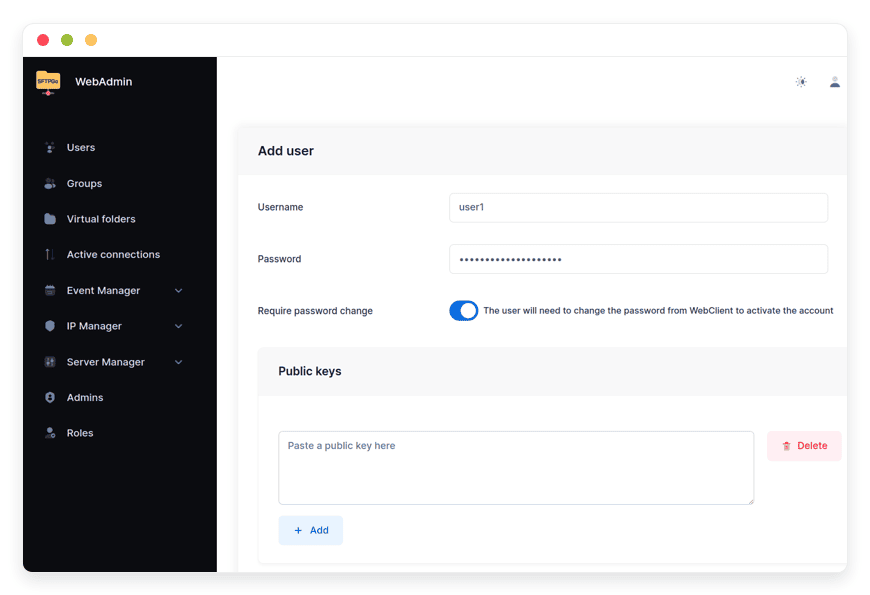
The account-level work inside each instance, meaning users, folders, quotas, and virtual folder mappings, is web-admin work you keep, and the SFTPGo knowledge base covers each task in operator detail.
What white-label looks like here, honestly
You can put your brand on the invoice, on the relationship, and on the hostname the client's partners connect to. You cannot rebrand the software itself, and pretending otherwise is the one move in this line that carries real legal risk.
SFTPGo is a registered trademark of its owner, and DANIAN is an independent managed-hosting provider running the unmodified community edition. The project enforces that boundary actively: in June 2025 the maintainer removed 31 unauthorized marketplace listings, stating plainly that open source does not mean free to sell rebranded copies. Hosting the open edition, describing it accurately, and crediting the project is the established and legitimate model, and it is exactly what a partner account operates by construction. On your invoice and in your proposal, say managed SFTPGo and name the software; never present the endpoint as your proprietary product or imply endorsement by the project.
The licensing question has the same shape. The community edition is AGPL-3.0 licensed software that anyone can inspect, and DANIAN runs it unmodified. As a reseller you never distribute software at all; you resell a hosted service, so the license's source obligations sit with the hosting layer, not on your invoice and not on your client.
Storage is the variable that decides your margin
The base instance includes 30 GB of storage and 1,000 GB of monthly traffic; extra storage bills at €0.50 per GB per month and traffic beyond the included terabyte at €0.03 per GB. Most file-exchange clients sit far inside the included storage, and the ones who do not are predictable in advance.
Two archetypes make the range concrete. A client exchanging price lists, invoices, and point-of-sale exports rarely leaves the single gigabytes; their instance costs you exactly €9. A client parking print-ready media or archived datasets at 100 GB costs €9 plus 70 GB at €0.50, which is €44 a month. Both hold margin if you price storage deliberately.
The move that protects the line: sell storage as invoice tiers rather than absorbing the meter. Include 30 GB in the base fee, publish your own overage rate, and quote heavy clients up front. The variable becomes a priced part of your service instead of a leak in it.
The operations you keep, and the ones you drop
You keep everything client-facing: designing the folder layout, creating accounts, onboarding trading partners, invoicing. The platform runs the server layer: installation, version updates, daily encrypted backups to a separate region, monitoring, and 24/7 human support under a 99.9 percent uptime SLA.
| You keep | The platform runs |
|---|---|
| Folder design, accounts, quotas, and web admin | Installation, upgrades, and the current community release |
| Onboarding the client's trading partners | Daily encrypted backups and tested restores |
| Invoicing, contracts, and the client relationship | Monitoring and 24/7 support from humans |
| The answer when a partner cannot connect | The overnight failure, the diagnosis, and the fix |
Three situations honestly do not fit the line, and saying so early earns more trust than a yes that sours. A client with a formal compliance program that needs enterprise features such as HIPAA mode, data-loss-prevention pipelines, or managed PGP belongs in the vendor's commercial editions; new headline features ship there first, and the community edition a managed instance runs receives maintenance and core updates. A client asking for a cloud drive with document editing and shared calendars needs a different product category, not a bigger SFTP endpoint. And an estate moving terabytes every day is a bandwidth-math problem first; metered-terabyte workloads deserve their own spreadsheet before any commitment.
How to start the line this month
The first invoice is usually four weeks away, because the path is short and the first client is usually already known: the one emailing attachments today.
- Apply to the Partner Program: free to join, no volume commitment, and approval starts the volume pricing.
- Open a trial instance and stage the pilot client inside the 15-day window: their accounts, their folder layout, one real trading partner.
- Set the invoice line before the cut-over: a flat €29 to €49 by workload, with storage tiers published for heavy clients.
- Move the pilot's first workload through a dual-run window, so the old path stays open while partners switch, then repeat the recipe for the next client.
When the second client asks for the same thing, the line exists. The endpoint underneath is managed SFTPGo hosting: €9 a month flat, 30 GB of storage included, daily backups, and support on every plan.
Frequently asked questions
Is reselling managed SFTPGo worth it for a small MSP or agency?
Yes, once you have roughly five clients who exchange files with outside parties, because the line rides infrastructure you already sell. Five clients at a €35 invoice gross €130 a month at the base rate and ten gross €260, and the work per client is account setup and partner onboarding, not server administration.
How much should I charge clients for a managed SFTP endpoint?
A flat €29 to €49 per month fits the workload, set by file volume and partner count rather than user seats. The market anchors are metered: Couchdrop lists $50 a month for one connection, SFTP To Go's entry tier published at $150, and the vendor's own SaaS starts at €50. Publish storage tiers beyond the included 30 GB so heavy clients are priced, not absorbed.
What margin does the file-exchange line carry at ten clients?
About €260 a month at a €35 invoice and the €9 base rate, which is roughly 74 percent gross margin. The program discounts per-app pricing by volume, so the real margin sits above that floor, and the client-facing work of setup and onboarding is billable on top when you price it as a project.
How do growing storage needs affect my margin?
Extra storage costs you €0.50 per GB per month beyond the included 30 GB, so a 100 GB client costs €44 a month wholesale. Sell storage as invoice tiers with your own overage rate and growth stays margin instead of becoming a surprise; traffic only bills beyond the included 1,000 GB per month, at €0.03 per GB.
Do partners pay less than the €9 per app price?
The Partner Program prices apps at €9 per app per month, discounted by volume. The discount applies across the catalog rather than per app, which is why the margin tables in this guide use the undiscounted base rate as the floor; your actual cost only improves from there.
Should every client get a separate SFTPGo instance?
Yes. Separate instances keep client data in separate credential domains, shrink the failure radius of a quota mistake or a brute-force attempt to one client, and let each client restore their own folders, event rules, and settings independently. A shared instance saves €9 a month and concentrates every client's risk in one place.
Can a client's endpoint run under their own domain?
Yes. The custom domain lane on a managed instance runs through a support ticket, with DNS records added by you or by the platform team, and existing users, folders, and settings stay untouched. The client's trading partners connect to a hostname the client owns, which reads as the client's infrastructure rather than a vendor's.
Who supports the client when something breaks overnight?
The platform does. Managed instances carry 24/7 support from humans and a 99.9 percent uptime SLA, so the overnight failure, the diagnosis, and the fix belong to the operations layer. You stay the client's vendor for the relationship and the configuration, and the escalation path exists whether or not you are awake.
Do I need Linux skills to resell managed SFTP hosting?
No. Server administration, updates, backups, and monitoring are the platform's work. What you operate is the web admin: users, folders, quotas, and virtual folder mappings, all documented in the knowledge base. File-exchange literacy, meaning knowing what a trading partner needs in order to connect, matters far more than sysadmin skills.
How do pilot deployments work for hesitant clients?
Every new deployment on a partner account carries a 15-day trial, longer than the public window, sized for exactly this case. Stage the client's real accounts and one real trading partner during the trial, prove the transfers, and start the invoice when they say yes; canceling an app mid-trial costs nothing.
Is it legal to resell SFTPGo as a paid service?
Hosting the open community edition as a managed service is the established model in this category, and it is what a partner account operates. What the maintainer has enforced against, including the removal of 31 unauthorized marketplace listings in June 2025, is selling rebranded copies as authorized products. Describe the service accurately, credit the project, and never imply endorsement, and you are in the legitimate lane.
Can I present the endpoint as my own branded product?
Your brand belongs on the invoice, the relationship, and the hostname. The software itself remains SFTPGo, a registered trademark of its owner, and the interface clients see is the project's own. Selling managed SFTPGo with your service wrapped around it is the honest, durable framing; stripping or hiding the software's identity is the framing that draws enforcement.
What security claims can I honestly make to clients?
Transport encryption on SFTP and FTPS, per-user credentials with SSH key support, two-factor authentication for admin and web client logins, brute-force protection, per-user quotas, and daily encrypted backups, all standard on a managed instance. Compliance certifications and enterprise features such as managed PGP or data-loss prevention belong to the vendor's commercial editions; do not promise them on this stack.
What happens to a client's endpoint if they leave or stop paying?
You cancel that app from your account, with no notice period or volume penalty, because the program carries no volume commitment. The client's files can be exported before the instance is removed, and the rest of your roster is untouched, since every client runs a separate instance with separate backups.
Why would a client buy this from me instead of going direct?
Some will go direct, and letting them is fine. The clients who buy from you are buying the parts the software alone does not ship: the initial setup, the account design, the onboarding of their trading partners, and one accountable provider when something needs an answer. The endpoint underneath is identical either way, so the decision is about who they want to call.
Sources
- Partner Program terms, volume pricing model, and 15-day deployment trial: danian.co/partners (viewed November 2026)
- Per-app pricing, storage and traffic inclusions, overage rates, and SLA: danian.co/pricing and danian.co/sftpgo (viewed November 2026)
- Instance operations, custom domains, and backup mechanics: danian.co knowledge base, SFTPGo category (viewed November 2026)
- SFTPGo licensing, editions, and feature split: SFTPGo README and documentation, github.com/drakkan/sftpgo and docs.sftpgo.com (viewed November 2026)
- Trademark enforcement history: maintainer statements on sftpgo.com, June 2025
- Metered SFTP market pricing: couchdrop.io/pricing (viewed November 2026), sftptogo.com/pricing (verified October 2026), and vendor SaaS tiers at sftpgo.com/saas (viewed November 2026)


