Open-source meal planning in 2026
THE SHORT VERSION
- Two open-source apps replace the usual meal-planning subscriptions: Mealie (clean interface, weekly planner) and Tandoor (deep search, strong import). Both handle recipes, meal plans and shopping lists.
- One instance covers the whole family. You pay €9 a month for the instance, not a fee per person.
- This is not the cheapest option. Plan to Eat is $49 a year and Paprika is a small one-time purchase. Managed hosting costs more.
- What the extra buys: a private instance you own, no ads, no data resale, and recipes that outlive any one vendor.
- Recipe import works well on sites with structured data. Messy blogs and paywalled pages need a hand.
A recipe collection is one of the few things in a kitchen meant to last for decades. The apps that hold it usually don't. They get sold, change their pricing, or shut down, and the family recipe box goes with them. This guide covers two open-source apps that keep your recipes, meal plans and shopping lists on an instance you control: Mealie and Tandoor. We host either one for €9 a month, so you get the ownership without running a server yourself.
Why people are leaving recipe subscriptions in 2026
Most meal-planning apps are cheap, polished, and rented. Plan to Eat charges $5.95 a month or $49 a year for one account that covers a household. Paprika asks for a small one-time payment per platform. Samsung Food is free. None of these is expensive, so cost is rarely the reason people look elsewhere. The reason is ownership and trust.
Whisk is the clearest example. It was a popular meal-planning app, then Samsung bought it in 2019 and rebranded it as Samsung Food in 2023. The app is still capable and still free, but it now sits inside a large platform with a data-driven business model. Free recipe apps make money from somewhere, and usually that somewhere is your data and your attention.
The other reason is durability. Recipes you have collected for years are tied to one vendor's account and one vendor's export format. If that vendor raises prices, gets acquired, or closes the service, your collection is suddenly someone else's decision. People who have lived through one app shutdown tend not to want a second.
Open-source meal planning answers both worries at once. The software is free and the code is public, so it can't be taken away or quietly turned into an ad product. Run on an instance you control, your recipes stay on hardware you chose, with no ads and no third party mining what your family eats. The trade is that someone has to run that instance, which is the job we do.
What self-hosted meal planning actually means
"Self-hosted" means the app runs on a server you control rather than on a vendor's cloud. With a recipe app, that server holds your recipes, your meal plan, your shopping lists and your family's accounts. Nobody else can read them, sell them, or switch the service off. The catch is that a server needs setting up, updating and backing up.
There are three honest ways to get there, and they suit different people.
- Keep the subscription app. Plan to Eat, Paprika or Samsung Food all work today with zero setup. If you are happy with the app and not worried about who holds the data, staying put is a reasonable choice.
- Self-host it yourself. Mealie and Tandoor are free to download. You install them with Docker on your own hardware or a rented server, then own the backups, updates and security. This is a good path if you enjoy that work and already run other services.
- Have it managed. You get the same open-source app on a private instance, but someone else runs the server. That is what we do at DANIAN for €9 a month per instance, with daily off-site backups and updates included.
The managed path is the middle ground. You keep ownership and privacy, but you don't have to learn Docker or wake up to a failed backup. One independent review summed up Tandoor as excellent if you are comfortable with hosting, backups and basic server maintenance. Managed hosting is simply Tandoor, or Mealie, without that prerequisite.
The shortlist: two apps worth hosting
Two open-source apps stand out for households and small teams in 2026. Both manage recipes, plan meals, and build shopping lists. They split on personality: Mealie is the friendly one, Tandoor is the powerful one. Pick by how your household actually cooks and how much structure you want.
Mealie
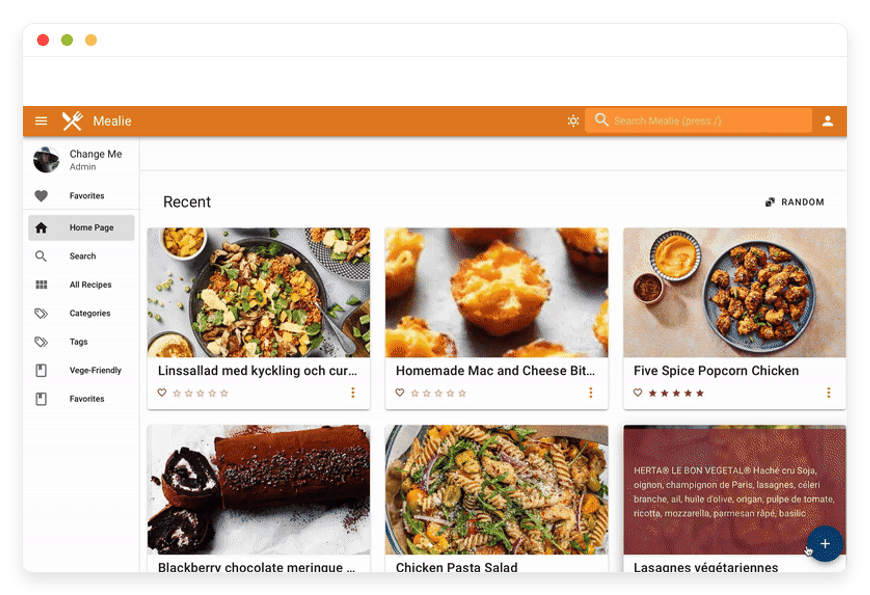
Mealie is a self-hosted recipe manager, meal planner and shopping list built for the whole household. You add a recipe by pasting a URL, and it pulls in the title, ingredients and steps for you. The interface is clean and modern, the kind a family member can use without a tutorial. It is published under the AGPL-3.0 licence and has around 12,500 stars on GitHub, with active releases through 2026.
The weekly meal planner shows what is for dinner across the days ahead, and the shopping list sorts itself into supermarket sections. You can group users into a household so everyone shares one collection, organise recipes into cookbooks, and scale ingredient amounts when the serving count changes. Mealie keeps automatic backups of your data and offers an open API for anyone who wants to connect other tools. Best for: a household that wants a clean, approachable recipe box and a simple weekly plan.
Tandoor
Tandoor is a recipe manager built by and for power users, with around 8,400 stars on GitHub. It does the same core jobs as Mealie, then goes deeper. Its search is fast and customisable with full-text matching, you can tag recipes and batch-edit them, and it plans multiple meals per day rather than one. The licence is AGPL-3.0 with a Commons Clause selling exception, which keeps every feature free for anyone who self-hosts.
Import is Tandoor's standout. It reads recipes from thousands of websites that publish structured data, and it imports existing collections from many other recipe managers, which makes it the stronger choice if you are migrating a large library. It also handles fractions, recipe scaling, themes, and syncing files with services you may already use. One honest caveat: Tandoor is built for a trusted group of family and friends, not as a public website, and its maintainer notes that a single developer leads it, so some changes land slowly. Best for: a power user who wants deep search, structure, and the strongest import.
Want the friendly option run for you, with backups and updates included? See managed Mealie hosting.
Mealie versus Tandoor: which one fits you
Both apps do recipes, meal plans and shopping lists well, so the decision is about fit, not features. The split is simple. Mealie optimises for a clean, familiar interface that anyone in the house can pick up. Tandoor optimises for depth: search, tags, structure and import power for someone who treats their recipe library seriously.
Choose Mealie if the people in your household range from teenagers to grandparents and you want a screen that needs no explaining. The weekly planner and aisle-sorted shopping list cover what most families need, and the learning curve is close to flat. It is the better default for a shared family recipe box.
Choose Tandoor if you are the kind of cook who has hundreds of recipes, wants to find any of them in two seconds, and cares about tags, units and precise scaling. If you are moving a big collection out of another app, Tandoor's import will save you the most time. It rewards a power user and can feel like more than a casual cook needs.
You don't have to decide forever. Both are open-source and both let you export your data, so trying one and switching later costs you a migration, not your collection. If you are unsure, a household leans Mealie and a tinkerer leans Tandoor.
Prefer deep search and the strongest import? See Tandoor for recipes and planning.
Side by side
Here is how the two apps compare on the things that matter when you are choosing a recipe box for the long run. Both run on a private instance we manage for €9 a month.
| Mealie | Tandoor | |
|---|---|---|
| Replaces | Plan to Eat, Paprika, Samsung Food | Plan to Eat, Paprika, Samsung Food |
| Licence and code | AGPL-3.0, ~12,500 GitHub stars | AGPL-3.0 + Commons Clause, ~8,400 stars |
| Recipe import | URL import from structured-data sites | URL import plus import from many other recipe apps |
| Meal planner | Weekly planner | Multiple meals per day |
| Shopping list | Sorted into supermarket sections | From the meal plan or any recipe |
| Family sharing | Users and groups on one instance | Shared spaces for family and friends |
| Interface | Clean and approachable | Deep, with full-text search and tags |
| Where your data lives | Your private instance, region you choose | Your private instance, region you choose |
| Managed price | €9 / month | €9 / month |
What it actually costs
Here is the honest pricing picture, because it is the opposite of what people expect. Managed open-source hosting is the most expensive option on this page, not the cheapest. The subscription and one-time apps cost less. We think the trade is worth it for the right person, but only if you can see the real numbers first.
| Option | Up front | Year 1 | 3 years | Ads / data use |
|---|---|---|---|---|
| Plan to Eat | $0 | $49 | $147 | No ads; vendor holds your data |
| Paprika 3 | ~$5–30 once | ~$5–30 | ~$5–30 | No ads; vendor cloud sync |
| Samsung Food | $0 | $0 | $0 | Ads; data-driven model |
| Mealie or Tandoor on DANIAN | €0 | €108 | €324 | No ads; no data resale |
Plan to Eat and Paprika price in US dollars; DANIAN prices in euros. Convert at the current rate; the gap is real either way.
So on price alone, the apps you are replacing win. Plan to Eat at $49 a year covers a whole family, and Paprika asks once and never again. If the only question is "what is cheapest," the answer is not us, and we would rather say so than pretend otherwise.
What the €9 buys is a different thing from a lower price. It buys a private instance you own, hosted in the region you choose, with no ads and nobody mining your data. It buys backups we run off-site every day and updates you never have to think about. And it buys durability: your recipes sit on your instance, not inside a vendor that might be sold or shut down next year. If a card payment fails, we wait rather than delete anything. We do not sell your data to anyone, because the flat fee is the whole business.
How to pick: questions to ask yourself
Before you move a single recipe, three questions decide whether managed open-source meal planning is right for you, and which app to choose. Answer them honestly and the path is usually clear within a minute.
Do I care who holds my recipes? If a free app holding your family's cooking data is fine, Samsung Food or a cheap subscription is the rational pick, and you should keep it. If that bothers you, or you have been burned by an app shutdown, ownership is worth paying for, and open-source on your own instance is the answer.
Do I want to run the server myself? If you enjoy Docker, backups and patching, self-host Mealie or Tandoor for free and keep full control. If you want the ownership without the maintenance, managed hosting does the server work for you at a fixed monthly price.
How does my household cook? If you want a screen anyone can use and a simple weekly plan, choose Mealie. If you have a large library, want fast search and tags, and care about precise scaling, choose Tandoor. If you are moving a big collection from another app, Tandoor's import tips the balance.
FAQ
Can my whole family use one Mealie or Tandoor instance?
Yes. Both Mealie and Tandoor support multiple user accounts on a single instance, so the whole household shares one recipe collection, meal plan and shopping list. You pay one flat monthly fee for the instance, not a fee per person. Add family members from the app's own settings.
Can I import my recipes from a website?
Yes, and this is where both apps are strong. Paste a recipe URL and the importer reads the page and fills in the title, ingredients and steps. It works best on sites that publish structured recipe data, which most large recipe sites do. Messy blogs and paywalled pages import less cleanly.
Can I move my recipes over from Plan to Eat or Paprika?
Often, yes. Tandoor reads exports from several other recipe managers, and both apps import recipe URLs in bulk. Plan to Eat and Paprika can export your collection, which you then bring in. Expect to tidy a few imports by hand, because no importer is perfect across every source format.
Is Mealie or Tandoor cheaper than Plan to Eat?
No. Plan to Eat costs 49 dollars a year and Paprika is a small one-time purchase, while managed hosting is nine euro a month. On price alone the apps you are replacing usually win. What you gain instead is a private instance you own, family sharing, and no ads or data resale.
Do Mealie and Tandoor have a mobile app?
Both run in any phone browser and are built to work well on a small screen. You can add the page to your home screen so it opens like an app. There is no separate native app to install, which also means nothing to buy a second time for another phone or tablet.
What happens to my recipes if I cancel?
Your recipes stay yours. The app exports your full collection whenever you want, so you can leave with your data in hand. If a card payment fails we wait rather than delete anything, and we help on chat if you need a complete backup before you go.
Can I scale a recipe up or down for more people?
Yes. Both apps scale ingredient amounts when you change the serving count, so a recipe for four becomes a recipe for eight in one tap. Tandoor also handles fractions and unit conversion for cooks who want precise measurements rather than rounded numbers.
Does the shopping list group items by aisle?
Yes. Mealie sorts the shopping list into supermarket sections, and Tandoor builds lists from your meal plan or from any single recipe. You tick items off as you shop, and the list lives on the same instance the rest of the household can see.
Will you show me ads or sell my cooking data?
No. There is nothing to fund with ads here, because the flat monthly fee is the whole business model. Your recipes, meal plans and shopping habits sit on your own instance. We do not run ads, and we do not sell your data to anyone.
How is this different from just self-hosting it myself?
You can self-host Mealie or Tandoor for free if you enjoy running Docker, doing backups and patching a server. Managed hosting is for people who want the same app without that work. We run the server, patch it, and back it up off-site every day.
Which should I pick, Mealie or Tandoor?
Pick Mealie if you want a clean, approachable interface that the whole family will find familiar. Pick Tandoor if you are a power user who wants deep search, tags and strong import from other apps. Both manage recipes, meal plans and shopping lists, so the difference is depth versus simplicity.
Where is my data stored?
On a private instance we run for you, in the datacenter region you choose from 21 locations across six continents. Your recipes are not pooled into a shared public service. You decide where the instance lives, and the data stays on it rather than on a vendor's central cloud.
What are the best open-source alternatives to Plan to Eat and Paprika?
The two leading open-source alternatives are Mealie and Tandoor. Both manage recipes, meal plans and shopping lists, and both run on a private instance you control. Mealie is the simpler, friendlier option, and Tandoor is the power-user option with deeper search and import. You can self-host either for free or have it managed for nine euro a month.
Do I need to be technical or know how to code to use this?
No. With managed hosting you use the app in your browser and never touch a server or the command line. We do the setup, updates and backups for you. You only need to be technical if you choose to self-host the app yourself.
What do I need to self-host Mealie or Tandoor myself?
To self-host, you need a server or a device that runs Docker, such as a home server or a Raspberry Pi. You install the app with a Docker Compose file, then keep it updated and backed up yourself. It is a good fit if you enjoy that kind of work. If you would rather not, managed hosting does the server side for you.
How much does it cost to self-host a recipe manager myself?
The software itself is free. Your only cost is the machine it runs on, which can be a device you already own or a small server that rents for a few dollars a month. On top of that you spend your own time on setup, updates and backups. Managed hosting trades that time and server cost for one flat fee.
Can I run Mealie or Tandoor on a Raspberry Pi or a NAS?
Yes. Both ship as Docker images for ARM hardware, so they run on a Raspberry Pi or a home NAS. A Raspberry Pi 4 or newer handles a household collection comfortably. Older or very small devices can be slower, and you still own the updates and backups.
Is there a free trial or a free version?
The open-source apps are free to self-host. Managed hosting is paid, and you can try it free for seven days before you pay. There is no separate free tier on the managed side. The trial is the way to test it with your own recipes first.
What recipe formats can I import?
Both import recipes from a URL by reading the structured data a page publishes. Tandoor also reads exports from many other recipe managers, which helps when you move a large library. Mealie offers migration tools for some other apps as well. Plain or handwritten recipes you add by hand.
Does Mealie or Tandoor track nutrition or calories?
Both can store nutrition information on a recipe. Tandoor can also calculate values from the ingredients you list, and estimate them with its assistant features. Mealie holds the numbers you enter but does not rescale them when servings change. Neither is a full calorie-tracking app like a dedicated diet tool.
Can I add recipes manually instead of importing them?
Yes. You can type a recipe in by hand, with its ingredients, steps, photo and tags. Manual entry works the same as an imported recipe once it is saved. This is how most people add family recipes that were never online.
How are backups handled, and what if the server goes down?
We run off-site backups of your instance every day, so a failure does not lose your recipes. If the server has a problem, we work to bring it back and restore from a recent backup. You can also export your own full backup at any time. Nothing depends on a single machine staying healthy forever.
Is my recipe data secure?
Your recipes live on a private instance we run only for you, not in a shared pool with other customers. The connection to it is encrypted, and only the accounts you create can sign in. We keep off-site backups every day, so a hardware failure does not lose your data. We do not sell or mine what is on your instance.
What happens to my recipes if DANIAN shuts down?
Your setup does not depend on us staying in business. Mealie and Tandoor are open-source, and your data exports at any time. If we ever closed, you could take a full backup and run the same app yourself or move it to another host. Nothing about your recipes is locked to us.
How long does it take to get set up?
Managed setup takes minutes, not an afternoon. You pick the app and the region, we start your instance, and you sign in and begin adding recipes. Importing an existing collection takes a little longer, depending on its size. Self-hosting takes longer, since you install and configure it yourself.
Does it work in languages other than English?
Yes. Mealie's interface is community-translated into dozens of languages, and Tandoor is localized into many languages too. You choose the language in the app's settings. Your recipes can be in any language regardless of the interface.
Can I access my recipes offline?
Both apps install to your home screen and behave like an app. Tandoor's app keeps recently viewed recipes available offline, which helps at the shops. In general the apps work best with a live connection to your instance. Editing and syncing need that connection.
What to do this week
Decide one thing first: do you want to own your recipes, or just keep using a rented app? If a cheap subscription is fine, keep it with our blessing. If ownership matters, the next step is small. Pick Mealie for a friendly family recipe box or Tandoor for power and import, then run a private instance for a week and move a handful of recipes in.
Trying it is low-stakes. The trial runs for seven days, your recipes export at any time, and one instance covers everyone in the house. If something needs a human, you reach a named person on chat, not a queue. When you are ready, start a 7-day trial and see how your own recipe box feels.
Sources
- Plan to Eat pricing and account terms — plantoeat.com
- Mealie features, licence and source — mealie.io and github.com/mealie-recipes/mealie
- Tandoor features, licence and import — docs.tandoor.dev and github.com/TandoorRecipes/recipes
- Samsung Food (formerly Whisk) background — samsungfood.com
- Paprika pricing model — Apple App Store and Google Play listings