HubSpot Marketing Hub alternatives — Mautic and EspoCRM
TL;DR
- HubSpot Marketing Hub Professional starts at $890/month month-to-month, or $800/month on annual upfront. That covers 3 seats and 2,000 marketing contacts.
- At 5 seats with 5,000 contacts, the real bill lands around $1,140/month — plus a $3,000 mandatory onboarding fee in year one.
- Mautic covers HubSpot's email, automations, landing pages, forms, and lead scoring. EspoCRM covers contacts, deals, and the sales pipeline.
- Both apps run on DANIAN at €9/month each. The full Mautic + EspoCRM stack costs €18/month flat — no per-seat math, no contact-overage charges.
- The honest catch: Mautic needs an SMTP relay for production volume. Plan for Amazon SES, Postmark, or DANIAN's included transactional SMTP for low-volume use.
Why teams are leaving HubSpot Marketing Hub Pro in 2026
HubSpot Marketing Hub Professional costs $890/month month-to-month, or $800/month on annual billing. The base tier includes 3 seats and 2,000 marketing contacts. Crossing 2,000 contacts triggers $250/month per additional 5,000. Two extra seats add about $90/month. Year one carries a mandatory $3,000 onboarding fee.
The numbers worth pinning down for a 5-seat team:
- 5 seats, 5K contacts, annual billing: $800 + $90 + $250 = $1,140/month. Add $3,000 onboarding, amortised over year one. Year-one effective: about $1,390/month. Year-two effective: $1,140/month.
- 5 seats, 25,000 contacts: $800 + $90 + $1,250 (25K overage at $250 per 5K) = $2,140/month.
- 5 seats, 100,000 contacts: $800 + $90 + $4,900 = $5,790/month.
Three triggers show up in the Marketing Hub renewal conversations small teams have with us.
The first is per-seat creep. A marketing manager, a designer, a freelancer, and two part-time hands is not an enterprise team. That's a normal 10-person SaaS or a boutique consultancy. Five seats on Pro adds $90 above the headline number every month.
The second is contact-tier overage. A trade-show import, a partner cohort, or a podcast list pushes a team across 2,000 marketing contacts overnight. The next bracket is a $250/month jump — and the bracket after that is another $250.
The third is feature gating. A/B testing, custom reporting, marketing automation workflows, ad retargeting — all gated behind Pro. Starter at $20/seat is a contact database with branded email. Pro is the version that does marketing automation. There is no in-between.
The fourth, less talked about, is the data-ownership story. HubSpot's contact database, custom property schema, workflow definitions, and email send history all live in HubSpot's account. Export is possible, but it's a CSV and a JSON dump — not a portable application you can stand back up elsewhere unchanged. For teams whose customer relationships are the business, that asymmetry starts to chafe at renewal time. Open-source equivalents flip the equation: the application is yours, the database is yours, the schema is yours. The migration story works in both directions, not just the in direction.
What "alternative" means here in practice
Three honest paths exist when leaving HubSpot Marketing Hub Pro. Each one fits a different team shape. We've watched all three play out with customers; none is wrong, and one is right for you.
The cheaper-SaaS path keeps you on rails. ActiveCampaign Plus at 5 seats and 5,000 contacts runs about $145/month. Brevo's Business at 5 users and 20,000 emails sits around $65/month. These are real options when "managed for me" is the deciding word and the feature set lines up. The trade-off is you're still paying per contact above a tier and per seat above a base.
The self-host-on-a-VPS path is cheapest on paper. A production-class VPS at $24/month — 2 vCPU, 4 GB RAM — runs both apps for a 5-seat team. Add $5/month for backups and $15/month for monitoring. Add 2-4 hours of operator time monthly at €60-120 per hour: €120-480 in implicit cost. Effective total: €164-524/month. That's when nothing breaks.
The managed-open-source path is the topic of this post. Mautic on DANIAN at €9/month. EspoCRM on DANIAN at €9/month. Total: €18/month flat. No per-seat math, no contact-tier overage, no onboarding fee. The trade-off: you're trusting a managed-hosting operator with the patch cycle, the backups, and the on-call. For a non-developer SMB, that trade is usually the right one.
The shortlist — two open-source apps that cover HubSpot's ground
Mautic — marketing automation, email, landing pages, lead scoring
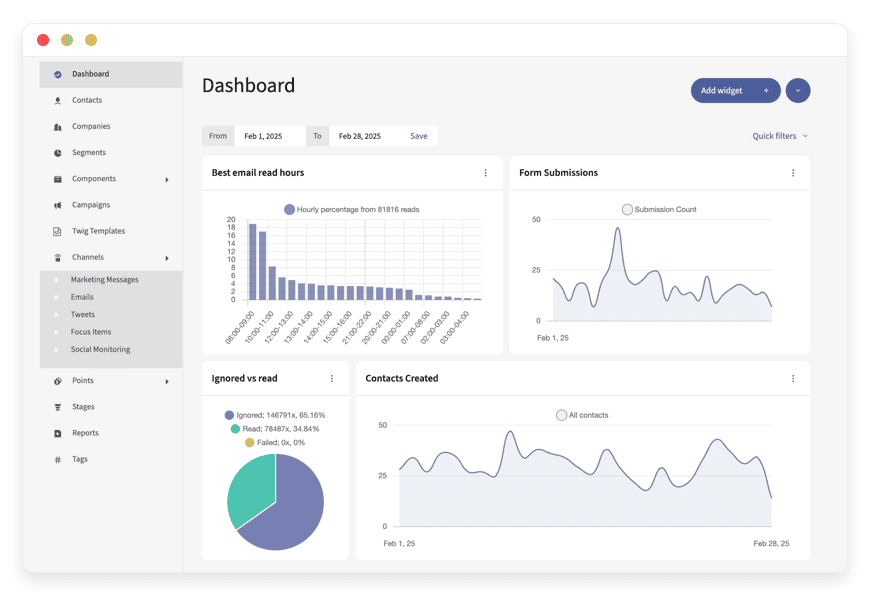
Mautic is the open-source equivalent of HubSpot Marketing Hub's automation layer. It handles email campaigns, a drag-and-drop workflow builder, dynamic forms, landing pages, segmentation, and lead scoring. David Hurley founded the project in 2014; it's now stewarded by Acquia and a global community. Around 8,000 GitHub stars, GPL-licensed, PHP and MySQL stack. On DANIAN, you get managed Mautic hosting at €9/month — the patches, the cron jobs, the backups, the dashboard, all included.
Best for: small-to-mid marketing teams that want HubSpot-style automation, want to own their data, and have moved past per-contact pricing. Less ideal for: teams with no SMTP relationship and no plans to set one up.
EspoCRM — CRM, contacts, deals, pipeline, support cases
EspoCRM is an open-source CRM built as a single-page web app on a PHP REST API backend. It handles contacts, accounts, leads, opportunities, sales pipeline, and calendar. It also covers email integration, support cases through a customer portal, and a workflow engine for sales automation. Around 2,900 GitHub stars, AGPL-3.0, runs on MySQL, MariaDB, or PostgreSQL. On DANIAN, you get managed Mautic hosting at €9/month — the install, the upgrades, the backups, the SSL, all handled.
Best for: 1-25 seat sales and account-management teams that want a Salesforce or HubSpot-CRM shape without seat creep. Less ideal for: teams that need built-in advanced telephony, native marketing automation in the same product (that's why Mautic is here), or vertical-specific workflows out of the box.
A note on Castopod, Listmonk, and bridging tools
Castopod is fine open-source software for hosting a podcast feed. But a podcast is rarely the marketing automation gap teams are leaving HubSpot to fill. Listmonk is excellent for transactional email and bulk newsletters, though it sits outside DANIAN's catalog today — set it aside. The integration layer between Mautic and EspoCRM is a separate conversation, covered in the next section.
At a glance — Mautic and EspoCRM vs HubSpot Marketing Hub Pro
| Dimension | HubSpot Marketing Hub Pro | Mautic on DANIAN | EspoCRM on DANIAN |
| Cost at 5 seats / 5K contacts (annual) | $1,140/month + $3K year-one onboarding | €9/month flat | €9/month flat |
| Cost at 5 seats / 25K contacts | $2,140/month | €9/month flat | €9/month flat |
| GitHub stars | n/a (proprietary) | ~8,000 | ~2,900 |
| License | Commercial | GPL | AGPL-3.0 |
| Region options | US-led infrastructure | 21 datacenter regions, 6 continents | 21 datacenter regions, 6 continents |
| Per-seat cost | $45-50 per extra seat | None | None |
| Contact-tier overage | $250/month per +5,000 | None | None |
| Onboarding fee | $3,000 mandatory (Pro tier) | None | None |
| Switching effort | n/a | Medium — SMTP, DNS, contact import | Lower — contact and pipeline import |
How the stack fits together in practice
Mautic and EspoCRM are two apps, not one. Mautic handles outbound — emails, drip campaigns, automations, landing pages, lead scoring. EspoCRM handles inbound — accounts, deals, pipeline stages, sales tasks. The two talk to each other through three honest patterns. Webhook plus REST API. A no-code bridge using n8n. Or a custom Mautic IntegrationsBundle plugin.
The webhook plus REST API pattern is the simplest. EspoCRM has a workflow engine that fires webhooks on entity changes — new lead, won deal, lost opportunity. Mautic's REST API accepts contact creates and segment changes. A shop with one developer can wire a one-way sync (EspoCRM → Mautic) in an afternoon. A bidirectional sync needs more thought — usually two scheduled jobs, one in each direction, with a "system of record" rule for conflicts.
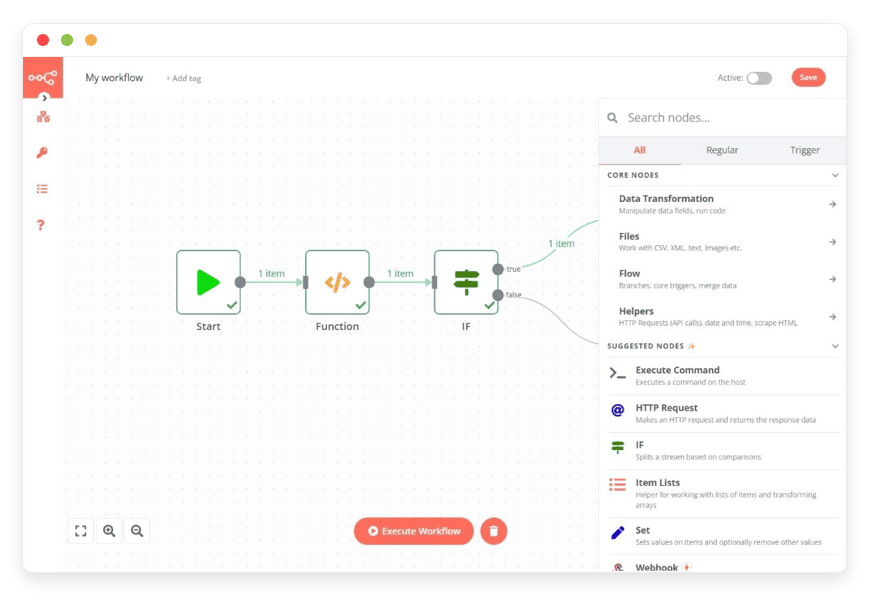
The no-code bridge pattern uses n8n, which is also in DANIAN's catalog at €9/month. n8n has nodes for both EspoCRM and Mautic, plus generic HTTP nodes for the REST APIs directly. For a non-developer team, this is the cleanest path. A small workflow watches EspoCRM for new contacts, pushes them to a Mautic segment, then listens for Mautic engagement events and updates the EspoCRM activity timeline. Adding n8n brings the stack total to €27/month — still a fraction of Marketing Hub Pro.
The custom plugin pattern uses Mautic's IntegrationsBundle framework. Mautic's plugin system supports first-class CRM connectors — there's a HubSpot one, a SuiteCRM one, a Salesforce one. There is no first-class EspoCRM plugin in Mautic core today. A custom plugin is doable but it's a developer project, not a configuration project.
The honest summary: this is two apps that talk, not one app that does everything. HubSpot's value to teams that pick it is the unified UX. Replace the unified UX with a Mautic-EspoCRM bridge, and you save the money but spend a few hours getting the bridge configured.
A concrete sync setup that works in production at five-seat scale:
- EspoCRM is the system of record for accounts, deals, and the sales pipeline. Anything a salesperson edits is authoritative.
- Mautic is the system of record for engagement events. Email opens, clicks, form submissions, and lead-score changes live here.
- Webhook 1 (EspoCRM → Mautic): when a lead is created or updated in EspoCRM, fire a webhook to Mautic's contact API. Mautic creates or updates the contact and adds it to the segment matching the lead's status field.
- Webhook 2 (Mautic → EspoCRM): when a contact's lead score crosses a threshold or completes a campaign, fire a webhook to EspoCRM's REST API. EspoCRM creates a task on the relevant deal: "follow up — high engagement signal."
- Conflict rule: email address is the unique key. If both sides edit a non-key field within the same minute, EspoCRM wins for sales fields, Mautic wins for engagement fields. In practice, this conflict almost never fires.
Setup time once you've decided on the rules: half a day for a developer, a day or two for a non-developer using n8n's visual builder. Maintenance after that is near-zero — the rules are stable across upgrades because they live in your sync code, not in the apps' configurations.
The deliverability conversation — why Mautic isn't a one-click HubSpot replacement
Mautic is not an email service provider. It's the marketing automation engine that talks to one. To send emails through Mautic, you bring an SMTP relay — Amazon SES, Postmark, SendGrid, Mailgun, or DANIAN's included transactional SMTP for low-volume use. HubSpot bundles deliverability into the price; Mautic separates the concerns.
The bundling matters at small volume and matters less at scale. HubSpot delivers your emails through their own infrastructure, paid for inside the seat-and-contact pricing. Volume up means bill up. With Mautic, deliverability cost scales separately, and almost always lower:
- Amazon SES: $0.10 per 1,000 emails outbound, plus relay overhead. 50,000 emails/month: $5/month.
- Postmark: $1.25 per 1,000 emails up to 10,000/month, with volume discounts. 50,000 emails/month: about $50/month.
- SendGrid: paid plans start at $19.95/month for 50,000 sends.
- DANIAN's included transactional SMTP: covers low-volume operational sends — opt-in confirmations, password resets, small newsletters. Not a substitute for a dedicated relay above 10,000 sends/month.
The deliverability work is real. Send-domain SPF, DKIM, and DMARC records (15-30 minutes if you're comfortable with DNS, longer if you're not). IP warm-up if you're using a dedicated IP. Bounce and complaint handling — Mautic's segment rules suppress hard bounces once you switch the rule on. Suppression list import from your old HubSpot account.
Two practical rules. First: under 10,000 monthly sends, the included transactional SMTP plus opt-in confirmations is enough; you'll pay nothing extra. Second: above 10,000 monthly sends, a dedicated relay is non-negotiable, and Postmark or Amazon SES is what most teams pick.
This is the genuine trade-off versus HubSpot. You're not paying for managed deliverability; you're paying for a relay separately. At 50,000 emails/month on Postmark, the deliverability bill is around $50/month. Add Mautic plus EspoCRM at €18/month flat. Total stack cost: under $90/month. Compare to HubSpot at $1,140/month for the same scale. The math works. The configuration work is not zero.
What you won't get on a Mautic + EspoCRM stack (and what to do about it)
Three honest gaps to name, because pretending they don't exist would be a worse post:
The first is HubSpot's content management system. HubSpot Marketing Hub Pro bundles a CMS with native blog, landing pages, and SEO tools tied directly to contacts. Mautic has landing pages and forms, but it isn't a CMS for your marketing site. If your blog runs on HubSpot today, plan for a parallel migration to a separate CMS — Ghost, WordPress, or a managed open-source CMS in DANIAN's catalog. Most teams find this is a clarifying separation rather than a regression. The marketing automation engine and the public website have different release cycles and different maintainers. Decoupling them is healthy.
The second is HubSpot's integrated ad reporting. Marketing Hub Pro pulls in spend and attribution data from Google Ads, Facebook Ads, and LinkedIn Ads. It joins that data to contacts and surfaces the report in the same UI as your email campaigns. Mautic doesn't do this natively. The workaround for most 5-25 seat teams is straightforward. Run ad reporting in the ad platforms' own dashboards. Or stand up a privacy-respecting analytics tool like Matomo (also in DANIAN's catalog at €9/month) for cross-channel attribution. The combined stack is still well under HubSpot's price.
The third is HubSpot's customer success and onboarding. The $3,000 onboarding fee buys you a person who will configure the account, train your team, and answer questions for the first 90 days. That's a real service, and it's worth something. With Mautic and EspoCRM, the onboarding equivalent comes from three places:
- DANIAN's support for hosting and SMTP questions.
- A Mautic partner agency or Acquia for marketing-strategy work.
- The Mautic and EspoCRM community forums for product questions.
None of these is a single phone number for a single account manager. For some teams, that's a deal-breaker. For others, it's a feature.
How to pick — three questions to ask yourself
Three diagnostic questions sort most teams into the right path. Answer them honestly. The wrong stack is a six-month tax on focus.
How big is your active marketing list, and how fast is it growing?
Under 2,000 contacts: HubSpot Starter at $20/seat may be defensible, and the migration tax is rarely worth saving $200/month. Under 10,000 contacts: Mautic plus EspoCRM on DANIAN is the strongest value path. €18/month flat plus a small SMTP relay covers everything. Above 25,000 contacts and growing: the math swings hard in Mautic's favour. HubSpot's per-5K overage at $250/month means a 100K-contact list costs an extra $4,900/month over a 5K plan — Mautic charges $0 for the same scale.
Who in your team will operate the stack day-to-day?
If the answer is "the same person who logs into HubSpot every day," migration is largely a UX swap and a one-time DNS task. If the answer is "we'll figure it out," be more conservative: pilot for 30 days on a non-critical campaign before committing the full list. If the answer is "we have a developer who handles things," a self-hosted-on-VPS path is also realistic — that's a different post.
How much do you depend on HubSpot's specific UX patterns?
HubSpot's Smart Content (dynamic email content based on contact properties), Workflows builder, and Sequences UX have eaten years of muscle memory. Mautic's Campaign Builder is competitive; the learning curve is real but bounded. EspoCRM's deal-pipeline UX is adequate, not as polished as HubSpot's. If your team would mutiny over the visual change, run a 30-day parallel pilot rather than a hard cutover.
Frequently asked questions
Will Mautic and EspoCRM replace HubSpot Marketing Hub Pro?
For most 5-25 seat marketing teams, yes — at a fraction of the cost. Mautic covers the email automation, the landing pages, the forms, the lead scoring. EspoCRM covers the CRM. The gap to manage is the bridge between them and the SMTP relay for production sends. Plan for 5-10 hours of total setup the first month.
What does email deliverability look like on managed Mautic?
Mautic isn't an ESP. You bring the SMTP — Amazon SES, Postmark, SendGrid, or DANIAN's included transactional SMTP for low-volume operations. Plan for SPF, DKIM, and DMARC records on your sending domain (15-30 minutes of DNS work) and a sender warm-up if you're starting cold. Above 10,000 monthly sends, budget $5-50/month for a dedicated relay.
How do Mautic and EspoCRM integrate with each other?
Three options. Webhooks plus REST APIs (developer setup, about half a day). A no-code bridge using n8n, also on DANIAN at €9/month, configured in a few hours. Or a custom Mautic IntegrationsBundle plugin (a longer engineering project). There is no first-class EspoCRM plugin in Mautic core today; the bridge is the same shape as Mautic's HubSpot, SuiteCRM, or Salesforce integrations.
What's the actual cost at 5 seats and 25,000 contacts?
HubSpot Marketing Hub Pro at 5 seats and 25K contacts (annual billing): $800 base + $90 (2 extra seats) + $1,250 (25K overage at $250 per 5K) = $2,140/month, plus $3,000 onboarding year one. Mautic plus EspoCRM on DANIAN: €18/month flat. Add a Postmark relay at 25K sends: about $32/month. Stack total: under $50/month. Difference: roughly $2,090/month, or $25,080 a year.
Can I migrate my existing HubSpot contacts and workflows?
Contacts: yes — HubSpot lets you export contacts, lists, and properties as CSV; Mautic and EspoCRM both accept CSV imports with field mapping. Workflows: not byte-for-byte. Plan to rebuild the 5-10 most important automations in Mautic's Campaign Builder. Most teams find this is cleaner than a literal port — old HubSpot workflows usually carry cruft.
Which datacenter region will my Mautic and EspoCRM stack be hosted in?
You pick at deploy time. DANIAN runs across 21 datacenter locations on 6 continents — including EU regions, US regions, Asia-Pacific, and South America. Pick the region closest to your users. We won't move your application data to a different region without telling you first.
Is Mautic really free?
Mautic is GPL and EspoCRM is AGPL-3.0 — zero license fees. Real costs: hosting (€9/month each on DANIAN), an SMTP relay above 10K sends ($5-50/month via Amazon SES or Postmark), and DNS time. Self-hosting on your own server is "free" until you count the weekends spent on PHP, cron jobs, and backup scripts.
What does this stack cost over 3 years compared to HubSpot?
Over 3 years, a 5-seat team with 25K contacts spends north of $50,000 on HubSpot Marketing Pro. That covers the $890 base, $250 per +5,000 contact overage, extra seats at ~$45 each, and the $3,000 first-year onboarding. The DANIAN stack costs roughly €650 total (€18/month × 36) plus ~$30/month for Amazon SES. The delta funds a junior marketer.
How does the cost compare to ActiveCampaign or Brevo?
ActiveCampaign Plus runs about $149/month for the CRM-included tier. Brevo bills by send volume, often $40-100/month at small scale, but the lighter CRM means you'd pair it anyway. Mautic + EspoCRM on DANIAN is €18/month flat regardless of contact count, plus your SMTP. The trade-off is managed SaaS convenience vs. owning the database yourself.
Do I need a developer to run this stack day-to-day?
For campaign work, no — Mautic's drag-and-drop campaign builder and EspoCRM's admin UI are usable by marketers. Where you want a developer is the initial bridge config (webhooks or n8n flows), DNS records for sender authentication, and any custom Mautic IntegrationsBundle plugin. Budget 5-10 hours of one-time technical work, then it runs hands-off.
How are version upgrades handled on managed Mautic?
DANIAN handles PHP, MySQL, and Mautic version updates on the managed plan. Mautic 7 Columba Edition shipped GA on 20 January 2026 with a four-year support cycle. Point releases and security patches roll out without your team running Composer. EspoCRM updates ship the same way. You retain full database access if you ever want to take over.
Can I customize Mautic and EspoCRM beyond the UI?
Both are fully open source, so yes. Mautic exposes a plugin system (IntegrationsBundle) and a REST API. EspoCRM ships an OpenAPI-spec'd REST API, custom entity types, and a JSON-driven extension framework. Add fields, write custom routes, build a Stripe sync. The ceiling is whatever a PHP developer can write — not what a vendor's roadmap allows.
Does Mautic have A/B testing and lead scoring?
Yes to both, built in. Mautic A/B tests emails and landing pages on click-through and conversion, then promotes the winner. Lead scoring is point-based on behavior, demographics, page visits, form fills, and email engagement, with a decay model for inactive contacts. EspoCRM picks up scored contacts via the bridge and assigns owners or triggers sales workflows.
Does this stack do SMS, WhatsApp, and push notifications?
SMS works through Twilio or Plivo plugins in core Mautic. WhatsApp ships via third-party plugins — Zender, Wassenger, or Twilio's WhatsApp template API — with carrier costs separate. Mobile push uses the OneSignal plugin for iOS and Android. None of this matches HubSpot's polished UI, but every channel HubSpot offers is reachable from a Mautic campaign step.
Can I build forms and landing pages without a designer?
Yes. Mautic ships a drag-and-drop form builder (embeds, popups, kiosk mode for sales teams) and a responsive landing page builder. Both include A/B testing and dynamic content based on segment membership. The honest gap vs. HubSpot is template polish — Mautic's defaults look dated. Plan to bring your own HTML or hire a designer for a few hours.
Where exactly does my data live and who can access it?
You pick the datacenter region at signup from 21 locations on 6 continents. The MySQL database and PHP application files for Mautic and EspoCRM run under your own single-tenant deployment. DANIAN operations staff hold keys for backups and patching; no third-party marketing vendor reads your contacts. You can pull a database dump any time.
What if I want to leave DANIAN later?
You leave with your full database. Mautic and EspoCRM use standard MySQL — request a dump, or pull one yourself. Re-deploy on any PHP host that meets the requirements (Mautic 7 needs PHP 8.2+). Your campaigns, contacts, segments, custom fields, and email templates all travel. There is no proprietary export format to negotiate around.
Is the Mautic and EspoCRM deployment single-tenant or multi-tenant?
Each Mautic and EspoCRM instance on DANIAN is single-tenant — your own database, your own application files, your own subdomain. No shared contact tables with another customer. This matters for audit trails, custom schemas, and data residency choices. Multi-tenant SaaS like HubSpot pools customer data on shared infrastructure with logical separation; that's a different threat model.
Does Mautic have AI features like HubSpot's Breeze?
Mautic does not ship a Breeze equivalent in 2026. The community has an AI working group exploring it, but nothing is in core yet. What you can build today: connect Mautic via webhooks to OpenAI or Anthropic through n8n (€9/month on DANIAN) for subject line generation, lead enrichment, or reply drafting. It's plumbing work, not point-and-click.
Is Mautic still actively maintained in 2026?
Yes. Mautic 7.0 GA shipped on 20 January 2026 with a four-year support cycle. Point releases continue on the 6.x and 5.x LTS branches. The project reports roughly 35-45K active instances worldwide and ~9,000 community members. Acquia, Webmecanik, Dropsolid, Leuchtfeuer, and Friendly are the largest contributing partners. The "is Mautic dead" forum thread is well-aged but inaccurate.
Are there agencies and freelancers for Mautic and EspoCRM?
Plenty. Mautic has certified partners — Acquia (the steward), Webmecanik, Dropsolid, Leuchtfeuer, Friendly, Aivie — plus a long tail of freelance PHP shops on the Mautic Community Slack of ~9,000 members. EspoCRM has its own partner directory and an active forum. Day rates run $400-1,200 depending on region. The community is smaller than HubSpot's but real.
What to do this week
Don't migrate the whole list on day one. The cleanest pilot is small. Deploy Mautic and EspoCRM on a 7-day trial. Wire one EspoCRM segment to one Mautic email campaign. Send to a 200-person test list, watch the bounces and the engagement, and decide on day five. test the stack on a 7-day free trial — no credit card, cancel from the dashboard.
Four steps for the pilot.
First, sign up. Pick a region close to your users. Both apps deploy automatically; the dashboard tells you when they're ready.
Second, in EspoCRM, import a 200-row CSV of your warmest leads. The default field mapping handles email, name, company, and lead source. Build one segment: "interested in product X."
Third, in Mautic, set up the SMTP relay. For the pilot, the included transactional SMTP is enough. Add SPF, DKIM, and DMARC records on your sending domain. Configure Mautic to pull the EspoCRM segment via webhook, or via a manual export-import for the trial.
Fourth, build one drip campaign in Mautic — three emails over five days, gated by engagement. Send. Watch deliverability, opens, clicks. If the numbers look right, scale. If they don't, the bottleneck is almost always SMTP setup or list quality, not Mautic.
If the pilot works, the cutover plan is straightforward. Contact migration in week two. Workflow rebuild in week three. Full HubSpot teardown in week four. For most teams, this is the cleanest path off Marketing Hub Pro that exists in 2026.
SourcesHubspot - https://www.hubspot.com/pricing/marketing,
https://www.docket.io/resources/research/hubspot-marketing-hub-pricing
ActiveCampaign - https://www.activecampaign.com/pricing
Brevo - https://www.brevo.com/pricing/
Mautic - https://mautic.org, https://github.com/mautic/mautic, https://devdocs.mautic.org
EspoCRM - https://www.espocrm.com, https://github.com/espocrm/espocrm
SendGrid/Twilio - https://www.twilio.com
Amazon SES - https://aws.amazon.com/ses/pricing
Postmark - https://postmarkapp.com/pricing