Open-source alternatives to Zapier in 2026
Open-source alternatives to Zapier when task overage hits. What n8n actually replaces in 2026
TL;DR
- A 2,001-task Zapier Pro account costs about $73/month. A 10,000-task account costs about $169. A 50,000-task account is no longer a budget conversation — it is a renewal-cycle audit.
- n8n is the open-source workflow tool most n8n-curious Zapier customers actually want. 186,328 GitHub stars. 400+ first-party integrations plus a community node ecosystem of around 700 more.
- DANIAN runs managed n8n at €9 per month. No per-task fee, no per-step fee. Daily backups, patching, 24/7 support. 21 datacenter locations across six continents.
- The honest trade: n8n is more powerful than Zapier and slightly more technical. Most teams swap 30 minutes of learning for unbounded workflow runs.
- Pure scheduled work — nightly backups, server-fleet maintenance, daily SQL reports — is a different shape. Ctfreak handles it cleanly. We mention where it fits.
Why people are leaving Zapier in 2026
The trigger arrives by email. Subject line: "You’re approaching your task limit." Open rate: high. The user signs in and sees the meter. A small badge notes that pay-per-task billing will engage at 1.25× the base rate the moment the limit is crossed.
Then the math starts.
Zapier’s task model counts every successful action a Zap completes. A five-step workflow — webhook trigger, lookup, format, branch, write — burns five tasks per execution. Triggers are free. Filters, Paths, and Formatter steps are free.
Actions are not. So a small team running half a dozen multi-step Zaps with daily volume can chew through 2,000 tasks in a fortnight.
The resulting price ladder is the part finance notices at renewal:
- Pro at 2,000 tasks — about $73/month, billed annually.
- Pro at 10,000 tasks — about $169/month.
- Pro or Team at 50,000 tasks — pricing now climbs into the $300–600/month band on most account configurations, depending on tier and add-ons.
Zapier is a well-built product. Tens of thousands of teams pay for it because the editor is gentle, the integration library is enormous, and the support is real. The complaint is not the quality. It is the pricing model.
Tasks scale linearly with growth; revenue does not always cooperate. The business that automates customer onboarding and ends up with 400 onboardings a month is also the business that starts auditing automation spend.
That is the conversation this post is for.
What "alternative" actually means here
Three honest paths exist when the Zapier renewal email lands. They are not equivalent, and the post does not pretend they are.
Path A — a cheaper SaaS at the same model. Make and Pabbly Connect bill on operations or actions, just at lower per-unit cost. The migration is usually a weekend’s work.
The trade-off: the meter is still running. Growth still costs money on the same axis. This is the right fit for buyers who like the SaaS model and want a smaller bill, not a different kind of bill.
Path B — self-host an open-source workflow tool. n8n, Activepieces, Windmill, and Node-RED all cover this ground. Per-task cost goes to zero.
Per-month hosting cost goes from zero to a real number, and per-month operational time goes from zero to a real number. This path is genuinely good for buyers who have a developer in-house, who are comfortable owning the patch cycle, and who actually enjoy this kind of work. Coolify on a $24 production-class VPS is the most common shape we see for this path.
Path C — managed open-source. DANIAN runs n8n for you at €9 per app per month, flat. The per-task cost is zero. The per-month operational time is zero. The 24/7 support is included.
This is the path most readers of this article are quietly looking for: open-source price economics without becoming a hosting company themselves.
The post focuses on Path C because it is the one most n8n-curious Zapier escapees end up choosing. But the cost math we run later assumes you might still be evaluating Path B fairly. We will not pretend self-hosting is harder than it is.
Spin up a managed n8n instance →
The shortlist
n8n — the lead replacement
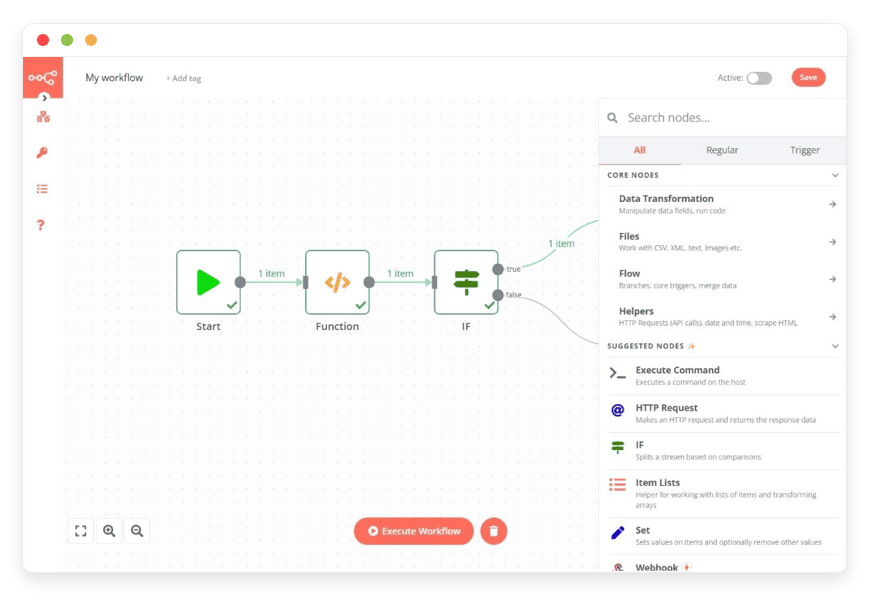
n8n is an open-source workflow automation tool built by n8n GmbH in Berlin since 2019. It runs on Node.js, exposes a visual editor that maps cleanly to Zapier’s mental model, and adds capabilities Zapier intentionally does not — code nodes (JavaScript and Python), custom HTTP requests, and self-hostable everything.
The numbers. 186,328 GitHub stars at the time of writing. 400+ first-party integration nodes covering the apps Zapier covers — the major CRMs, the major email tools, the major cloud storages, the major databases, plus the AI surface that has grown sharply since 2024.
Beyond the official catalog, the community node ecosystem adds approximately 700 more integrations, installable directly from inside n8n.
The pricing model that is the whole point. n8n bills on executions, not tasks. One execution is one run of a workflow, regardless of how many steps it contains.
A five-step workflow that fires daily costs the same as a one-step workflow that fires daily — both are 30 executions a month. On Zapier, that same five-step workflow is 150 tasks a month. The difference compounds quickly.
On DANIAN. Managed n8n on DANIAN is €9 per month for the base instance. That covers hardware, security patching, automatic updates, daily off-site backups, monitoring, and 24/7 email and ticket support. No per-execution fee. No per-step fee. No per-seat fee.
Resource ceilings on the base tier are generous for the kind of workload Zapier customers typically run; teams that grow into heavy concurrency upgrade resources with explicit consent. The dashboard ships with per-container access for the rare day you need to look at logs.
Managed n8n hosting at €9/month →
Best for. Any team replacing more than two Zaps and tired of watching the task counter. Marketing operations replacing a Zapier-powered lead-routing stack. RevOps glueing CRM events to Slack and Notion.
Indie SaaS founders running webhook-driven onboarding. The buyer who Zooms past Zapier’s gentle on-ramp and starts asking "can I just write a code node here" is the buyer who finds n8n welcome.
Honest about the friction. n8n is slightly steeper on first contact than Zapier. The editor is excellent and the docs are good, but the surface is broader. Most teams report a real first-workflow time of about 30 minutes — longer than Zapier’s "drag, drop, done" but bounded.
Migrating ten existing Zaps is a 2–3 hour port, not a one-day project, once the patterns are familiar.
Ctfreak — when the job is scheduled, not triggered
Ctfreak is an IT task scheduler and centralized cron replacement. It runs Bash, PowerShell, SQL, and Ansible scripts on multiple servers via SSH or WinRM, schedules them, captures logs, and notifies via Slack, Teams, Mattermost, Discord, or email when something fails. Self-hosted, Docker-ready, mobile web UI.
It is not a Zapier alternative. It is the better fit for scheduled batch work that a team has historically pushed into Zapier because Zapier was the only thing on their list.
If the job is "every night at 02:00, run this SQL report and email the result," "every Sunday, vacuum the database," or "on a schedule, run this maintenance script across the fleet" — that work belongs in a scheduler, not a workflow tool. Doing it in Zapier costs tasks and surfaces less detail when something fails.
On DANIAN. Managed Ctfreak runs at €9 per month, same as n8n. Same patching, same backup, same support. The combination — n8n for event-driven workflows, Ctfreak for scheduled batch jobs — is what most operations teams actually need.
Best for. The work that is currently in a crontab nobody touches. The maintenance scripts that should be observable. The SQL reports that should produce a chart and email the CFO every Monday morning.
Other open-source options worth naming
This is the honest-broker note. The post leads with n8n because n8n is what most readers want, but the open-source workflow space is wider than one tool.
- Activepieces — MIT-licensed, similar shape to n8n, smaller integration library. The freer license is genuinely useful for buyers building products on top of a workflow engine.1
- Windmill — script-first, code-heavy, oriented toward developer teams that prefer code to drag-and-drop. Strong for teams that already think in functions.
- Node-RED — older, IoT and industrial roots, technical user base, very stable. Worth knowing if your workflows touch hardware or message queues.
- Make and Pabbly Connect — closed-source SaaS, but cheaper per-operation than Zapier. If the SaaS model is not the problem and the bill is, these are real options.
We do not run Activepieces, Windmill, or Node-RED on DANIAN today. If your call is between n8n on DANIAN and self-hosting one of those tools on a VPS, the cost math in the next section still applies — the operational time and infrastructure spend are similar across self-hosted options.
Comparison — Zapier vs n8n on DANIAN
| Zapier Pro at 2K tasks | Zapier Pro at 10K tasks | n8n on DANIAN | |
| Monthly cost | ≈ $73 | ≈ $169 | €9 |
| Per-task fee after limit | 1.25× base rate | 1.25× base rate | none |
| How runs are counted | each step counts as a task | each step counts as a task | one workflow run = one execution, regardless of steps |
| Self-hostable | no | no | yes (source-available) |
| Source code access | closed | closed | open (Sustainable Use License) |
| GitHub stars | n/a | n/a | 186,328 |
| Code nodes (JS / Python) | no | no | yes |
| First-party integrations | 8,000+ apps | 8,000+ apps | 400+ official + ~700 community |
| Hosting region choice | Zapier-managed (US-default) | Zapier-managed (US-default) | 21 datacenter locations across six continents |
| Switching effort from Zapier | n/a | n/a | ~30 min for first workflow; 2–3 hours for a 10-Zap port |
| Support | tier-dependent | tier-dependent | 24/7 support, included |
Zapier prices verified against zapier.com/pricing. n8n license verified against the LICENSE.md in the n8n GitHub repository. n8n star count verified at the n8n GitHub page.
The cost math at three real-world scales
This is the section finance asks about at renewal time. Numbers are monthly, in the currency the vendor publishes.
At 2,000 tasks per month.
- Zapier Pro: ~$73/month → ~$876/year
- Self-host n8n on a $24 production-class VPS + $5 backup + $15 monitoring + €60–240/month operational time = €100–280/month effective
- DANIAN managed n8n: €9/month → €108/year
Difference at 2K tasks: DANIAN is roughly an order of magnitude cheaper than Zapier and broadly even with self-host on a VPS once operational time is counted honestly.
At 10,000 tasks per month.
- Zapier Pro: ~$169/month → ~$2,028/year
- Self-host n8n on the same VPS class: same €100–280/month effective (the VPS does not care how many executions you run, up to its capacity)
- DANIAN managed n8n: €9/month → €108/year
Difference at 10K tasks: DANIAN is materially cheaper than every other path. Self-host gets relatively cheaper than Zapier the more you run, but the time cost still dominates.
At 50,000+ tasks per month.
- Zapier: pricing climbs into the $300–600/month band on most accounts at this scale, plus the per-task overage rate if you cross the configured ceiling
- Self-host: still €100–280/month, assuming the VPS is correctly sized and you have not yet outgrown a single instance
- DANIAN: €9/month base; for very heavy concurrency, the conversation moves to a resource upgrade, with explicit consent before any billing change
At this scale, the Zapier conversation is usually no longer "should we switch" — it is "when, and what is migration going to cost in attention."
The numbers above use Zapier’s published per-tier pricing. Per-task overage is 1.25× the base task rate when the configured limit is hit. We have not stress-tested every billing edge case Zapier’s pricing slider can produce — we have tested the three buckets most readers of this post will fall into.
See managed n8n hosting at €9/month →
How to pick — three questions to ask yourself
1. How many task-equivalent steps do your workflows actually run per month?
Count steps × triggers across your active Zaps. If you are already over 2,000 Zapier-tasks a month, the savings start now.
If you are under 1,000, there is no immediate budget pressure — switch when growth picks up, not before. Zapier is fine at low volume; the model only breaks at scale.
2. Do you have someone in-house comfortable with a 30-minute UI learning curve?
n8n is well-designed but it is not as gentle as Zapier on first contact. The editor is broader, the docs are thicker, the surface area includes things Zapier intentionally hides (code nodes, custom error workflows).
Most teams find this welcome; some teams want the simplest possible interface and should stay where they are. The honest answer is that n8n rewards 30 minutes of attention with materially more capability.
3. Are your workflows internal, or are you reselling them to clients as part of a paid product?
This is the n8n license question. If your workflows are internal — your team automates your business — n8n on DANIAN is cleanly aligned with the Sustainable Use License.
If you are an agency building n8n workflows for your clients as part of consulting or implementation work, also clean. If you are embedding n8n inside a SaaS product where end-users log into n8n’s UI to build their own workflows on your platform, that is the gray-zone area where n8n’s commercial team is the right next conversation, separate from the hosting decision. The DANIAN-managed instance is the same instance either way.
A note on the n8n Sustainable Use License
The license is short. It is also where buyers most commonly get tripped up, because "open source" and "Sustainable Use License" are not the same thing. n8n calls its model fair-code — source-available, freely usable, with one carve-out around resale and embedding.
Allowed. Internal business use inside your own company. Self-hosting on your own servers. Modifying the source code for your own use. Personal and non-commercial use. Building n8n workflows for clients as part of consulting or implementation work — the "we install n8n for our customer and configure it for them" pattern is allowed, has been since March 2022, and does not need a separate agreement.
Not allowed without a separate agreement with n8n. Hosting n8n and charging users for access to that hosting (the "we are an n8n-as-a-service company" model). Embedding n8n inside a paid SaaS where n8n IS the value proposition users are paying for. Reselling n8n itself as a productized service.
Where DANIAN sits. When DANIAN runs n8n for a customer, the customer is using n8n for their own internal business purposes. That is squarely the allowed pattern.
DANIAN provides the hosting and the operational layer — the customer owns the workflows and the data — and the customer’s use is internal. The economics of this map cleanly onto the license. The same logic holds for Ctfreak, which is independently open-source and licensed for self-host and managed-host use.
Where the line gets blurry. An agency that uses managed n8n on DANIAN to build workflows for client A, client B, and client C — billed as a workflow consulting engagement — is fine.
An agency that wants to build a "workflow automation platform" product, branded as their own, where each agency client logs into a labelled n8n UI and builds their own workflows on the agency’s bill — that is the embedding case n8n’s license restricts, and that conversation belongs with n8n, separate from the hosting choice. DANIAN is happy to host either; only the second pattern needs n8n’s commercial agreement on top.
FAQ
At what task volume does n8n on DANIAN become the cheaper choice?
Roughly the moment your Zapier bill crosses about $50/month, which most teams hit somewhere between 1,000 and 2,000 tasks per month on multi-step Zaps. The economics get sharper from there: at 10,000 tasks a month, DANIAN is roughly an order of magnitude cheaper than Zapier; at 50,000 the gap is large enough that the migration pays for itself in the first month.
What does it actually take to migrate from Zapier to n8n?
About 30 minutes for the first workflow and 2–3 hours for a typical port of ten Zaps, once the patterns become familiar. n8n’s node-for-node coverage of the major Zapier integrations (Gmail, Slack, HubSpot, Salesforce, Airtable, Notion, OpenAI, Stripe, Shopify, the major databases) is good. Edge-case integrations may need a community node or a generic HTTP request node, both of which are straightforward.
Does n8n have all the same integrations as Zapier?
Zapier has more apps in its catalog by raw count — over 8,000 — but most of them are long-tail integrations a typical SMB never uses. n8n covers the apps that drive 95% of real workflows, plus an HTTP node and a webhook node that handle anything not in the catalog. Practical answer: for the workflows we see migrate, integration parity is rarely the blocker.
What about Make, Pabbly, or other cheaper Zapier-style SaaS?
Real options if your problem is "the bill is too high" rather than "the model does not fit." They use the same operations-counted billing shape Zapier uses. The savings versus Zapier are meaningful at low volume; the structural problem returns at high volume. n8n’s execution-counted billing is a different shape, and that is what makes the cost math hold up at scale.
I just need scheduled jobs — do I need n8n or Ctfreak?
Ctfreak. It is purpose-built for scheduled tasks across a server fleet — bash, PowerShell, SQL, Ansible, on multiple nodes via SSH or WinRM. n8n can do scheduled work too, but if scheduling is 95% of what you need and there are no event triggers, Ctfreak is cleaner. Same €9/month on DANIAN.
What if I prefer to self-host n8n on my own server?
Genuinely a good path if you have a developer in-house, you are comfortable with the patch cycle, and you enjoy this kind of work. Coolify on a $24 production-class VPS is a common DIY setup. Plan on 5–10 hours of initial setup and 1–2 hours per month for security updates, certificate renewal, backup verification, and on-call. At a freelance sysadmin rate of €60–120 per hour, the operational time is the line item that usually decides the question.
Is n8n actually free?
n8n is free to download and self-host under the Sustainable Use License. There is no per-user fee, no task cap, and no execution cap on the self-hosted edition; the only cost is whatever your infrastructure costs. n8n Cloud, the company's own hosted offering, is paid; managed n8n on DANIAN is €9/month and bundles the hosting, updates, and backups.
Can I use n8n commercially?
Yes, for internal business use and for client work delivered as consulting or services. The Sustainable Use License allows companies of any size to run n8n internally and to use it on behalf of clients. The line you cannot cross without a separate agreement is reselling n8n itself as a hosted product or embedding it inside a paid SaaS where the n8n functionality is the value being sold.
Is n8n open source or "fair-code"?
The source is public on GitHub and contributors can read, modify, and submit patches, but the license is the Sustainable Use License rather than a classical OSI-approved license, which is why the project describes itself as fair-code rather than open source. For most buyers the practical answer is what matters: you can read the code, run it yourself, and use it in your business without paying n8n. The license restriction targets companies trying to resell n8n as a service, not anyone running automations for their own work.
Does n8n have AI and LLM nodes for OpenAI, Anthropic, and Gemini?
Yes. n8n ships first-party nodes for OpenAI, Anthropic, Google Gemini, and several open-weight model providers, plus a generic HTTP node that covers anything missing. The 2024–2025 release cycle added a dedicated AI Agent node, vector-store nodes for Pinecone, Qdrant, and Weaviate, and chat-trigger nodes — meaning the kind of LLM workflows that became standard in 2026 are covered out of the box.
Can a non-developer use n8n?
Mostly yes — the visual editor is the same drag-and-connect model people already know from Zapier, and the majority of nodes need only credentials and a few field mappings. The honest caveat: n8n exposes more surface area than Zapier, which means a small Code node or an expression in JavaScript-like syntax sometimes shortens what would otherwise be a chain of three nodes. If your team has someone who can read a JSON object, the rest is learnable in a weekend.
How many integrations does n8n have?
Around 400 first-party integrations and roughly 700 community-contributed nodes, with a generic HTTP node and webhook node covering anything beyond that. Zapier's catalog is larger by raw count — over 8,000 — but most of that is long-tail apps a typical SMB never touches. For the workflows that actually run inside small teams, integration coverage is rarely the constraint.
Does n8n bill by tasks the way Zapier does?
No. Self-hosted n8n has no task or step counter at all — your only cost is the hosting. n8n Cloud bills by executions, where one workflow run is one execution regardless of how many steps it contains — the opposite shape of Zapier's per-step task billing, and the reason the cost math diverges so sharply at volume.
What happens if my managed n8n instance goes down?
Managed n8n on DANIAN runs on monitored infrastructure with daily backups; if the host has a problem, the standard recovery path is restoring from the most recent snapshot onto a healthy node, with workflows resuming from their last completed run. Zapier has its own incidents — every SaaS does — and the practical difference is that with self-hosted you have direct access to the logs, the queue, and the recovery path, rather than waiting for someone else's status page to update. For workflows that absolutely cannot lose an event, the right pattern in either system is queueing the trigger upstream.
Can I export and back up my n8n workflows?
Yes. Every workflow exports as a JSON file from the editor, and the full database can be backed up through standard PostgreSQL or SQLite tooling depending on your setup. On managed n8n at DANIAN the backups run nightly and can be downloaded on request; the lack of lock-in is one of the structural advantages of running on open code.
Does n8n support multiple users on a team?
Yes. n8n has user accounts, role-based permissions, shared credentials, and folders for organizing workflows across a team. The features that used to be enterprise-only — SSO, fine-grained permissions, project-level isolation — have been moving into the community edition release by release, and the gap that remains tends to matter only for organizations large enough to be looking at the Business tier of Cloud anyway.
Is there an automatic Zapier-to-n8n converter?
No reliable one-click converter exists yet, and the community scripts that attempt it tend to handle the trivial Zaps and break on anything with branching, filters, or custom logic. The pragmatic approach is manual: list your Zaps, sort by execution volume, port the top ten one at a time, and use the hours saved to fund the rest. The first Zap takes about 30 minutes; by the third the patterns are familiar.
How does n8n compare to Make.com specifically?
Make handles iteration and branching better than Zapier and is cheaper per operation, but it shares Zapier's structural shape: you pay per operation, and the bill scales linearly with volume. n8n's billing shape is different — executions, or nothing at all if self-hosted — which is why the cost crossover happens at a similar point against Make as it does against Zapier. If the only complaint about Zapier is the price tag at low volume, Make is a fair port; if the problem returns at high volume, the answer is open-source automation regardless.
How does n8n compare to Activepieces and Windmill?
Activepieces is the closest direct alternative to n8n in feel — visual editor, similar node model, lighter touch — and is the right call if you find n8n's surface area overwhelming. Windmill is a different shape: script-first, designed for engineers who would rather write TypeScript or Python and let the platform handle scheduling, secrets, and UI. Most teams that evaluate all three end up on n8n because the ecosystem of nodes and community workflows is materially larger; Activepieces is gaining ground; Windmill is the right answer when the team already lives in code.
What is the difference between n8n Cloud and self-hosted n8n?
The product is the same — same editor, same nodes, same workflows — but n8n Cloud is run by the n8n team, billed by executions, and starts at €20/month for the Starter plan. Self-hosted n8n removes the execution billing entirely and hands you control of the database, the credentials, and the upgrade cadence; the trade is you (or your hosting provider) handle the operations side. Managed n8n on DANIAN at €9/month sits in the middle: self-hosted economics, with the operations handled.
Can n8n replicate Zapier's Filter, Formatter, and Paths?
Yes — Filter is the IF node, Formatter is split across Set/Edit Fields and the transformation nodes (Date & Time, String, Crypto), and Paths is the Switch node. The mapping is one-to-one for most cases, and where Zapier hits its limits — multiple conditional branches, loops over arrays, sub-workflows — n8n has more headroom rather than less.
Conclusion — what to do this week
Open the Zapier task usage page. Look at last month’s number. Multiply by 12 for an annualised view. If the answer is uncomfortable, do this:
- Spin up a managed n8n instance on the 7-day DANIAN trial. No card required.
- Port your top three Zaps. The first will take 30 minutes; the next two will take about ten minutes each.
- Run them in parallel with Zapier for a week. Confirm the workflows behave the way you need.
- If they do, cancel Zapier at the next renewal and migrate the rest. If they do not, you have spent a week and lost nothing.
The cost math is straightforward at this point. The only real question is the 30 minutes of n8n on-ramp, and whether it is worth trading for an unbounded pricing model. For most teams who got the task-overage email, the answer is already obvious by the time they finish the third workflow.
Try DANIAN for 7 days, no card →
Sources
Zapier — Pricing — https://zapier.com/pricing
n8n — Product — https://n8n.io/
n8n on GitHub (LICENSE.md) — https://github.com/n8n-io/n8n
n8n Cloud — Pricing — https://n8n.io/pricing/
Ctfreak — Product — https://ctfreak.com/
n8n Docs — Sustainable Use License — https://docs.n8n.io/n8n-community-license