Open-source stack for property managers 2026
If you manage a handful of rentals, most of your software bill pays for things you barely use. A per-unit platform charges you for rent collection, resident portals, and maintenance tickets. What you touch every week is narrower: tenant records, leases, signed documents, and a place to talk to your contractor. Five open-source tools cover that slice, and you own the data behind each one.
THE SHORT VERSION
- This is a stack for records, leases, documents, and chat — not a rent-collection platform.
- The five apps are Dolibarr, Nextcloud, DocuSeal, Paperless-ngx, and Mattermost.
- Run all five at DANIAN for €45/month, flat, no matter how many units you hold.
- The storage and signing pieces alone cost a small office about $70/month on the usual paid tools.
- AppFolio's entry plan carries a minimum near $280/month even at 30 units. This stack does not do what that minimum buys.
Who this list is for, and who it isn't
Read the gap before the pitch. These five tools are not a dedicated property-management platform. They do not collect rent online, run a tenant self-service portal, or move maintenance tickets through a workflow. If you need those, keep AppFolio or Buildium and stop here. What follows fits a small landlord or manager whose real work is contacts, leases, files, signatures, and contractor messages.
The buyer this suits holds a small portfolio and resents paying per unit for features that sit idle. Maybe you run invoicing in a spreadsheet and store leases in a shared drive nobody can search. Maybe a renewal notice from your current vendor just landed with a higher number on it. This stack trades the all-in-one bundle for five focused tools you control, at a price that does not climb with your door count.
One more honest line. Self-hosting these apps yourself is real work: setup, patching, backups, and the occasional 2am restart. DANIAN runs them for you at €9 per app per month, so the tools below are framed as managed, not as a weekend project. The open-source licenses still mean the data and the software stay portable.
The five tools, and the job each one does
Each app below does one job for a small landlord. For each, here is what it is, the paid tool it stands in for, who it suits, and how much effort the switch takes. Prices for the proprietary tools are their published list rates, checked in June 2026 and footnoted at the end. DANIAN hosts every app at the same €9 monthly floor.
1. Dolibarr — tenant and owner records, plus invoicing
Stands in for: the contacts and invoicing slice of Buildium or AppFolio, and spreadsheet invoicing.
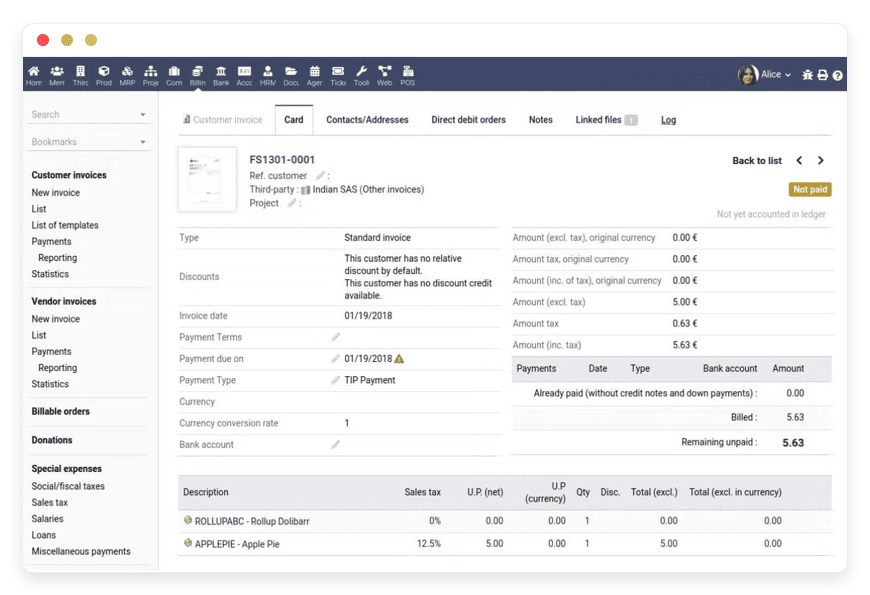
Dolibarr is an open-source ERP and CRM under the GPLv3 license. For a property manager, it holds your tenants and owners as contacts, tracks leases as contracts, and raises invoices for rent or fees. You can attach a lease to a tenant record and see what each unit has been billed. It scales from one user to a small office without a per-seat charge.
Be clear about what it is. Dolibarr is a general business system adapted to property work through its contacts and invoicing, not purpose-built rental software. There is no resident portal and no online payment collection inside it. If your job is keeping clean records and sending invoices that do not live in a spreadsheet, it does that well. We run it for you on the Dolibarr for records and invoicing plan. Switching effort is moderate: import contacts from a CSV, then rebuild your invoice templates once.
Two details matter day to day. Dolibarr raises recurring invoices, so monthly rent does not need re-keying each cycle. Community modules extend it toward property work, but their quality varies, so test one before you lean on it. The reporting is plain but real: pull what each owner is owed without a spreadsheet.
2. Nextcloud — leases and property files
Stands in for: Dropbox and other paid file storage.
Nextcloud is open-source file sync and sharing under the AGPLv3 license. It is the home for your leases, inspection photos, and property paperwork, in folders you organize per building or per unit. You share a folder with a co-owner by link, keep version history on every file, and reach it all from a phone or a laptop. The storage is yours, not a third party's.
What it is not is a database of tenants; that belongs in Dolibarr. Nextcloud is the filing cabinet, and it is a strong one. A small team gets shared folders, granular permissions, and a record of changes without paying per seat for storage. We host it on the Nextcloud for property files plan. Switching effort is low: drag your existing folders in, and bulk upload handles the rest.
A few features pay off for property work. Shared folders carry per-person permissions, so an owner sees their building and nothing else. The mobile app uploads inspection photos straight from a unit, and built-in preview lets you read a lease without downloading it. None of this adds a per-seat charge.
3. DocuSeal — lease signing
Stands in for: DocuSign and other paid e-signature seats.
DocuSeal is an open-source document-signing tool under the AGPL-3.0 license, with roughly 17,000 stars on GitHub. You upload a lease PDF, drop in fields with a drag-and-drop builder, and send it to a tenant to sign from any device. Each completed document carries tamper-evident signing metadata: who signed, when, and from where. The self-hosted core has no per-envelope cap.
One careful note, because leases are legal documents. DocuSeal records a tamper-evident signing trail; it does not give legal advice or guarantee that a given signature holds. Whether an electronic signature is enough depends on your jurisdiction and your lease, so confirm that with a local advisor. The practical win over a paid seat is the cap: DocuSign's Standard plan limits you to 100 sends per user per year, while the self-hosted tool does not. We run it on the DocuSeal for lease signing plan. Switching effort is low: rebuild each lease template once.
The signing flow itself is simple for a tenant. They open a link, fill the fields in order, and sign on a phone screen. You get an email when each party finishes, and a sealed PDF lands in your files. For a busy lease season, removing the per-send cap is the practical difference from a paid seat.
4. Paperless-ngx — the document archive
Stands in for: a shared drive full of unsorted, unsearchable PDFs.
Paperless-ngx is an open-source document manager under the GPLv3 license. It reads every PDF you feed it, runs text recognition, and tags each one so you can search the full text later. Scan a signed lease, a receipt, or a notice, and it lands in a searchable archive instead of a folder you will never reopen. Find any document by a tenant name or a date in seconds.
Think of it as search and memory for paper, not a workflow engine. It does not route approvals or chase signatures; that is what DocuSeal handles upstream. For a manager drowning in receipts and signed copies, the searchable archive is the point. We host it at the same €9 monthly floor. Switching effort is low: point it at your existing PDFs and let it index them in the background.
Set it up once and it mostly runs itself. Mail a scan to a dedicated address, or drop files in a watched folder, and it files them. It learns tags over time, so receipts and leases sort into the right place. When a deposit dispute arrives, you find every related document by typing a name.
5. Mattermost — team and contractor chat
Stands in for: scattered texts, WhatsApp threads, or a paid Slack seat.
Mattermost is an open-source team chat platform; its self-hosted Team Edition is MIT-licensed. It gives you channels for a building, a turnover, or a contractor, so the plumber's photos do not get lost in your personal messages. There is no per-user fee and no message limit on the self-hosted edition. Files, search, and threads all stay on infrastructure you control.
The honest limit is the edition. Team Edition has no guest accounts or single sign-on; those are paid features. For a small operation that does not matter much. A contractor gets a standard account on one shared channel, which keeps the conversation contained without a separate seat to manage. We run it at €9 per month. Switching effort is very low: create a channel and invite people.
Day to day it stays out of your way. Channels keep one building's chatter separate from another's. You can pin the lease or the gate code to a channel so nobody asks twice. Mobile notifications reach you when a contractor sends a photo, without handing your phone number to every trade.
How the five fit together
The tools are useful alone, but they earn their place as a chain. A new tenant becomes a contact in Dolibarr. Their lease lives as a file in Nextcloud, goes out for signature through DocuSeal, and the signed copy comes back. That copy gets archived and indexed in Paperless-ngx. When the unit needs work, the contractor coordination happens in a Mattermost channel. Records, files, signatures, archive, and chat, each owned by you.
You do not have to adopt all five at once. The records-and-files pair, Dolibarr plus Nextcloud, is a complete starting point on its own. Add DocuSeal when lease season arrives and you are tired of paying per signature. Add Paperless-ngx once the signed copies pile up. Mattermost is the easiest to bolt on whenever contractor messages start slipping through the cracks.
Here is a turnover in practice. A tenant gives notice, you log it on their Dolibarr record, and the inspection photos go into that unit's Nextcloud folder. The new lease goes out through DocuSeal and comes back signed within the day, then archives into Paperless-ngx. You post the cleaner and the painter into one Mattermost channel, and no part of the loop waited on a ticket.
What the stack leaves out, on purpose
Honesty means naming the holes, not just the wins. A per-unit platform earns its price on features this stack does not try to match. If any of the items below is core to how you run, keep the dedicated software. If they are not, you are paying every month for capability you do not use.
- Online rent collection and card or bank payment processing.
- A tenant self-service portal for requests and balances.
- A maintenance ticket workflow with vendor assignment.
- Tenant screening, credit checks, and listing syndication.
- Deep trust and fund accounting built for property books.
That list is most of what makes AppFolio and Buildium cost what they do. The five tools here cover the rest, the part you open every week, and leave the meter behind.
The math at a small portfolio
Picture a manager with 30 units, a three-person office, and around 150 leases and notices sent for signature a year. That portfolio is too small for AppFolio's pricing to work in your favor, yet too busy for a spreadsheet. Here is what the document, signing, and records slice costs on the usual paid tools, set against the same jobs run as managed open source.
| The job | A paid path (list price, June 2026) | The DANIAN open-source path |
|---|---|---|
| Tenant and owner records, invoicing | Buildium Growth, $192/mo, plus transaction and e-sign fees | Dolibarr, €9/mo |
| Leases and property files | Dropbox Business Standard, $15/user/mo, 3-user minimum = $45/mo | Nextcloud, €9/mo |
| Lease signing | DocuSign Standard, $25/user/mo, capped at 100 sends/user/yr | DocuSeal, €9/mo, no send cap |
| Document archive and search | A shared drive, no text search or recognition | Paperless-ngx, €9/mo |
| Team and contractor chat | A paid Slack or Teams seat | Mattermost, €9/mo |
| Per-unit charge as you grow | Yes — cost rises with door count and transactions | No — €45/mo flat for all five |
Two numbers do the persuading. The storage and signing pieces alone, Dropbox plus DocuSign for a small office, run about $70 a month before you add a records tool. The whole five-app stack at DANIAN is €45 a month, flat. And AppFolio's Core plan charges a minimum near $280 a month even at 30 units, because the floor applies long before your unit count would.
The per-unit trap is worth spelling out. AppFolio's Core rate reads as $1.49 a unit, which sounds small. At 30 units the minimum still applies, so the effective rate climbs past $9 a unit, several times the headline. Per-unit pricing rewards large portfolios and quietly penalises small ones.
Read this fairly. AppFolio and Buildium bundle online rent collection, a resident portal, and maintenance tickets that this stack does not provide. If you use those features, the suites earn their price. The comparison above is only for the records, documents, leases, and chat slice — which, for many small managers, is most of what they actually open each week.
How to start without a big migration
Do not move everything at once. Pick the one tool that hurts most today: Dolibarr if your records are a mess, Nextcloud if your files are scattered, DocuSeal if signing season is here. Start a 7-day free trial, then load a single property: its tenant record, its lease, and its documents. Run that one property for two weeks before you decide.
That two-week test answers the only question that matters: does this fit how you actually work? If it does, move the next property and the next, on your schedule. There is no per-unit meter running while you migrate. Every app comes with the same 7-day free trial, so you can stage the switch one tool at a time.
You are not on your own once you switch. We patch each app, run daily off-site backups, and watch for trouble, so the move does not hand you a new set of chores. If something needs a human, you reach one by email or chat. The point of managed open source is to own the tools without owning the upkeep.
Frequently asked questions
Common questions from small landlords and managers weighing this stack against a per-unit platform.
Can these tools collect rent online?
No. None of these five tools process payments or collect rent online. They handle records, files, leases, signing, and team chat. For online rent collection and a resident portal, a dedicated platform like AppFolio or Buildium is the better fit. This stack does not replace that piece, and it is priced as if it does not.
Can I still send invoices and track what each tenant owes, even without online rent collection?
Yes. Dolibarr raises invoices for rent or fees and records what each tenant or owner has been billed, so you can see balances without a spreadsheet. It does not process card or bank payments inside the app, so the money still arrives by your existing method, but the record of what is owed and what is paid lives in one place.
Is an open-source e-signature as good as DocuSign for leases?
DocuSeal produces signed PDFs with tamper-evident signing metadata: who signed, when, and from where. It does not give legal advice or guarantee that a signature will hold. Whether an electronic signature is enough depends on your jurisdiction and the lease itself, so confirm the requirements with a local advisor before you rely on it.
Do I need technical skills, or is the hosting managed for me?
It is managed. You do not install anything, run a server, or apply updates, that is the part DANIAN handles. You work in the apps through your browser like any website, set up your records and folders, and reach a person by email or chat when you have a question. The point is to own the tools without doing the system administration.
Why not just self-host these apps on my own server?
You can, they are open source and free to run yourself. The catch is the work: installation, updates, security patches, daily backups, and the occasional restart at an awkward hour. DANIAN does that part for €9 per app a month, so you get the same software and the same data ownership without the upkeep landing on you.
How much does the whole stack cost versus AppFolio or Buildium?
All five apps run for €45 a month at DANIAN, flat, regardless of how many units you hold. AppFolio's Core plan carries a minimum near $280 a month even at 30 units. Buildium runs from $62 to $400 a month plus transaction and signing fees. Those suites bundle rent collection this stack does not.
Does the monthly price rise as I add more units, tenants, or team members?
No. DANIAN charges €9 per app each month, flat, no matter how many units you manage, tenants you record, or staff you invite. The self-hosted apps carry no per-seat fee, so a three-person office pays the same as someone working alone. Your bill only changes if you add or remove an app, which keeps costs predictable as you grow.
Can I start with just one or two of the apps instead of all five?
Yes, and most people do. Dolibarr for records and Nextcloud for files make a complete starting point on their own. You can add DocuSeal when lease season arrives, Paperless-ngx when signed copies pile up, and Mattermost when contractor messages start slipping. Each app is €9 a month, so you only pay for what you actually turn on.
Can I keep using these tools alongside my current property software?
Yes. Each app works on its own, so you can run just the pieces you need, files in Nextcloud and signing in DocuSeal, while keeping your existing platform for rent collection and tenant portals. Nothing forces an all-or-nothing switch, which makes it easy to trim one expensive line item without replacing your whole setup.
Where is my data hosted, and do I own it?
Each app runs on managed infrastructure in the region you choose, across 21 datacenter locations on six continents. You pick the location closest to your tenants. Backups run daily, off-site. The data stays yours, and you can export it at any time. We will not lock your exports behind a paywall if you decide to leave.
Is my data safe and private on this stack?
Each app runs in its own isolated container on managed infrastructure, reached over an encrypted connection, and only you and the people you invite can sign in. Your files and tenant records are not mined or sold, and daily off-site backups mean a lost file can be recovered. You hold the data, and you can export or delete it whenever you want.
Can I choose which country my data is stored in?
Yes. There are 21 datacenter locations across six continents, and you pick the region when you set up each app. Most people choose the one closest to their tenants for speed and for keeping records near where they operate. If you need a specific location, ask before you start and we will confirm what is available.
How often is my data backed up, and can it be restored?
Backups run every day and are kept off-site, separate from the live app. If a file is deleted by mistake or a change goes wrong, reach us by email or chat and we restore from the most recent backup. Because the apps are open source, you can also keep your own export on hand at any time.
What happens to my data if I cancel or stop paying?
Your data stays yours. Before you go, you export your contacts, files, and signed documents in standard formats, there is no charge to take them and nothing is held back. Because the apps are open source, the exports open in the same software anywhere else you run it, so leaving never means losing your records.
If I outgrow this stack, can I move to a dedicated platform later?
Yes. Nothing here locks you in. Your tenant records export from Dolibarr as a standard file, your documents come out of Nextcloud and Paperless-ngx as ordinary PDFs, and your signed leases are yours to keep. If a per-unit platform later makes sense for your size, you carry your history with you instead of starting over.
Can I move my existing tenant data and documents in?
Yes. Dolibarr imports contacts and invoices from a CSV file, and Nextcloud and Paperless-ngx accept bulk file uploads. The safe way to start is one property at a time: load its tenant record, lease, and documents, run it for two weeks, then move the rest once you trust the fit. No per-unit meter runs while you migrate.
Do my tenants need accounts or a portal?
No. This stack is built for you and your team, not for your tenants. A tenant receives a lease to sign by email through DocuSeal and a copy of the signed document afterward. They never log in to a portal. If a tenant self-service portal is something you need, this stack is not the right fit and a dedicated platform is.
Can a contractor get chat access without a full account?
On the self-hosted Mattermost Team Edition, a contractor gets a standard account on a single shared channel, not a restricted guest seat, since guest accounts are a paid Enterprise feature. For a handful of contractors that works fine: a dedicated channel keeps their messages and photos contained and out of your personal texts.
Can several people on my team use the tools at the same time?
Yes. The apps are built for shared use, with no per-seat charge on the self-hosted editions. Your team can work in the same Dolibarr records, share folders in Nextcloud with per-person permissions, and talk in Mattermost channels at once. You decide who can see and edit what, so a bookkeeper and a leasing agent each get the right access.
Can I manage multiple owners or buildings and keep each one's data separate?
Yes. In Nextcloud you share each owner a folder scoped to their building, so they see their own property and nothing else. You can keep separate contacts, contracts, and invoices per owner in Dolibarr, and a dedicated Mattermost channel per building keeps conversations from crossing. That separation is what makes the stack workable for a manager handling several portfolios at once.
Can I access the tools from my phone?
Yes. Nextcloud has a mobile app that uploads inspection photos straight from a unit, Mattermost sends a notification when a contractor messages you, and a tenant can open and sign a lease in DocuSeal from a phone browser. You can check records, files, and chat on the move without being tied to a desk.
What to do this week
Pick the one tool that would save you the most aggravation and start a trial today. Most small managers find that is Dolibarr for records or Nextcloud for files. Load a single property, send one lease through DocuSeal, and see how the chain feels end to end. You will know within two weeks whether five owned tools beat one rented platform for the work you actually do. The €45 monthly floor does not move as you grow, and the data stays yours.
Sources, checked June 2026. Prices are published list rates and change often.
- AppFolio pricing — Core plan, per-unit rate and monthly minimum.
- Buildium pricing — Essential, Growth, and Premium plan rates.
- DocuSign eSignature pricing — Standard plan and annual envelope allowance.
- Dropbox Business pricing — Standard plan rate and three-user minimum.
- Dolibarr (dolibarr.org), Nextcloud (nextcloud.com), DocuSeal (docuseal.com), Paperless-ngx (docs.paperless-ngx.com), Mattermost (mattermost.com) — project pages, licenses, and features.