Open-source Canny and UserVoice alternatives 2026
Open-source alternatives to Canny and UserVoice in 2026
Fider gives you a feature-request board with voting that you own. Loomio handles the group decisions that come next. Both are open source, and both run on DANIAN for €9 per month, flat.
TL;DR
- Canny prices by tracked user — anyone who votes or comments — so a popular board grows your bill. UserVoice is quote-only and reported to start around $1,000 a month.
- Fider is the closest open-source match to Canny: feature-request boards, voting, status updates, and a changelog. It has about 4.3k GitHub stars and an AGPL-3.0 licence.
- Loomio does a different job — structured group decisions with a permanent, searchable record. Reach for it when governance is the problem, not feature requests.
- DANIAN runs either app for €9 per month, per app: no per-seat fee, no per-tracked-user meter, no sales call.
- These are two tools for two jobs. Match the tool to the job rather than buying one product and expecting both.
Why teams leave Canny and UserVoice in 2026
The trigger is rarely the product. It is the invoice. Canny charges by tracked users and puts roadmap integrations on higher tiers; UserVoice quotes custom enterprise pricing with no public plan. As your feedback board succeeds and more people vote, the meter climbs — and the integration you wanted sits one tier up.
Canny's published plans, as of June 2026, run as follows. There is a Free tier with 25 tracked users and five managers, a Core tier from $19 per month billed yearly, and a Pro tier from $79 per month billed yearly. A tracked user is anyone associated with feedback — someone who posts, votes, or comments. The $19 and $79 figures are starting points, not ceilings; they rise as your tracked-user count grows, and monthly billing costs more than annual.
The feature gates matter as much as the headline price. Custom domains and content translations begin on Core. The integrations most product teams actually want — Jira, Linear, ClickUp, GitHub, Asana — sit on Pro. Single sign-on, CRM connections, and advanced data controls are reserved for the custom-priced Business tier. So the two things that make a feedback tool more useful, more voters and deeper integrations, are the two things that cost more.
Put numbers on it. A product with a few hundred tracked users can sit on Core at about $228 a year, but Core has no Jira or Linear sync. The moment you want those, you are on Pro — starting near $948 a year and climbing as tracked users pass the included band. Cross into several thousand tracked users and you are negotiating a custom Business contract. The same board on DANIAN-hosted Fider is €9 per month, €108 a year, whether ten people vote or ten thousand.
UserVoice sits at the other end of the market. It no longer publishes tiered pricing; access runs through a sales conversation. Independent pricing write-ups in early 2026 put the floor somewhere around $900 to $1,500 per month — roughly $11,000 to $18,000 a year — scaled by feedback volume and integrations rather than per seat. There is no free plan. The product is built for large product organisations with budgets to match.
The honest part: Canny and UserVoice are polished, and their integrations are good. If your job is a roadmap wired two-way into Jira and a CRM, with AI triage on inbound feedback, they do that well. The real question for a smaller team is whether you need all of it — and what it costs you on the day your board gets popular.
What “alternative” really means
Alternative splits three ways, and only one of them changes the economics. You can move to a cheaper proprietary tool and trade one meter for another. You can self-host the open-source app and own it outright. Or you can have someone run that open-source app for you at a flat price. The last option is what DANIAN does.
Self-hosting is free software, not a free outcome. A production-class instance needs a server, backups you can actually restore, monitoring, and the time to keep all three healthy. A realistic setup runs about $24 per month for a 2 vCPU / 4 GB VPS, roughly $5 for off-site backup storage, and about $15 for monitoring — call it $44 before your own hours. Plan on five to ten hours to set it up and one to two hours a month to patch, renew certificates, and confirm that backups work.
If you have a developer in-house who enjoys that work, self-hosting is a sound choice, and Fider's single Go binary makes it one of the friendlier apps to run. If you would rather never log into a server, the managed path exists for that reason. Neither is wrong; they are different trades of money for time.
The ownership point is the one that matters most for these tools. Feature requests and decisions are your data. On the open-source path — self-hosted or managed — the board and the record live on infrastructure you choose, with exports you can take whenever you want. You are not renting access to your own customers' words.
Two tools, two jobs
Fider and Loomio both come up in self-hosted feedback searches, but they solve different problems. Fider is a feature-request board with voting — the closest open-source match to Canny and UserVoice. Loomio is for making group decisions and keeping a record of them. One collects what people want; the other decides what to do.
Fider — the Canny-style board you own
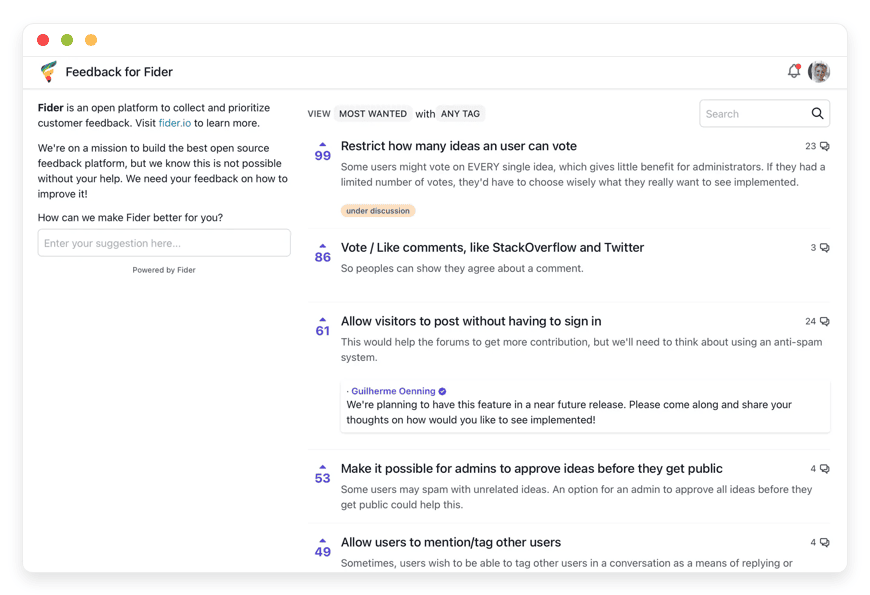
Fider is an open-source feedback portal for feature requests and suggestions, built by a small team and released under AGPL-3.0. It has about 4.3k GitHub stars and ships as a single Go binary with a Postgres database. On DANIAN it runs for €9 per month.
Best for: a public or private feature-request board with voting.
Visitors post ideas, upvote the ones they want, and comment to add detail. You set statuses — planned, started, completed — so people can see what you are building, and you can post a changelog when you ship. It supports tagging, sign-in through common OAuth providers, email notifications, a public API, and interface translations for a multilingual audience.
Be clear about the gap. Fider is leaner than Canny. There is no two-way Jira or Linear sync, no AI triage of inbound feedback, and no polished roadmap view out of the box. If those integrations are central to how you work, Canny earns its price. If what you need is a clean, owned board where customers vote on features, Fider does that job without a per-user meter.
Loomio — for decisions, not feature requests
Loomio is a collaborative decision-making app, run as a cooperative since 2012 and released under AGPL-3.0. It has about 2.5k GitHub stars and is built on Ruby on Rails. On DANIAN it runs for €9 per month.
Best for: boards, co-ops, committees, and membership organisations that need decisions with a record.
Loomio gives a decision a shape: discuss with context, put up a proposal, vote with your reasoning attached, and record the outcome with a timestamp. A thread sits apart from day-to-day chat, so weighty choices are not buried in a channel that scrolled past while half the team slept. Months later, you can search why a decision was made. It is used by the OpenSSL project for community governance, by the New York City Democratic Socialists of America to coordinate members, and by the World Resources Institute across continents.
This is where honesty matters most. Loomio is not a customer-feedback board, and it will not replace Canny. Do not deploy it to collect feature requests. Deploy it when a group — a board, a co-op, a committee — needs to make decisions together and remember the reasoning. For many teams the real stack is both: a feedback board for what customers want, and a decision tool for what the group commits to.
The year-one math
Stretch the prices over a year and the gap is plain. Canny Pro starts near $948 a year and rises with your audience. UserVoice runs into five figures. A DANIAN-hosted Fider board is €108 a year, flat. The open-source tool is the same software your users touch — the difference is who pays the meter.
None of this counts the proprietary tools' real strengths, and it should. Canny's AI triage and clean roadmap save product teams time; UserVoice's analytics are built for organisations weighing thousands of requests against revenue. If that is your situation and the budget is there, paying for it is reasonable. For a one-to-ten-person company replacing a single line item, the flat €9 usually wins, because the job is simpler than the price tier implies.
A second cost hides in the proprietary path: lock-in. Your feedback, your voters, and your roadmap live in a portal you rent. Export options exist, but the gravity pulls toward staying. With an open-source board you own the data outright and can move it. That is worth something on the day a renewal quote arrives with a number you did not expect.
Side-by-side comparison
The first table compares the two proprietary feedback tools with Fider run on DANIAN, because those three do the same job. The second sets Fider against Loomio, since they do different jobs. All prices are current as of June 2026, with sources linked at the end.
| Feature | Canny | UserVoice | Fider on DANIAN |
|---|---|---|---|
| Pricing model | Per tracked user, tiered | Custom quote, by volume | Flat €9/month per app |
| Starting price | Free; Core $19/mo, Pro $79/mo (billed yearly) | No public price; ~$900–$1,500/mo reported | €9/month |
| What grows the bill | More tracked users; higher tier for integrations | Feedback volume and integrations | Nothing — flat per app |
| Roadmap & PM integrations | Jira, Linear, ClickUp on Pro and above | Included at enterprise scale | Leaner; no built-in two-way sync |
| Single sign-on | Business (custom) tier | Enterprise | OAuth / OpenID, included |
| Free plan / trial | Free tier (25 tracked users) | No free plan; sales-gated trial | 7-day trial, no card |
| Self-hostable | No | No | Yes (AGPL-3.0) |
| Source & licence | Closed | Closed | Open, AGPL-3.0 |
| Where your data lives | Vendor cloud (US) | Vendor cloud (US) | The region you choose (21 locations) |
| Who operates it | Canny | UserVoice | DANIAN |
Read down the pricing rows and the pattern is consistent. Canny and UserVoice meter the things that grow — tracked users, feedback volume, admin seats — and reserve the useful integrations for higher tiers. The managed open-source column is flat: €9 per app, the same whether your board is quiet or busy. What you trade for that flat price is the deep, built-in integrations the proprietary tools polish.
| Feature | Fider | Loomio |
|---|---|---|
| Job | Feature-request board with voting | Group decision-making with a record |
| Replaces | Canny, UserVoice | Decisions lost in email, chat, meetings |
| Licence | AGPL-3.0 | AGPL-3.0 |
| GitHub stars | ~4.3k | ~2.5k |
| Built with | Go + Postgres (single binary) | Ruby on Rails |
| Self-host effort | Low–moderate | Moderate |
| On DANIAN | €9/month | €9/month |
The second table is the one to read before you buy anything. Fider and Loomio are both open source and both run for €9 on DANIAN, but they are not substitutes. Pick by the job, not by the price — they happen to cost the same.
Where each tool fits
Three buyer types ask this question, and the answer differs for each. A small-business owner replacing a SaaS line item, an agency standing up boards for clients, and a co-op or community running its own governance want different things. Here is the short version for each.
The small-business owner. You want a feature-request board your customers can use, without a per-seat invoice that grows with your success. Fider on DANIAN fits: €9 a month, voting and statuses included, your data exportable. There is no need for the enterprise tiers you would never touch.
The agency or freelancer. You are standing up tools for clients and do not want to become a hosting company. A managed Fider board per client, at €9 each, is a clean line item you can mark up or pass through. One price, and no usage surprises to explain to a client later.
The co-op, board, or community. Your problem is usually decisions, not feature requests. Loomio gives members a vote with reasons and a permanent record — the pattern OpenSSL and the NYC DSA rely on. Run it on DANIAN for €9 and keep the governance archive yours.
How to pick: three questions
Three questions settle most of this. What job are you doing? How much integration do you truly need? And who is going to run the thing? Answer those in good faith and the choice between Canny, UserVoice, Fider, and Loomio falls out on its own.
- Feature requests, or a group decision? If you are collecting what users want, you want a feedback board — Fider. If a board or committee needs to decide and record why, you want Loomio. They are not interchangeable.
- How much integration do you need today? If a two-way Jira or CRM link and AI triage are central, Canny or UserVoice may be worth their price. If you want an owned board with voting and statuses, Fider does the core job for €9.
- Who runs it? If you have a developer who likes owning a server, self-host. If you would rather it were handled — patched, backed up, monitored — that is what the €9 managed price buys.
Moving off Canny without losing your feedback
Switching from Canny to Fider is mostly export, setup, and a redirect. Take your Canny export first, stand up a Fider board, recreate the threads that still matter, then point your old feedback link at the new one. Most teams finish in an afternoon.
Export before you cancel. Canny lets you export your posts, and that file is your record of what customers asked for — pull it while your account is still active. Keep it somewhere safe even if you do not plan to import every item. A stale request from two years ago rarely needs to make the move.
Set up the board next. On DANIAN, a Fider instance is ready to configure from the dashboard: create your categories, set your statuses, and turn on sign-in through an OAuth provider your users already have. Seed it with the handful of open requests that matter most, so the board is not empty when the first visitor arrives.
Then redirect and announce. Point your existing feedback subdomain or link at the new board, and tell users where it moved. A one-line note — your feedback board has a new home — keeps voters from getting lost. The Canny export stays as your archive of the old threads, so nothing is truly gone.
Be realistic about what does not carry over. Vote counts and comment history rarely transfer cleanly between two different products, because each stores them its own way. Decide which threads are worth recreating by hand and let the long tail go. A clean board showing your live priorities beats a faithful copy of a list nobody reads.
FAQ
A few questions come up every time a team weighs these tools. The short answers are below; the numbers behind them are in the tables above. None of this is legal or procurement advice — it is the operator's view of what these products cost and what they do.
What is Fider?
Fider is an open-source feedback portal for collecting and prioritising product ideas. Visitors post suggestions, upvote the ones they want, and comment to add detail. It is released under AGPL-3.0 and ships as a single Go binary with a Postgres database. On DANIAN it runs for €9 per month.
What is the best open-source alternative to Canny?
For most teams, Fider is the closest open-source match. It does the core Canny job — feature-request boards, voting, statuses, and a changelog — under an AGPL-3.0 licence, with no per-tracked-user fee. Canny still wins on deep integrations and AI triage. If governance is your real need, look at Loomio instead.
Is Fider really free?
Fider's source code is free and open under AGPL-3.0, so you can run it at no licence cost. “Free” stops at the software, though. Running it yourself means paying for a server, backups, and monitoring, plus your own time. On DANIAN, the software plus all of that is €9 per month, per app.
Are there free alternatives to UserVoice?
Yes. Fider is open source and free to self-host, so there is no licence fee — unlike UserVoice, which has no free plan and quotes custom pricing. Self-hosting still costs you a server, backups, and time. On DANIAN, a managed Fider board is €9 per month, with no sales call.
What's the difference between Fider and Canny?
Both run feature-request boards with voting, statuses, and comments. Canny adds AI triage, polished roadmaps, and two-way integrations with Jira, Linear, and CRMs — and charges by tracked user. Fider is leaner and open source, with no per-user meter. If integrations are central, Canny is stronger; if an owned board is the job, Fider fits.
Is Loomio a Canny alternative?
No, and it is worth being clear. Loomio is for group decision-making — discuss, propose, vote with reasons, record the outcome. It does not collect customer feature requests the way Canny or Fider do. Use Loomio for board, co-op, or committee decisions; use Fider for a feedback board. Many teams run both.
How much does Canny cost?
As of June 2026, Canny has a Free tier for 25 tracked users, a Core tier from $19 per month billed yearly, and a Pro tier from $79 per month billed yearly. Pricing scales with tracked users — anyone who posts, votes, or comments — so a busier board costs more.
How much does UserVoice cost?
UserVoice does not publish prices; access runs through a sales conversation, and there is no free plan. Independent 2026 write-ups put the floor around $900 to $1,500 per month, scaled by feedback volume and integrations. Treat those figures as approximate. It is built for large product organisations.
What does it cost to run Fider or Loomio on my own server?
Plan on about $24 per month for a 2 vCPU / 4 GB VPS, roughly $5 for off-site backups, and about $15 for monitoring — call it $44 before your time. Add five to ten hours of setup and one to two hours a month of upkeep. DANIAN folds all of that into €9.
How does DANIAN's €9 compare to Canny as we grow?
DANIAN stays at €9 per month, per app, no matter how many people vote or comment. Canny's bill rises with tracked users, and the integrations you want sit on the $79 Pro tier or the custom Business tier. The more your board succeeds, the wider that gap gets.
Does Fider have a roadmap and changelog?
Partly. Fider lets you set statuses — planned, started, completed — so people can see what you are building, and you can post a changelog when you ship. It does not have the polished, drag-and-drop roadmap view Canny offers. For a simple owned board, statuses and a changelog cover most needs.
Does Fider integrate with Jira, Slack, or Linear?
Not out of the box. Fider has no built-in two-way sync with Jira, Linear, or Slack — this is where Canny is stronger. Fider does expose a public API, so a developer can wire up custom automations. If deep project-management integrations are central to your workflow, Canny earns its price.
Does Fider have an API?
Yes. Fider ships a public HTTP API that lets you manage posts and other data programmatically, using an API key tied to a collaborator or administrator account. You can use it to automate invitations, sync data, or build custom integrations Fider does not offer natively. All requests use standard JSON.
Does Fider support single sign-on?
Yes. Fider signs users in through OAuth2, with native support for Google, GitHub, and Facebook, plus any custom OAuth provider you configure. That includes corporate identity providers such as Okta, Azure AD, and Google Workspace, so your team can use existing single sign-on. On DANIAN this is included at €9.
Can I use a custom domain with Fider?
Yes. Because Fider is self-hosted, it runs on a domain you control rather than a vendor subdomain. On DANIAN you point your own domain or subdomain at the board, so customers reach feedback at your address. There is no extra tier required to use it, unlike some proprietary tools.
Does Fider work in multiple languages?
Yes. Fider's interface is translated into many languages, so you can run a board for a multilingual audience. Visitors see the portal in a supported language rather than English only. Your own posts and categories are written in whatever language you choose. This ships with Fider at no extra cost.
Where is my data stored when I host Fider on DANIAN?
In the region you choose. DANIAN runs across 21 datacenter regions on six continents, and your Fider board lives in the one you pick. Your feedback data stays on that instance, isolated in its own container. You can export it over SFTP whenever you want.
Is a self-hosted feedback board secure?
It can be, and managed hosting helps. On DANIAN, each app runs isolated in its own hardened container, not shared with other customers, with traffic encrypted in transit and daily off-site backups. We patch the software and monitor it around the clock. You avoid the gaps that come from forgetting to update a server yourself.
Does DANIAN back up my Fider data?
Yes. DANIAN takes daily off-site backups of your Fider instance, so your posts, votes, and settings can be restored if something goes wrong. Backups are included in the €9 — there is no separate storage bill. You can also pull your own export over SFTP at any time.
Can I move my feedback or decisions out later?
Yes. Because Fider and Loomio are open source, the data is yours and exportable — you are not locked into a vendor's portal. On DANIAN you can take a backup or export over SFTP whenever you want. If you ever leave, the app and its data go with you. That is the point of the open-source path.
How hard is it to migrate from Canny to Fider?
Most teams do it in an afternoon. Export your posts from Canny while the account is active, stand up a Fider board on DANIAN, recreate the threads that still matter, and redirect your old feedback link to the new one. Vote counts rarely transfer between products, so recreate the few that count and archive the rest.
Do I need a credit card to try Fider?
No. DANIAN offers a 7-day free trial with no card required. You can spin up a Fider board, invite a few users, and see whether it fits before paying anything. If you continue, it is €9 per month, per app, and you can cancel anytime from the dashboard.
What to do this week
Start with the job, not the tool. If you need a feature-request board, spin up Fider and point your users at it. If you need group decisions on the record, start with Loomio. Either runs on DANIAN for €9 per month, with a 7-day trial and no card.
We run both apps the same way: patched, backed up daily off-site, monitored around the clock, with a human when something needs attention. You pick the region; we keep the instance healthy. No per-seat maths, no usage calculator, and no sales call to get a price.
When you are ready, start a 7-day trial — no card, and cancel anytime from the dashboard.
Sources
- Canny pricing — canny.io/pricing
- Fider — fider.com
- Fider on GitHub (stars, licence, releases) — github.com/getfider/fider
- Loomio — loomio.com
UserVoice pricing is quote-based and not published publicly; the figures cited are drawn from independent 2026 pricing analyses and should be treated as approximate.