After Mint shut down — self-hosted budgeting 2026
After Intuit shut down Mint — where personal budgets went in 2026
Mint shut down on March 23, 2024. Intuit moved users to Credit Karma, which doesn’t budget. Most budgeters who wanted to keep their own data landed on two open-source tools: Firefly III for tracking and reports, and Actual Budget for envelope budgeting. DANIAN runs either one for €9/month — no ads, no data sale.
The short version
- Mint shut down on March 23, 2024. Intuit pushed roughly 3.6 million users toward Credit Karma, which dropped budgets and spending trends.
- Two open-source budgeting tools absorbed the migration: Actual Budget (about 27,000 GitHub stars, MIT licence) and Firefly III (about 23,000 stars, AGPL licence).
- The honest catch: neither does Mint-style automatic bank sync. Both rely on manual import or region-specific connectors.
- Actual Budget is envelope, zero-based budgeting with a fast, local-first interface. Firefly III is double-entry tracking with rules and detailed reports.
- Self-host either one for free if you run servers. Or DANIAN runs one for €9/month, with your data kept private and portable.
What actually happened to Mint
Intuit announced Mint’s shutdown in late 2023 and closed the app on March 23, 2024. Users were pushed to Credit Karma, another Intuit product. Credit Karma tracks accounts and net worth, but it dropped Mint’s budgets, savings goals, and month-over-month spending. Roughly 3.6 million people had to find something else.
Mint launched in 2007, and Intuit acquired it in 2009. For more than a decade it was the default free budgeting app in the United States. The first shutdown date was January 1, 2024. That date later moved to March 23, 2024, which gave users a few more weeks.
The migration was thinner than it sounded. When Mint closed, only your login carried over to Credit Karma. Transaction history, custom categories, budgets, goals, and bill reminders did not. Users had a window from November 2023 to March 23, 2024 to export their data as CSV files. After that date, the old Mint data was deleted from Intuit’s servers.
Credit Karma was never a budgeting app. It monitors credit scores and recommends financial products such as cards and loans. It shows spending by category and tracks net worth, but it does not let you build a budget or set savings goals the way Mint did. Many former Mint users found that out the week they migrated.
The shutdown hit a loyal base. Mint had run for over 15 years, and many users had a decade of financial history inside it. The reaction online was loud, and the lesson was plain: a free tool you depend on can disappear when its owner’s priorities change. The people who felt it most were those who had never saved a backup.
Why “free” was the problem, not the price
Mint cost nothing because the budgeter was not the customer. Advertisers and Intuit’s cross-sell funnel were. Credit Karma had roughly 130 million US users and far better ad targeting, so Mint was the product Intuit cut. When the business model shifted, the free app vanished, and the data went with it.
A free product has to earn money somewhere. Mint earned it through ads, referral offers, and routes into other Intuit products. That model works until the parent company finds a better vehicle. Credit Karma was the better vehicle, so Mint was retired. This is the structural risk with any free finance app: you don’t own the software, and you often don’t own the data.
The paid successors flip half of that equation. YNAB costs $109 per year, and Monarch Money costs $99.99 per year. You become the paying customer, and several of these tools are ad-free. But you still rent closed software you cannot inspect, and the lock-in is real. YNAB only issues a prorated refund if you delete your entire account, which erases your budget data in the process.
Open-source budgeting flips the other half. You own the software and the data outright. If a project ever stalls, the code and your records are still yours to move. The trade you make for that ownership is convenience, and the sections below name it plainly.
What “self-hosted budgeting” actually means
“Self-hosted” means the budgeting app runs on a server you control, not on a vendor’s cloud. The software is open source, so your data lives in a format you can export and keep. There are three honest ways to run it, and they trade off cost, control, and effort differently.
Open source matters for a budgeting tool. Anyone can read the code, so there are no hidden trackers and no quiet data sales. The format your records sit in is documented, which means you can move them. You are not trusting a promise; you are trusting code you or others can check.
Run it yourself. You install the app on a small server, then handle updates, backups, and security. This costs little in licence fees and real time in upkeep. It suits people who already enjoy running servers.
Pay for managed hosting. A provider runs the open-source app for you on infrastructure they maintain. You get the app and your data without the server work. DANIAN does this for €9/month per app.
Stay on a closed SaaS. A vendor runs proprietary software and rents you access. It is often the most turnkey option. It is also the one that can close or change terms, the way Mint did.
The two tools Mint refugees actually landed on
Two open-source apps absorbed most of the budgeting migration. Both are mature, actively developed, and free to self-host. They solve different problems, though. One is built to plan money forward; the other is built to track and analyse it. The right pick depends on how you think about money.
Actual Budget — envelope budgeting, fast and local-first
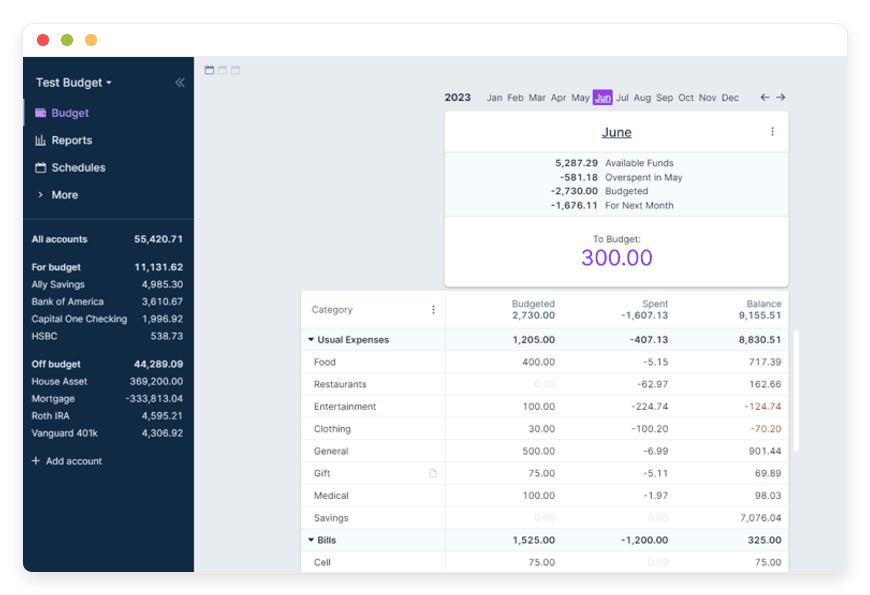
Actual Budget is a free, open-source budgeting app under the MIT licence, with about 27,000 GitHub stars. It uses envelope, zero-based budgeting: you give every euro a job before you spend it. It is local-first, works offline, and offers optional end-to-end encryption. The interface is fast. DANIAN runs it for €9/month.
The method keeps the plan realistic. You can only budget money you actually hold, so the numbers stay honest. The app stays usable with no internet connection, and your data sits in a local file by default rather than in a company’s cloud. It imports the common financial file formats and migrates budgets straight from YNAB.
It runs as a web app you reach from any browser, with mobile-friendly layouts for phones. A sync server keeps multiple devices in step when you host it. An undo history lets you reverse any change, so mistakes are cheap. Built-in reports show spending by category and net worth over time.
Best for: active, hands-on budgeters who want to plan before spending and like a quick, modern interface.
See Actual Budget for envelope budgeting if you want it run for you.
Firefly III — tracking, rules, and detailed reports
Firefly III is a free, open-source personal finance manager under the AGPL licence, with about 23,000 GitHub stars. It tracks income and expenses using double-entry bookkeeping. It supports budgets, categories, tags, recurring transactions, savings goals, and multiple currencies. Its reports are deep. DANIAN runs it for €9/month.
Firefly III is built for understanding where money goes. You can write your own rules to sort transactions, and savings goals live in “piggy banks.” By design, it never contacts an outside server until you tell it to. You import data through its companion Data Importer, using CSV files or a bank connector, and a full API has grown a community of extra tools around it.
Double-entry means every transaction moves money from one place to another, so the books always balance. It supports two-factor login, multiple currencies, and recurring bills. A public demo lets you try the interface before you commit. The REST API has drawn a community of importers, mobile clients, and add-ons.
Best for: people who want to track and analyse spending, automate categorisation, and run detailed reports.
See managed Firefly III hosting if you want it run for you.
The honest catch — bank sync is not what Mint did
Mint synced every linked account automatically, in the background. Self-hosted budgeting tools do not work that way. Actual Budget and Firefly III use manual import or region-specific connectors, and they fetch on demand rather than on their own. If one-tap automatic sync across every account is non-negotiable, this is the real trade.
Mint’s best trick was automatic bank aggregation. It pulled transactions from all your accounts on its own. That convenience is exactly what made you the product, because the aggregation ran through Mint’s servers and Mint’s business model. Open-source tools take the opposite stance on purpose. Actual does not sync bank data automatically; you press a button to fetch new transactions. Firefly III imports through a separate tool that you run or schedule.
The connectors are region-specific, and the details are worth knowing. SimpleFIN covers US and Canadian banks for about $1.50 per month. GoCardless covers UK and European banks for free, but it stopped accepting new sign-ups in July 2025, so newer users often rely on manual import or a community connector instead. Manual import always works: download a transaction file from your bank, then load it into the app.
In practice, a real month looks like this. You open the app, press fetch or upload a file your bank exported, then review the new transactions. Rules or categories sort most of them. The whole task takes a few minutes, once or twice a week. It is more effort than Mint, and it is not hard.
State the trade plainly. If you want budgeting that updates itself with no effort, a paid SaaS such as Monarch or YNAB will feel smoother. If you want to own your data and you accept a few manual steps, the open-source route fits. Managed hosting removes the server work, but it does not turn a self-hosted tool into Mint.
Actual Budget vs Firefly III — at a glance
| Feature | Actual Budget | Firefly III |
|---|---|---|
| Budgeting style | Envelope / zero-based — assign every euro a job | Double-entry tracking with rules and reports |
| Best for | Active budgeters who plan before spending | People who track and analyse where money goes |
| Interface | Fast, local-first, works offline | Web app, report-heavy, highly configurable |
| Bank data | Region-specific connectors or file import | Data Importer: CSV file or bank connector |
| Licence | MIT | AGPL-3.0 |
| GitHub stars | ~27,000 | ~23,000 |
| Your data | Local file you control; export any time | Self-hosted database; export any time |
| DANIAN price | €9/month | €9/month |
What each route costs, and what you own
A free successor such as Credit Karma costs nothing but keeps you as the product. A paid budgeting SaaS costs about €8–9 per month and runs closed software you rent. Self-hosting on a VPS costs more once you count your time. Managed hosting from DANIAN is €9/month, and the software and data are yours.
| Route | Monthly cost | Who runs it | Do you own the data? | The catch |
|---|---|---|---|---|
| Free successor (e.g. Credit Karma) | €0 | The vendor | No — you’re the product | Ads and product pitches; budgeting features dropped |
| Paid budgeting SaaS (e.g. YNAB, Monarch) | ~€8–9 | The vendor | No — closed software | Subscription lock-in; terms can change |
| Self-host on a VPS | ~$24 server + your time | You | You | You patch, back up, and stay on call |
| Managed by DANIAN | €9 per app | DANIAN | You | Bank sync is manual, not Mint-style automatic |
The raw price is close between a paid SaaS and managed open-source. YNAB is $109 per year, and Monarch is $99.99 per year, which is about €8–9 per month. DANIAN is €9 per month. The difference is not the number on the invoice. It is what you walk away with.
With the SaaS, you rent access to closed software. With managed open-source, you run software you can inspect, on data you can export and keep. If the provider ever closes, the app is still yours to move elsewhere. That is the gap Mint exposed for 3.6 million people.
Running it yourself costs less in licence fees and more in time. A production-class VPS runs about $24 per month, before backups, monitoring, and the hours you spend on updates and on-call. For a single budgeting app, €9/month managed is usually the lower total once your own time counts.
How to pick — three questions
Three questions settle most of the decision. Do you plan money before you spend it, or track it after? How much do you value owning your data against turnkey convenience? And do you want to run the server yourself? Your answers point to one tool and one route.
- Do you budget forward or track backward? If you assign money to categories before spending, choose Actual Budget. If you want to see where money already went and run reports, choose Firefly III.
- How much do you value ownership? If owning your data matters and you accept a few manual steps, the open-source route fits. If one-tap automatic sync is non-negotiable, a paid SaaS will feel smoother.
- Do you want to run the server? If you enjoy it, self-host for free. If you would rather not, managed hosting at €9/month removes the server work.
Who should stay on a paid app
Open-source budgeting is not for everyone, and pretending otherwise would be dishonest. Some people are better served by a paid app like YNAB or Monarch. If your priorities point that way, staying put is the right call. Here is who should not switch.
If automatic, hands-off sync across every account is the whole point for you, a paid app will feel better. If you want phone apps polished by a large team, the closed tools lead there today. And if you never want to think about import files, manual steps will annoy you. None of that is wrong. The open-source route asks for a little involvement in exchange for ownership. Readers who want zero involvement should keep paying, and keep a data export saved just in case.
How DANIAN runs Firefly III and Actual Budget
DANIAN runs either app for €9/month. We patch the software, back it up daily off-site, and monitor it around the clock. When something needs attention, a named person replies by email, not a queue. The €9 covers the work you would otherwise do yourself.
Getting started is the part people worry about. We help you import a Mint CSV if you saved one, or set up a regional bank connector where it is available. If neither fits, we show you the manual file import once, and after that it is routine. You are never left staring at an empty app.
You choose where your app runs, across 21 datacenter locations on six continents. Pick the region closest to you. You also get per-container access to your instance, so you can dive in when you want without managing a whole server.
Two promises matter most here. We will not run ads against your budget, and we will not sell your data. And billing stays humane: Card failed? We wait. We don’t delete your data.
Leaving takes one step: export your data any time over SFTP or as a download. The open-source app and its database are yours; DANIAN only operates them.
FAQ
What happened to Mint, and is it really gone?
Yes, Mint is gone. Intuit closed the app on March 23, 2024, after more than fifteen years. It pushed users to Credit Karma, which tracks accounts but dropped budgets and goals. Roughly 3.6 million people had to move. The data was deleted unless you exported it first.
Why did Intuit shut down Mint?
Mint was free because advertisers, not users, paid for it. Intuit already owned Credit Karma, with roughly 130 million US users and stronger ad targeting. So Mint was the product it cut. The lesson is plain: a free app you depend on can vanish when its owner finds a better vehicle.
Is Credit Karma a good replacement for Mint for budgeting?
Not for budgeting. Credit Karma monitors credit scores and recommends financial products such as cards and loans. It shows spending by category and net worth, but it does not let you build a budget or set savings goals the way Mint did. Many former Mint users found that out immediately.
Is Firefly III or Actual Budget a drop-in replacement for Mint?
Not exactly. Both track spending and budgets, and both keep your data private. Neither does Mint’s automatic background sync across every account. You import transactions manually or through a region-specific connector. The trade is some convenience in return for owning your software and your data.
What is the best free alternative to Mint in 2026?
Two open-source apps lead: Actual Budget and Firefly III. Both are free to self-host, with no ads and no data sale. Actual Budget suits forward, envelope budgeting; Firefly III suits tracking and reports. If you would rather not run a server, DANIAN hosts either one for €9/month.
What is the difference between Actual Budget and Firefly III?
Actual Budget is envelope, zero-based budgeting: you assign every euro a job before spending, in a fast, local-first interface. Firefly III is double-entry tracking: it records where money goes, sorts it with rules, and produces detailed reports. Actual plans forward; Firefly analyses backward. Both are free and run on DANIAN for €9/month.
Which one should I pick if I just want Mint-style tracking?
Choose Firefly III for tracking and reports. It records income and expenses, sorts them with rules, and produces detailed breakdowns of where money goes. Choose Actual Budget if you want to plan forward and assign every euro a job before spending. Both run on DANIAN for €9/month.
Is Actual Budget a good YNAB alternative?
Yes. Actual Budget uses the same envelope, zero-based method as YNAB, and it imports YNAB4 and newer YNAB budgets directly. It is open source and free to self-host, where YNAB costs $109 per year. The trade is that Actual’s bank sync is manual, not automatic. DANIAN hosts it for €9/month.
Do I need technical skills to use Firefly III or Actual Budget?
To self-host, yes — you handle installation, updates, and backups. To use the app once it runs, no. Both have approachable interfaces. If the server work is the part you would rather avoid, DANIAN runs either app for €9/month, so the only skill you need is budgeting itself.
Do Actual Budget and Firefly III have mobile apps?
Both run as web apps you can open on a phone browser. Actual Budget offers mobile-friendly layouts and works offline as a progressive web app. Firefly III has a documented API, and the community has built mobile clients on top of it. Neither is a polished phone app from a large vendor.
Can I use these budgeting apps without running my own server?
Yes. DANIAN runs Firefly III or Actual Budget for you at €9/month per app. We handle patching, daily off-site backups, and monitoring. You get the app and your data without touching a server. You also pick the region, across 21 datacenter locations on six continents.
Can I try Firefly III or Actual Budget before paying?
Yes, in a few ways. DANIAN offers a 7-day trial with no card required. Firefly III also runs a public demo you can click through. And because both apps are open source, you can self-host either one for free and evaluate it as long as you like.
How much does it cost to host Firefly III or Actual Budget?
DANIAN charges €9 per month per app, flat. That covers updates, daily off-site backups, monitoring, and support. Self-hosting on your own server costs less in fees but more in time, since a production-class VPS runs about $24 per month before backups, monitoring, and your hours.
How is paying €9/month for DANIAN different from paying for YNAB or Monarch?
The price is similar; both YNAB and Monarch cost about €8–9 per month. The difference is ownership. DANIAN runs open-source software you can inspect and export, with no ads and no data sale. The honest trade is that bank sync is manual, not the automatic sync a closed SaaS offers.
What is the cheapest way to budget after Mint?
Self-hosting Actual Budget or Firefly III is cheapest in fees: the software is free, though you supply a server and your time. A paid app like YNAB at $109 per year or Monarch at $99.99 per year is simpler. DANIAN sits between them at €9 per month, with the server work removed.
How do I move from Mint to Actual Budget or Firefly III?
If you saved a Mint CSV export before March 2024, both apps import it. Pick Actual Budget for forward budgeting or Firefly III for tracking, set up your accounts and categories, then import. On DANIAN, we help with the import and connector setup so you are not starting from an empty app.
Can I import my old Mint data?
Yes, if you exported it. Mint let users download their history as CSV files before it closed on March 23, 2024. Both Actual Budget and Firefly III import CSV files. If you saved that export, you can bring your history with you. If you didn’t, the original Mint data is gone.
How does bank sync work, and what does it cost?
It depends on your region and bank. One connector covers US and Canadian banks for about $1.50 per month. A second is free where available, but it closed to new sign-ups in July 2025. Manual import from a downloaded bank file always works, at no cost, in both apps.
Is self-hosted budgeting software safe and private?
It can be more private than a free app. The code is open source, so anyone can check it for trackers. Your data sits on your own instance, not in a company’s advertising funnel. Actual Budget also offers optional end-to-end encryption. With DANIAN, there are no ads and no data sale.
What happens to my data if I leave DANIAN?
You take it with you. Export your data any time over SFTP or as a download. The open-source app and its database are yours; DANIAN only operates them. There is no proprietary format to escape. A card failure pauses the account; it does not erase your data.
What happens to my budget if DANIAN shuts down?
You keep everything. The app is open source and your data is portable, so nothing is locked to DANIAN. Export your records over SFTP or as a download, then move them to your own server or another host. That portability is the whole point of running open-source software instead of a closed app.
What to do this week
Start with the forward-or-backward question. If you plan before spending, try Actual Budget. If you want to track and report, try Firefly III. If you saved a Mint CSV, you can bring your history into either one. Either way, you end up owning your budget instead of renting it.
Then decide who runs it. Self-host if you enjoy server work. If you would rather skip it, DANIAN runs both for €9/month, with your data kept private and portable. Start a 7-day trial and put one of them to work this week.
Sources
- CNBC, “Budgeting app Mint is shutting down” (November 2023): cnbc.com
- WalletHub, “What happened to Mint?” (shutdown date and Credit Karma feature gap): wallethub.com
- Firefly III — official site and project: firefly-iii.org · github.com/firefly-iii
- Actual Budget — official site and project: actualbudget.org · github.com/actualbudget
- Actual Budget — bank sync documentation (manual fetch; GoCardless and SimpleFIN): actualbudget.org/docs
- YNAB and Monarch Money current pricing (verified 2026): ynab.com/pricing · monarchmoney.com