After Google Podcasts — self-hosted podcasting 2026
After Google Podcasts shut down — where independent podcasters landed in 2026
TL;DR
- Google shut down Google Podcasts in the United States on 2 April 2024 and folded podcasts into YouTube Music.
- Listeners could export their subscriptions to YouTube Music or to an OPML file until July 2024.
- The shutdown split into two separate jobs: where listeners subscribe, and where creators host the feed.
- Castopod hosts and publishes a show over RSS, and each podcast also acts as a fediverse account.
- oPodSync syncs a listener's subscriptions and play progress across apps. It is a listener tool, not a host.
- DANIAN runs either app for €9 per month, in the region closest to your listeners.
What actually happened to Google Podcasts
Google announced the end of Google Podcasts in September 2023. The app stopped working in the United States on 2 April 2024, and the global wind-down followed through 2024. Google moved podcasts into YouTube Music and shipped an export tool. Listeners had until July 2024 to migrate.
The app had been installed more than 500 million times on Android. Google's stated reason was consolidation: one podcast destination inside YouTube Music rather than two products. The company pointed to its own figures showing more listeners already used YouTube than the standalone app.
Two export paths shipped. One moved subscriptions into YouTube Music. The other produced an OPML file — a plain list of feeds that any podcast app can read. OPML is the quiet hero here. It meant no listener was locked in, and no show disappeared.
For creators, the shutdown changed less than it first looked. Google Podcasts never hosted anyone's audio. It was a directory and a player that read public RSS feeds. A show's files lived wherever its owner had put them. So the closure removed a listening app, not a publishing platform.
Why owning the feed is the hedge
This was not the first product Google retired. Google Reader closed in 2013. Google Play Music closed in 2020, with listeners moved to YouTube Music. Google Podcasts followed in 2024, with the same destination. Large companies sunset products; that is normal, and the point here is not blame.
The point is dependence. Each shutdown moved people who had built a habit inside a product they did not control. The listeners and creators who felt the least disruption were the ones standing on the open layer underneath — RSS — rather than on any single app on top of it. A feed you own outlives the apps that read it.
Two problems the shutdown created
The shutdown created two separate problems that are easy to confuse. Listeners lost an app and had to choose a new one. Creators had to make sure their feed stayed reachable and well-formed. The two jobs need different tools, and treating them as one wastes time.
Most coverage in 2024 mixed the two. A headline would promise to explain where to move your podcasts, then list listening apps. That helps a listener and does nothing for a creator. A creator's question is about the feed: who hosts it, who owns it, and what happens if that host shuts down too.
This post keeps the two jobs apart. The listener side is short, because the choices are well known. The creator side is longer, because owning the feed is where the real decision sits in 2026.
Where listeners landed
Most Google Podcasts listeners moved to YouTube Music, Apple Podcasts, or Spotify. A smaller group chose open apps such as AntennaPod or Pocket Casts. The listeners who wanted cross-device sync without a Big Tech account ran into one specific gap: a reliable place to store that sync.
For years the default sync service was gpodder.net, the hosted companion to the gPodder desktop client. It still runs, but it is community-maintained and prone to downtime — server errors are a common complaint. People who listen on a phone with AntennaPod and on a laptop with gPodder or Kasts want their subscriptions and their place in each episode to match. That is the sync problem, and it has a self-hosted answer further down.
There is a practical note for anyone rebuilding a follow list. If you saved the OPML export before July 2024, any modern app imports it in one step, and your subscriptions return intact. If you did not, the list is gone, but the shows are not — they still sit on Apple Podcasts, Spotify, and their own sites, ready to follow again.
Where creators landed: owning the feed
A podcast is, at its core, an RSS feed. Directories such as Apple Podcasts and Spotify do not store the show; they read the feed and point listeners at it. Whoever controls that feed controls the show. The creators who took the shutdown as a prompt moved toward hosting they own.
Owning the feed has a plain benefit: no single company can switch it off. When a host closes, a feed on infrastructure you control keeps working, and the directories keep reading it. Migrating away from a closed host means changing a URL and waiting for directories to catch up — friction, but not loss.
The open-source path to owning a feed has matured. A creator can run software that builds the RSS feed, stores the audio, submits to directories, and reports downloads — without writing code. Two pieces of that path are in DANIAN's catalogue today, and they do different jobs.
Castopod — host and publish your show
Castopod is open-source podcast hosting software, licensed under AGPL-3.0 and built by the French company Ad Aures. It generates your RSS feed, stores your audio, and submits to directories such as Apple Podcasts and Spotify. It supports Podcasting 2.0 tags — chapters, transcripts, funding links — and reports first-party download analytics from your own instance.
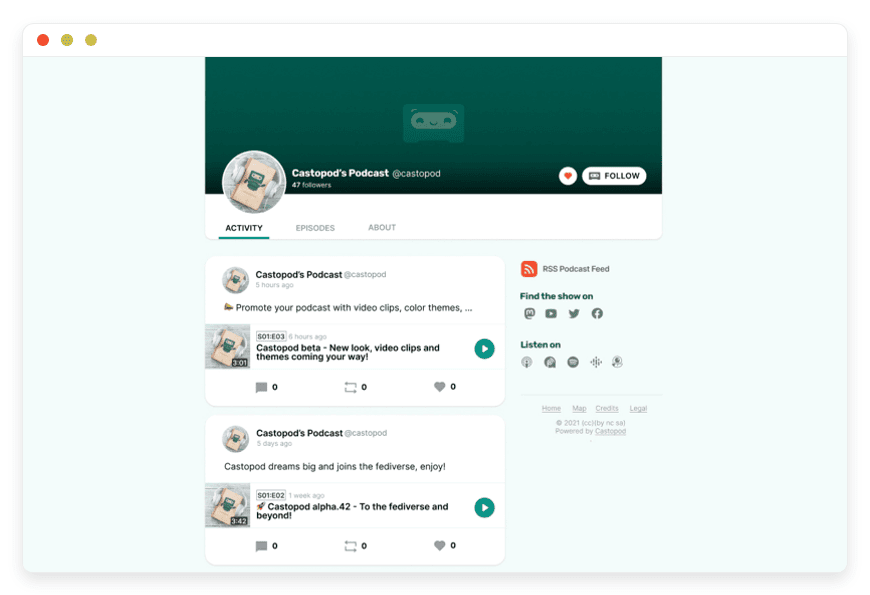
What sets Castopod apart is the fediverse. Each podcast on Castopod is also an ActivityPub account. Someone on Mastodon can follow the show directly, and their likes and replies attach to the episode. The podcast becomes its own small social network, with no separate comment platform to depend on. By the end of 2025 the project reported more than 1,000 active podcasts and over 43,000 episodes published, with 200-plus contributors.
The federation is a real differentiator. Its state deserves an honest description. ActivityPub support has had rough edges across releases, and interoperability with every Mastodon server is not guaranteed. For a creator who wants their audience reachable from the fediverse, it is a strong reason to pick Castopod. For a creator who only needs a feed and directory submission, it is a bonus rather than the deciding factor.
Castopod also runs a WebSub server, so apps that support it learn about new episodes without waiting for a scheduled feed poll. Its analytics are first-party and sit on your own instance: daily download totals, plus device, platform, and rough location breakdowns. Download numbers are noisy across the whole industry, so treat them as a trend line rather than a precise count — but the data is yours, not a platform's dashboard you rent.
Running Castopod yourself means a PHP and MySQL server, a domain, TLS, backups, and the monthly patch cycle. DANIAN runs managed Castopod hosting in the region closest to your listeners, across 21 datacenter regions on six continents, for €9 per month. We handle the server, the updates, the daily off-site backups, and the monitoring. You upload episodes and write show notes.
See managed Castopod hosting — DANIAN runs the box; you make the show.
oPodSync — keep your subscriptions in sync
oPodSync is a small open-source server that syncs podcast subscriptions and play progress across devices. It speaks the gPodder API, so apps that already support gPodder sync — AntennaPod on mobile, gPodder and Kasts on the desktop — work with it directly. It also supports the Nextcloud gPodder Sync endpoints. It solves the listener problem, not the hosting one.
This is the honest line of this post. oPodSync does not host a podcast and does not publish a feed. It is a listener-side tool. It remembers which shows you follow and how far into each episode you are, then keeps that record consistent whether you open your phone or your laptop. It is the self-hosted answer to a public sync service that keeps going down.
oPodSync is built in PHP with a SQLite database, so it is light to run. A creator using Castopod does not need oPodSync, and a listener using oPodSync does not need Castopod. They sit at opposite ends of the same ecosystem. DANIAN runs managed oPodSync for €9 per month, with the same patching, backups, and monitoring as any other app.
Run oPodSync for subscription sync — one place for your subscriptions and episode progress.
Castopod and oPodSync do different jobs
The two apps are often listed together, which invites the wrong conclusion that they overlap. They do not. Castopod is for the person who makes a podcast. oPodSync is for the person who listens to podcasts. The table keeps the line clear.
| Feature | Castopod | oPodSync |
|---|---|---|
| Job | Hosts and publishes your show | Syncs your subscriptions and progress |
| Who it is for | Podcast creators | Podcast listeners |
| Core output | An RSS feed plus a public site | A sync record across your apps |
| Works with | Apple Podcasts, Spotify, the fediverse | AntennaPod, gPodder, Kasts |
| What it is not | A listening app | A podcast host |
| DANIAN price | €9/month | €9/month |
A creator who also listens widely might run both — one to publish, one to keep their own listening in sync. That is two apps at €9 each, €18 per month total. Most people need only one of the two.
What this costs, honestly
DANIAN charges €9 per app, per month. One app is €9; Castopod plus oPodSync is €18. The price covers the server, security updates, daily off-site backups, monitoring, and support over chat and email. There is a 7-day free trial, and no card is required to start.
Podcast hosting has one cost most platforms hide: bandwidth. Every download moves an audio file, and popular shows move a lot of them. DANIAN's base plan includes 1,000 GB of traffic per month per app. A show with heavy downloads can pass that, and overage is billed at €0.03 per GB. You can see your usage, and we tell you before it matters rather than after.
As a rough gauge, a 50 MB episode downloaded 2,000 times uses about 100 GB. A weekly show at that level, with back-catalogue downloads on top, sits under the 1,000 GB included. A show pulling tens of thousands of downloads per episode will pass it, and that €0.03 per GB is where the real cost of a popular show appears.
Setup is not zero effort. Importing an existing show means pointing Castopod at your current feed, checking that episodes and artwork came across, and submitting the new feed URL to the directories. We help with that over chat. After the first import, publishing a new episode is upload-and-write.
The honest comparison is not against a hosted podcast platform feature for feature. Many of those bundle a built-in ad marketplace, dynamic ad insertion, and hosted sponsorship tools. Castopod does not. If advertising revenue through a marketplace is your model, a commercial podcast host may fit better. If owning the feed and the audience relationship matters more, the open-source path is the stronger one.
A federated audio and music platform, Funkwhale, is planned for the DANIAN catalogue and is not available yet. It serves a different need — sharing and streaming audio libraries across the fediverse — rather than podcast publishing. For podcasting today, Castopod and oPodSync are the two live pieces.
Who should pick which path
No single path fits every podcaster, and pretending otherwise reads as a sales pitch. The right choice depends on how technical you are, what you want to own, and how the show makes money. Four honest profiles follow.
Self-host on a production-class VPS if you run Linux for fun, you are comfortable being on call, and you want full control of the box. Castopod installs on PHP and MySQL, and a creator who enjoys that work will do it well. You own the patch cycle and the backups, and that is the price of the control.
Stay on a commercial podcast host if your revenue runs through a built-in ad marketplace, or you need dynamic ad insertion and hosted sponsorship tools today. Those platforms are built around that model, and rebuilding it on open source is not worth your time.
Pick managed Castopod if you want to own your feed and your audience relationship without running a server. You upload episodes; we keep the box patched, backed up, and monitored. This is the common case for an independent creator who is not a sysadmin.
Add oPodSync if you listen across more than one device and want your subscriptions and progress to match, without trusting a public sync service that goes down. It is a listener convenience, separate from any hosting choice.
How moving a feed actually works
Moving a podcast to a new host sounds risky and usually is not. A show's listeners follow a feed URL, not a server. When you move, you redirect the old URL to the new one and tell the directories the feed has changed. Listeners keep their subscriptions, and new episodes arrive as before.
Two mechanisms do the work. A 301 redirect on the old feed points apps and directories at the new address. Apple Podcasts also reads a dedicated tag, itunes:new-feed-url, that announces the move inside the feed itself. Spotify and most apps follow the redirect on their next refresh. Setting both is the belt-and-braces approach.
The slow part is patience, not labour. Directories re-read feeds on their own schedule, so a move can take a few days to settle everywhere. Keep the old feed redirecting for a few weeks until the long tail of apps has caught up. After that, the old host can go.
One thing does not move cleanly: your historical download numbers. Analytics live with each host, so a move starts a fresh count on the new instance. Export or screenshot your old figures before you switch if the history matters to a sponsor or a media kit. The audience and the feed carry over; the back-room stats do not, and that is true of any host-to-host move, not just this one.
Frequently asked questions
Is Google Podcasts really gone?
Yes. The app stopped working in the United States on 2 April 2024, and Google wound it down globally through 2024. Podcasts now live inside YouTube Music. If you still had subscriptions in the old app, the export window to YouTube Music or to an OPML file closed in July 2024.
What is the best open-source alternative to Google Podcasts?
It depends on the job. For listening, open apps such as AntennaPod or Pocket Casts replace the player. For keeping subscriptions in sync across devices, oPodSync replaces the old gpodder.net service. For hosting and publishing a show on a feed you own, Castopod is the open-source option.
Do I need to move my podcast off YouTube Music?
Only if you want to own the feed. YouTube Music can host a show, but the feed and the audience relationship sit inside Google's product. Running Castopod gives you an RSS feed you control, which the directories — including Apple and Spotify — read the same way.
What happened to gpodder.net, and does it still work?
gpodder.net is the hosted sync service that pairs with the gPodder desktop client. It still runs, but it is community-maintained and prone to downtime, and server errors are a common complaint. oPodSync is the self-hosted alternative: the same gPodder API, on a server you control.
What is Castopod?
Castopod is free, open-source podcast hosting software, licensed under AGPL-3.0 and built by the French company Ad Aures. It generates your RSS feed, stores your audio, submits to directories such as Apple Podcasts and Spotify, and supports Podcasting 2.0 tags. Each podcast is also a fediverse account.
What is oPodSync?
oPodSync is a small open-source server that syncs your podcast subscriptions and play progress across devices. It speaks the gPodder API, so apps like AntennaPod, gPodder, and Kasts work with it directly, and it supports the Nextcloud gPodder Sync endpoints. It is a listener tool, not a podcast host.
What is the difference between Castopod and oPodSync?
Castopod hosts and publishes a podcast: it builds your RSS feed and stores your audio. oPodSync syncs a listener's subscriptions and play progress across apps. One is for creators, the other for listeners. They do not overlap, and most people need only one.
What is the difference between a podcast host and a podcast directory?
A host stores your audio and serves your RSS feed — that is what Castopod does. A directory, such as Apple Podcasts or Spotify, does not store the show; it reads your feed and lists it for listeners. You publish once on your host, and the directories pull from it.
What is Podcasting 2.0, and does Castopod support it?
Podcasting 2.0 is a set of extensions to the podcast RSS standard, adding tags for chapters, transcripts, funding links, episode persons, soundbites, and a stable identifier. Castopod supports these tags, so apps that read them show richer information. The features are optional and degrade cleanly in older apps.
How does Castopod connect to Mastodon and the fediverse?
Each podcast on Castopod is also an ActivityPub account, the same protocol Mastodon uses. People can follow your show from Mastodon directly, and their likes and replies attach to the episode. Support has had rough edges across releases, so interoperability with every server is not guaranteed.
Does Castopod include analytics, and can listeners comment on episodes?
Yes to both. Castopod reports first-party analytics from your own instance — daily download totals, plus device, platform, and rough location. Download numbers are noisy across the industry, so read them as a trend. Listeners on the fediverse can reply to episodes, and those replies appear as comments on your show.
Should I self-host my podcast or use managed hosting?
Self-host on a production-class VPS if you are comfortable with Linux, on-call, and owning the patch cycle and backups. Choose managed hosting if you want to own your feed without running a server. With DANIAN, you upload episodes while the server, updates, backups, and monitoring are handled, for €9 per month.
Do I need to be technical to run a podcast this way?
Not with managed hosting. On DANIAN you upload episodes and write show notes; the server, updates, backups, and monitoring are handled for you. Self-hosting Castopod on your own VPS does need Linux comfort, so the managed path exists for creators who would rather avoid that work.
Is Castopod free?
The software is free and open-source under AGPL-3.0. Running it is not free: you need a server, bandwidth, a domain, and the time to maintain them. You can self-host on your own VPS, or run it managed on DANIAN for €9 per month, which covers the server, updates, and backups.
How much bandwidth does a podcast need?
Bandwidth scales with downloads: each download moves one audio file. As a rough gauge, a 50 MB episode downloaded 2,000 times uses about 100 GB. DANIAN's base plan includes 1,000 GB per month per app, with overage at €0.03 per GB, so most small and mid-size shows stay within it.
Does managed Castopod hosting include backups, updates, and a custom domain?
Yes. On DANIAN, the €9 per month covers security updates, daily off-site backups, monitoring, and support over chat and email. You can run the show on your own domain. Some changes, such as resource upgrades, are handled by our team rather than self-service, so reach out when you need one.
How do I migrate my podcast to Castopod from another host?
Point Castopod at your current feed to import the show, then check that episodes and artwork came across. Submit the new feed URL to the directories, and set a 301 redirect on the old feed plus the itunes:new-feed-url tag. Keep the old feed redirecting for a few weeks while apps catch up.
How do I submit my podcast to Spotify and Apple Podcasts?
Submit your RSS feed URL once in each directory — through Apple Podcasts Connect and Spotify's creator dashboard. After that, both pull new episodes from the feed automatically. Castopod produces a standard feed the directories accept, so you submit the same URL everywhere and never upload an episode twice.
Will my podcast still appear on Apple Podcasts and Spotify?
Yes. Castopod produces a standard RSS feed, and you submit that feed to each directory once. Apple Podcasts, Spotify, and the others pull new episodes from the feed automatically after that. Moving hosts later means updating the feed URL, not re-submitting every episode.
Can I keep my podcast subscriptions in sync across devices without a Big Tech account?
Yes. oPodSync stores your subscriptions and your place in each episode, and syncs them between apps that speak the gPodder protocol — AntennaPod on mobile, gPodder or Kasts on the desktop. There is no Google or Apple account involved; the sync record lives on your own instance.
What happens to my feed if I leave DANIAN?
You keep your data. Castopod is open-source software running on your instance, and your audio and feed are exportable. If you move to your own server or another host, you point your domain at the new instance and the directories follow. We do not hold a show hostage.
What to do this week
If you listened on Google Podcasts and never exported, your old subscriptions are gone, but rebuilding a follow list takes minutes in any modern app. If you make a show, the more useful move is to make sure you own the feed before another host changes its terms.
For a creator, the practical steps are short. Confirm where your feed lives today and who controls it. If it sits inside a platform you do not control, stand up a Castopod instance, import your show, and submit the new feed to the directories. Once the directories catch up, the move is done.
If you want to own the feed without owning the server, that is the job DANIAN exists to do.
Start a 7-day trial, deploy Castopod, and upload an episode.
If listening across devices is your itch instead, oPodSync solves that on its own.
Sources
1. Google Podcasts shutdown timeline — TechCrunch (29 March 2024) and 9to5Google (Sept 2023).
2. Castopod — castopod.org and the Castopod documentation.
3. Castopod source code — code.castopod.org (GitHub mirror: ad-aures/castopod).
4. oPodSync — github.com/kd2org/opodsync.