Open-source tools for small NGOs in 2026
Open-source tools for small NGOs in 2026 — six apps for outreach, donor management, and operations on a tight budget
Most small NGOs are running fifteen to twenty-five SaaS tools right now. The board approves the spend in Q4. By April, somebody on the finance committee asks whether the line items still add up. Especially the ones that scale with staff count, contact count, or ticket volume. This guide answers that with six open-source apps. They cover donor management, outreach, document collaboration, member community, surveys, and fundraiser ticketing. Total managed cost: €54/month for the whole stack.
TL;DR
- Six open-source apps cover the operational stack of a small NGO: EspoCRM, Mautic, Nextcloud, HumHub, LimeSurvey, and Pretix.
- Together they replace Salesforce Nonprofit Cloud, Mailchimp, Google Workspace, Slack, SurveyMonkey, and Eventbrite.
- Managed on DANIAN, the total stack costs €54 per month — flat, regardless of staff count or contact count.
- The SaaS bill they replace typically runs €350–€650/month after nonprofit discounts, plus per-ticket Eventbrite fees on each event.
- Right move for 5–80-staff NGOs whose tech spend is climbing faster than headcount. Wrong move for orgs that fit entirely within US 501(c)(3) free tiers or depend on Salesforce’s pre-built nonprofit reporting.
Who this list is for (and who it isn’t for)
Three signals say a small NGO is the right reader. First, the tech bill is climbing while headcount stays flat — per-seat or per-contact SaaS pricing has outgrown the org. Second, a board or finance-committee member asks where donor and member records actually live. Third, a recent procurement review flagged how many vendor relationships the org now maintains.
This list is not for everyone. A US-based 501(c)(3) with under 10 staff and under 250 community members can often run on free nonprofit tiers. Google Workspace Business Starter is free for verified nonprofits. Slack Pro is free. Salesforce gives ten free seats via the Power of Us program. If that footprint covers the work, migrating to a self-hosted stack is hard to justify. Larger NGOs with deep Salesforce Nonprofit Success Pack dependencies, or with full in-house IT teams, also have different trade-offs.
The sweet spot is the 5–80-staff donor-driven or member-driven NGO that has outgrown the free tiers. Paying €200–€1,500/month across fragmented SaaS lines. Wants donor and member data on infrastructure the org chooses — without becoming a sysadmin shop.
Why this is a 2026 conversation
Three trends have compounded for small NGOs in 2026. Commercial SaaS terms have tightened on the tools NGOs use most. Regulatory attention on where donor and member data lives has intensified. And Q4 budget cycles have made tech-spend reviews a recurring board agenda item. May to September is the practical window for evaluating replacements before the next budget locks in.
Commercial SaaS terms have tightened on the tools NGOs use most. Mailchimp killed unlimited free years ago and now bills for unsubscribed contacts. A nonprofit with 5,000 contacts on the Standard plan pays around €85/month before the 15% nonprofit discount and roughly €72 after it (Mailchimp pricing 2026). Eventbrite removed fee caps in 2026 and stopped refunding fees on cancelled events.
The effective per-ticket fee on a €40 fundraiser ticket runs close to 11% after the 50% nonprofit Pro discount (Eventbrite Help Center).
Salesforce Nonprofit Cloud’s Enterprise edition lists at $60 per user per month after the first 10 free seats (Salesforce for Nonprofits pricing guide). Consultants estimate first-year implementation at $15,000–$100,000 on top.
Regulatory attention on where data lives has intensified. The EU Data Act became enforceable in September 2025; the AI Act reaches full enforcement in August 2026. Audit conversations and donor due-diligence questions now routinely ask where member and donor records sit. Self-hosted infrastructure makes those conversations shorter.
And budget cycles align. Most small NGOs review tech spend in Q4 for the following year. That makes May to September the practical window for evaluating replacements, running pilots, and migrating data before the next budget locks in.
The shortlist
Six apps cover the core operational stack of a small NGO. Each replaces one commercial SaaS line item. Each runs on DANIAN at €9 per month, flat. Together they total €54 per month. The notes below give what each app replaces, the team-size fit, the honest gap relative to the commercial alternative, and the switching effort.
EspoCRM — donor and member CRM
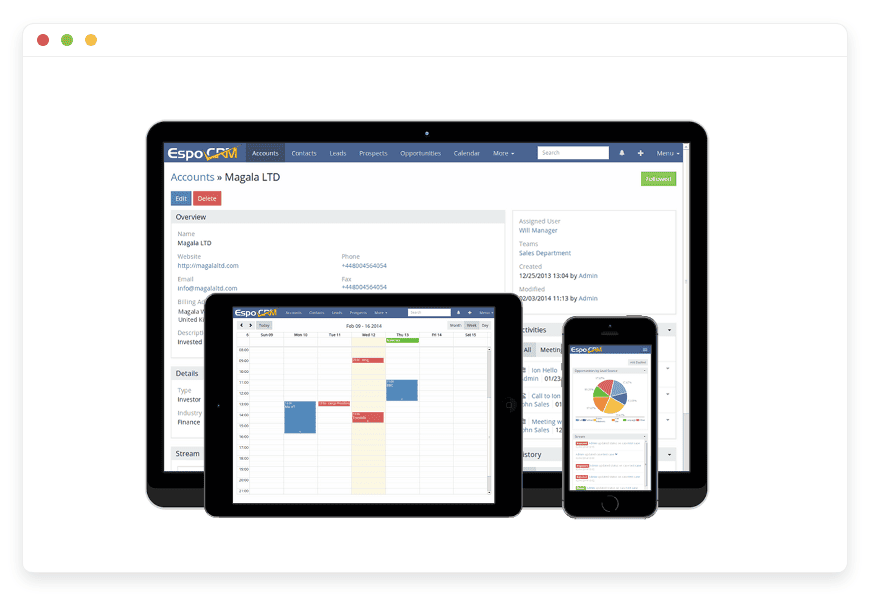
EspoCRM is a full customer-relationship platform. It maps cleanly to donor management when each donor or member is a contact, each gift an opportunity, each campaign a marketing record. It runs as a single-page web app on a PHP backend. Custom entities and fields are built in the UI, without code. A REST API handles integrations. License is AGPLv3. Multilingual support is configurable per user.
What it replaces: Salesforce Nonprofit Cloud, HubSpot, Zoho CRM.
Best for: An NGO with 100–10,000 donors and 2–20 staff. The team needs a shared, structured place to track relationships, gifts, grants, and outreach. The data model doesn’t fight you when you add a grant cycle, a member tier, or a stewardship cadence.
Honest gap: Salesforce Nonprofit Cloud’s Nonprofit Success Pack ships with pre-built nonprofit-specific reports — major-gift pipelines, recurring-donor dashboards, grant lifecycle views. EspoCRM matches the data model but reports are do-it-yourself. If your fundraising team needs those dashboards tomorrow, migration friction is real. If you’re willing to build the three or four reports you actually use, EspoCRM gets there in a week.
Switching effort: Medium. Contact and gift records export from Salesforce as CSVs. Field-mapping takes 1–3 days for a 5,000-contact org.
→ See managed EspoCRM for donor management.
Mautic — campaign emails and automation
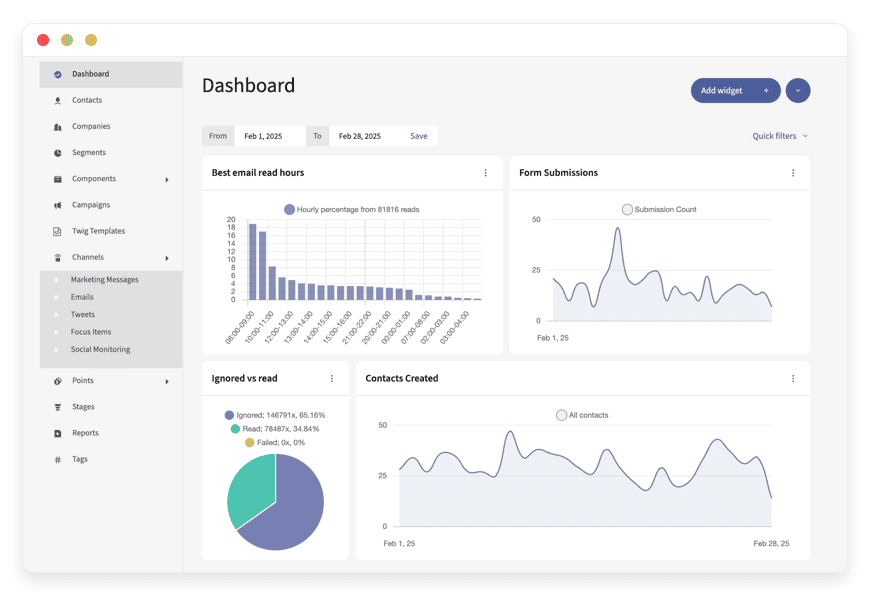
Mautic is open-source marketing automation. It runs email campaigns, segmented sends, drip sequences, lead scoring, and landing pages. It shipped a redesigned email builder, predictive send-time, and heat-map analytics (mautic.org). License is GNU GPLv3.
What it replaces: Mailchimp, ActiveCampaign, Brevo.
Best for: An NGO sending more than 4 campaign emails per month to a list of 1,000+ contacts. The team wants segmentation, automation, and lifecycle email — without per-contact billing.
Honest gap: Mautic needs an SMTP relay to send mail. Amazon SES, Postmark, or a similar transactional provider. Setup is a one-time configuration. Deliverability needs the same DKIM, SPF, and DMARC discipline any sender needs. Mailchimp absorbs that work in its price. On DANIAN, the SMTP integration is part of setup that the support team handles.
Switching effort: Medium. Contact lists export from Mailchimp as CSVs and import into Mautic with field mapping. Email templates need re-creation. Plan two weeks to migrate templates, segments, and the most-used automations.
→ See managed Mautic
Nextcloud — document collaboration and the team’s digital workspace
Nextcloud Hub is the most widely deployed open-source content-collaboration platform. File sharing, real-time document editing, calendar, contacts, video calls, chat, and email in one workspace (nextcloud.com). License is AGPL-3.0. Translated into 60 languages.
What it replaces: Google Workspace, Microsoft 365.
Best for: A 5–80-staff NGO that wants its working documents on infrastructure it controls. Grant proposals, beneficiary records, board minutes, financial spreadsheets. File sharing and real-time editing that feel familiar to anyone who has used Google Drive.
Honest gap: Google Workspace Business Starter is free for verified US 501(c)(3) nonprofits through Google for Nonprofits. Business Standard runs $3.50/user/month after the 75% nonprofit discount (Google for Nonprofits). For a five-person org that fits in Starter, that’s hard to beat on price alone. The case for Nextcloud is data ownership, the 60-language coverage that Workspace’s interface doesn’t always match, and the fact that “free” SaaS programs can change terms. The case is stronger for NGOs whose donors and beneficiaries already ask where data sits.
Switching effort: Medium-high for full migration. Low for a parallel deployment. Many NGOs keep Workspace email during transition and use Nextcloud for the document and collaboration layer. Migrate one department per quarter.
→ See managed Nextcloud
HumHub — member community and internal social
HumHub is an open-source social-network kit. Private spaces, member directories, discussion threads, polls, activity feeds — what Slack does for team chat plus what Facebook Groups did for member communities. The latest stable release is 1.17.5 (December 2025). License is AGPLv3. Built by HumHub GmbH, a Munich-based open-source company (humhub.com).
What it replaces: Slack, Facebook Groups, Mighty Networks.
Best for: A member-driven NGO — an association, a federation, an alumni network, a donor circle. The org wants a private, branded community space rather than a chat workspace. HumHub’s model is spaces, not channels. A donor circle is a space. A regional chapter is a space. A board committee is a space. Members join the ones relevant to them.
Honest gap: HumHub is not Slack. If your team’s daily work runs on fast-paced channel chat with threading and a deep app ecosystem, Slack — especially Slack Pro free for verified nonprofits under 250 members — is the better tool for that job. HumHub is where Slack’s value drops off. Persistent member community. Longer-form posts. Structured spaces with their own membership rules. Many NGOs end up with both: Slack for staff team chat, HumHub for the volunteer and donor community.
Switching effort: Low if you’re starting a new community space. Medium if consolidating from a mix of Facebook Group, Slack, and email lists.
→ See managed HumHub
LimeSurvey — multilingual surveys and assessments
LimeSurvey is the open-source survey platform academic researchers, government agencies, and global associations have used for over a decade. 80+ languages. 28+ question types. 1,000+ templates. Advanced conditional logic. Offline data collection (limesurvey.org). Built by LimeSurvey GmbH in Hamburg, Germany. License is GPL v2.0 or later.
What it replaces: SurveyMonkey, Typeform, Qualtrics, Google Forms.
Best for: An NGO running multilingual surveys for members, beneficiaries, or programme evaluation. Annual member surveys. Beneficiary feedback. Programme outcomes. Post-event evaluation. The 80-language support is the load-bearing fact. Few commercial competitors match it.
Honest gap: The default LimeSurvey interface is functional rather than slick. Academic-grade rather than marketing-grade. If your surveys need to look like a Typeform conversation, LimeSurvey’s templates need design work. The trade-off: SurveyMonkey’s Team Advantage plan starts at $30 per user per month with a three-user minimum and annual billing — roughly $1,080/year before extra-response fees (SurveyMonkey pricing). LimeSurvey on a managed instance is €108/year flat. Same applies to users and response volume within the resource ceiling.
Switching effort: Low. SurveyMonkey questionnaires copy across in a single afternoon. Results data exports as CSV.
→ See managed LimeSurvey
Pretix — event ticketing for fundraisers
Pretix is the open-source ticketing platform built specifically for events — conferences, festivals, exhibitions, and the fundraisers a small NGO runs once or twice a year. The project was started in 2014 by Raphael Michel. It has been developed for over a decade by a team in Heidelberg, Germany. The company was originally rami.io GmbH and was renamed to pretix GmbH in 2025 to reflect the product focus (pretix.eu about page). pretix Open is licensed under AGPLv3.
What it replaces: Eventbrite, Ticket Tailor, Universe.
Best for: Any NGO running paid fundraisers, gala dinners, conference-style events, or ticketed donor receptions. The branded checkout, multi-language storefront, reserved seating, and full attendee-data export work from 20-person donor dinners to 5,000-person galas.
Why this matters financially: Eventbrite charges 3.7% + $1.79 per ticket plus 2.9% payment processing. On 200 fundraiser tickets at €30 each — a small evening event — that’s roughly €450 in Eventbrite fees, or about €2.25 per ticket. Pretix on a managed instance is €9/month flat, with no per-ticket platform fee. The payment processor (Stripe, PayPal, whoever you connect) still takes their standard rate. For an org running 4 events a year, that’s roughly €1,700/year that stays with the cause instead of the platform.
Honest gap: Eventbrite is also a discovery platform. People search Eventbrite for things to do. A first-time fundraiser relying on Eventbrite’s organic traffic for ticket sales to non-followers loses that channel with Pretix. If your event marketing is mostly to your own donor list, social media, and partner networks, that loss is small. If you depend on Eventbrite’s marketplace for new audiences, factor that in.
→ See Pretix for fundraiser ticketing.
How they fit together
A small NGO’s operational stack maps to a donor and member lifecycle, and these six apps cover most of it. Nextcloud or LimeSurvey handles intake. EspoCRM holds the donor record. Mautic runs the campaign sequences. Pretix sells the fundraiser tickets and credits them back to the donor record. LimeSurvey runs post-event evaluation. HumHub gives major donors and members their own community space.
A prospective donor fills out an enquiry form on the org’s Nextcloud-hosted site or a LimeSurvey landing page. The data flows into EspoCRM as a new contact. Mautic picks up the contact via EspoCRM’s API and starts a welcome email sequence. Three weeks later the donor makes their first gift; an automation triggers a thank-you email plus a tag for the quarterly impact-update segment. At the annual gala, Pretix processes ticket sales against the EspoCRM donor records. The post-event survey runs in LimeSurvey and exports back to each record. The major donors get invited into a private HumHub space — a quarterly briefings circle with the board and programme leads.
This works because each app speaks the same language. CSV exports with stable record IDs. REST APIs on EspoCRM and Mautic.
Webhook outputs from Pretix and LimeSurvey. The integration work is real but bounded — a couple of days of configuration, not months of custom development. No app is locked into the others; you can swap any one out later without breaking the rest.
Comparison table
| App | What it replaces | DANIAN price | Team-size fit | Region choice |
|---|---|---|---|---|
| EspoCRM | Salesforce Nonprofit Cloud, HubSpot | €9/month | 2–50 staff, 100–10,000 contacts | Pick from 21 datacenter regions |
| Mautic | Mailchimp, ActiveCampaign | €9/month | Lists of 500+ contacts | Pick from 21 datacenter regions |
| Nextcloud | Google Workspace, Microsoft 365 | €9/month | 5–80 staff | Pick from 21 datacenter regions |
| HumHub | Slack, Facebook Groups | €9/month | Communities of 20–5,000 members | Pick from 21 datacenter regions |
| LimeSurvey | SurveyMonkey, Typeform | €9/month | Any size; strong for multilingual | Pick from 21 datacenter regions |
| Pretix | Eventbrite, Ticket Tailor | €9/month | Events from 20 to 5,000 tickets | Pick from 21 datacenter regions |
| Total stack | All six SaaS lines | €54/month | 5–80-staff NGOs | 21 locations across six continents |
The same six SaaS tools at typical small-NGO usage run roughly €350–€650/month in subscription costs. That assumes five Salesforce paid seats after the Power of Us free tier. A 5,000-contact Mailchimp Standard plan with the nonprofit discount. Google Workspace Business Standard at the nonprofit rate for ten users. Slack Pro free for a sub-250 nonprofit. Three SurveyMonkey Team Advantage seats. Eventbrite Pro with the 50% nonprofit discount. Not counting per-ticket Eventbrite fees on actual fundraisers — those alone add another €1,500–€3,000/year for a four-event programme.
The honest counterargument — when this stack doesn’t make sense
Several NGOs should stay on commercial SaaS. The post would be dishonest not to say so. Three profiles in particular have real reasons to defer or skip the migration: small US 501(c)(3)s that fit entirely in free nonprofit tiers, orgs with deep Salesforce Nonprofit Success Pack reporting dependencies, and orgs without operational capacity to absorb a migration this quarter.
A US-registered 501(c)(3) with under 10 staff, under 250 community members, and an event programme of free tickets has a real free option. Google Workspace Business Starter at no cost. Slack Pro free. Ten Salesforce seats via Power of Us. Eventbrite’s no-fee free events. For that org, the total commercial-SaaS bill might be €0–€80/month — below the €54 managed open-source floor once you account for migration time. The honest call: stay where you are until headcount, contact volume, or paid-ticket programmes push you over the free thresholds.
An NGO with deep Salesforce Nonprofit Success Pack reporting dependencies has real migration friction. Five years of customised donor reports, grant lifecycle workflows, major-gift pipelines built on NPSP. EspoCRM matches the underlying data model. But a fundraising team that runs Tuesday-morning reports off NPSP dashboards loses those the day the migration completes. Plan for 4–8 weeks of report rebuilding. Or stage the migration so reports get re-created before historical data switches over.
An NGO with no operational time to evaluate and onboard new tools should not start a migration this quarter. Software migrations consume executive-director attention and staff goodwill. If the org is mid-grant-cycle, mid-merger, or running on capacity-stretched programme staff, defer the migration to a quieter period.
These aren’t sales-pitch concessions. The cost math runs cleanly in DANIAN’s favour for the typical 10–50-staff donor-driven NGO with €200+/month in fragmented SaaS bills. For the orgs in the paragraph above, the math doesn’t run cleanly. Saying so up front is what makes the rest of the post worth trusting.
How to start — pick one, deploy, evaluate
Don’t migrate everything in one quarter. Pick the one app where the savings are largest, the lock-in is lowest, and the operational risk is smallest. Run a 14-day pilot on a real workload. If it sticks, add the next tool 60–90 days later. If it doesn’t, you’ve spent two weeks learning what doesn’t fit before committing the rest.
For most small NGOs, the right starter is Pretix. Fundraiser ticketing is event-driven, so a botched migration affects one event rather than ongoing operations. The per-ticket savings are immediate and visible. The data exposure on event sales is low compared to a CRM migration. Run one fundraiser through Pretix end-to-end before deciding to move anything else.
The second-best starter is LimeSurvey — same reasons: low ongoing dependency, easy to revert if it doesn’t fit, immediate cost savings if the org runs more than one substantive survey per year.
Mautic and EspoCRM are the deeper bets. They sit at the centre of the operational stack. Most orgs that move these two do so 3–6 months after the first quick win on the lighter tools.
Nextcloud and HumHub fit different cases. Nextcloud whenever the question is “where do our files live.” HumHub whenever the question is “where does our member community live.” Neither needs a hard cutover from the incumbent.
Every DANIAN app comes with a 7-day free trial, no credit card. Deploy one app. Configure it for the actual workload. Run the work for a week. Then decide.
FAQ
How much does a small NGO typically spend on software per month?
NGOs in the 5–80 staff range that pay for commercial SaaS usually land between €200 and €800/month across CRM, email marketing, document collaboration, surveys, and event ticketing. Per-ticket fees on Eventbrite events add another €1,500–€3,000/year for a four-event programme. Larger orgs with custom Salesforce reporting or full marketing automation often clear €1,500–€3,000/month.
Is open-source software actually cheaper for nonprofits than discounted SaaS?
It depends on org size. A US 501(c)(3) under 10 staff that fits in Google Workspace Starter free, Slack Pro free, and 10 free Salesforce seats can run on €0–€80/month — below DANIAN’s €54/month stack floor. Once headcount or contact volume pushes the org out of those free tiers, the open-source stack typically saves €150–€600/month versus paid SaaS lines.
What’s the total cost of ownership for managed open-source hosting?
On DANIAN, total cost of ownership equals the flat €9/month per app — no per-seat fees, no per-contact charges, no per-ticket platform fees. Hardware, security updates, backups, monitoring, and human support are included. Staff time for initial migration is a one-off cost — typically 1–4 weeks for a six-app stack — not an ongoing operational cost.
Are there nonprofit grants or discounts available for managed open-source hosting?
DANIAN’s flat €9/month per app applies to all customers — nonprofits and commercial businesses pay the same price. That flat rate already runs €150–€600/month below the typical post-discount nonprofit SaaS stack, so a separate nonprofit pricing tier would add little. Several open-source projects in this stack also run independent community grant programs worth checking directly.
What size NGO benefits most from switching to open-source software?
The 5–80-staff donor-driven or member-driven NGO with €200–€1,500/month in fragmented SaaS bills typically sees the cleanest savings. Below 5 staff, US nonprofit free tiers often beat any paid stack on cost alone. Above 80 staff with custom Salesforce reporting dependencies, migration friction increases — though savings on contact-based and per-ticket fees often still justifies the move.
When should a nonprofit move from Salesforce Nonprofit Cloud to open-source?
When per-seat costs scale faster than headcount, when board questions about data location come up routinely, or when staff need custom donor reports that take weeks to commission. Salesforce makes sense for nonprofits with five-figure annual budgets and dedicated admins. EspoCRM makes sense once paid Salesforce seats start replacing the original 10 Power of Us freebies.
Is now a good time for nonprofits to switch from commercial SaaS to open-source?
2026 has compounded several factors: Mailchimp bills for unsubscribed contacts, Eventbrite removed fee caps, and audit conversations now routinely ask where donor data sits. Q4 budget cycles make tech-spend reviews a recurring board agenda. May through September is the practical window — evaluate, pilot one app, and migrate before the next budget locks in.
Should our nonprofit self-host or use managed open-source hosting?
Self-hosting requires a sysadmin to handle servers, updates, backups, monitoring, and security patches across six different apps. For most small NGOs, the saved staff time is worth the €9/app managed fee. Self-hosting makes sense for orgs with in-house IT capacity that already runs Linux infrastructure for other reasons. Otherwise, managed hosting is usually the better trade.
Can our small NGO use open-source software without a dedicated IT team?
On managed hosting, yes. The day-to-day work — adding donors, sending campaigns, processing tickets — happens in each app’s own web interface. No server administration, no command line, no patch management. The skills your team already uses for SaaS apply directly. The trade-off is no in-product chat; help comes via email tickets with documented response times.
How long does it take to migrate a small NGO from Salesforce to EspoCRM?
For a 5,000-contact org, the data export and field-mapping work runs 1–3 days. Custom report rebuilding adds 4–8 weeks if your fundraising team depends on Salesforce NPSP dashboards. Most NGOs that migrate run a parallel period of 30–60 days where both systems hold the same data before fully cutting over to EspoCRM as the single source.
Can we keep our existing donor records when moving from Salesforce to EspoCRM?
Yes. Salesforce exports Contacts, Accounts, Opportunities, and Campaigns as CSV. EspoCRM imports the same shapes. The field-mapping step takes 1–3 days for a 5,000-contact org. Custom fields need to be created on the EspoCRM side first, then matched during import. Historical activity history exports separately and imports as Notes or Tasks linked to each contact.
What if we need email deliverability help with Mautic?
Mautic sends through an SMTP relay you configure once — Amazon SES, Postmark, or similar. The DKIM, SPF, and DMARC records on your domain are the same any sender needs. On managed Mautic, the support team handles the SMTP wiring and DNS-record guidance as part of setup. Deliverability after that is the same discipline any email sender follows.
Does Nextcloud really replace Google Workspace for our remote team?
For files, calendar, contacts, video calls, chat, and document collaboration: yes. For Gmail specifically, Nextcloud Mail handles inbound and outbound mail with an SMTP/IMAP service, but it’s not Gmail-grade spam filtering. Many NGOs keep Gmail for the email layer and use Nextcloud for everything else — a parallel deployment that works well during transition or indefinitely.
We use Slack for fast team chat. Does HumHub do that?
Not really, and that’s intentional. HumHub is a community platform built around spaces, member directories, and longer-form posts — closer to a private Facebook Group or Mighty Networks than to Slack. If you need fast team chat, keep using a chat tool and add HumHub for the member community layer. The two cover different jobs.
Will LimeSurvey work for surveys in our beneficiaries’ languages?
LimeSurvey supports 80+ languages out of the box. That includes right-to-left scripts like Arabic and Hebrew. Plus CJK — Chinese, Japanese, Korean. Multi-language surveys define each question once and translate the wording per language. Respondents pick their language at the start. For NGOs serving beneficiaries across regions, this is the load-bearing feature.
What about ticket fees — does Pretix really retain everything for fundraisers?
Pretix charges no per-ticket platform fee on a managed instance. The €9/month flat rate covers it. The payment processor — Stripe, PayPal, whichever — still takes their standard fee, typically 1.5%–2.9% by card type and country. On a €30 ticket that’s €0.45–€0.90, versus Eventbrite’s effective ~€2.25 with all fees combined.
Is open-source CRM software reliable enough for donor management?
EspoCRM, the CRM in this stack, runs at thousands of organisations including financial institutions, government agencies, and global NGOs. The codebase has been under active development since 2014. The data model handles the same record types Salesforce does — contacts, accounts, opportunities, campaigns. Reliability depends more on how the software is hosted than on whether it’s open-source or commercial.
Do open-source NGO tools get regular security updates?
All six apps in this stack are actively maintained. Nextcloud Hub 26 shipped February 2026. HumHub 1.17.5 shipped December 2025. Mautic 5 added a redesigned email builder and predictive send-time. EspoCRM, LimeSurvey, and Pretix run continuous release cycles with security patches. On managed hosting, updates apply automatically. On self-hosted setups, the org applies them.
Do we need to manage backups and updates ourselves with managed open-source hosting?
No. Daily backups, security updates, version upgrades, monitoring, and incident response are part of the €9/month per app. Your team manages the application layer — donors, campaigns, surveys, events — and the platform manages the infrastructure underneath. The work that requires a sysadmin in a self-hosted setup is included in the managed service price.
What happens to our data and apps if we want to leave DANIAN?
All six apps in this stack are open-source under AGPL or GPL licenses. Full data export is available at any time — CSV for records, full database dumps on request — and can move to any other host that runs the same software. The lock-in is zero on the software side. The portability is the point of running open source.
Why don’t more nonprofits already use open-source software?
Three reasons. Commercial SaaS vendors invest heavily in nonprofit marketing programs. Open-source projects rarely have sales teams or conference budgets. And many NGOs still assume open-source means “install it yourself” — true 10 years ago, less true now that managed open-source hosting exists at SaaS-comparable convenience. Awareness is the bottleneck, not capability.
Conclusion — what to do this week
Three steps for the small-NGO operator reading this. Add up the current monthly SaaS bill across the six categories above. Pick the one tool where the savings are largest and the operational risk is smallest — Pretix or LimeSurvey for most orgs. Set a 90-day calendar reminder to evaluate whether the first pilot earned the next one.
Include the per-ticket Eventbrite fees on actual events, not just the Pro subscription. Include the unsubscribed-contact charges on Mailchimp. Most small NGOs land at €200–€800/month once those are honest.
Then start a 7-day free trial on DANIAN. Configure the chosen tool for an actual upcoming event or survey. Run the work through it.
Six apps. €54 per month. Hardware, security, updates, backups, and human support all included.
→ See DANIAN’s flat €9/app pricing.