Open-source stack for real-estate teams in 2026
The real-estate team’s open-source stack in 2026 — CRM, contracts, and document workflows you own
TL;DR
- Six open-source tools cover the general business layer a real-estate team runs on: a CRM, e-signature, file storage, a searchable archive, drip email, and viewing scheduling.
- The apps are EspoCRM, Documenso, Nextcloud, Paperless-ngx, Mautic, and Easy!Appointments. You own the data, and the source code is public.
- On DANIAN the six run at €9 each per month — €54 a month, flat, regardless of how many agents log in. The proprietary bundle they replace bills per seat and climbs every time you add an agent.
- This is the toolkit around the agent’s workflow. It does not replace MLS access, listing-portal syndication, or transaction-compliance forms — a real-estate platform still owns that layer.
- You can run one app first, test it for the length of a 7-day free trial, and add the rest only if each earns its place.
Who this stack is for (and who it isn’t)
This list is for a small brokerage or team — roughly two to fifteen agents — that has watched its software bill grow one per-seat line at a time. It is not for a solo agent happy on a free tier, and it is not a wholesale replacement for an MLS-connected real-estate platform. More on that limit below.
A brokerage rarely buys its software all at once. A CRM arrives first, then a tool for sending contracts, then shared storage, then an email platform, then a booking link. Each one is priced per agent. Each renewal is a little higher than the last. By the time the team reaches eight or ten agents, the monthly total is real money, and most of it scales with headcount rather than with revenue.
The open-source stack changes the axis. You pay per application, not per agent. A booking tool costs the same whether three agents share it or twelve do. The trade is that you give up one vendor’s all-in-one bundle for a set of focused tools you own outright.
That trade does not suit everyone. A single agent closing a few deals a year is well served by a free tier and should stay there. A team whose whole workflow lives inside one MLS-connected platform — lead capture, listing syndication, and transaction forms in one login — will find that this stack covers the business tools but not the real-estate-specific spine. We name that gap plainly later, because pretending it isn’t there would waste your time.
The six tools, one at a time
Each tool below does one job well. Together they cover lead tracking, signing, storage, archiving, email, and booking. We list what each replaces, what it costs on DANIAN, the team size it suits, and — for every one — the honest limitation, because a tool’s edges matter as much as its features.
EspoCRM — leads, contacts, and the pipeline
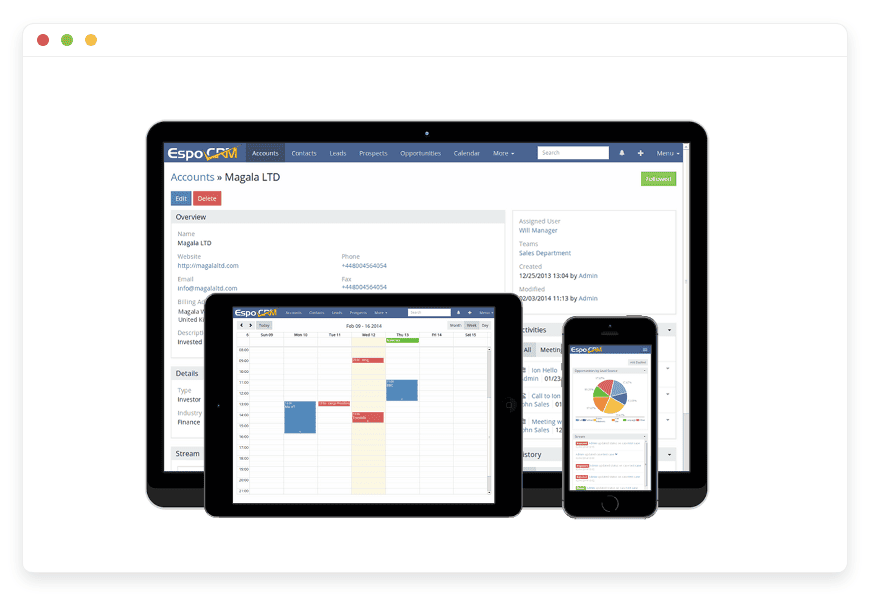
EspoCRM is an open-source CRM with around 3,000 stars on GitHub1, released under the AGPLv3 licence. It tracks leads, contacts, accounts, and opportunities, and it moves deals through a pipeline you define. It ships with email, a customer portal, and a no-code layout editor, so you can add the fields a property deal needs — listing address, price band, buyer or seller side — without writing code. There is even an official real-estate extension that adds property and listing records to the data model.
For a brokerage, EspoCRM replaces the contact-and-pipeline core of a tool like Follow Up Boss, whose Grow plan runs $69 per user per month2, or the CRM layer of an all-in-one such as kvCORE. The math turns on the words “per user.” Five agents on the per-seat plan is $345 a month before add-ons; the EspoCRM instance is €9, flat, no matter how many agents share it.
The honest limitation: EspoCRM is a general-purpose CRM, not a real-estate operating system. It will not pull MLS listings, score leads from a portal feed, or push a listing to a national site. It tracks the relationship and the deal; it does not replace the MLS-connected lead machine. If your team’s value sits in its CRM discipline rather than a specific portal integration, that is a fair trade.
We run managed EspoCRM for your pipeline so the patching and backups aren’t your problem.
Documenso — offers and contracts
Documenso is an open-source electronic-signature tool with roughly 13,000 stars on GitHub3, released under the AGPLv3 licence. The loop is the familiar one: upload a PDF, drag signature and date fields onto it, send it to the people who need to sign, and collect a sealed PDF when they’re done. Each completed document carries tamper-evident signing metadata and a record of who signed and when. It has reusable templates, a REST API, and the option to embed signing into your own site.
For a real-estate team, Documenso replaces the day-to-day signing you would otherwise route through DocuSign — whose Standard plan is $25 per user per month on annual billing and caps each user at 100 envelopes a year4 — or the signing inside a transaction tool like dotloop, at $31.99 per user per month5. When you run the tool yourself there is no envelope cap and no per-send surcharge; the number of documents you send is your own business.
The honest limitation: this is general-purpose signing, not a real-estate transaction suite. Documenso does not carry your jurisdiction’s standard forms, does not enforce a brokerage’s checklist, and does not run a deal from offer to close the way a platform with built-in forms does. It signs documents reliably. Whether a signed document satisfies a specific legal requirement is a question for your broker and your lawyer, not for a hosting page.
We run Documenso for offers and contracts on the same €9 floor.
Nextcloud — document storage and client sharing
Nextcloud is an open-source file platform with more than 30,000 stars on its main server repository6, released under the AGPLv3 licence. It stores and syncs files across desktop, mobile, and the browser, and it shares them through password-protected links you can set to expire on a date you choose. Its built-in office suite lets two people edit the same document in a browser, which helps when an agent and a client are working through a disclosure together.
For a brokerage, Nextcloud replaces the shared-storage role of Dropbox Business — around $15 per user per month on the Standard plan7 — or Google Workspace’s Drive at a similar per-seat rate. Five agents on Dropbox Standard is $75 a month, climbing with each new hire; the Nextcloud instance is €9, and you choose which of 21 datacenter regions it sits in.
The honest limitation: storage is the part of any stack that grows. The €9 base tier includes 30 GB, which is generous for documents but modest for years of listing photography and video walk-throughs. A team that stores heavy media will add storage at €0.50 per GB per month, and past a certain volume a dedicated media workflow makes more sense than a general file server. Nextcloud is excellent for documents and client sharing. It is not a video-asset manager.
We run Nextcloud for document sharing in the region you pick.
Paperless-ngx — the searchable archive
Paperless-ngx is an open-source document-management system with around 41,000 stars on GitHub8, released under the GPLv3 licence. It does the job nobody enjoys: it takes the pile of signed contracts, disclosures, and receipts and turns it into a searchable archive. It runs optical character recognition on every document, tags it, assigns a correspondent and a type, and lets you find a three-year-old purchase agreement by typing a street name. It can ingest documents straight from a watched email inbox.
For a brokerage, Paperless-ngx replaces the habit of dropping PDFs into dated folders on Dropbox or Drive and hoping to find them later. It is the layer that turns storage into a real records system — retention rules, full-text search, and an organised history of every deal.
The honest limitation, and it matters for a business that holds sensitive client paperwork: Paperless-ngx stores its documents unencrypted at the application level. The project says so directly9. That makes the security of the machine it runs on the thing that matters, which is part of why running it on infrastructure someone else patches and monitors is a reasonable choice. It is a superb archive. It is not, by itself, an encrypted vault, and you should treat it that way.
Mautic — drip campaigns to buyers and sellers
Mautic is an open-source marketing-automation platform with around 9,000 stars on GitHub10, released under the GPLv3 licence, and it reached version 7 in early 2026. It sends the long, patient email sequences that real-estate work depends on: a nurture track for buyers who are months from purchase, a seller track timed to a listing, a re-engagement series for cold leads. It handles segments, lead scoring, landing pages, and forms.
For a brokerage, Mautic replaces Mailchimp, where multi-step automation requires the Standard plan — $20 a month at a small list, climbing past $100 as your contacts grow11, and billed on every contact including the ones who unsubscribed. Mautic’s cost does not scale with your list the same way.
The honest limitation: Mautic is the heaviest tool in this stack. It expects scheduled background jobs and a properly configured mail setup, and email deliverability rewards attention — sender reputation, authentication records, send-rate discipline. The learning curve is real. This is the one app where “we run it for you” earns its keep most clearly, because the parts that break — the scheduled jobs, the mail relay, the delivery monitoring — are exactly the parts we handle. If your email need is a monthly newsletter to 200 people, Mautic is more engine than you need.
Easy!Appointments — viewing scheduling
Easy!Appointments is an open-source scheduling tool with around 3,000 stars on GitHub12, released under the GPLv3 licence. It gives each agent a booking page where buyers pick a viewing slot from real availability, and it syncs with Google Calendar so a double-booking does not happen. You define services, providers, working hours, and breaks, and it sends the confirmation and reminder emails.
For a brokerage, Easy!Appointments replaces Calendly, whose Standard plan is $10 per seat per month and whose Teams plan is $1613 — again, per seat, so the cost rises with every agent who needs a booking link. One Easy!Appointments instance covers the whole team at €9.
The honest limitation: this is a focused scheduler, not a sales-routing engine. It does the core job — availability, booking, reminders, calendar sync — and stops there. It does not collect a deposit at booking, it has no round-robin lead distribution, and its community is smaller than the larger scheduling projects, so new features arrive more slowly. For booking viewings and consultations it is more than enough. For a team that needs payment capture or complex routing inside the booking flow, a heavier tool fits better.
How the six fit together
The tools are useful alone, but they earn their place as a chain. A lead enters EspoCRM, books a viewing through Easy!Appointments, receives a nurture sequence from Mautic, signs an offer in Documenso, and the signed contract lands in Nextcloud and is filed for good in Paperless-ngx. One workflow, six owned tools.
Picture a single deal moving through the stack. An enquiry comes in from a portal or a referral and becomes a contact in EspoCRM, attached to a property and a side of the transaction. The buyer books a viewing through that agent’s Easy!Appointments page, which drops the slot straight onto the agent’s calendar.
While the deal is slow, Mautic keeps the relationship warm with a sequence written once and sent on a schedule. When the buyer is ready, the offer goes out for signature through Documenso and comes back sealed. That signed document is stored and shared with the client through Nextcloud, and a copy is filed in Paperless-ngx, where it stays searchable long after the deal closes.
None of these tools needs to know about the others for the chain to work; the agent is the connective tissue, the same way they are today across a bundle of SaaS. What changes is ownership. The contact list, the signed contracts, the email history, and the archive all sit on infrastructure you control, in a region you picked, under licences that let you export and leave whenever you want.
What this costs
Six apps at €9 each is €54 a month, flat. The proprietary bundle they replace is priced per agent, so its total depends on headcount — and for a five-agent team, a conservative tally of the equivalent tools runs several hundred dollars a month before add-ons. The gap widens with every hire.
Here is the comparison, tool by tool. The proprietary prices are published entry tiers as of mid-2026; real bills tend to run higher once add-ons, envelope overages, and contact-count tiers are included.
| Open-source tool | Replaces | Proprietary entry price | On DANIAN | Region |
|---|---|---|---|---|
| EspoCRM | Follow Up Boss / kvCORE CRM | $69 / user / month | €9 / month flat | Your choice of 21 |
| Documenso | DocuSign / dotloop signing | $25–$32 / user / month | €9 / month flat | Your choice of 21 |
| Nextcloud | Dropbox / Google Drive | about $15 / user / month | €9 / month flat | Your choice of 21 |
| Paperless-ngx | Ad-hoc PDF folders | — | €9 / month flat | Your choice of 21 |
| Mautic | Mailchimp | $20+ / month, climbs with list | €9 / month flat | Your choice of 21 |
| Easy!Appointments | Calendly | $10 / seat / month | €9 / month flat | Your choice of 21 |
The structural difference is the pricing axis. Take a five-agent team. On the proprietary side, the per-seat tools alone — CRM at $69, signing at $25, storage at $15, scheduling at $10 — come to $119 per agent per month, or $595 for five, before the email platform and before a single add-on. Add the sixth agent and it is $714. At ten agents those same four tools are close to $1,200.
The open-source stack does not move. Six applications at €9 are €54 a month whether three agents use them or thirteen. The one thing that grows your bill is storage, at €0.50 per GB beyond the 30 GB each app includes — a real cost for a media-heavy archive, but a predictable one, and unrelated to how many people you hire.
That €54 covers the parts of self-hosting that usually go wrong: security patching, daily off-site backups, monitoring, the mail and DNS setup, and a person available when something needs a human. You are paying for six applications to use, not six servers to maintain. If you want the per-app breakdown next to your current bill, the catalogue lists every app on the same €9 floor.
Where this stack stops
This is the honest part. The six tools cover the general business layer, but real estate has a specialised spine they do not touch: MLS access, listing-portal syndication, and transaction-compliance forms. If your work depends on those, you keep a real-estate platform for that layer and use this stack for everything around it.
Three things this stack does not do, stated plainly so you can plan around them.
It does not connect to the MLS. None of these tools pull listing data, sync active inventory, or check a property against a multiple-listing service. That connection lives in real-estate-specific platforms, and there is no open-source substitute that plugs into your local MLS the way a licensed product does.
It does not syndicate listings. Pushing a listing to a national portal is handled by platforms with those distribution deals in place. The tools here manage your relationships and your documents; they do not market your inventory to the portals.
It does not carry compliance forms. A platform like dotloop ships with jurisdiction-specific transaction forms and a brokerage’s compliance workflow built in. Documenso signs whatever PDF you give it, but it does not supply your standard contract or enforce a broker’s checklist.
The practical conclusion is not “don’t do this.” It is “do this for the right layer.” Keep the MLS-connected platform you need for listings and forms, and stop paying per seat for the general tools — the CRM, the signing, the storage, the archive, the email, and the booking — that you can own instead. For most small teams that second category is where the bill quietly grew, and it is the category this stack is built to take back.
How to start
Don’t migrate everything at once. Pick the one tool whose proprietary bill annoys you most, run it for the length of a 7-day free trial, and move real work through it. If it holds up, add the next. A stack you adopt one app at a time is one you actually keep.
The mistake is treating this as a migration project. It isn’t one. It is six independent decisions you can make in any order, and the sensible first move is the tool with the worst price-to-value ratio for your team right now.
For most brokerages that is the CRM or the e-signature line, because both are per-seat and both climb fastest. Start a trial, import a slice of real data — a few live contacts, one real contract — and use it for a week the way you would for real. A tool that survives a week of actual work has earned a place; one that doesn’t has saved you a migration.
When you are ready, deploying any app on DANIAN is a matter of picking it from the catalogue and choosing a region. We handle the setup, the mail configuration, and the custom domain, and we are there if a step needs a human. Add the apps one at a time, keep the ones that earn it, and let the rest wait. You can start a 7-day free trial on a single app, no card.
FAQ
How much does an open-source software stack for a real-estate team cost?
Six open-source apps — EspoCRM, Documenso, Nextcloud, Paperless-ngx, Mautic, and Easy!Appointments — run €9 each per month on DANIAN, so €54 a month for the full stack. That price is flat. It covers every agent on the team, and the only variable is storage at €0.50 per GB beyond each app’s 30 GB.
Is a self-hosted stack cheaper than per-seat real-estate software?
Usually, and the gap grows with headcount. Per-seat tools — a CRM, e-signature, storage, and scheduling — run roughly $119 per agent per month, so about $595 for five agents before add-ons. The six open-source apps are €54 a month, flat, whether three agents use them or thirteen.
Why €9 per app instead of one bundled price?
Because per-app pricing is what stays flat as your team grows. A bundled per-seat product charges you more every time you hire; six apps at €9 are €54 a month whether three agents use them or thirteen. The only variable is storage, at €0.50 per GB beyond each app’s included 30 GB.
Is managed open-source hosting worth it for a small brokerage?
It is worth it when your software bill scales with headcount and the per-seat lines keep climbing. You own the data and the apps, and we handle patching, daily off-site backups, monitoring, and mail. If you are a solo agent on a free tier, it is not worth the switch — stay where you are.
How many agents do I need before this stack makes sense?
There is no hard threshold, but the value shows from the moment per-seat pricing starts to bite — often around two to fifteen agents. Because the six apps cost €54 a month flat, every agent you add widens the gap against a per-seat bundle. A single agent on a free tier should stay there.
Do I have to move all six tools at once?
No. Each app is independent and priced on its own, so you can adopt them in any order. Most teams start with the CRM or the e-signature tool — the two that hurt most on per-seat pricing — run one for a week, and add the rest only as each proves itself in real use.
What is the best open-source alternative to DocuSign for real estate?
Documenso is the closest open-source alternative for day-to-day signing. You upload a PDF, place signature and date fields, send it, and collect a sealed document with tamper-evident signing metadata. There is no envelope cap and no per-send surcharge. It does not carry your jurisdiction’s standard transaction forms, so a real-estate platform still owns that part.
What open-source CRM is a good alternative to Follow Up Boss or kvCORE?
EspoCRM is a strong open-source option. It tracks leads, contacts, and a pipeline you define, and an official real-estate extension adds property and listing records. It runs €9 a month flat for the whole team. It does not pull MLS data the way an all-in-one platform does, so pair it with your MLS tool.
What can I use instead of Calendly to book property viewings?
Easy!Appointments is the open-source option for viewing scheduling. Each agent gets a booking page, buyers pick a slot from real availability, and it syncs with Google Calendar to avoid double-bookings. One instance covers the whole team at €9 a month. It does not take a deposit at booking or do round-robin lead routing.
Is there an open-source way to send drip emails to buyers and sellers?
Yes — Mautic handles marketing automation: nurture sequences for buyers, seller tracks timed to a listing, and re-engagement series for cold leads. It manages segments, scoring, and forms. Mautic is the heaviest app to run well, needing scheduled jobs and careful mail setup, which is the part we manage for you at €9 a month.
Will this replace my MLS or listing-portal tools?
No, and that is the honest answer. These six cover the general business layer: CRM, signing, storage, archive, email, scheduling. MLS access, listing syndication to portals, and built-in transaction-compliance forms live in real-estate-specific platforms. Keep that platform for those jobs and use this stack for everything around it.
Do these six tools connect to each other automatically?
Not automatically — they are independent apps, not a single integrated suite. In practice the agent is the connective tissue: a lead in EspoCRM books through Easy!Appointments, gets a Mautic sequence, signs in Documenso, and the file lands in Nextcloud and Paperless-ngx. Each app also has an API if you want to wire them together.
Is a signed contract from Documenso valid?
Documenso produces a sealed PDF with tamper-evident signing metadata and a record of who signed and when. Whether that satisfies a specific legal or brokerage requirement depends on your jurisdiction and your transaction. That is a question for your broker and your lawyer; a hosting page cannot answer it for you.
Is it safe to store sensitive real-estate documents on self-hosted apps?
It can be, with the right care. The apps run on infrastructure we patch, monitor, and back up daily off-site, in the region you choose. One honest caveat: Paperless-ngx stores documents unencrypted at the application level, so the security of the underlying machine matters — which is part of why a managed, monitored setup is sensible.
Can I choose where my data is hosted?
Yes. Each app can run in the datacenter region you pick from 21 locations across six continents, so your data sits where you want it — close to your team or your clients. You can also export your data at any time, since these are open-source apps under public licences.
What happens to my data if I leave?
It stays yours. These are open-source apps under public licences, so you can export your contacts, documents, and archive and take them elsewhere whenever you want. We back up every instance daily, off-site, and we publish how to pull your data out.
Do I need server or technical skills to run these tools?
No. That is the point of the managed service — we run the servers, apply security patches, take daily off-site backups, monitor uptime, and set up mail and DNS. You use six finished applications in the browser. Mautic is the most demanding to run well, and it is the one we look after most closely.
Who keeps these tools patched and backed up?
We do. The €9 per app covers security patching, daily off-site backups, monitoring, and the mail and DNS setup, plus support when something needs a person. You get six applications to use across the region you choose, not six servers to maintain. Open-source software, run for you.
Can I try the tools before paying?
Yes. Every app comes with a 7-day free trial and no card required. The sensible approach is to start with the one tool whose per-seat bill annoys you most, import a slice of real data, and run it for the week. If it earns its place, add the next app.
How long does it take to get started?
The setup itself is on us — we configure the app, the mail, and your custom domain when you pick it from the catalogue and choose a region. The time that actually matters is your own: importing a slice of real data and testing for a week, which is exactly what the 7-day trial is for.
Can I use my own domain with these apps?
Yes. Each app can run on your own custom domain — your CRM, signing, storage, and booking pages all live under a domain you control, not a generic shared one. We handle the domain and mail configuration as part of the setup, so the apps look like part of your own brand.
What to do this week
This week, pick one line on your software bill that scales with headcount and shouldn’t. Start a trial of its open-source equivalent and move one real piece of work through it. Keep the MLS platform you need; take back the general tools you don’t.
A real-estate team’s software bill grows the way a garden does — one plant at a time, until it’s overgrown and nobody remembers planting half of it. The per-seat tools are the fastest-growing of all, because they charge you for success: every agent you add is another set of subscriptions.
The six tools here will not change the part of your business that depends on the MLS, and we have been clear about that. What they change is everything around it. The CRM, the contracts, the shared files, the archive, the drip email, and the booking page can all be tools you own, running at a price that doesn’t care how many people you hire.
You don’t have to decide today. Pick the one that annoys you most on this month’s bill, try it for a week, and see whether owning it feels better than renting it. The pricing is the same €9 floor for every app. Most teams find the second app is an easier decision than the first.
Sources:
1. EspoCRM, official site: https://www.espocrm.com/
2. Follow Up Boss pricing: https://www.followupboss.com/pricing
3. Documenso, official site: https://documenso.com/
4. DocuSign plans and pricing: https://ecom.docusign.com/plans-and-pricing/esignature
5. dotloop plans and pricing: https://www.dotloop.com/products/plans-pricing/
6. Nextcloud, official site: https://nextcloud.com/
7. Dropbox plans: https://www.dropbox.com/plans
8. Paperless-ngx documentation: https://docs.paperless-ngx.com/
9. Mautic, official site: https://mautic.org/
10. Mailchimp pricing: https://mailchimp.com/pricing/marketing/
11. Easy!Appointments, official site: https://easyappointments.org/
12. Calendly pricing: https://calendly.com/pricing/