White-label managed stack for 3-person agencies
The 3-person agency's white-label managed stack in 2026 — recurring revenue without the on-call burden
TL;DR
- A three-person agency can add recurring revenue by reselling four managed open-source apps — Mautic, Matomo, n8n, and Chatwoot — without running the servers.
- The wholesale cost is €36 per client per month: four apps at €9 each.
- At a €120–200 retail bundle, twenty clients return €2,400–4,000 in monthly revenue and €1,680–3,280 in gross margin before your own time.
- Three of the four apps resell cleanly. n8n's license is stricter, and this post explains how to stay on the right side of it.
- We carry the infrastructure on-call — patching, backups, monitoring, and 24/7 support. You keep the client relationship.
The agency math, in one table
The arithmetic is the whole argument. Four managed apps cost €36 per client per month at wholesale. Sell the bundle at €120–200, and twenty clients return €2,400–4,000 a month. After the wholesale bill, €1,680–3,280 is yours. The recurring revenue compounds; the server work does not land on you.
The €36 is fixed and transparent: Mautic, Matomo, n8n, and Chatwoot at €9 each. There is no per-seat fee, no per-contact tier, and no task meter. Your retail price is your decision.
| Clients | Wholesale (€36 each) | Retail @ €120 | Retail @ €200 | Margin @ €120 | Margin @ €200 |
|---|---|---|---|---|---|
| 10 | €360/mo | €1,200/mo | €2,000/mo | €840/mo | €1,640/mo |
| 20 | €720/mo | €2,400/mo | €4,000/mo | €1,680/mo | €3,280/mo |
| 40 | €1,440/mo | €4,800/mo | €8,000/mo | €3,360/mo | €6,560/mo |
Take one client as a worked example. The agency runs Mautic for the email campaigns and Matomo for the analytics behind the monthly report. n8n routes new leads into the CRM, and Chatwoot runs the chat widget on the client's site. That is the full €36 wholesale line. The agency bills the client €180 a month and folds it into the existing retainer.
On that one client, the margin is €144 a month before time. Across twenty clients on the same setup, the pattern repeats: €36 in, €180 out, the relationship already yours. The stack is the same four apps every time, so you learn one playbook and run it across the book.
Two levers move you toward the €5–15K monthly range. The first is client count: at €120–200 a client, roughly forty to seventy-five clients gets you there. The second is the bundle itself. Wrap the four apps inside a fuller retainer — campaign work, dashboards, reporting — and price it at €250–750 a client, and twenty clients reach the same range. The €36 wholesale is then a small line on the invoice.
One honest adjustment. The margin above is before your own time. At twenty clients, plan for a handful of account-management hours a month — onboarding, a config tweak, a client question. That is work you already do on a retainer. It is not infrastructure on-call, which is the part that does not scale for a small team.
Start a 7-day trial on one app — no card needed.
Why becoming a SaaS partner stopped being the obvious move
For years, the recurring-revenue play for an agency was to join a partner programme — HubSpot, ActiveCampaign, or a chat tool like Drift — and resell the vendor's plan. That still works, with one structural catch. You are a channel, not the owner. The vendor holds the data, the renewal, and the off-switch.
Reselling a proprietary SaaS means the client pays the vendor. HubSpot's Marketing Hub Pro runs $800 or more a month, and the client's contract is with HubSpot. You earn a margin or a commission, but you do not own the recurring infrastructure line, and you do not control the renewal.
The off-switch is not hypothetical. Salesloft acquired Drift in 2024 and, after its Clari merger, announced Drift's sunset in March 2026 — naming a separate product as the successor for existing customers. Any agency that built recurring revenue on reselling Drift now has to migrate every client to something else. That is the risk of building on a platform you do not own.
Usage-metered tools carry a different version of the same problem. Zapier's Team plan is $69.50 per user per month and bills by task, so the cost climbs with every client workflow you run. The price is the vendor's to change, not yours.
Owning a managed open-source stack inverts this. The app is the client's own instance. The code is open — under GPL or MIT — so no vendor can withdraw it or reprice it out from under you. For an agency moving past ad-spend management toward durable recurring revenue, that ownership is the point.
The four-app agency core stack
Four apps cover most of what an agency resells: marketing automation, web analytics, workflow automation, and live chat. Each runs as the client's own instance at €9 a month. Here is what each replaces, how it is licensed, and the wholesale price your margin is built on.
Mautic — managed marketing automation
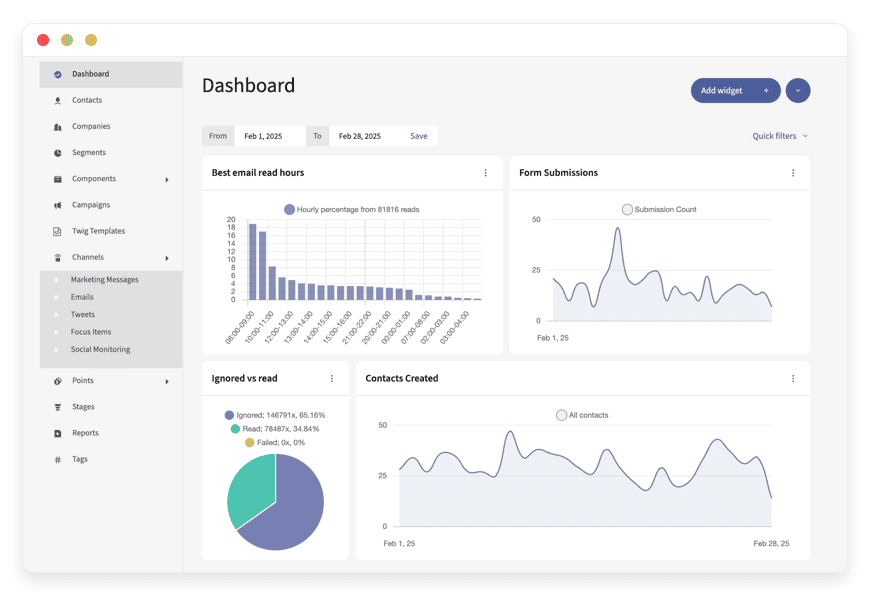
Mautic is the largest open-source marketing-automation project, with around 9,000 GitHub stars and a release history going back to 2014. It covers email campaigns, landing pages, lead scoring, and contact management. It replaces HubSpot Marketing Hub and ActiveCampaign for clients who want to own their contact data.
Mautic is licensed under GPL-3.0, which is resale-friendly for a hosted service. The project's own managed Mautic Cloud starts at €247.50 a month, so a €9 managed instance is a different order of price. Self-hosting it well means PHP, MySQL, cron jobs, and email-deliverability tuning — the part most agencies would rather not own.
We run managed Mautic for agencies at €9 a month per client instance.
Matomo — privacy-first analytics
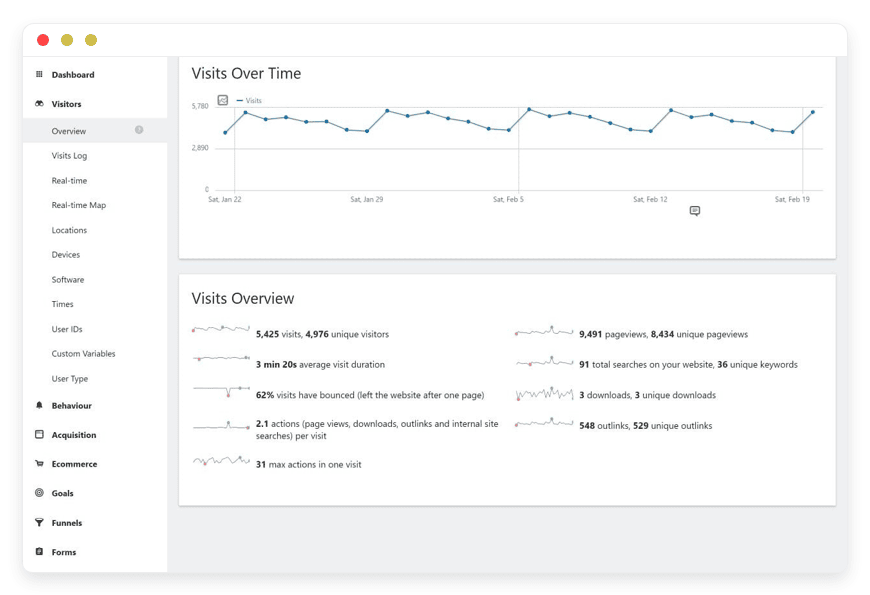
Matomo is a privacy-first web-analytics platform, first released in 2007 and used on over 1.4 million websites. It tracks visitors, campaigns, and goals while keeping the data on infrastructure the client controls. It replaces Google Analytics, often after a privacy-policy review or a Google Analytics audit.
Matomo is GPL-3.0 licensed, so reselling it as a hosted service is straightforward. Its managed cloud starts around €19–29 a month per 50,000 hits, and premium plugins such as heatmaps and session recording are sold separately. Running it yourself needs PHP, MySQL, and a database you tune as a client's traffic grows. We run managed Matomo.
n8n — workflow automation
n8n is a workflow-automation tool with more than 120,000 GitHub stars and 400-plus integrations, founded in 2019. It connects apps and automates tasks visually, and it replaces Zapier for teams tired of per-task pricing. Its license, though, is the one detail every reseller has to read first.
n8n is distributed under the Sustainable Use License, which is not an open-source license in the strict sense. It permits internal business use and self-hosting, but restricts offering n8n to your customers for them to build their own workflows. The next section covers what that means for reselling. We run managed n8n for client workflows at the same €9 floor.
For comparison, Zapier's Team plan is $69.50 per user per month and meters by task; a busy account can run $400–600 a month on its own. A self-hosted n8n instance has no per-task meter.
Chatwoot — live chat and shared inbox
Chatwoot is an open-source live-chat and shared-inbox platform with around 30,000 GitHub stars, first released in 2017. It unifies website chat, email, and social messages into one queue, with no per-seat fee when self-hosted. It replaces Drift, Intercom, and Zendesk for support and conversational sales.
Chatwoot is MIT-licensed, the most permissive of the four — you can fork it, rebrand the chat widget, and resell it freely. Its managed cloud runs $19 to $99 per agent per month; self-hosting removes the per-seat tax entirely. The trade-off is operations: Docker, PostgreSQL, and Redis all have to be kept running. We run managed Chatwoot.
Agencies often extend the core four with EspoCRM for client CRM and Penpot for design hand-off. Both sit in the same €9 catalogue, so the bundle grows without a new vendor.
The license question every reseller answers first
Before you sell a managed open-source app, check what its license permits. Three of the four are clear. Mautic and Matomo are GPL-3.0, and Chatwoot is MIT — all three let you host and resell freely. n8n is the exception, and its Sustainable Use License needs a closer read.
GPL-3.0, which covers Mautic and Matomo, is a copyleft license. You can run either app as a managed service for a client without restriction. If you modify the source and distribute that modified version, you share your changes — but operating the unmodified app as a hosted service does not trigger that obligation. For reselling, GPL is friendly.
The MIT license, which covers Chatwoot, is the most permissive of the set. You can fork it, change the branding, build on it, and resell it. The code is yours to adapt for clients.
n8n's Sustainable Use License is what its maintainers call "fair-code": the source is public, but it is not open source by the strict definition. The license allows internal business use and self-hosting. It restricts making n8n available to your customers for them to connect accounts and build their own workflows, and it restricts reselling n8n as a competing managed service.
In practice, there is a safer pattern and a riskier one. The safer pattern: each client runs their own n8n instance, owns the data, and uses it for their own business — close to internal use, with the agency operating it on the client's behalf. The riskier pattern: you run one n8n product that many clients log into to build workflows, billed for access. That is closer to what the license restricts.
The honest instruction is simple. If you plan to offer a client-facing n8n workflow product, read the Sustainable Use License and email n8n before you sell. For straightforward per-client instances, you are on firmer ground. A managed provider does not change this — the obligations travel with the software, whoever runs the server.
What white-label actually requires — and what we do today
White-label resale needs four things: each client's app on the client's own domain, a branded sign-in, suppressed product-update banners, and billing you control. We do the domain part today, and we isolate every client's instance. The branded control plane and billing pass-through are on the roadmap, not shipped.
| Capability | DANIAN today | On the roadmap |
|---|---|---|
| Custom domain per client | Yes — each app runs at the client's chosen domain | — |
| Per-client isolation | Yes — each instance is a hardened, isolated container with its own resources | — |
| Branded sign-in / hidden update banners | App-dependent — varies by app; not guaranteed across all four | A consistent branded experience across the stack |
| Unified partner dashboard | Not yet — client instances are managed individually | A control plane to manage every client instance under your brand |
| Branded invoices / billing pass-through | Not yet — you bill clients directly; we bill you | A commission tier and billing pass-through |
Today, the white-label experience is custom domains and real isolation, managed instance by instance. A consistent branded sign-in and hidden update banners vary by app — some allow it, some do not — so we will not promise it across all four. A unified partner dashboard, branded invoices, and billing pass-through are roadmap items, not live features.
The isolation point matters for resale. Each client's app runs in its own hardened container with its own resources, not pooled into one shared account. That removes the fragile multi-tenancy that breaks when one client's data leaks into another's view.
Here is the shape of it today. You hold one DANIAN account and deploy a separate instance per client, each on the client's own subdomain or domain. You manage the instances from the dashboard and reach support when a change needs a human. You invoice the client through your retainer; we invoice you at the €36 wholesale. It is manual where a partner dashboard will later be automatic, but it works now.
If a finished partner dashboard and branded billing are deal-breakers for you this quarter, a turnkey reseller programme will fit better right now, and that is an honest answer. If you want to shape what our partner programme becomes, early agency partners influence the roadmap. We would rather build it with the agencies who will use it.
The per-app price is flat and public, which makes agency-friendly flat pricing easy to model against your own client count.
See the per-app numbers on the pricing page.
The on-call burden — who carries the pager
Self-hosting the four-app stack means owning four operational surfaces: Mautic's cron jobs and deliverability, Matomo's database at traffic, n8n's queue, and Chatwoot's Docker, PostgreSQL, and Redis. The recurring revenue is attractive until a client's app breaks at 2am. That pager is the part we take off your desk.
The work self-hosting hides is steady, not dramatic. Each app needs monthly patching, certificate renewal, backup verification, and database tuning as a client's traffic grows. Then there is the pager — being reachable when something breaks outside office hours, which for client-facing apps is when it hurts most.
Our side of that is plain. We patch monthly, monitor 24/7, and back up every instance daily, off-site. When a client's instance needs attention, a named engineer answers chat, usually within minutes.
Your side does not change. You still own the client relationship and the first question — why a campaign is not sending, a new automation, a config tweak. That is account-management work you already do. What you are not doing is owning the patch cycle or the midnight breakage.
This is the honest split behind the title. The infrastructure on-call is the part that does not scale for a three-person team, and it is the part we run. The relationship work stays with you, where it belongs.
When this works — and when it doesn't
This model fits a specific kind of agency. If you already run client retainers and want to own recurring infrastructure revenue, the math works. If you need a turnkey white-label dashboard today, or your team would rather run the servers itself, a different path fits better. Here are the signals.
It fits when:
- You already manage ten or more client retainers and want a recurring revenue line you own, not a vendor's plan you resell.
- You want each client's data in its own isolated instance, not pooled in one shared account.
- You are comfortable managing client instances individually today while a partner control plane is built.
It doesn't fit when:
- You need a finished white-label partner dashboard, branded invoices, and billing pass-through this quarter. Those are on the roadmap, not shipped.
- You want to resell n8n as a client-facing workflow product and have not checked the Sustainable Use License. Clear the license first.
- You have an in-house DevOps engineer who would rather self-host the stack on a VPS — with a tool like Coolify — and keep the operational margin in-house. If you have the people and want to own the on-call, that is a genuinely good path.
FAQ
What is white-label managed open source?
White-label managed open source means an agency resells open-source apps to clients under the agency's own brand, while a provider runs the servers. The agency owns the client relationship and the pricing; the provider handles patching, backups, and monitoring. The client uses the app on their own domain without dealing with the infrastructure.
Which open-source apps are best for an agency to resell in 2026?
For most agencies, four apps cover the core: Mautic for marketing automation, Matomo for analytics, n8n for workflow automation, and Chatwoot for live chat. Each runs at €9 a month managed. Agencies often add EspoCRM for client CRM and Penpot for design hand-off from the same 150-plus app catalogue.
Can a small agency resell these apps without becoming a hosting company?
Yes. The client's app runs as a managed instance you resell; we operate the server, the patching, and the backups. You package, price, and support the client relationship. You never touch a VPS, a patch cycle, or a backup job — which is what "without becoming a hosting company" means in practice.
How is reselling managed open source different from becoming a HubSpot or SaaS partner?
As a SaaS partner, the client pays the vendor — HubSpot's Marketing Hub Pro runs $800 or more a month — and you earn a commission on the vendor's plan. Reselling managed open source flips it: the app is the client's own instance, you set the price and own the recurring revenue, and no vendor controls the renewal.
How is this different from self-hosting the apps on a VPS myself?
Self-hosting on a VPS — for example with a tool like Coolify — keeps the operational margin in-house but puts the patching, backups, and 2am pager on your team. Managed hosting at €9 an app removes that on-call work. The trade-off is the monthly fee versus the cost of your own time and risk.
What does the wholesale stack cost, and what should I charge?
The four-app stack is €36 per client per month — Mautic, Matomo, n8n, and Chatwoot at €9 each. Retail is your call. A €120–200 bundle is a common hosting markup; wrapping the apps inside a fuller retainer at €250–750 raises the figure and the value you deliver.
What gross margin can an agency make on a managed open-source bundle?
At a €36 wholesale stack sold for €180 a month, the gross margin is €144 per client — about 80 percent before your own time. Across twenty clients that is roughly €2,880 a month in gross margin. Your net depends on the account-management hours you spend, not on infrastructure work.
What's the minimum number of clients to make reselling worth it?
There is no setup fee, so the model pays from the first client: €36 wholesale, €120–200 retail. Most agencies treat ten clients as the point where it becomes a real revenue line — roughly €840–1,640 a month in gross margin at that count. Beyond twenty, it compounds without adding infrastructure work.
Why is €9 per app so cheap — what's the catch?
There is no catch, but there is a model. Each app runs in its own isolated container on shared underlying infrastructure, which keeps the per-app cost low without per-seat or per-contact fees. You get isolation and predictable pricing; you do not get root server access. For most agency clients, that is the right trade.
Do I need a developer or DevOps person to resell these apps?
No. The point of managed hosting is that the patching, backups, scaling, and security run on the provider's side. You handle the client-facing work — campaign setup, a config change, a report — which is account management, not server administration. A part-time technical contact helps for advanced client requests, but is not required to start.
How long does it take to set up a client's app?
Most apps activate quickly, often the same day. More involved setups — custom domains, email deliverability for Mautic, or data import — sometimes need a human touch and a little longer. Support handles the configuration over chat when a client's app needs it, so you are not blocked waiting on a server.
What happens at 2am if a client's app breaks?
You message us, or we have already caught it. We monitor every instance 24/7, and a named engineer answers chat, usually within minutes — not a queue. The client never learns there was a server to worry about, which is the point of reselling a managed app.
What if a client needs an app that isn't in the catalogue?
The catalogue covers more than 150 open-source apps, and new ones are added on request — usually within a few days for active accounts. Email the project's URL and it gets evaluated for the catalogue. That responsiveness is part of why agencies consolidate client apps with one provider rather than juggling several.
Can I white-label the stack today?
Partly. Each client's app runs on the client's own domain in an isolated instance today. A consistent branded sign-in and hidden update banners depend on the app and are not guaranteed across all four. A unified partner dashboard and branded billing are on the roadmap, not shipped yet.
Do I keep the client relationship, or does the provider take it over?
You keep it. The client is yours — you sell, price, and support the relationship, and the apps run under your brand on the client's domain. The provider operates the infrastructure in the background and does not market to or bill your clients directly. There is no partner programme that inserts itself between you and the client.
How do I bill my clients?
Today, you bill clients directly and we bill you €36 per client per month at wholesale. Billing pass-through and a commission tier are on the roadmap. For now, most agencies fold the stack into an existing retainer invoice, which keeps the client relationship cleanly yours.
Is it legal to resell open-source software to clients?
Usually yes, but it depends on the license. Permissive licenses like MIT (Chatwoot) and copyleft licenses like GPL-3.0 (Mautic, Matomo) let you host and resell freely. Fair-code licenses such as n8n's Sustainable Use License add restrictions on offering the app to clients. Always check the specific license before you sell.
Does n8n's license let me resell it to clients?
It depends on the pattern. n8n's Sustainable Use License permits per-client instances used for the client's own business. It restricts running one n8n product that many clients log into to build workflows. If you plan a client-facing workflow product, read the license and email n8n first.
Can my clients export their data if they leave?
Yes. The app is open source and the data is the client's, so there is always an exit. Instances are backed up daily, and data can be exported or downloaded on demand. Because the software is standard open source, a client can move to self-hosting or another provider without being locked in.
What happens to my clients if the hosting provider shuts down?
Because the apps are open source and the data is exportable, your clients are never trapped on one provider. If you ever needed to move, the same Mautic, Matomo, n8n, or Chatwoot instance can be self-hosted or rehosted elsewhere. That portability is the structural advantage of open source over a closed SaaS you cannot take with you.
Do I have to sign a contract or pay upfront to start reselling?
No long contract and no upfront fee. Billing is monthly per app — €9 each — and you can start with a single client or a 7-day trial. The partner relationship today is informal and month-to-month; a formal commission tier and partner agreement are on the roadmap. You commit at the pace your client base grows.
What to do this week
Three steps tell you whether this fits your agency. Start with one app and see it through a client's eyes. Model the margin on your real client count using the table above. Then, if you want to resell at scale, set up a partner account and help shape what the white-label programme becomes.
- Start a 7-day trial on one app. Mautic or Chatwoot show a client the fastest. No card needed.
- Model the margin on your own client count with the €36 wholesale and your retail price.
- Email partners@danian.co to set up a partner account and influence the white-label roadmap.
Sign up for your partner account.
The recurring revenue is real, and the arithmetic holds at €36 wholesale. The work that does not scale for a small team — the patching, the backups, the pager — is the part we run.
Sources: Mautic, Matomo, n8n and the Sustainable Use License, Chatwoot, Drift, Zapier pricing, and HubSpot pricing. Pricing verified May 2026; figures change — check the current pages.