Reselling managed Metabase in 2026
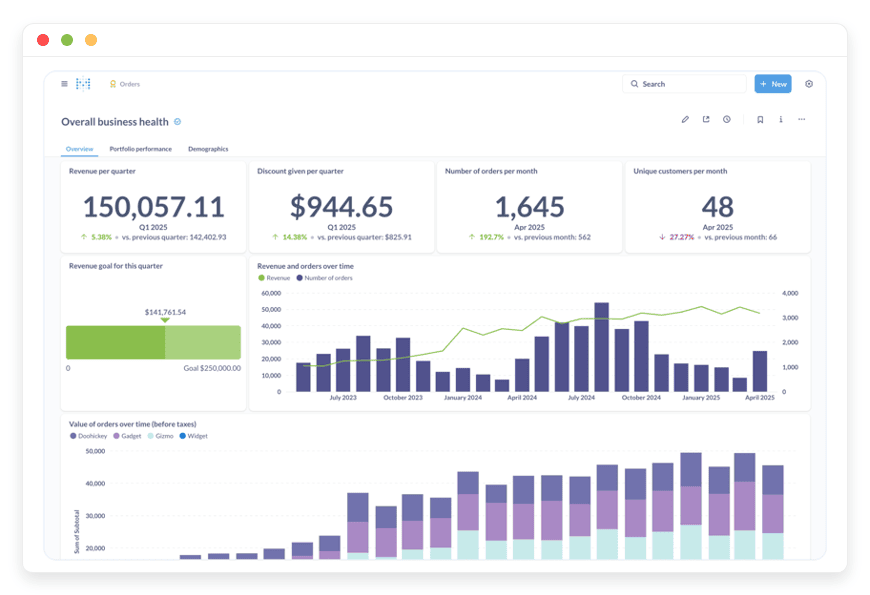
This is a guide for agencies that want a recurring dashboard line without running servers. The model is simple: one managed, self-hosted Metabase instance per client, billed to you at €9 per month. Metabase's open-source edition is free to self-host and supports unlimited users. Your cost stays flat at €9 while a client's per-seat BI bill climbs with every viewer.
The trigger is on the client side. A growing team hits Tableau, Looker, or Power BI seat pricing, or a Metabase Cloud tier, and the bill scales with headcount. The agency pull is the question every operator eventually hears: can you just run our reporting? This post shows the math, the white-label reality, what we run, and where Metabase stops.
TL;DR
- The model: one isolated Metabase instance per client. Your cost is €9 per month; retail the line at €60 to €200 per month for the build plus hosting.
- Why now: Tableau runs $75 Creator, $42 Explorer, $15 Viewer per user per month; Power BI is $14 Pro and $24 per-user Premium; Looker starts around $60,000 per year. Self-hosted open-source Metabase has no per-seat licensing.
- The margin: at 12 clients, €720 to €2,400 per month recurring, against €108 per month in hosting cost.
- The honest part: your value is the data modeling and dashboard build, not a hosting markup. And Metabase is not Tableau or Looker — know where it ends.
- What we run: patching, daily off-site backups, monitoring, and the region you choose. There is no white-label console or branded invoicing from us today.
Why agencies are adding a BI line
The reason is per-seat pricing that punishes the client for sharing reports. On the major BI tools, every authenticated viewer becomes a paid seat. A dashboard the whole team needs turns into a bill that grows with headcount. A self-hosted instance removes that tax, and the gap is what an agency can package and sell.
Here is the client-side picture, verified against each vendor's current pricing. Tableau Cloud Standard is $15 per Viewer, $42 per Explorer, and $75 per Creator, per user per month, billed annually. Every deployment needs at least one Creator. A 10-person team lands near $4,212 per year, and 50 external client viewers cost about $9,000 per year before anyone builds a dashboard.
Power BI Pro is $14 per user per month and Premium Per User is $24, both raised in April 2025. Both builders and viewers need a paid licence unless the client buys a large Fabric capacity. Looker, the platform with the LookML modeling layer, sells through enterprise sales. Its platform fee is reported to start near $60,000 per year, plus per-user seats and warehouse query costs.
Even Metabase's own hosted plans are per-seat. Metabase Cloud Starter is $100 per month for five users, plus $6 per extra user. Pro is $575 per month for ten users, plus $12 per extra user. The open-source edition you self-host carries none of that per-seat cost — which is the whole basis of the reseller model.
The agency math
Start from the cost basis. A managed Metabase instance is €9 per month, flat, for one client. You retail the line at €60 to €200 per month, which prices the analytics work, not the server. The recurring gross margin is roughly €51 to €191 per client per month, before the build hours you bill separately.
Scale it modestly. At 12 clients, the recurring line is €720 to €2,400 per month, while your total hosting cost is €108 per month. The first month of each client includes setup and modeling time. Read early months as project work, and the monthly spread as the durable revenue.
The structural advantage is flat-versus-per-seat. A client who grows from 5 to 40 dashboard viewers pays the same €9 on a self-hosted instance. The equivalent seats on Tableau or Power BI would multiply. Your margin does not just hold as the client grows; it widens. Their per-seat alternative gets more expensive while your €9 cost does not move.
| Clients | Your hosting cost / mo | Recurring line at €60–200 / client |
|---|---|---|
| 1 | €9 | €60 – €200 |
| 5 | €45 | €300 – €1,000 |
| 12 | €108 | €720 – €2,400 |
| 25 | €225 | €1,500 – €5,000 |
One honest caveat on the table: it shows the recurring line, not profit. Subtract your build and maintenance hours, and price the retail end to the value of the dashboards, not to a multiple of €9. If you would not pay for the dashboard yourself, the client probably will not renew for it either. You can start with managed Metabase at €9/month on a single client and prove the line before you scale it.
What white-label actually requires today
Agencies mean four things by white-label. A custom domain, a branded login, branded invoices, and a console to manage every client at once. Some of that is available now, and some is not. Being straight about the gap is better than selling a tier that does not exist, so here is each piece.
Custom domain works today. Each instance can run on a subdomain you choose, such as analytics.clientname.com, so the dashboard sits inside the client's brand. Branded login and badge removal do not. The open-source edition shows a Powered by Metabase mark. Removing it needs the paid Enterprise edition licence on top of hosting.
Branded invoicing and a central console are not products we offer today. You bill clients through your own system and manage each instance on its own. There is no co-branded DANIAN invoice and no single screen that lists 10 to 100 client instances. Agencies ask for both, and these conversations are how we scope whether and when to build them.
The DANIAN reseller setup today
Here is exactly how it works now, with no fine print. You are the account holder. You pay the standard €9 per app per month for each client instance. You set retail, and you keep the client relationship and the billing.
That flat structure is the honest advantage for a small agency. Large SaaS partner programs often carry a prohibitive upfront cost. Some reseller programs require a block commitment, such as roughly $400 per month for 30 instances. Here you can start with one client at €9, with no minimum and no commitment, and add instances as you sign work.
What we run on each instance: patching, security updates, daily off-site backups, monitoring, and the region you choose at setup. Your operational time on the server is zero hours. We will not upgrade your resources or charge you without your explicit consent. Card failed? We wait. We don't delete your data. Email or chat us. A human replies.
For more info, see our Partner program page.
Isolation and data — what each client gets
Each client gets their own Metabase instance in an isolated container, not a shared login on one multi-tenant system. One client's users, data connections, and dashboards never touch another client's. That separation is the reason to run one instance per client rather than a single shared deployment with fragile internal walls.
Clients keep their own data. Metabase connects to the client's existing database — Postgres, MySQL, BigQuery, Snowflake, and others — and reads from it. The agency sets up the connection and builds the model; the client keeps owning the database. Application data is hosted in the region you choose, across 21 datacenter locations spanning six continents.
The open-source edition supports unlimited users, so the client's whole team views dashboards with no per-seat cost. That is the enabler the whole model rests on. One honest limit: the open-source edition offers collection-level permissions and Google sign-in. Row and column data restrictions and SAML or LDAP single sign-on are Enterprise-edition features. For one isolated instance per client, that is usually fine; price it in if a client needs internal row-level restrictions.
Three open-source tools that resell well
Metabase leads for client reporting, but it is not the only tool that fits the model. The choice depends on what the client's dashboard is for: business reporting, live operations, or heavy large-scale analysis. Each runs as its own €9 instance, so you can mix them across a client base under one approach.
Metabase, around 48,000 GitHub stars and AGPL-v3 licensed, is the default. Its no-code query builder lets non-technical client teams read and filter dashboards, with raw SQL underneath for you. It is the right pick when the client wants clean, self-serve reporting rather than a data-science workbench.
Grafana, around 75,000 stars and AGPL-v3 licensed, is for live operational and time-series dashboards: uptime, infrastructure, device telemetry, and real-time KPIs. Reach for it when the client is watching metrics move, not reading a weekly business report. It is a different job from Metabase, not a heavier version of it.
Superset, around 73,000 stars and Apache-2.0 licensed, is heavier BI for data-savvy teams that have outgrown a simpler tool. It offers deeper charting and SQL for analysts who want more control. When a client's needs pass what Metabase covers, point them at Superset for heavier BI rather than overselling Metabase.
What Metabase does not do
Selling the model honestly means naming the ceiling. Metabase favors quick, readable dashboards. It does not match Tableau's deep statistical visualization or Looker's governed LookML semantic layer. Some clients need a single governed definition of every metric across a large organization. For that job, Metabase is the wrong tool.
Several features sit behind the paid editions, not the free one. Badge removal, interactive embedding, SAML single sign-on, and row or column data restrictions are Enterprise-edition features. Each costs a licence on top of hosting. The unlimited-user model is great for internal client reporting. It is not built to monetize thousands of external viewers inside the client's own product.
So know when to walk away. A client who needs a governed enterprise semantic layer is not a Metabase open-source fit. Neither is one who wants to embed analytics for thousands of external users at scale. That is a Superset conversation, or a different tool entirely. Saying so early protects the trust the rest of the relationship runs on.
When this works — and when it doesn't
Three signals say the model fits. You already do the client's data work, so dashboards are a natural add. The client has five or more people who need to view reports, which is exactly where per-seat tools get expensive. And you want recurring revenue while keeping the client relationship rather than handing it to a partner program.
Three signals say it does not. You want a turnkey white-label console and branded billing today, which is not here yet. Your client needs enterprise governance, SSO, or row-level restrictions inside one instance, which means an Enterprise licence or another tool. Or you do not want to do any data modeling — in which case there is no value-add and no margin to capture.
Frequently asked questions
Money and margin
How much can I charge a client for a managed Metabase dashboard?
Agencies typically retail a managed dashboard line at €60 to €200 per client per month. The price reflects the data modeling and dashboard build, not a hosting markup. Your hosting cost is a flat €9 per instance per month, so the spread is the value of your analytics work.
What is the margin on reselling managed Metabase?
Your cost basis is €9 per client instance per month. At a €60 to €200 retail line, the recurring gross margin is roughly €51 to €191 per client per month. Unlike per-seat tools, that cost stays flat as the client adds dashboard viewers, so the margin widens over time.
How many clients do I need for a real recurring line?
At 12 clients, a €60 to €200 retail line is €720 to €2,400 per month recurring. Your hosting cost is €108 per month total. The first month of each client carries build hours, so treat early months as setup and the recurring spread as the durable revenue.
Should I charge separately for the dashboard build and the monthly hosting?
Most agencies bill the build as a one-time setup fee, then a flat monthly retainer that folds in hosting plus ongoing changes. The setup fee pays for connecting data sources and modeling. The retainer covers the €9 instance cost plus dashboard tweaks, new charts, and support you provide.
Is there a partner discount or a wholesale rate?
The partner program is available at this link.
White-label and setup
Can I run Metabase on my client's own domain?
Yes. Each managed instance can run on a subdomain you choose, such as analytics.clientname.com, so the dashboard sits inside the client's brand. You point the DNS record and we handle the certificate and the running instance. The setup is per instance, one client at a time.
Can I remove the Powered by Metabase badge for clients?
Not on the open-source edition. Self-hosted Metabase shows a Powered by Metabase mark on static embeds. Removing it requires the paid Enterprise edition license on top of hosting. For most internal client reporting the badge sits inside the client's own tool, so it rarely matters.
Does DANIAN have a partner or reseller control plane?
Not today. There is no central agency console for managing 10 to 100 client instances from one screen, and no branded DANIAN invoicing. You manage each instance individually and handle client billing yourself. A multi-client console is a thing agencies ask for, and these conversations help us scope it.
How do I handle billing my clients?
You bill clients directly through your own system, such as Stripe or your existing invoicing. DANIAN charges you €9 per instance per month; you set and collect retail. There is no billing pass-through or co-branded invoice from us today, so the client relationship and the margin stay yours.
Isolation and data
Is each client's Metabase instance isolated from other clients?
Yes. Every client gets their own Metabase instance in an isolated container, not a shared login on one multi-tenant system. One client's users, data connections, and dashboards never touch another client's. That isolation is the point of running one instance per client rather than one big shared deployment.
Do clients connect their own databases, or do I?
Either, but the agency usually does it. Metabase connects to the client's existing database, such as Postgres, MySQL, BigQuery, or Snowflake, and reads from it. You set up the connection and build the model. The client keeps owning their database; Metabase queries it and visualizes the results.
Where does my client's data live?
Application data is hosted in the region you choose, across 21 datacenter locations spanning six continents. You pick the region per instance at setup. The client's source database stays wherever they already run it. Metabase connects to it and stores its own dashboards and settings in the chosen region.
Do viewers cost extra on self-hosted Metabase?
No. The open-source edition has no per-seat licensing and supports unlimited users. A client's whole team can view dashboards at no extra license cost. This is the core reason the reseller model works: per-seat BI tools charge for every viewer, and a self-hosted instance does not.
What happens to a client's dashboards if they leave my agency?
The dashboards and data are portable. Metabase is standard open-source software and the client's database is theirs. The instance and its content can move with them or be handed over. You are reselling a service, not locking anyone in, which is an easier relationship to sell.
Fit and tooling
What is the difference between Metabase, Grafana, and Superset for client work?
Metabase is for self-serve business reporting that non-technical client teams can read. Grafana is for live operational and time-series dashboards, such as uptime and infrastructure metrics. Superset is heavier large-scale BI for data-savvy teams. Each runs as its own €9 instance under the same reseller model.
What does Metabase not do that Tableau or Looker do?
Metabase favors quick, readable dashboards over advanced analysis. It does not match Tableau's deep statistical visualization or Looker's governed LookML modeling layer. SSO beyond Google, row and column data restrictions, interactive embedding, and badge removal are Enterprise-edition features. Know these limits before you pitch a complex BI program.
Do I need to be a developer to resell Metabase dashboards?
No, but you do need to be comfortable with data and SQL. Metabase has a no-code query builder for most work, with raw SQL when you need it. The skill that earns the margin is modeling the client's data and building useful dashboards, not running servers, which we handle.
How is this different from reselling Metabase Cloud?
Metabase Cloud is per-seat: $100 per month for five users, plus $6 per extra user. An agency reselling it inherits that per-seat bill. A self-hosted managed instance is a flat €9 with unlimited users, so your cost does not climb as the client's viewer count grows.
What to do this week
Pick one client who is hitting per-seat BI costs or asking you to run their reporting. Spin up one managed Metabase instance at €9, connect their database, and build a single useful dashboard. Price the recurring line to the value of that dashboard, not to a multiple of the hosting fee.
The recurring revenue is real and the margin is real, because the work is real. You connect data, model it, and build dashboards a client will actually open. Hosting is the part we take off your plate. When you are ready to talk volume or scope a multi-client setup, start that conversation.
Sources
- Metabase — metabase.com
- Metabase source and licence — github.com/metabase/metabase
- Metabase Cloud pricing — metabase.com/pricing
- Tableau pricing — tableau.com/pricing
- Looker pricing and editions — cloud.google.com/looker/pricing