Open-source stack for remote SaaS startups
The remote-first SaaS startup's open-source stack in 2026 — six tools to ship faster and spend less
TL;DR
A typical five-person remote-first SaaS startup runs Slack, GitHub, Zapier, Mixpanel, 1Password and Google Workspace.
The combined bill lands between $300 and $800 per month before any of those tools really stretch.
A managed open-source stack covering the same six surfaces — Mattermost, GitLab, n8n, Matomo, Vaultwarden and OnlyOffice Docs — runs €9 per app on DANIAN.
Six apps, €54 per month, all-inclusive: hardware, security patches, daily backups, monitoring and 24/7 support.
The cost gap is real. The migration trade-offs are real. This post names both.
Who this list is for (and who it isn't)
You're a founder or technical co-founder running a remote-first SaaS startup. Pre-seed or seed. Three to ten people, mostly engineers and one or two on the commercial side. Your SaaS bill crept from $200 a month at founding to $600 a month around month nine. The renewals are stacking on top of each other. Runway is the only number you check more than once a day.
This is a migration list, not a build-from-scratch list. Every app below has been in production for years at companies bigger than yours. The point is not to convince you that open source is morally superior. The point is that six well-chosen apps, hosted by someone else, can cut a meaningful slice of recurring spend without forcing you to hire a sysadmin.
This list is not for you if any of the following describes your team:
- Two of your five people genuinely enjoy ops work. Self-hosting on a $24 production-class VPS with Coolify is a real path; you'll save another margin on top.
- You're a single-founder bootstrapper running mostly on free tiers. Your SaaS bill isn't big enough yet — come back at five seats.
- You have a hard regulatory requirement for an attested vendor. Buyers will ask you for documents DANIAN doesn't currently issue. A compliance-certified provider is the right fit today.
- You're deeply dependent on a specific GitHub Marketplace Action your CI/CD pipeline cannot replicate. The migration friction on that one is honest and named below.
If none of those, read on.
The cost frame, in numbers
Before the apps, the math. At five paid seats in mid-2026, the proprietary stack a remote SaaS startup typically runs looks roughly like this, using each vendor's published list pricing for the tier that actually works in production:
- Slack Pro at five seats: about $43.75/month on monthly billing, $36.25 on annual. Slack Pro is $7.25/user/month annual or $8.75 monthly.
- GitHub Team at five users: $20/month at $4/user/month. Startups that need SSO, SCIM or compliance features move to Enterprise Cloud at $21/user — $105/month at five seats. Add CI overage and the bill grows.
- Zapier Professional at 750 tasks: $29.99/month. Most growing startups hit the task cap and move to Team at $103.50/month for 2,000 tasks.
- Mixpanel Growth: free up to one million events, then $0.28 per thousand. A startup tracking three million events monthly pays around $560.
- 1Password Business at five seats: $39.95/month. 1Password Business is $7.99/user/month billed annually.
- Google Workspace Business Standard at five seats: $70/month. Workspace Business Standard runs $14/user/month.
Lower bound, all entry tiers, five seats: about $203 per month.
Realistic mid-range with one or two tools at the next tier and modest event volume: $400–$500 per month.
Upper bound with Enterprise GitHub, Zapier Team, Mixpanel Growth at three million events and Workspace at ten seats: $800+ per month.
The managed open-source equivalent on DANIAN is six apps at €9 each. €54/month, flat, with hardware, security updates, daily off-site backups, monitoring and 24/7 support included. At roughly $1.08/€, that's about $58. Against the $400 mid-range that's a 7× reduction. Against the $800 upper bound it's nearly 14×.
The reduction is genuine. It's also not the whole story. Migration time costs money. Some workflows don't translate. The rest of this post names both sides.
The shortlist — six apps, six replacements
Mattermost — team chat (replaces Slack)
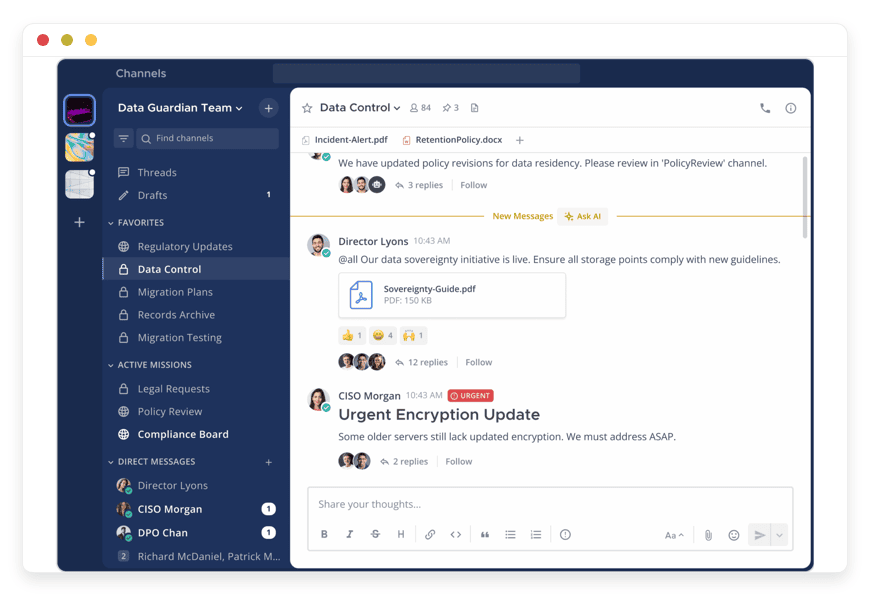
Mattermost is a Slack-shaped messaging platform built by a public company in Palo Alto. Channels, threads, direct messages, integrations, mobile and desktop apps. Search across history that doesn't disappear after 90 days. The open-source Team Edition is MIT-licensed and ships the full collaboration feature set.
The migration honesty: Slack's third-party app ecosystem is richer. If your team lives in twenty Slack integrations that map to specific Slack apps — Linear, PagerDuty, specific marketing tools — expect to rebuild some of those connections. Mattermost's plugin framework or n8n workflows handle most of it. Most teams find the friction sits with five or six integrations, not the whole list. Channel structure, file uploads, search and the day-one user experience are close enough that engineers and non-engineers both adapt within a week.
For a five-to-ten person team, Mattermost on DANIAN handles the full chat workload on the base €9 tier. Past twenty active users with heavy file sharing, the +€9 per additional vCPU upgrade path keeps responsiveness even.
Migration effort: a weekend if you don't care about history. One to two weeks with Mattermost's official Slack importer. Idle Slack workspaces can stay live, frozen, for record-keeping.
→ See managed Mattermost for team chat.
GitLab — code, issues, CI/CD (replaces GitHub)
GitLab Community Edition is the source-available Git platform that runs your repositories, issues, merge requests and CI/CD pipelines in one place. GitLab's Premium SaaS plan costs $29 per user per month billed annually. The self-hostable Community Edition is MIT-licensed and free to run — what DANIAN hosts.
Three honest things about GitLab on a managed stack.
One: GitLab is the heaviest app on this list. A team with five developers and moderate CI activity wants more than the base 1 vCPU. DANIAN scales each app independently at +€9 per additional vCPU and RAM unit. A typical small-team GitLab instance lands at €18–€36/month once sized for real CI/CD throughput. That's a fraction of GitHub Enterprise Cloud at $21/user × 10 = $210/month, with Actions overages on top. Starting March 1, 2026, GitHub self-hosted runners begin consuming plan minutes and incur a $0.002/minute platform charge. GitLab's predictability gets stronger as GitHub's gets harder to forecast.
Two: GitHub Actions migration friction is real. This is the one place the open-source path needs an honest disclosure. GitHub Marketplace has thousands of Actions written specifically against GitHub's runtime — actions/checkout, actions/setup-node, vendor-published deploy actions for Vercel, Netlify, Cloudflare. Most have GitLab CI equivalents you write yourself in YAML. Many simple workflows port in an afternoon. But if your CI pipeline depends on a niche Marketplace Action no one has reimplemented for GitLab CI, you're either rewriting it from scratch or keeping that one workflow on GitHub. Teams whose CI/CD is mostly npm test, Docker builds and standard deploy steps migrate cleanly. Teams running ten custom vendor Actions don't. Audit your .github/workflows/ directory before you commit.
Three: GitLab's all-in-one model is more pleasant for a small team. Issues, code, pipelines and the wiki live behind one login. No glue work between five GitHub-adjacent tools.
Migration effort: one engineer-week for a small monorepo with five to ten repos and straightforward CI. Two to three weeks if you have a deep Actions catalog to port.
→ See managed GitLab hosting.
n8n — workflow automation (replaces Zapier)
n8n is a node-based workflow automation tool. A Zapier “zap” is a chain of triggers and actions. An n8n workflow is the same idea with a more powerful editor and full code blocks where you need them. No per-task billing on a self-hosted instance. Zapier counts tasks differently — a 4-step Zap that runs once uses 4 tasks. At scale, Zapier costs 3–5x more than self-hostable alternatives for equivalent volume. n8n is published under the Sustainable Use License — source-available with a fair-use clause that affects competing managed services more than your internal use.
What n8n does well: the same things Zapier does. New row in Airtable → enrich via Clearbit → message in chat → record in CRM. Webhook from Stripe → check user state → update HubSpot → send a one-off email. Cron jobs that scrape a daily report. n8n has 500+ built-in integrations and an HTTP node that handles anything else.
What's different in practice: a graph editor that becomes faster than Zapier's once you've built three workflows. JavaScript or Python code nodes for steps that don't fit a clean integration. Zero per-task budget anxiety. For an internal team running fifteen automations that fire a few hundred times a day, the math is €9/month flat versus Zapier's Team tier at $103.50/month plus the ever-present task-cap risk.
The honest trade-off: if your team is non-technical and you'd struggle to debug a JavaScript expression in a workflow node, Zapier's user experience is more forgiving when things break. n8n needs slightly more comfort with logs and variable inspection.
Migration effort: an afternoon for the first five workflows. A steady week's drip for the rest. Most teams rebuild rather than import; the underlying logic is small.
→ See managed n8n hosting.
Matomo — privacy-respecting analytics (replaces Mixpanel and Google Analytics)
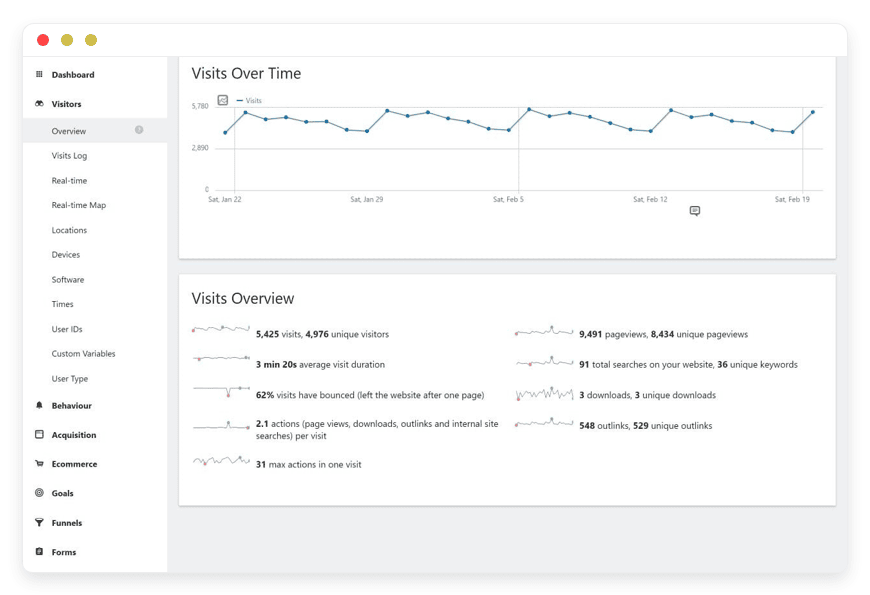
Matomo is the open-source web and product analytics platform that's been in production since 2007. GPL-3.0 licensed core. Self-hosted Matomo gives you complete data ownership — every pageview, every event, every conversion stays on your infrastructure. The cloud version (Matomo Cloud) starts at $23/month for up to 50,000 monthly visits; DANIAN hosts the self-hosted version at €9/month flat with no per-event pricing.
What Matomo replaces well: Google Analytics, in full, with a more thorough feature set. Goals, multi-step funnels, segmentation, custom dimensions, e-commerce tracking and 200+ reports work out of the box. Matomo handles three to thirty million events monthly on its own infrastructure; Mixpanel Growth at the same volume costs $560+/month.
What Matomo doesn't replace cleanly: the deepest part of Mixpanel. If your team runs ten-step retention cohort analysis with custom segment math every week, Matomo's plugin-based approach to funnels and cohorts is less elegant than Mixpanel's purpose-built UI. For pre-seed and seed-stage SaaS startups, this rarely matters — the team running deep behavioural cohort analysis is usually one data scientist past five engineers. Until then, Matomo plus a few well-built dashboards covers the work that actually moves the business.
What you get on DANIAN: the GPL-3.0 core with goals, funnels, segments, custom events, real-time visitors, and the full reporting suite. Heatmaps, session recordings, A/B testing and form analytics are sold as paid plugins by Matomo's vendor (InnoCraft) and can be installed on top — that cost is separate from DANIAN's €9 and sits on the customer's side.
Migration effort: an hour for the JavaScript tag swap on your marketing site. Half a day to mirror your existing Google Analytics or Mixpanel goal definitions. Run Matomo and the SaaS analytics side-by-side for two weeks and validate the numbers reconcile before you cut over.
→ See managed Matomo hosting.
Vaultwarden — password manager (replaces 1Password)
Vaultwarden is the unofficial, Rust-rewritten server implementation of the Bitwarden API. Published under AGPL-3.0 by Daniel García on GitHub, it's been in heavy production use for years. Vaultwarden is fully compatible with official Bitwarden client apps and browser extensions.
Why this matters: your team uses the official Bitwarden clients — desktop, browser extension, mobile, CLI — pointed at your own Vaultwarden server. The user experience is identical to Bitwarden's cloud product. The cost difference is the only thing that changes. 1Password Business is $7.99/user/month billed annually. At five seats that's $39.95/month, $79.90 at ten, scaling linearly forever. Vaultwarden on DANIAN is €9/month flat for the whole team.
What you give up: 1Password's polish. Travel Mode, the Secret Automation product for managing CI/CD secrets at scale, and the built-in identity-provider integrations on the Business tier. For a five-to-ten person team that uses a password manager to store passwords and a few secure notes, this isn't a meaningful loss.
Migration effort: 1Password's export-to-Bitwarden-CSV plus Vaultwarden's import takes about thirty minutes per user. The bigger cost is cultural — getting the team to actually move their daily logins. Plan a one-week dual-running window and a thirty-minute team session.
→ See managed Vaultwarden hosting.
OnlyOffice Docs — collaborative documents (replaces Google Workspace docs/sheets/slides)
OnlyOffice Docs is the collaborative-editing core of the OnlyOffice productivity suite. Real-time co-editing on Word-, Excel- and PowerPoint-compatible documents, with full Microsoft Office format fidelity. AGPL-3.0 licensed, deployed as a Docker container, integrates with most file storage layers.
This is where the comparison gets nuanced. Google Workspace is more than its docs. It's Gmail, Calendar, Drive, Meet and the identity layer behind your team's logins. OnlyOffice Docs replaces the documents, spreadsheets and presentations part. If you're using Workspace primarily for Gmail and Calendar and the docs are secondary, the migration math is different. Keep Workspace Starter at $7/user for mail and calendar. Run OnlyOffice for the collaborative document work where your team creates the artifacts that matter. That's $35/month + €9/month at five seats — still far below Workspace Business Standard at $70/month.
What OnlyOffice does well: format compatibility with Microsoft Office is the best in the open-source category. Real-time co-editing works at small-team scale. A clean web UI everyone can use without training.
What it doesn't do: Gmail and Calendar. Plan to keep Workspace's mail layer or migrate it separately to a mail-focused provider.
Migration effort: a Drive folder export to .docx/.xlsx/.pptx files, then re-upload into the storage layer behind OnlyOffice. Half a day per ten gigabytes of documents.
→ See OnlyOffice Docs for collaboration.
How the six fit together
The stack is not random. The six apps cover the six surfaces a remote-first SaaS startup actually touches every day: where you communicate, where you write code, where you wire things together, where you measure what's working, where you keep secrets, and where you collaborate on documents.
The chat tier (Mattermost) is where the team lives. n8n watches for events across the stack — a new GitLab merge request, a Matomo conversion goal triggered, a Vaultwarden vault access — and posts them to the relevant Mattermost channel. GitLab's webhooks fire on every push, build and deployment. n8n decides which of them warrant the team's attention. Matomo feeds business-side dashboards that show conversion movement to non-technical co-founders without needing them to write SQL.
A team running this stack ends up with one place each thing lives, instead of seven SaaS dashboards that each cost twenty dollars a seat. The integration layer is n8n — the same n8n that replaces Zapier. The automation work pays double duty.
For startups that are mostly engineers, the natural pairing is GitLab + Mattermost + n8n on day one. Vaultwarden joins a week later once the team's password hygiene is bought-in. Matomo and OnlyOffice Docs usually arrive last, because product analytics and document collaboration are slower-burning needs that compound over months.
Comparison table
| App | Replaces | Team size fit | Region choice | DANIAN price |
|---|---|---|---|---|
| Mattermost | Slack | 3–50 | 21 datacenter regions | €9/month |
| GitLab | GitHub | 3–25 | 21 datacenter regions | €9 base, €18–€36 typical with CI sizing |
| n8n | Zapier | 1–25 | 21 datacenter regions | €9/month |
| Matomo | Google Analytics / Mixpanel | 1–50 | 21 datacenter regions | €9/month |
| Vaultwarden | 1Password | 3–30 | 21 datacenter regions | €9/month |
| OnlyOffice Docs | Google Workspace docs | 3–50 | 21 datacenter regions | €9/month |
| Six-app total | €54/month base, €63–€81 with GitLab sized for CI |
Region choice matters more than it looks. A São Paulo-based founding team running Mattermost shouldn't host it in Frankfurt — latency taxes every message. DANIAN's catalog runs across 21 datacenter regions on six continents. You pick the region per app, not per account.
How to start — phase the migration, don't switch everything in one weekend
Six apps in one weekend is the wrong play. The right phasing for most teams looks like this:
Week one — pick one app.
Mattermost is the usual first pick because chat is high-engagement; the team adopts it through use. Start a 7-day free trial on DANIAN, run Mattermost alongside Slack, move daily team chatter over by Friday. Leave Slack running but frozen for a fortnight as a safety net.
Week two — add a quiet one.
Matomo or Vaultwarden. Matomo because no one has to change a habit; you swap a JavaScript tag and the dashboards start filling. Vaultwarden because the migration is mechanical and the post-swap experience is identical.
Weeks three and four — the heavier ones.
GitLab if your CI is in good shape. n8n if you have a manageable Zapier inventory. Both want a real engineering week.
Month two — OnlyOffice Docs.
This is the slowest migration. Documents accumulate over time and the change requires the team to agree on a new shared drive structure.
If a migration stalls, stop. You don't need to ship all six. A four-app stack that works is better than a six-app stack nobody trusts.
Evaluate after fourteen days of real use, not after the first install. The first three days of any migration feel worse than the SaaS you left. The second week is when the actual fit becomes visible.
FAQ
What's the total cost of running this stack at ten people versus the SaaS equivalent?
At ten paid seats, the proprietary stack typically runs $500–$1,200/month depending on tiers, plus Mixpanel scaling and Zapier overages. The managed open-source equivalent on DANIAN runs €54/month flat for the base six apps. Expect €63–€81/month once GitLab is sized for a ten-developer CI workload. The gap widens as the team grows.
How much can a 5-person startup save annually by switching from SaaS to this open-source stack?
A five-person startup on mid-tier SaaS plans typically pays $400–$500/month on these six lines, which is $4,800–$6,000/year. The same six apps managed on DANIAN cost €54/month, roughly $700/year. Annual savings: $4,100–$5,300. At the upper SaaS bound of $800/month, savings reach $8,500+ per year.
Can my team actually migrate all six apps in one go?
No. Pick one app per week or per fortnight. Most teams hit four of the six in a quarter, leave OnlyOffice for the second quarter, and genuinely decide whether the sixth app is needed. A four-app open-source core paired with two SaaS lines that fit your workflow is a perfectly reasonable end state.
How long does the full six-app migration actually take in practice?
Calendar time: six to ten weeks for the full stack. Engineering time: roughly three to four engineer-weeks total, spread out. Mattermost takes a weekend to two weeks. Matomo and Vaultwarden are half-day setups each. GitLab needs one engineer-week. n8n needs a steady week. OnlyOffice is the longest tail because of document migration.
What if we rely on a specific GitHub Action that doesn't exist in GitLab CI?
Honest answer: keep that one workflow on GitHub, or rewrite the Action's logic as a few lines of GitLab CI YAML. Many GitHub Actions are thin wrappers around shell commands; rewriting in GitLab CI is usually quicker than expected. If the Action is a vendor's proprietary deploy tool, ask the vendor for a GitLab equivalent — most major vendors publish both.
Does Matomo offer the same analytical depth as Mixpanel for product analytics?
For 80% of what most SaaS startups actually do — goals, funnels, segmentation, conversion tracking, real-time dashboards — Matomo matches Mixpanel closely. For deep behavioural cohort analysis with ten-step retention math, Mixpanel's purpose-built UI is still ahead. Most pre-seed and seed startups don't run that depth of analysis; the gap matters past 50,000 monthly active users.
Will OnlyOffice open my existing Google Docs without breaking the formatting?
Mostly yes. OnlyOffice has the strongest Microsoft Office format fidelity in the open-source category, and Google Docs exported to .docx renders cleanly in OnlyOffice. Expect minor visual drift on documents with heavy custom styles, embedded charts, or unusual fonts. For most business documents — proposals, contracts, internal memos — the round-trip is clean.
Is Vaultwarden as secure as 1Password?
The core security model is identical to Bitwarden's because Vaultwarden implements the Bitwarden API; the same end-to-end encryption applies. The difference is operational maturity: 1Password runs a dedicated security team and a published bug bounty program. Vaultwarden's security depends on the operator (in this case, DANIAN) keeping the server patched, isolated and backed up — which is what €9/month covers.
Can we import historical Slack messages into Mattermost?
Yes. Mattermost ships an official Slack importer that handles channels, threads, direct messages, file uploads and user metadata from Slack's ZIP export. The import is automated for free Slack workspaces and Pro/Business plans. Plan for one to two days of preparation and one engineer-half-day to run the import for a small workspace.
Are these apps multi-tenant on shared infrastructure, or fully isolated?
Each app runs in its own hardened container with dedicated resource allocations, isolated networking and per-app backups. The underlying infrastructure is multi-tenant — that's what makes €9 per app possible. The boundary between containers is real, audited, and operationally identical to what we'd run if each app had its own VM.
Do these open-source apps support SSO and SAML for team logins?
Most do. Mattermost, GitLab, Matomo and OnlyOffice Docs support SAML and OIDC SSO on their open-source editions. n8n's SAML SSO sits behind its enterprise tier; for self-hosted use, OIDC integration is typically configured at the reverse proxy. Vaultwarden supports SSO via the SSO bridge that ships with Bitwarden Enterprise patterns.
How are daily backups handled and where are they stored?
Every app on DANIAN gets a daily off-site backup, included in the €9/month. Backups are encrypted and stored in object storage separate from the production infrastructure, in the region you pick. Restore is performed by support on request and tested as part of routine operations. The backup window is daily; finer cadences are available on the upgraded tiers.
Does n8n handle the same workflow volume as Zapier at scale?
Yes, and usually better. A single n8n instance on €9 of resources comfortably handles tens of thousands of workflow executions per day. Zapier's Team plan caps at 2,000 tasks per month at $103.50; n8n has no equivalent cap. The constraints are CPU and memory, not task quota — and DANIAN scales those at +€9 per vCPU when you need more.
Why GitLab Community Edition instead of one of GitLab's paid tiers?
GitLab CE includes source-code management, issues, merge requests, CI/CD pipelines, container registry, wiki and 80% of what most teams use Premium for. Premium ($29/user/month) adds advanced approvals, multiple reviewers and priority support. The top paid tier adds security scanning and compliance features. For a five-to-ten-person SaaS startup, CE is genuinely sufficient.
What happens if DANIAN goes down or we want to leave?
The underlying apps are open source. Daily off-site backups are part of the €9. You can export your data and stand up the apps elsewhere — on a VPS, a home server, another managed provider — at any time. There is a published “how to leave” guide. The OSS apps are yours; we just operate them.
Is n8n's Sustainable Use License a problem for using it internally at a SaaS startup?
No. The Sustainable Use License permits free use, modification and distribution for internal business purposes. It restricts only one thing: offering n8n itself as a hosted service to third parties (essentially preventing competing managed n8n products). A SaaS startup using n8n to run its own internal workflows sits well inside the licence's allowed uses.
Do these apps have mobile apps that work as well as the SaaS originals?
Mattermost, Bitwarden (used with Vaultwarden) and OnlyOffice Docs all ship polished iOS and Android apps that match the SaaS user experience closely. GitLab has a competent mobile experience via its responsive web app rather than a dedicated native app. n8n is an admin tool and doesn't need a mobile app. Matomo offers a mobile app for dashboard viewing.
Should we wait until after our Series A funding to migrate?
Almost certainly the opposite. Pre-funding, every dollar saved extends runway proportionally; the same €4,000/year saved is meaningful at pre-seed and trivial post-Series A. Post-funding, the team is bigger, integrations are deeper, and migration time is more expensive. The window where the math is best is pre-seed to early seed — before the SaaS stack is fully entrenched.
Can we run a hybrid stack — some of these apps with you, some elsewhere?
Yes, and most teams end up here. The six apps don't have to come from one provider. Some run Mattermost and GitLab on DANIAN and keep n8n on a separate self-hosted server. Some run Vaultwarden on DANIAN and keep Mixpanel on the SaaS for analytics depth. Mix freely.
At what team size does this open-source stack stop being cheaper than the SaaS equivalent?
It doesn't, mathematically. The DANIAN stack is flat at €9 per app; the SaaS stack scales per seat. At 25 people the SaaS bill is roughly $2,000–$3,500/month; the managed open-source equivalent is still €54–€100/month including resource upgrades. What changes at larger scale is the relative weight of migration time versus monthly savings — at 50+ people the migration is harder, but the math gap is also larger.
What about SSL certificates and custom domains — do we configure those ourselves?
Mostly no. DANIAN provisions SSL automatically through Let's Encrypt on every app instance and renews certificates without intervention. Custom domains are configured by the customer via DNS, with support performing the DANIAN-side wiring on request. Most teams complete custom-domain setup in under thirty minutes including DNS propagation.
Conclusion — what to do this week
Three concrete steps for a founder reading this on a Sunday evening with a runway spreadsheet open.
Audit your current SaaS spend, line by line. Pull the actual numbers from the invoices, not the rounded estimates. Most founders are off by 20–40% on what they think they're paying. The audit alone usually produces a “we can cut this” or two unrelated to any migration.
Pick the one app where the SaaS pain is sharpest. For most pre-seed SaaS teams that's Zapier — the task cap is the most aggravating per-dollar limit in the SaaS landscape. Or Mixpanel — event-based billing punishes growth. Run a 7-day free trial on the open-source equivalent. Don't commit to a six-app migration on a Sunday; commit to one app and see how it fits.
See the catalog for the full list of 150+ apps. See pricing for the per-app €9 floor and resource-scaling rules. Either way, test the fit on one app before you spend a euro.
The stack on this list isn't a religion. It's a budget arithmetic exercise dressed up as a tooling decision. The math is on the open-source side at this team size, and the migration is a defined piece of work, not an open-ended project. Either it pays back in four weeks or it doesn't. You'll know which by week two.
Sources cited:
- Mattermost — official project site: https://mattermost.com/
- GitLab — pricing page: https://about.gitlab.com/pricing/
- n8n — official project site: https://n8n.io/
- Matomo — official project site: https://matomo.org/
- Vaultwarden — source repository: https://github.com/dani-garcia/vaultwarden
- OnlyOffice — official project site: https://www.onlyoffice.com/