Open-source rank tracking in 2026 (SerpBear)
Open-source rank tracking in 2026: SerpBear, when SEO suites charge for every keyword
The short version
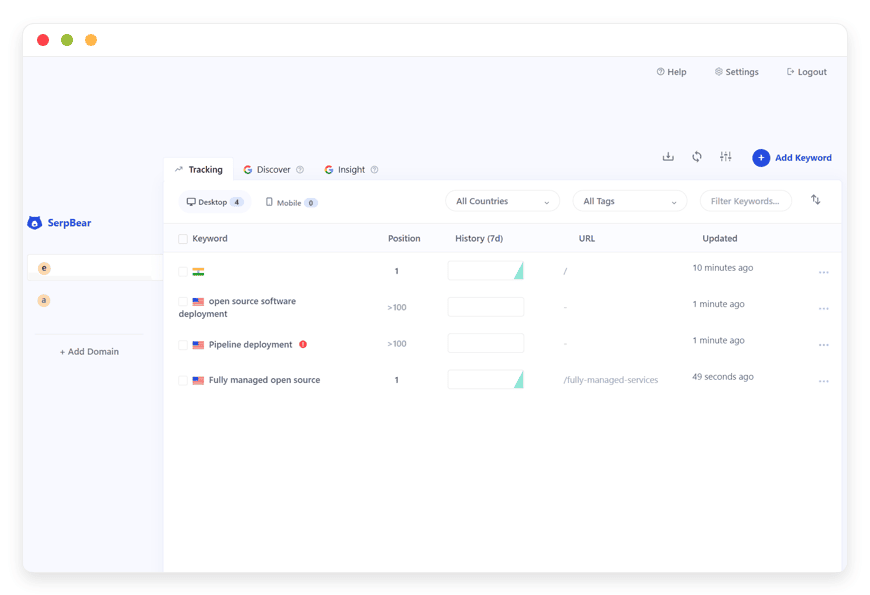
- SerpBear is an open-source, self-hosted rank tracker. It watches unlimited keywords across unlimited domains in Google, by country and device, and emails you when positions move. Around 1.9k GitHub stars, MIT-licensed.
- It replaces the rank-tracking slice of an SEO suite — not the whole suite. No backlink index, no keyword database, no site crawler. If you need those, SEMrush or Ahrefs is still the right tool.
- The catch most posts skip: SerpBear needs its own search-data source. You connect a third-party scraping API key (ScrapingAnt, ScrapingRobot, SerpApi, SearchApi, HasData) or your own proxies. Free tiers cover small keyword sets.
- The math: Ahrefs Lite is $129/month, SEMrush Pro is $139.95/month, and dedicated trackers climb with every keyword you add. DANIAN runs SerpBear for €9/month flat, unlimited keywords — you add only the scraper credit you control.
- Pair it with Matomo, also €9/month and self-hosted, to own both your rankings and your on-site traffic data.
Why people are leaving SEO suites for the rank-tracking job
SEO suites and dedicated trackers price rank tracking by keyword count and by seat. Ahrefs Lite runs $129/month for 750 tracked keywords. SEMrush Pro runs $139.95/month for 500. Dedicated trackers like AccuRanker and Nightwatch climb with every keyword you add. If rankings are all you watch, you are renting a whole suite to use one tool.
A lot of small sites and freelancers track between 30 and 200 keywords for one or a few domains. They open the suite once a week to glance at a chart, and touch none of the other ninety percent of features. The invoice arrives in full regardless. That gap between what you pay for and what you use is the trigger.
Two readers fit this exactly. One is the freelancer who tracks 40 to 150 keywords each for a few client domains, and reports movement monthly. The other is the founder who watches 30 keywords after a launch, to see whether new pages are landing. Neither needs a backlink index. Both are paying for one anyway.
The cost pressure is not imagined. Google removed the num="100" search parameter in 2025, which let tools read 100 results in one request. Rank checks now read ten results per page, so deep tracking costs more lookups. Trackers priced that change into their plans. The bill to watch a few dozen positions kept rising.
SerpBear answers a narrow question: where does my domain sit in Google for the keywords I care about, and did that change overnight? For owners and freelancers who only need that answer, the open-source path is cheaper and the data sits on an instance they control.
What open-source rank tracking actually replaces (and what it doesn't)
SerpBear does one job well. It checks where your domain ranks for the keywords you give it, in the country and on the device you set, and it emails you when positions move. It does not crawl your site, index backlinks, or hold a keyword research database. It replaces the rank-tracking slice of a suite, and only that slice.
Here is the honest split. SerpBear covers keyword position tracking for unlimited keywords and domains. It runs daily or weekly checks and sends email and Slack alerts on movement. It also connects to Google Search Console, which shows real clicks, impressions, and average position next to each keyword. It exports everything to CSV and exposes a REST API for your own reports. It even generates light keyword ideas through a Google Ads test account.
What it does not do is the rest of what a suite sells. There is no backlink index for link-gap work. There is no keyword research database with difficulty scores across millions of terms. There is no site crawler flagging broken pages or technical issues. There is no competitor traffic estimate. SerpBear is a position tracker with a few useful extras, not a research platform.
So the test is simple. If your work is link building, competitor backlink analysis, or technical site crawls, keep the suite — SerpBear will not replace it, and pretending otherwise wastes your time. If you mainly need to know whether your positions are going up or down, week to week, SerpBear covers that job at a fraction of the cost.
The setup requirement nobody mentions: SerpBear needs a search-data source
SerpBear ships without a built-in way to read Google reliably. You connect a search-data source before it can track anything. That source is either a third-party SERP scraping API, plugged in with one API key, or your own pool of proxy IPs. This step is the part most write-ups gloss over, and it is the single thing that catches new users.
The reason is structural. SerpBear is the dashboard, the scheduler, and the alerting layer. It does not own a search index, so it asks an outside scraper to fetch live Google results for each keyword. The providers it supports include ScrapingAnt, ScrapingRobot, SerpApi, SearchApi, and HasData. You register with one, copy the key into SerpBear's settings, and the tracking begins.
For small keyword sets this can cost nothing. Some scrapers offer free tiers — ScrapingAnt, for example, has long offered a free monthly allowance large enough to cover a handful of keywords checked daily. A site tracking 150 keywords once a day uses roughly 4,500 lookups a month, which fits comfortably inside a free tier. Heavier tracking moves you to paid credits.
Paid credits stay predictable because you set the dials. You choose daily or weekly checks. You choose how many result pages to read per keyword. You choose how many keywords to track. Each dial maps directly to lookup volume, so the scraper bill never surprises you. That control is the trade for running the data source yourself.
One point matters for the comparison below: this scraper credit is the same whether you self-host SerpBear or have DANIAN run it. The €9/month covers the operational layer around the app, not the search data. The credit runs on your own scraper account either way, which is exactly why you keep control of cadence and spend.
How accurate is open-source rank tracking, really?
Accuracy is the first question people ask, and the honest answer has conditions. SerpBear's positions are only as good as the scraper feeding it. A reliable scraping API, the right country and device settings, and a daily check will track close to what a paid tool reports. Get one of those wrong and the numbers drift.
Three settings move accuracy the most. Country and language decide which Google you read. A check set to the US and one set to Germany return different positions for the same keyword. Device matters too, since mobile and desktop results differ. Cadence sets freshness — a weekly check can miss a two-day spike that a daily check would catch.
One built-in cross-check makes accuracy easier to trust. SerpBear connects to Google Search Console and pulls Google's own reported average position for each keyword. That figure sits right next to the scraped position in the same view. When the two roughly agree, the scraper is reading correctly and you can rely on the numbers. When they diverge sharply, it is an early signal to check your country, device, or cadence settings. Search Console data lags by a couple of days and averages across the period, so the two will never match exactly. Used as a sanity check rather than a second tracker, it is a free second opinion from Google itself.
There is one real fragility to name. The scraper reads Google's live HTML, and when Google changes that markup, parsers can break until they are updated. This is the most failure-prone part of any self-hosted tracker, not a SerpBear quirk. It is also the exact maintenance a managed plan absorbs. When a check stops returning data, fixing it is our job, not yours.
The cost math — rank tracking only
Here is the comparison for the rank-tracking job, with current pricing read from vendor pages in mid-2026. The point is not that SerpBear is free. The point is that the rank-tracking slice runs on a flat €9/month, with a scraper credit you control. That costs far less than renting a whole suite or a per-keyword tracker — as long as rankings are the whole job.
| Tool | Monthly price | Keyword limit | Backlinks + site crawl? | Search-data source | Best for |
|---|---|---|---|---|---|
| SEMrush Pro | $139.95 | 500 (position tracking) | Yes — full suite | Included | Teams using the whole suite |
| Ahrefs Lite | $129 ($108 annual) | 750 (rank tracker) | Yes — full suite | Included | Backlink and keyword research users |
| AccuRanker | ~$100+, climbs by keyword count (about $224 at 2,000) | By capacity | No — rank only | Included | Agencies wanting on-demand refresh |
| Nightwatch | ~$32 (250 kw) to $170 (2,500 kw) | By capacity | Partial — rank plus some technical | Included | Keyword-priced tracking |
| SerpBear on DANIAN | €9 flat | Unlimited | No — rank only | Your own scraper key (free tier or paid credits you control) | Owners and freelancers who only need rankings |
Start with the smallest case. A founder tracks 40 keywords for one domain after a launch, checked daily. That is roughly 1,200 lookups a month, which sits inside a scraper free tier. So the all-in cost is €9 — the flat hosting fee, and nothing for the search data. A dedicated tracker for the same 40 keywords still starts at a paid monthly plan.
Walk one realistic case. A freelancer tracks 150 keywords across five client domains. On Ahrefs Lite that is $129/month, and the 750-keyword cap is already in sight if a client expands. On DANIAN the same tracking is €9/month flat, and 150 keywords checked daily fits inside a scraper free tier — call it €9 plus nothing. The flat price does not move when the sixth client arrives.
Now scale it. Two thousand keywords on a dedicated tracker runs near $180–$224/month because the price is tied to keyword count. The same two thousand keywords on DANIAN is still €9/month for the app. Only the scraper credit grows, and you cap it by reading fewer pages or checking weekly. The flat-versus-per-keyword gap widens as you add keywords, not narrows.
The honest caveat holds throughout. These numbers only favour SerpBear because rank tracking is the single job in scope. A suite at $129 also gives you backlinks, keyword research, and site crawls. If you use those, the suite is fair value and SerpBear is not a substitute. The math turns on whether you need the rest.
What running SerpBear yourself involves
SerpBear is light to host. It is a single container backed by a SQLite file, so a small, cheap server runs it without strain. That low floor is part of the appeal. It is also why people assume the whole thing is effortless. The install is easy; keeping it healthy over months is the actual work.
The first-day setup runs through a short list. You deploy the container, set a login and a session secret, and connect your scraper API key. You wire up SMTP so email alerts can send. Then you add your domains and keywords. You set the country, device, and cadence for each, and confirm the first check returns real positions.
The ongoing work is quieter and easier to forget. You track updates on a dated Next.js codebase and apply them. You watch that daily checks keep returning data, since a broken scraper fails silently. You keep a real off-site backup of the SQLite file, not just a copy on the same box. And you manage the server itself — the host, the SSL certificate, the renewals.
None of this is hard in isolation. It is a standing job that competes with your actual work. The flat €9/month is DANIAN taking that job on, so the tool keeps running and you only read the rankings.
Own your rankings and your traffic: pairing with Matomo
SerpBear tells you where you rank off-site. Matomo tells you what visitors do once they arrive. Both are open-source and self-hosted, and DANIAN runs each for €9/month. Together they cover the two halves of search data — positions and behaviour — without a third-party analytics vendor holding either side.
The division of labour is clean. SerpBear watches SERP positions and folds in Search Console clicks and impressions, so you see ranking movement and the traffic it produces. Matomo for on-site analytics then tracks sessions, pages, and conversions on first-party data, on an instance you control. One shows the door; the other shows what happens inside.
The pairing is two apps at €9 each, so €18/month for the set. That is still well under a single suite. It also removes the usual trade where your ranking data and your visitor data both sit inside platforms owned by someone else. For an owner who moved off third-party analytics to keep visitor data first-party, adding rank tracking on the same footing is a small, consistent step.
How to pick: three questions to ask yourself
Before switching anything, answer three questions honestly. They sort the people SerpBear genuinely fits from the people who should keep paying a suite. Getting this right saves a migration you would only reverse.
- Do you need backlinks, keyword research, or site crawls? If yes, keep the suite. SerpBear does not do these, and the price gap is the price of features you actually use. If rankings are the only thing you open the tool for, read on.
- How many keywords and domains, and how often do you need a refresh? Small sets checked daily fit a scraper free tier. Larger sets, or many domains, mean paid scraper credits — predictable, but real. Budget for them, and pick a cadence that matches how fast your positions actually move.
- Do you want to own the data and the line item? A flat €9 beats per-keyword and per-seat creep, and the history sits in a file you can export. If a predictable bill and portable data matter more than a one-window dashboard, the open-source path fits.
FAQ
What is SerpBear?
SerpBear is an open-source, self-hosted keyword rank tracker. It checks where your domains rank in Google for the keywords you choose, by country and device, and stores the history so you can see movement over time. It is licensed under MIT and runs as a single container. DANIAN hosts and operates it for a flat €9 per month.
Is SerpBear really free?
SerpBear's code is MIT-licensed and free to run. You pay for two things around it: the SERP data source it needs and the hosting. On DANIAN, hosting is a flat €9 per month. The scraper-API credit stays on your own account and can sit inside a free tier for small keyword sets.
Does SerpBear replace SEMrush or Ahrefs?
It replaces the rank-tracking slice, not the whole suite. SerpBear checks keyword positions and emails you when they move. It holds no backlink index, no keyword database, and no site crawler. For link building or competitor research, an SEO suite is still the right tool.
How does SerpBear get ranking data?
It connects to a third-party SERP scraping API, or to your own proxy IPs. Providers it supports include ScrapingAnt, ScrapingRobot, SerpApi, SearchApi, and HasData. SerpBear schedules the checks and stores the history; the scraper fetches the live Google positions for each keyword.
How accurate is it versus a paid tracker?
Accuracy depends on the scraper you connect, the country and device you set, and how often you refresh. With a reliable scraping API and daily checks, positions track closely to paid tools. The trade-off is that you own the data source and the cadence instead of a vendor setting them for you.
How many keywords and domains can I track?
Unlimited on both counts in the software itself. The practical limit is your scraper-API budget: more keywords checked more often means more lookups. Weekly instead of daily cadence, or page-one-only depth, keeps lookup volume and spend down while still catching real movement.
Will I get alerts when my rankings change?
Yes. SerpBear sends daily, weekly, or monthly email alerts on position changes, and it can post to Slack. Email runs through an SMTP service, and free options exist for low volume. On a managed plan, DANIAN wires up the SMTP details during setup so alerts work from day one.
What does the €9 per month from DANIAN cover?
The managed layer around SerpBear: hosting, SSL, updates, daily off-site backups, monitoring, and human support. It does not cover the SERP scraping credit. That runs on your own scraper account, so you keep control of the cadence and the spend rather than handing both to a vendor.
Can I move my data out later?
Yes. SerpBear exports keyword and ranking history as CSV at any time, and the app stores its data in a standard SQLite file. The software is yours under the MIT license. DANIAN operates the instance for you; it does not own the data inside it, and you can take it with you.
Is SerpBear a good alternative to SEMrush for rank tracking on a small site?
For rank tracking on a small site, yes. SerpBear watches your keyword positions in Google and alerts you when they move, which is the part of SEMrush most small sites actually open. It does not replace SEMrush keyword research, the backlink index, or the site crawler. If rankings are the job and the rest goes unused, SerpBear covers it at €9 a month flat.
How do I move from my current rank tracker to SerpBear?
There is no data import from a paid tracker; you start fresh by adding your domains and keywords to SerpBear. History begins building from your first check, so positions accrue from day one rather than backfilling. Most people run both for a week to compare, then drop the paid tool. On DANIAN, the setup and scraper wiring are handled, so the switch is mostly entering your keywords.
What is a SERP scraping API, and why does SerpBear need one?
A SERP scraping API is a service that fetches live Google results for a search term and returns the ranking positions. SerpBear needs one because it is the dashboard and scheduler, not a search index of its own. You connect a provider with one API key, and SerpBear uses it to read positions for each keyword. Providers it supports include ScrapingAnt, SerpApi, and SearchApi.
How much does the SERP scraping API cost?
It depends on how many keywords you check and how often. Small sets sit inside a free tier on some providers; ScrapingAnt, for example, has long offered a free monthly allowance. Heavier tracking moves you to paid credits, priced by the number of lookups. You control the cost directly by setting cadence, page depth, and keyword count. This credit runs on your own scraper account, separate from the hosting fee.
Does SerpBear connect to Google Search Console?
Yes. SerpBear connects to Google Search Console and shows the real clicks, impressions, and average position Google reports for each keyword. That sits next to the scraped position, so you see ranking and the traffic it produces in one view. The connection also gives you a built-in way to sanity-check the scraped numbers against Google own data.
How often does SerpBear check my rankings?
You set the cadence. SerpBear can check daily, weekly, or monthly, per keyword, and you pick what matches how fast your positions move. Daily catches short spikes but uses more scraper lookups; weekly costs less and still tracks real trends. There is no fixed schedule imposed on you, which is part of why the data source stays under your control.
Can SerpBear track rankings in Bing or other search engines?
SerpBear is built around Google, which is where it tracks positions by country and device. It does not track Bing, DuckDuckGo, or other engines the way it tracks Google. If your reporting is Google-first, that fits most sites. If you need multi-engine coverage, a dedicated multi-engine tracker is the better tool.
Does SerpBear track local or Google Map Pack rankings?
SerpBear tracks organic positions by country and device, not local map-pack or grid rankings tied to a physical address. For a local business that lives or dies on the map pack, a dedicated local-rank tool is the right fit. For organic keyword positions across a country, SerpBear does the job.
Can SerpBear track my competitors' rankings?
You can add any domain to SerpBear, including a competitor one, and track the same keywords for it. That lets you watch how your positions move against theirs over time. It does not estimate a competitor traffic or pull their backlink profile. For position-versus-position tracking it works; for deeper competitor research a suite is still needed.
Do I need technical skills to run SerpBear on DANIAN?
No. On a managed plan, the technical setup is done for you: the container, the login, the scraper key wiring, and the email settings. You add your domains and keywords and read the results. Running SerpBear yourself does take some comfort with containers and updates; the €9 a month is DANIAN taking that part off your plate.
What happens if my rank checks stop returning data?
The usual cause is the scraper: either its credit ran out or Google changed its result markup and the parser needs an update. On a self-hosted setup, fixing this is your job, and a broken check can fail quietly until you notice. On DANIAN, monitoring catches a stalled check and the fix is ours to make. Either way, your stored ranking history stays intact.
Can I use SerpBear for client rank reports?
Yes, within limits. SerpBear tracks unlimited domains, so you can keep each client keywords in one place, and it exports ranking history to CSV and exposes an API for your own reports. It does not ship a polished white-label client portal. For a freelancer sending periodic rank updates, the export and API cover the work; for a fully branded client dashboard, you would build that layer yourself.
Is my ranking data private on a self-hosted rank tracker?
Your keyword and ranking data sits in the SerpBear instance DANIAN runs for you, on infrastructure in the region you choose, not in a shared vendor platform. You decide who has a login. The data is stored in a standard SQLite file that you can export or take with you at any time. DANIAN operates the instance; it does not own the data inside it.
Why use SerpBear instead of tracking rankings manually in a spreadsheet?
A spreadsheet means searching Google yourself, recording positions by hand, and doing it again every week. SerpBear automates the check, stores the history, and emails you only when something moves. It also pulls Search Console data and handles country and device variations a manual check tends to miss. For more than a handful of keywords, the manual approach stops scaling fast.
Conclusion: what to do this week
If you only need to watch rankings, you are probably overpaying for the suite around them. SerpBear runs that one job on open-source software you control, and DANIAN operates it for a flat €9/month. The scraper credit stays small and on your own account. The decision is narrow, and that is the point.
Three steps this week. First, count the keywords and domains you actually track, and check whether you ever use the suite for anything else. Second, if rankings are the whole job, spin up managed SerpBear hosting and connect a scraper free tier to see real positions within a day. Third, if you also moved off third-party analytics, add Matomo on the same footing so both halves of your search data sit on instances you own.
| Managed SerpBear, run by us in the region you choose. €9/month, unlimited keywords, daily backups, human support. The scraper credit stays on your account. Start a 7-day trial — no card needed. |
Sources, read mid-2026: SerpBear project and documentation (serpbear.com; github.com/towfiqi/serpbear); SEMrush pricing (semrush.com/prices); Ahrefs pricing (ahrefs.com/pricing); current dedicated-tracker pricing for AccuRanker and Nightwatch from their pricing pages. Pricing changes often — figures above were current when this was written and are worth re-checking before you decide.