Fully Managed SerpBear
as a Service

Deploy SerpBear as a fully managed service starting at €9/mo. Get automated backups, SSL, updates, support and monitoring included.

SerpBear is an open-source SEO rank tracker — it records your domain's Google keyword positions over time with pluggable SERP scrapers, a built-in JSON API, and Google Search Console integration — combining the convenience of Ahrefs or Semrush with the data ownership of self-hosted infrastructure.

Free 7-day trial  99.9% Uptime SLA  No credit card  Cancel anytime

Free 7-day trial  99.9% Uptime SLA
No credit card  Cancel anytime

SerpBear

SerpBear

STARTING AT

€9/month
Automated Backups
Monitoring
Automated Updates
Auto SSL

USAGE

Unlimited
Human Support
Custom Domains
Terminal Access
File Manager Access
Deploy in your region 21 locations worldwide
GermanyFinlandNetherlandsUKSwedenUnited StatesCanadaSingaporeJapanAustraliaBrazilSouth Africa+9 more →
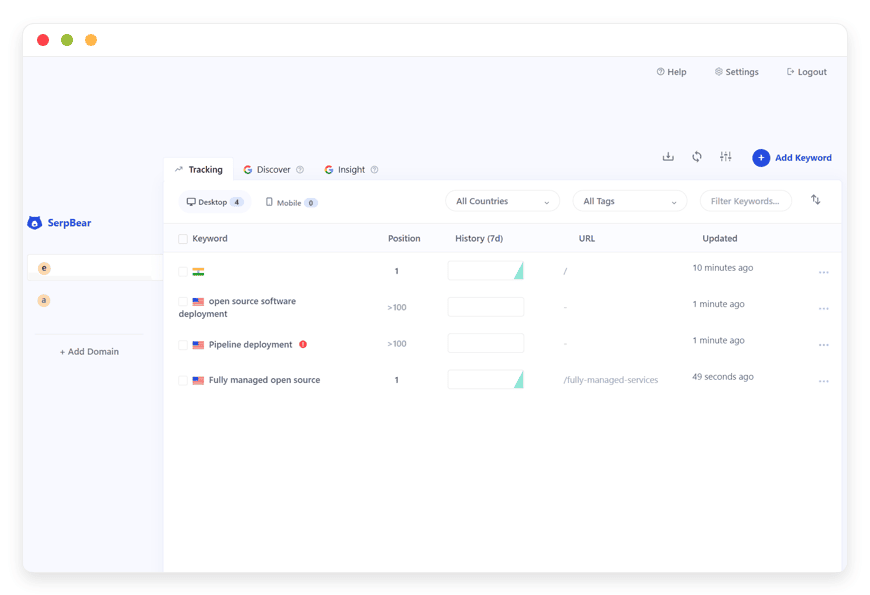
SerpBear Preview Image

ABOUT THE SOFTWARE

What is SerpBear

SerpBear is an MIT-licensed, self-hosted SEO rank tracker that monitors Google keyword positions for your domains, integrates with Search Console and Google Ads, and exposes everything through a built-in JSON API for downstream reporting.

The project was created and is maintained by Towfiq I. and contributors on GitHub. It runs as a Next.js application against a SQLite database, ships as a single Docker image, and has accumulated more than 1,800 stars and an active issue tracker over its lifetime. Notable downstream packagers include several one-click open-source app catalogs and community Synology and Raspberry Pi install guides.

SerpBear supports ten pluggable SERP providers — SerpApi, SearchApi, HasData, ScrapingRobot, ValueSerp, Serper.dev, ScrapingAnt, Serply, SpaceSerp, and CrazySerp — plus a custom HTTP-proxy mode for teams that want to route requests through their own IP pool. The same release introduced the Scrape Strategy system designed around Google's September 2025 removal of the &num=100 URL parameter.

FEATURES

What SerpBear does

SerpBear records a domain's Google keyword rankings on a schedule, charts the history, and surfaces the data via dashboard, API, and notifications. The feature surface is focused — rank tracking, well done — rather than a sprawling all-in-one SEO suite.

Domain and keyword tracking

Unlimited domains and keywords per instance, organised into projects with tag-based filtering for client or niche segmentation.

Mobile and desktop devices

Track each keyword on mobile and desktop separately. Divergence between the two surfaces immediately in the chart view.

Google Search Console integration

Pull real clicks, impressions, average position, and click-through rate. Discover keywords you rank for outside the tracked list.

Notifications and digests

Email, Slack, Telegram, and Discord channels. Daily or weekly cadence, per-domain, with rank-change thresholds you set.

Pluggable SERP scrapers

Ten supported providers including SerpApi, SearchApi, HasData, and ScrapingRobot. Switch providers without losing keyword history.

City-level local tracking

For scrapers that pass through the location parameter, track rankings at a specific city level for local-services and multi-location SMB networks.

Google Ads keyword volume

Integration with the Keyword Planner API surfaces monthly search volume next to position data for prioritisation decisions.

JSON API and CSV export

Built-in API and CSV export for piping data into client portals, Looker Studio, n8n workflows, or downstream reporting systems.

WHAT'S ALWAYS INCLUDED

Every app. Fully managed.
Nothing extra to pay for.

Every app you deploy includes the full managed service — security, backups, updates, and support from day one.

Automatic updates and patches

Apps run the latest stable version. Security patches applied silently, with rollback if needed.

Daily off-site backups

Multiple daily backups in redundant off-site locations. One-click restore if anything goes wrong.

24/7 uptime monitoring

Continuous monitoring with instant alerting. We respond before you notice.

SSL, firewall, DDoS protection

Auto-renewing SSL, hardened firewall rules, DDoS mitigation on every deployment.

Performance and scaling

We monitor resource usage continuously. When your app needs more headroom, we flag it and upgrade with your explicit approval.

Dedicated engineering support

Real engineers on chat. DNS, SMTP & migration help. All included in €9.

WHY MANAGED

Why teams pick managed SerpBear

In September 2025, Google quietly removed the &num=100 URL parameter, capping every results page at 10 organic listings. The change broke a decade of rank-tracker pricing models, and the SaaS price hikes that followed pushed buyers toward open-source alternatives.

"Just running SerpBear" looks easy until the operational layer shows up. The single most damaging failure mode in the issue tracker is the parser writing position 0 to history when Google returns a CAPTCHA or an unfamiliar HTML layout — vanilla SerpBear does not error, it overwrites valid rank history with zeroes silently. By the time a buyer notices on a Monday morning chart, three days of false data is already baked in. A managed host watches the scraper output stream for the pattern, alerts on it, and rotates the provider or IP pool before the corruption spreads.

The other operational levers a vanilla install leaves untouched: which scrape strategy the global default runs at, which scraper provider the keys are validated against, how the SQLite database is snapshotted while the container is running, and whether NEXT_PUBLIC_APP_URL is set correctly for Google Search Console and Google Ads OAuth callbacks to complete. Get any of these wrong on day one and the dashboard appears broken in ways the upstream docs do not always cover.

What we ship by default: Smart scrape strategy at the global level with per-domain overrides; recommendation SerpApi as the provisioned default scraper (1 credit per keyword regardless of rank depth, immune to the &num=100 change); nightly SQLite snapshot via the safe online .backup command, retained 30 days; a validated NEXT_PUBLIC_APP_URL on a TLS-terminated subdomain so OAuth callbacks work; and a scrape-health monitor that fires when position-0 returns cross a threshold.

REVIEWS

Hear from customers ​like you​​​​​​​

Successful businesses and professionals around the world rely on DANIAN every day

USE CASES

Three teams who run SerpBear on DANIAN

These are representative team types we set up most often. Each starts with the same flat €9 plan.

8-PERSON SEO AGENCY

Ditched Ahrefs Advanced after the per-client unit economics broke

Manages 25 client domains across the German, Austrian, Dutch, and French markets. SerpBear runs in Germany, SerpApi handles the scrape, daily cadence at 03:00 CET, Smart strategy globally with Basic for branded keywords. Weekly per-client PDF report exported through the JSON API into a white-labelled portal. Tag-based filtering by client.

IN-HOUSE GROWTH TEAM · 30-PERSON SAAS

Came off Semrush Pro because Pro's 500-keyword cap forced the Guru upgrade conversation

Tracks 600 commercial-intent and long-tail keywords against four competitor domains across the US, UK, Canada, and Australia. SerpBear runs on a small instance with ScrapingRobot free tier (5,000 lookups/month covers the load with Smart strategy). Search Console integration on. Slack digest every Friday for the exec team.

3-PERSON AFFILIATE OPERATOR

Hit the 1,500-keyword cap on Mangools Agency and the rate-limiter on Ahrefs Lite in the same week

Tracks 8,000 keywords across 15 niche domains, weekly cadence. SerpBear runs with a HasData plan, Custom strategy at three pages, Google Ads test account integrated for monthly volume data. No notifications — the operator monitors via the dashboard directly. Nightly SQLite snapshot routed to off-instance object storage.

COMPARISON

Four ways to run SerpBear

There are four credible paths for running rank tracking in 2026. Proprietary SaaS, self-host on a VPS, self-host on a home server, or hand it to a managed service. Here is the math at three buyer scales — the cost lines speak for themselves.

 PATH~100 KEYWORDS · 1 USER~1,000 KEYWORDS · 5 USERS~10,000 KEYWORDS · 10 USERS
Proprietary SaaS
Ahrefs / Semrush
Ahrefs Lite $129/mo (750 KW cap, 1 seat) or Semrush Pro $139.95/mo (500 KW cap)Ahrefs Advanced $449/mo (2,000 KW, 5 seats) or Semrush Guru + extra seats $339–$449/moSemrush Business + 5 seats ~$725/mo, or AccuRanker Expert $688–$849/mo
Self-host on a VPS
DIY, you operate it
$24/mo production-class VPS + $0–$50/mo scraper key
~1–2 hrs/mo ops time
$24/mo VPS + $50/mo SerpApi
~2–4 hrs/mo ops time
$24/mo VPS + $79/mo HasData
~4–6 hrs/mo ops time
Home server
Synology DS923+ class
€18–55 amortised hardware + €17–32 electricity + €40–80 business internet + €10–20 off-site backupSame hardware floor + scraper key
~2–4 hrs/mo ops time
Same hardware floor + scraper key
~4–8 hrs/mo ops time, scaling pressure on the box
DANIAN Managed SerpBear€9/month
Bring your own scraper key
€9/month
Bring your own scraper key
€9/month
Bring your own scraper key

Scraper-API credits run on your own account in every path that isn't proprietary SaaS — the cost is the same whether you self-host or hand off to us. The €9 covers the operational layer around SerpBear, not the SERP-data provider. SaaS pricing verified from vendor pages May 2026.

BY INDUSTRY

SerpBear for specific industries

Rank tracking pulls weight in four distinct industry shapes, each with a different operational pressure on the instance. The configuration choices we default to vary by industry — these are the ones we have settled on.

SEO agencies operate under client confidentiality clauses and data-residency expectations embedded in master service agreements.

The standard SaaS rank tracker answers data residency with a shared US/EU backend; self-hosting SerpBear converts that to a single subprocessor surface the agency can disclose explicitly.

We default new agency tenants to SerpApi for predictable per-keyword cost across many domains, since AccuRanker-style "credit overage" surprises wreck per-client unit economics.

We pin the instance to the region named in the agency's client agreements. A typical agency workflow tracks 1,500–6,000 keywords daily, exports weekly per-client PDFs via SerpBear's JSON API into a white-labelled client portal, and tags keywords by client for filtering.

Typical setup: 25 domains, 3,000 keywords, three to ten user seats, daily refresh.
Retailers tracking product-page rankings face marketplace seller agreements that restrict sharing competitive intelligence with third-party SaaS platforms.

Running SerpBear on managed infrastructure keeps that data inside the retailer's chosen region.

We default the scrape strategy to Smart for product-page keywords, since they cluster on pages 1–3 of the SERP and burn credits unnecessarily on deep pagination.

The workflow that earns its keep here is product-page rank cohort tracking — grouping keywords by product collection via SerpBear tags, then watching weekly cohort movement against merchandising changes.

Typical setup: 2,000–15,000 keywords, weekly cadence, one primary domain plus two to four competitor domains tracked alongside, and CSV export piped into the retailer's BI stack.
In-house growth teams at 30–200 person SaaS companies often have enterprise customer contracts that pull in vendor data-handling commitments.

Running SerpBear inside the company's chosen region keeps SEO query data inside that contractual boundary rather than feeding it to a third-party platform's shared backend.

We pair the instance with Google Search Console integration on by default, since combining real GSC clicks with tracked positions is the workflow most in-house teams want.

The workflow shape is segmenting keywords into branded, commercial-intent, and competitor-comparison ("X vs Y") cohorts, then watching the relative movement weekly.

Typical setup: 200–800 keywords, one or two domains plus three to eight competitor domains, weekly refresh, Slack digest on Friday afternoon.
Affiliate operators running 10–40 niche sites hit hard keyword caps on every SaaS tier long before they hit any other limit.

Mangools Agency caps at 1,500 tracked keywords; Ahrefs Lite at 750.

SerpBear removes that cap entirely — the only constraint is the scraper-API credit budget you set. Affiliate program terms of service typically prohibit disclosing commission and click-through data to third-party platforms, which makes a self-hosted store contractually safer.

We default affiliate tenants to HasData or SearchApi for high-volume cost efficiency, weekly cadence instead of daily, and Custom scrape strategy at three pages so long-tail keywords sitting on page 2 stay tracked without paying for deep pagination.

Typical setup: 5,000–25,000 keywords, 10–40 domains, segmented by niche tag.

FAQ

Frequently asked questions

Everything teams ask before signing up — answered straight, without sales speak.

Three groups: technical setup, migration, and how DANIAN works as a service.

01

Technical and configuration

SerpApi and SearchApi return up to 100 results per request and use one credit per keyword regardless of rank depth — the most cost-stable choice since Google removed the &num=100 parameter. ScrapingRobot's free tier covers about 150 keywords per day on the Smart strategy. We default new tenants to SerpApi with ScrapingRobot as fallback for trial accounts.
Yes. The Search Console integration surfaces real clicks, impressions, average position, and click-through rate per keyword, and lets the dashboard discover keywords the domain ranks for outside the explicit tracked list. We set up the OAuth callback during provisioning and verify it before handover, since the redirect URI rejects local addresses and is the most common reason in-house teams cannot complete the integration on a vanilla install.
SerpBear v3.0.0 shipped a Scrape Strategy system in March 2026: Basic scrapes page 1 only, Custom scrapes a fixed number of pages, and Smart scrapes only the pages around the keyword's last-known position. We run Smart at the global level for new instances with per-domain overrides available, and route high-priority commercial-intent keywords through SerpApi or SearchApi to bypass the pagination tax entirely.
When Google returns a CAPTCHA or an HTML layout the parser does not recognise, vanilla SerpBear writes position 0 instead of erroring — corrupting trend charts silently. We monitor the scraper output stream and alert on patterns of position-0 returns exceeding a sane threshold, then rotate the scraper provider or IP pool before false zeroes overwrite multiple days of valid history.
Yes. Each keyword can be added with a device flag, and the UI lets you add both mobile and desktop entries in a single action. Each counts as one tracked keyword toward your scraper-credit budget. The chart view groups the two devices side by side so divergence between mobile rankings and desktop rankings is immediately visible without exporting CSVs.
Yes. City-level scraping is supported when the chosen scraper provider passes through the location parameter — SerpApi, SearchApi, and ValueSerp handle this reliably. We configure city-level entries during onboarding for any tenant tracking local-services keywords or multi-location SMB networks. SerpBear also stores a screenshot of the SERP for each scrape, which is how map-pack presence is monitored over time.
Yes — competitor domains are added as separate domain entries, and each tracked keyword on a competitor counts the same as a keyword on your primary domain. SerpBear does not ship a first-party share-of-voice metric the way AccuRanker does, but the JSON API returns all data needed to compute share-of-voice externally, and several of our agency tenants pipe this into Looker Studio for client reporting.
Not as a dedicated field in v3.0.0. The scraper retains the raw SERP HTML, so AI Overview presence can be detected externally through a post-processing step, but the dashboard does not surface it natively. This is the largest feature gap relative to Semrush One and AccuRanker. We are tracking the upstream project for first-party support and will surface it via the dashboard once the field exists.

02

Migration and onboarding

We can activate your app on your own custom domain/subdomain. Examples: mydomain.com, anyword.mydomain.com.
Or, on our randomized free subdomain. Example: 963.apps.danian.cloud
If you wish to use a custom domain/subdomain, select that option when ordering your app (or notify us later). We will send you the required DNS records and if needed, our tech team will modify them for you.
21 datacenter locations across six continents. You choose the region at provisioning. Application data sits in the region you choose; pick whichever is closest to your users or matches your data-residency preference.
Yes. Request a region migration from the dashboard and we run the move in the background. The system emails you when the migration completes; total transfer time depends on data volume but typical instances finish in a few hours. There is no extra charge for a region change.
Yes. Full data export is available at any time, in a portable format you can bring to any infrastructure.
Historical rank data does not import natively — SerpBear's data model is the position it records itself, not third-party history. What does import is the keyword list: export a CSV from Ahrefs or Semrush with keyword, country, and device columns, and the SerpBear bulk-import flow handles the rest. From day one of the import, fresh scrapes start building the history that subsequent reports draw from.
For a typical 1,000-keyword setup with one or two domains, most tenants are running tracked scrapes within an hour of the trial starting: SerpBear instance live, scraper-provider key entered, keyword CSV imported, Google Search Console linked. Custom-domain DNS, OAuth callbacks for Google Ads, and white-labelled report templates add a few more steps and usually finish the same day.
SerpBear v3.0.0 is single-user by design — one username and password per instance. Teams typically share access through a password manager. Multi-tenant client access, with read-only roles per domain, is on the upstream roadmap but not shipped. If your structure needs separate logins per client, we can provision separate SerpBear instances per agency client at the per-app rate; we do not charge per seat.

03

Billing, support, and platform

€9 covers everything we do for that app: hardware in the region you choose, daily off-site backups with one-click restore, automatic security patches and version upgrades, 24/7 monitoring, SSL and firewall, and engineering support on Email/LiveChat. There are no setup fees or hidden line items. For more info see our Pricing page.
If you decide to continue, we charge €9/app/month from day 8. If you don't, the trial ends and you can export your data. No card is required for the trial, and we never auto-charge you without explicit consent.
No. The €9/month is flat regardless of how many users log into your app. Add 5 users or 50; the price doesn't change.
24/7 Live chat and email support, both staffed by engineers who run the systems. We handle DNS configuration, SMTP setup, app integrations, performance tuning, troubleshooting, and migration help. Response time is typically under an hour. There is no tier system — every customer gets the same support.
Yes. Cancel from the dashboard. We don't charge a cancellation fee, we don't lock data, and we will export your data to you on request before deletion. data to you on request before deletion.
Every customer instance is backed up daily to a separate region from the primary. We test restores. You can request a restore at any backup point within the retention window — usually 7 days for daily backups.
Your application data sits in the region you choose at provisioning — 21 datacenter locations across six continents. Account-level data (billing, account email, support ticket history) is processed centrally. Application data region is picked by you, per app.
99.9% uptime SLA on every app, every tenant. Service credits are documented at danian.co/service-level-agreement. The status page is located at status.danian.co.
When your tenant approaches the resource ceiling — the base tier holds 1 vCPU/RAM, 30 GB storage — we notify you. Resource upgrades happen with your explicit consent; we will not upgrade your tenant or charge you without it.
We wait. We don't suspend the app or delete your data on the first failed charge. We email you, you fix the card on file, and we continue.
Invoices can be downloaded from the billing dashboard in PDF the day each charge succeeds. EU VAT is added where applicable and the VAT-reverse-charge regime applies for VAT-registered businesses with a valid number.
150+ open-source apps across automation, team chat, file sync, analytics, AI, password management, email marketing, dev tools, project management, smart home, CMS, and federated social. See the full catalog →
Yes. Every instance comes with a web-based terminal and a file manager in your DANIAN management dashboard. Useful for managing your data and customizations.
Resources scale with your usage. If your app needs more vCPU, RAM, or storage, we add it — and we ask first before any change to your plan. €9 is the floor; resource-heavy workloads may price higher, but you'll always know in advance.
Yes. We have both a Partner program and an Affiliate program available. Anybody can sign up.
No contract. No minimum commitment. Cancel anytime from the dashboard with one click. The 7-day free trial requires no credit card. After the trial converts to paid, you can still cancel at any month without notice or penalty.

DEPLOY IN YOUR REGION

21 datacenter locations on six continents

Pick the region closest to your users.

United States, Germany, Finland, Singapore, Australia, Brazil, Canada, Netherlands, UK, Spain, Italy, France, Sweden, Malaysia, India, Japan, Mexico, Poland, South Korea, Chile, South Africa and more coming soon
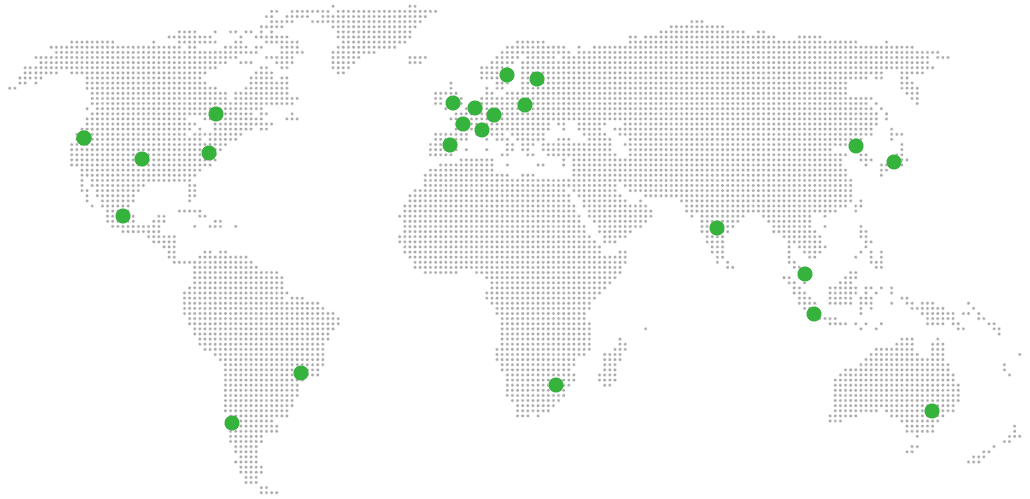
Global Reach Map

Try managed SerpBear for 7 days

No card. Cancel from the dashboard.