Fully Managed
MiroTalk P2P
as a Service

Deploy MiroTalk P2P as a fully managed service starting at €9/mo. Get automated backups, SSL, updates, support and monitoring included.

MiroTalk P2P is an open-source peer-to-peer browser video conferencing platform — calls, screen sharing, chat, and recording — built on WebRTC mesh so audio and video travel directly between participants without touching a third-party server.

Free 7-day trial  99.9% Uptime SLA  No credit card  Cancel anytime

Free 7-day trial  99.9% Uptime SLA
No credit card  Cancel anytime

MiroTalk P2P

MiroTalk P2P

STARTING AT

€9/month
Automated Backups
Monitoring
Automated Updates
Auto SSL

USAGE

Unlimited
Human Support
Custom Domains
Terminal Access
File Manager Access
Deploy in your region 21 locations worldwide
GermanyFinlandNetherlandsUKSwedenUnited StatesCanadaSingaporeJapanAustraliaBrazilSouth Africa+9 more →
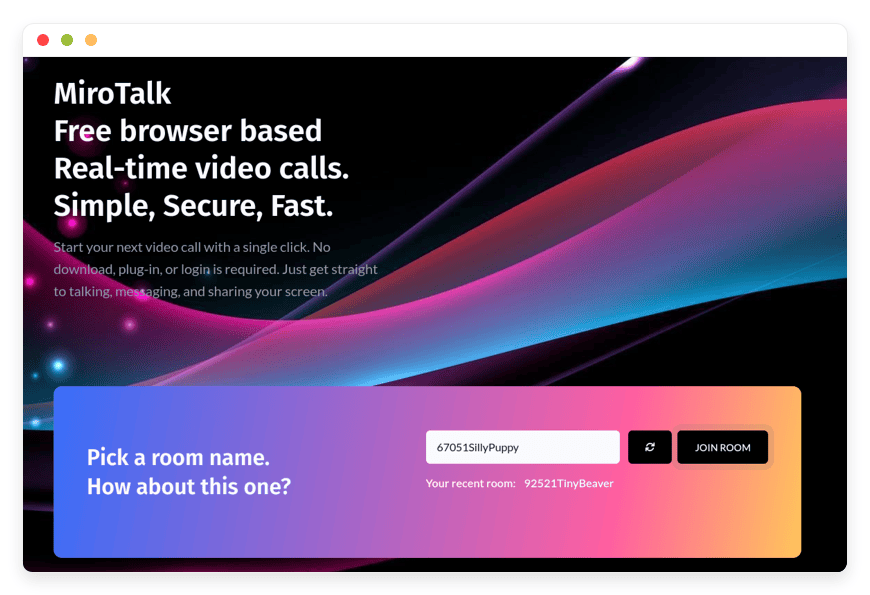
MiroTalk P2P Preview Image

ABOUT THE SOFTWARE

What is MiroTalk P2P

MiroTalk P2P is an open-source, browser-based WebRTC video conferencing tool built on a peer-to-peer mesh — audio and video travel directly between participants, with the server only handling room signalling and access control.

The project is licensed under AGPL-3.0 and maintained by Miroslav Pejic, an Italian developer who has shipped the MiroTalk family of WebRTC tools since 2020. The current stable version is v1.8.04, declared inline at the top of the project's environment template. Around 4,400 GitHub stars and 700+ forks track the repository; the interface is translated into 133 languages and the app installs as a PWA on desktop and mobile.

The MiroTalk family includes four sibling projects with different topologies: P2P (mesh, 2–8 participants), SFU (selective forwarding unit, up to 100 participants per CPU), C2C (cam-to-cam, exactly 2), and BRO (broadcast, one-to-many). DANIAN runs 3 of them. Picking P2P is the right call when you want the lowest latency, the lowest server cost, and the strongest media privacy story — media bytes never traverse the server at all.

FEATURES

What MiroTalk P2P does

The capability list below describes the application itself, not the DANIAN platform. Every item is shipped in the upstream project and tunable via config.js or environment variables on your instance.

Peer-to-peer mesh

Direct WebRTC connections between participants. Media bytes never traverse the server, lowest latency, no per-minute bandwidth cost. Optimal range is 2 to 8 participants per room.

Embed and widget

A documented iframe embed and a drop-in widget.js snippet let you place a "join a call" button on any web page with about ten lines of HTML.

Access control

Host protection with per-user credentials, full OIDC support (Auth0 and any node-oidc-provider-compatible identity provider), JWT tokens with configurable expiry, and an IP allow-list.

Recording and media sharing

Each host can record their own session locally via the browser's MediaRecorder API, take PNG snapshots of any frame, and play synchronised media to the whole room.

8K, 60fps streaming

Up to 8K resolution and 60 frames per second for both webcam and screen sharing — useful for design reviews, code-pair sessions, and anywhere pixel fidelity matters.

REST API and JWT

Endpoints at /api/v1/meeting, /api/v1/join, and /api/v1/token (Swagger at /api/v1/docs) let your backend mint one-time rooms and tokens.

Collaboration tools

Built-in collaborative whiteboard, drag-and-drop file transfer over DTLS, public and private chat with Markdown rendering and conversation export.

Workflow integrations

Slash-command launchers for Slack and Mattermost, Sentry error reporting, and an in-meeting ChatGPT panel with a bring-your-own-API-key model.

WHAT'S ALWAYS INCLUDED

Every app. Fully managed.
Nothing extra to pay for.

Every app you deploy includes the full managed service — security, backups, updates, and support from day one.

Automatic updates and patches

Apps run the latest stable version. Security patches applied silently, with rollback if needed.

Daily off-site backups

Multiple daily backups in redundant off-site locations. One-click restore if anything goes wrong.

24/7 uptime monitoring

Continuous monitoring with instant alerting. We respond before you notice.

SSL, firewall, DDoS protection

Auto-renewing SSL, hardened firewall rules, DDoS mitigation on every deployment.

Performance and scaling

We monitor resource usage continuously. When your app needs more headroom, we flag it and upgrade with your explicit approval.

Dedicated engineering support

Real engineers on chat. DNS, SMTP & migration help. All included in €9.

WHY MANAGED

Why teams pick managed MiroTalk P2P

Zoom Workplace Pro raised its annual price from $149.90 to $159.90 per user in 2025, with multiple users reporting they were charged the new rate at renewal without explicit notice. For a six-seat team that crosses €700 a year, and the unit economics get worse the more people you add.

Running MiroTalk P2P yourself swaps the per-seat bill for an operational job that the project's documentation, GitHub issues, and forum threads have already mapped. The defaults that ship in .env.template are explicitly marked as starter values: the TURN server credential is a shared anonymous OpenRelay tenant ("Please, create your own account," the comment reads), the API key is the literal string mirotalkp2p_default_secret, the JWT signing key is also a placeholder, and host protection is off. Leave any of those in place and a production install leaks call-establishment metadata, fails for participants behind symmetric NAT, or accepts unauthenticated room creation.

The other half is the long tail — iOS Safari quirks (volume sliders and mute controls greyed out, white-screen condition when two Safari tabs open the camera, mobile screen sharing unavailable), TURN relay capacity planning, certificate renewal, security advisories on the underlying mediasoup and socket.io stacks, branding via config.js, OIDC wiring if the team uses Auth0. Each piece is solvable; collectively they are a job.

REVIEWS

Hear from customers ​like you​​​​​​​

Successful businesses and professionals around the world rely on DANIAN every day

USE CASES

Three teams who run MiroTalk P2P on DANIAN

These are representative team types we set up most often. Each starts with the same flat €9 plan.

6-PERSON TUTORING CO-OP

Replacing per-seat SaaS when the math stops adding up

Six tutors paying for video seats they each used four hours a day. After the Zoom Pro renewal hike, the co-op moved to a managed MiroTalk P2P instance on a custom subdomain. Tutors mint per-lesson room URLs via the REST API. Flat €9/month replaced about €60/month in per-seat costs.

SOLO THERAPIST

Branded, browser-only sessions on a domain the client trusts

One-on-one client work where the conversation cannot route through a vendor server. HOST_PROTECTED on, JWT tokens with 1-hour expiry per session, server-side recording off, audit log on /api/v1/meetings. The room URL is on the practice's own domain. Mesh keeps media bytes between practitioner and client.

8-PERSON BOOTSTAPPED SAAS TEAM

Click-to-call sales demos embedded on the marketing site

The SaaS dropped widget.js onto its pricing page with data-widget-type="support" and data-position="bottom-right". Inbound demos start without leaving the page. The backend mints one-time rooms via REST. No per-minute or per-room billing surprises as demo traffic grew.

COMPARISON

Four ways to run MiroTalk P2P

Four paths buyers actually compare when they evaluate video conferencing. Costs shown at 1, 5, and 10 seats so the math at scale is visible — not hidden behind tiers and add-ons.

 PATHCOST AT 1 / 5 / 10 SEATSSETUP & OPSBRANDING & EMBEDDATA PATH
Zoom Workplace Pro
Proprietary SaaS
~€12 / ~€61 / ~€123 per month
$13.33/user/month annual, renewal $159.90/yr after 2025 hike
Instant signup, no opsVendor brand, limited iframe optionsVendor-hosted, vendor-controlled
Self-host on a VPS
DIY
~€24 / ~€24 / ~€24 per month
Production-class VPS, flat regardless of seats
4–8 hours initial, ~2 hours/month patching, TURN tuning at 25+ usersFull control via config.jsMesh — media direct between peers
Home server
Raspberry Pi 5 or mini-PC
~€120 one-time + €1–3/mo electricity
Pi 5 8 GB or Intel N100 mini-PC
Initial setup plus DNS, dynamic IP, and home-bandwidth limitsFull controlMesh + your home network
DANIAN Managed MiroTalk P2P
€9 / €9 / €9 per month
Flat, regardless of seat count
Fast signup-to-first-call, no ongoing opsYour domain, your branding, embed and widget supportedMesh — media direct between peers, dedicated TURN we run

BY INDUSTRY

MiroTalk P2P for specific industries

The mesh topology puts a practical ceiling around 5–8 participants per room. That makes MiroTalk P2P a strong fit for industries built on small, high-trust conversations — and a poor fit for town-halls. Below are five sectors where the architecture lines up with the workflow.

Tutoring practices and language schools operate under student-data protection rules and parental-consent obligations when minors are involved.

Branding the call URL on the school's own domain is often a trust requirement before parents will let children join.

On DANIAN we pin the instance to the region you choose, configure the subdomain, and ship with cloud recording off by default — recording in MiroTalk P2P is client-side via MediaRecorder, never server-side.

A typical workflow: the tutor uses /api/v1/meeting to mint a per-lesson room, emails the link, and both join in any browser with no install.

With mesh optimal for 2 to 8 participants, a 1-on-1 or small-group lesson sits comfortably inside the quality band, and the flat €9/month replaces the per-seat bills that scale linearly with tutor headcount.
Attorney-client privilege and professional confidentiality obligations require that conversation media stay outside third-party reach.

MiroTalk P2P encrypts media end-to-end between peers via DTLS-SRTP — the signalling server never sees decryptable media bytes.

On DANIAN we run a dedicated coturn instance per customer (so clients behind corporate firewalls connect cleanly without leaking metadata through a shared OpenRelay tenant), enable HOST_PROTECTED with JWT-tokenised access, and support OIDC if the firm already uses Auth0 or a self-hosted identity provider.

The typical workflow is a pre-scheduled consultation with a one-time room link; calls are 2 to 4 participants, well inside mesh capacity. €9/month replaces unpredictable per-seat SaaS pricing across the partnership.
Practitioners working under patient-confidentiality standards need control over session metadata, the brand the client sees, and where the instance physically runs.

DANIAN pins your region, ships your own subdomain, leaves server-side recording disabled (the project does not include it for P2P), and exposes the meetings audit log on /api/v1/meetings.

Sessions are typically 1 to 3 participants — practitioner, client, occasional family member — which is the strongest part of the mesh band.

We describe the architecture's properties honestly: media stays peer-to-peer, the server only relays SDP and ICE candidates.

We do not use attestation language; what we ship is what the architecture does.
Source-protection obligations and donor-confidentiality rules mean editorial and field calls cannot route through opaque third-party media servers.

MiroTalk P2P's mesh keeps media bytes off the operator's box entirely — the signalling server only relays SDP descriptions and ICE candidates.

On DANIAN we enable IP_WHITELIST_ENABLED for staff endpoints, run short-lived JWT tokens (default 1-hour expiry) for one-time source-facing calls, and operate TURN on a coturn instance unique to your deployment.

Workflow: a desk editor pre-shares a token-protected room with a source on a subdomain the newsroom controls.

Calls are 2 to 5 participants typical.

No metadata leaves your domain unless TURN relay is invoked, and even then the TURN node sees only encrypted relay traffic.
Studios working under NDA and IP-confidentiality clauses with clients need high-fidelity screen sharing for type, colour, and code review — plus branding control so the call doesn't look like it's running through a vendor product the client doesn't recognise.

MiroTalk P2P streams screen capture at up to 8K and 60fps, and config.js exposes theme, logos, and button-visibility per deployment.

On DANIAN we deploy under your client-portal subdomain and drop the widget.js snippet on the project tracker for click-to-call from any page.

A typical review is 4 to 6 participants — designer, client side, sometimes a producer — well inside mesh quality.

Branded room URLs, client-side review recordings, and embed inside the studio's project-management tool.

FAQ

Frequently asked questions

Everything teams ask before signing up — answered straight, without sales speak.

Three groups: technical setup, migration, and how DANIAN works as a service.

01

Technical and configuration

The project's own documentation cites 5 to 8 participants per room as the optimal range for the WebRTC mesh topology. Above 8, each participant's upload load grows linearly with peer count and quality drops. For 10 or more in a room, MiroTalk SFU is the right tool, and we host that one too.
Yes for 1-to-1 and small-group calls. We have reproduced the documented quirks in the project's issue tracker: volume sliders and mute controls greyed out on iOS 17 Safari, a white-screen condition when two Safari tabs request the camera simultaneously, and screen sharing not available on mobile because the underlying browser API is not exposed. We document all three in the onboarding email so practitioners know what to tell clients before they hit them.
Recording in MiroTalk P2P is client-side only — the host's browser captures the call via the MediaRecorder API and writes the file to the host's local disk. There is no built-in server-side recording in P2P. If you need server-recorded MP4s, MiroTalk SFU adds that capability via FFmpeg/RTMP; we run both variants on the same dashboard.
MiroTalk P2P is a WebRTC mesh — direct browser-to-browser media, no media server, optimal for 2 to 8 participants, lowest latency, lowest server cost. MiroTalk SFU forwards encrypted media through a mediasoup-based server and scales to roughly 100 participants per CPU. Pick P2P for small high-trust calls; pick SFU for larger meetings, webinars, or anything past 8 in a room.
Yes, for production use. The default install ships with a shared anonymous OpenRelay credential in the env template — the comment immediately above it reads "Please, create your own account." We run a dedicated coturn instance per customer instead, which fixes call-establishment for participants behind symmetric NAT and keeps ICE-candidate metadata off third-party shared tenants. The coturn credentials rotate on a schedule and are unique to your deployment.
Yes — the project documents two patterns. An iframe direct-embed (src=".../newcall?room=...&name=...&audio=1&video=1") drops a room into any page. A widget.js script tag adds a click-to-call button with data-position and data-widget-type attributes. We help wire either pattern to your domain and Content Security Policy during onboarding.
OpenID Connect is supported natively — including Auth0 and any self-hosted node-oidc-provider-compatible identity provider. The relevant environment variables are OIDC_ENABLED, OIDC_ISSUER_BASE_URL, OIDC_CLIENT_ID, and OIDC_CLIENT_SECRET.
SAML and LDAP are not natively supported in MiroTalk P2P today.
In mesh mode, media bytes never traverse the signalling server. Encryption is DTLS-SRTP directly between the peers in the room. We see SDP descriptions and ICE candidates needed to establish the peer connection, and we see the room state in memory. If TURN relay is invoked for symmetric-NAT participants, the TURN server sees encrypted relay traffic it cannot decrypt — and the TURN node is one we run, not a shared third-party tenant.

02

Migration and onboarding

We can activate your app on your own custom domain/subdomain. Examples: mydomain.com, anyword.mydomain.com.
Or, on our randomized free subdomain. Example: 963.apps.danian.cloud
If you wish to use a custom domain/subdomain, select that option when ordering your app (or notify us later). We will send you the required DNS records and if needed, our tech team will modify them for you.
21 datacenter locations across six continents. You choose the region at provisioning. Application data sits in the region you choose; pick whichever is closest to your users or matches your data-residency preference.
Yes. Request a region migration from the dashboard and we run the move in the background. The system emails you when the migration completes; total transfer time depends on data volume but typical instances finish in a few hours. There is no extra charge for a region change.
Yes. Full data export is available at any time, in a portable format you can bring to any infrastructure.
There is no data to migrate in the traditional sense — video conferencing rarely retains historical content the way file collaboration or email does. What we help with is the cutover: setting up the subdomain, generating room URLs that match your scheduling tooling, briefing your team on the iOS Safari quirks, and running a parallel pilot for a week before you cancel the SaaS plan.
No. MiroTalk P2P runs entirely in the browser. Anyone with a current Chrome, Firefox, Safari, or Edge can join with a single click on a room URL. The interface is translated into 133 languages and the project ships as an installable PWA if a user prefers a desktop-icon launcher.
MiroTalk SFU is the sibling project for 8 to 100-participant rooms, with server-side recording and live streaming. On DANIAN you can switch between or run both side by side — small group calls on P2P, all-hands on SFU. Your subdomain and access control stay consistent across the two.

03

Billing, support, and platform

€9 covers everything we do for that app: hardware in the region you choose, daily off-site backups with one-click restore, automatic security patches and version upgrades, 24/7 monitoring, SSL and firewall, and engineering support on Email/LiveChat. There are no setup fees or hidden line items. For more info see our Pricing page.
If you decide to continue, we charge €9/app/month from day 8. If you don't, the trial ends and you can export your data. No card is required for the trial, and we never auto-charge you without explicit consent.
No. The €9/month is flat regardless of how many users log into your app. Add 5 users or 50; the price doesn't change.
24/7 Live chat and email support, both staffed by engineers who run the systems. We handle DNS configuration, SMTP setup, app integrations, performance tuning, troubleshooting, and migration help. Response time is typically under an hour. There is no tier system — every customer gets the same support.
Yes. Cancel from the dashboard. We don't charge a cancellation fee, we don't lock data, and we will export your data to you on request before deletion. data to you on request before deletion.
Every customer instance is backed up daily to a separate region from the primary. We test restores. You can request a restore at any backup point within the retention window — usually 7 days for daily backups.
Your application data sits in the region you choose at provisioning — 21 datacenter locations across six continents. Account-level data (billing, account email, support ticket history) is processed centrally. Application data region is picked by you, per app.
99.9% uptime SLA on every app, every tenant. Service credits are documented at danian.co/service-level-agreement. The status page is located at status.danian.co.
When your tenant approaches the resource ceiling — the base tier holds 1 vCPU/RAM, 30 GB storage — we notify you. Resource upgrades happen with your explicit consent; we will not upgrade your tenant or charge you without it.
We wait. We don't suspend the app or delete your data on the first failed charge. We email you, you fix the card on file, and we continue.
Invoices can be downloaded from the billing dashboard in PDF the day each charge succeeds. EU VAT is added where applicable and the VAT-reverse-charge regime applies for VAT-registered businesses with a valid number.
150+ open-source apps across automation, team chat, file sync, analytics, AI, password management, email marketing, dev tools, project management, smart home, CMS, and federated social. See the full catalog →
Yes. Every instance comes with a web-based terminal and a file manager in your DANIAN management dashboard. Useful for managing your data and customizations.
Resources scale with your usage. If your app needs more vCPU, RAM, or storage, we add it — and we ask first before any change to your plan. €9 is the floor; resource-heavy workloads may price higher, but you'll always know in advance.
Yes. We have both a Partner program and an Affiliate program available. Anybody can sign up.
No contract. No minimum commitment. Cancel anytime from the dashboard with one click. The 7-day free trial requires no credit card. After the trial converts to paid, you can still cancel at any month without notice or penalty.

DEPLOY IN YOUR REGION

21 datacenter locations on six continents

Pick the region closest to your users.

United States, Germany, Finland, Singapore, Australia, Brazil, Canada, Netherlands, UK, Spain, Italy, France, Sweden, Malaysia, India, Japan, Mexico, Poland, South Korea, Chile, South Africa and more coming soon
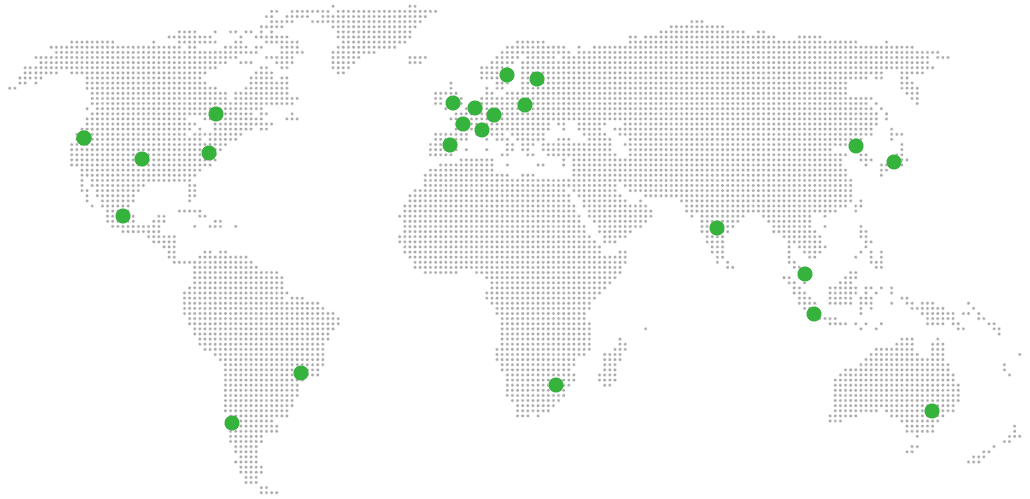
Global Reach Map

Try managed MiroTalk P2P for 7 days

No card. Cancel from the dashboard.