Fully Managed
Mirotalk BRO
as a Service

Deploy Mirotalk BRO as a fully managed service starting at €9/mo. Get automated backups, SSL, updates, support and monitoring included.

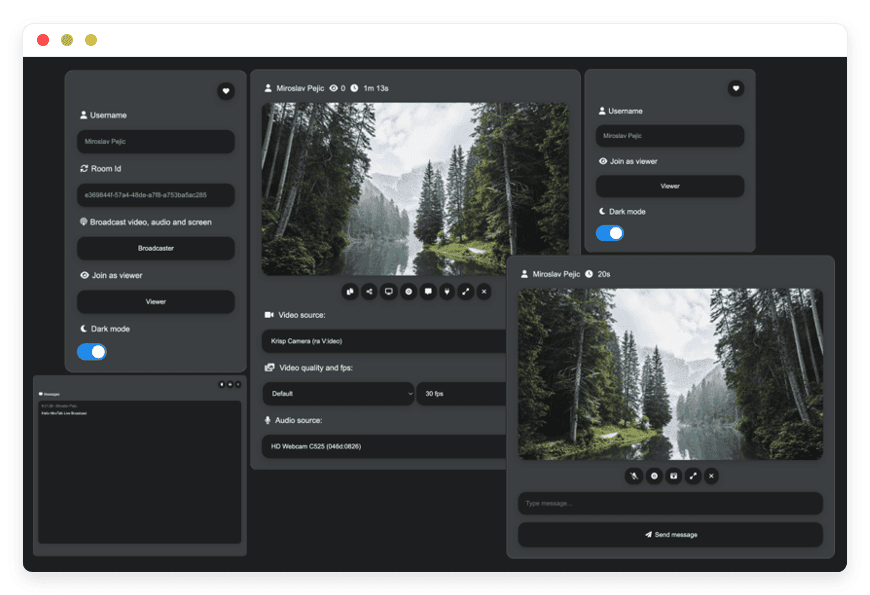
MiroTalk BRO is an open-source WebRTC live-broadcast platform — one broadcaster, unlimited viewers, sub-second latency, recordings, screen sharing, embeddable iframe, no signups, no time limits. It combines the immediacy of YouTube Live or Twitch with the sovereignty and cost predictability of broadcasting from your own domain.

Free 7-day trial  99.9% Uptime SLA  No credit card  Cancel anytime

Free 7-day trial  99.9% Uptime SLA
No credit card  Cancel anytime

Mirotalk BRO

Mirotalk BRO

STARTING AT

€9/month
Automated Backups
Monitoring
Automated Updates
Auto SSL

USAGE

Unlimited
Human Support
Custom Domains
Terminal Access
File Manager Access
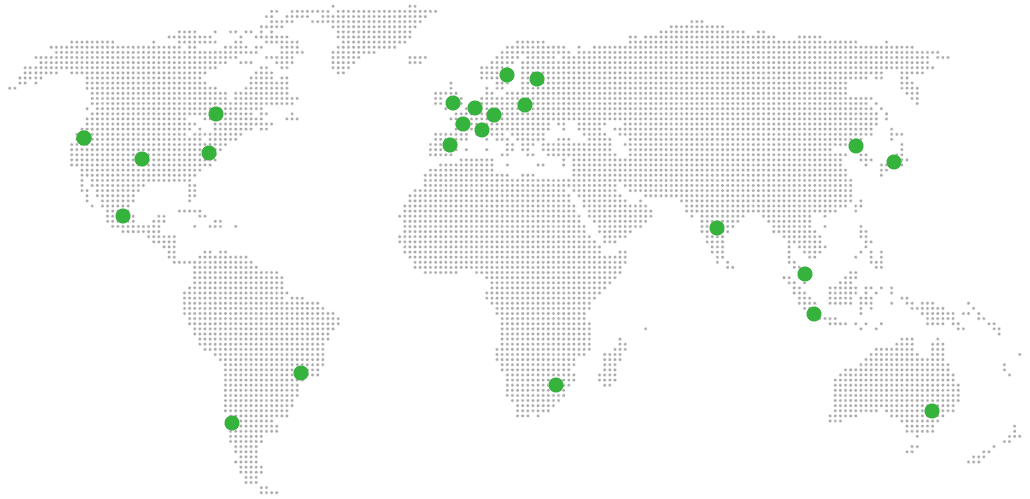
Deploy in your region 21 locations worldwide
GermanyFinlandNetherlandsUKSwedenUnited StatesCanadaSingaporeJapanAustraliaBrazilSouth Africa+9 more →
Mirotalk BRO Preview Image

ABOUT THE SOFTWARE

What is Mirotalk BRO

MiroTalk BRO is a self-hosted WebRTC live-broadcast platform built for one-to-many real-time streaming. One broadcaster speaks; unlimited viewers watch with sub-second latency, in a room you own, on a domain you control, without an intermediary platform deciding what's allowed.

The project is maintained by Miroslav Pejic under the AGPL-3.0 license. It runs on Node.js, uses native browser WebRTC for media transport, and ships with two operating modes: peer-to-peer mesh (for low viewer counts) and SFU via mediasoup (for production-scale audiences). The codebase tracks the upstream main branch — DANIAN pins to a tested commit and rolls forward on a controlled cadence rather than auto-upgrading on every push. The documentation hub is at docs.mirotalk.com.

BRO is one of several MiroTalk variants — alongside SFU (group video conferencing), P2P (peer-to-peer calls), and C2C (private cam-to-cam). What makes BRO specific: it is the one tuned for asymmetric audiences. The broadcaster is the only sender; viewers are passive consumers with an optional upstream chat. That asymmetry is what lets a single small instance serve hundreds of viewers when the SFU is configured correctly — the part most self-hosters get wrong on the first try.

FEATURES

What Mirotalk BRO does

MiroTalk BRO ships as a focused broadcasting tool, not a Swiss army knife. Its capability set is built around the one-to-many WebRTC model: a broadcaster pushes video, audio, and screen; viewers consume in sub-second latency, with an optional return channel for text chat and a REST API for room control.

Unlimited rooms, unlimited duration

One BRO instance handles unlimited concurrent broadcasts. Each room is keyed on an opaque id parameter — no signups, no time limits, no participant caps imposed by the application.

DTLS-SRTP encrypted streams

All media is encrypted between broadcaster, server, and viewers using the WebRTC standard cryptographic suite. No clear-text streams cross the wire at any hop.

Viewer-to-broadcaster chat

Optional upstream text channel so viewers can ask questions, comment, or place sealed bids in live-commerce contexts without opening a separate tool.

REST API for room control

The /app/api/ endpoints let your backend mint signed join URLs, list active rooms, and trigger broadcaster auth flows. Wire BRO into your CRM without forking.

SFU mode via mediasoup

Production-scale fanout to hundreds of viewers per CPU core. Switch from P2P mesh with a single environment variable; we ship every instance in SFU mode by default.

Screen sharing and camera

Broadcasters switch between camera, screen, or combined views mid-stream. Viewers see the change without reconnecting and without buffer interruption.

Embeddable iframe

Drop the viewer page into any HTML with the standard iframe tag. Embed on Substack posts, course portals, parish websites, or Shopify product pages.

Recording with off-host storage

Capture broadcasts to disk locally. We configure the recording storage on your instance during onboarding.

WHAT'S ALWAYS INCLUDED

Every app. Fully managed.
Nothing extra to pay for.

Every app you deploy includes the full managed service — security, backups, updates, and support from day one.

Automatic updates and patches

Apps run the latest stable version. Security patches applied silently, with rollback if needed.

Daily off-site backups

Multiple daily backups in redundant off-site locations. One-click restore if anything goes wrong.

24/7 uptime monitoring

Continuous monitoring with instant alerting. We respond before you notice.

SSL, firewall, DDoS protection

Auto-renewing SSL, hardened firewall rules, DDoS mitigation on every deployment.

Performance and scaling

We monitor resource usage continuously. When your app needs more headroom, we flag it and upgrade with your explicit approval.

Dedicated engineering support

Real engineers on chat. DNS, SMTP & migration help. All included in €9.

WHY MANAGED

Why teams pick managed Mirotalk BRO

On January 20, 2026, Bending Spoons announced mass layoffs at Vimeo — four months after the $1.38 billion acquisition closed. Broadcasters who'd already watched the same firm raise StreamYard prices 80 to 369 percent in 2024 understood the playbook. Self-hosting MiroTalk BRO is the sovereign alternative. Running it well is the hard part.

The Vimeo announcement is the latest data point in a multi-year pattern: broadcast tools get acquired, prices get restructured, free tiers shrink, grandfathering doesn't apply. Restream, StreamYard, Vimeo, Eventbrite, WeTransfer, and Brightcove now share a parent company. For broadcasters whose entire audience-acquisition strategy depends on a tool that might be repriced or repositioned next quarter, the calculus changes. Owning the broadcaster — running it on your own infrastructure, on your own domain — is no longer paranoid; it is prudent.

Self-hosting MiroTalk BRO is technically approachable in P2P mode and operationally punishing in production. The default broadcast mode meshes every viewer directly to the broadcaster's browser, which means a residential 10 Mbps uplink caps at roughly six concurrent viewers before frame-rate collapses. Operators discover this somewhere around viewer 25, flip the .env to SFU mode, and walk into the second trap: mediasoup needs MEDIASOUP_ANNOUNCED_IP bound to the public IPv4, the RTC port range 20000–20099 opened on both UDP and TCP at every firewall layer, and a working TURN server for viewers behind corporate NAT. Miss any one and the stream silently fails to start. The maintainer's own diagnostic blog walks through chasing missing ICE relay candidates because the trap is that common.

We ship every MiroTalk BRO instance with SFU mode enabled out of the box, the public IP pre-bound, the port range already opened, and a dedicated coturn TURN server with rotating credentials wired into the config. On day one a tenant can put 200 viewers on a single broadcaster without touching an environment variable.

REVIEWS

Hear from customers ​like you​​​​​​​

Successful businesses and professionals around the world rely on DANIAN every day

USE CASES

Three teams who run Mirotalk BRO on DANIAN

Three example customer shapes with different configurations — a parish broadcasting Sunday services, a two-person education company running paid cohorts, and a specialty retailer hosting live product drops. They differ in region, retention policy, and integration point. They share the same flat €9 base.

600-MEMBER PARISH

Broadcasting Sunday services to 150 concurrent viewers across the diaspora

A parish in Lyon broadcasts Sunday 10:00 services and Wednesday Bible studies to a congregation split between France, Quebec, and the Maghreb. Region: Germany. Recordings auto-archive on a 12-month rotation. Room password rotated weekly via the REST API. The BRO viewer is iframe-embedded directly on the parish WordPress site.

TWO-PERSON EDUCATION COMPANY

Four cohorts a year, 120 paid students each, recordings auto-purged at day 91

A UK education company runs four eight-week cohorts annually of a £950 product-management course. Region: UK. Recordings retained 90 days then purged to match their published policy. Chat enabled with display-name hashing so no email PII lands in room logs. Iframe-embedded inside the Teachable course shell.

SPECIALITY HORTICULTURE RETAILER

Saturday-morning rare-aroid auctions, sealed bids in chat, 12% buy-rate

A Pacific Northwest plant nursery runs 30-minute Saturday product drops with audience-driven sealed-bid sales. Region: US. They moved off Instagram Live and TikTok after horticultural-export claims kept tripping platform rules. No recording for bid integrity. coturn fallback for viewers on corporate lunch-break networks.

COMPARISON

Four ways to run Mirotalk BRO

Most broadcasters reach MiroTalk BRO from a proprietary SaaS — Restream, StreamYard, Vimeo Livestream — or are weighing a fresh deployment. The math below compares total monthly cost across four paths at 1, 5, and 10 broadcaster seats, with operational time priced honestly.

 PATH1 BROADCASTER5 BROADCASTERS 10 BROADCASTERSOPS TIME / MONTHNOTES 
Restream
Professional + per-seat

$49 / mo$149 / mo$274 / mo0 hrs
Per-seat at $25/mo. Multistream to YouTube/Twitch; not direct-to-audience. Latency 5–15s.
Self-host
on a $24/month production-class VPS
~€100–280 / mo~€100–280 / mo~€100–280 / mo5–10 hrs initial
1–2 hrs/mo
$24 VPS + $5 object storage + $15 monitoring = $44/mo infra. Plus €60–240/mo ops time at €60–120/hr.
Home server 
(Synology DS923+ or HP ProLiant ML30 Gen10)
~€210–667 / mo~€210–667 / mo~€210–667 / mo2–4 hrs/moHardware €650–1,500 amortised + electricity €17–32 + business internet €40–80 + off-site backup €10–20 + ops time €120–480.
DANIAN Managed Mirotalk BRO€9 / mo€9 / mo€9 / mo0 hrsOne instance, unlimited broadcasters and rooms. Resources upgrade only with your written approval.

MiroTalk BRO instance cost is flat regardless of how many broadcasters share it — we bill the instance, not the seat. The total at 1, 5, and 10 broadcasters is identical because the architecture treats additional broadcasters as additional rooms on the same instance.

BY INDUSTRY

Mirotalk BRO for specific industries

MiroTalk BRO fits a narrower set of industries than the generic open-source app framing suggests — broadcast-shaped use cases where one-way streaming, sub-second latency, and the right to your own domain matter more than mass-platform reach. Four industries with the strongest fit.

Religious organisations broadcasting services, sermons, and study groups operate under specific music-licensing obligations. In the UK and Commonwealth, the CCLI Streaming Licence governs hymn and worship-song broadcasts; in continental Europe, PRS for Music and equivalent national collecting societies (SACEM in France, SIAE in Italy, GEMA in Germany) hold equivalent rights. Recording retention and accessibility — including live captioning bridges and replay availability for hearing-impaired members — drive most configuration decisions.

We provision a coturn fallback so viewers on corporate or hotel networks still connect. A typical parish workflow: broadcaster opens the URL with a week-slug ID from the parish CRM, congregants receive an SMS link from the bulletin generator, and recording auto-uploads off-host for the Sunday afternoon replay service in a neighbouring chapel. A 600-member parish with 150 concurrent live viewers generates roughly 26 GB of 1080p recording per year over 52 weekly broadcasts.

Cohort-based education providers running paid live sessions face two operational constraints at once: data-handling expectations from international students (the UK Children's Code applies when under-18 cohorts are possible; the US FERPA framework shapes recording-retention practice for US-rostered students) and the conversion math of replacing per-attendee webinar tools that price-cliff at 100 or 500 seats.

We pin data residency to UK or EU based on the cohort's primary market and provision a lifecycle rule on the recording bucket that auto-deletes at day 91. A typical workflow: the instructor launches the broadcast via iframe inside the Teachable or Thinkific course shell; chat moderation is enabled with a banned-word filter; recordings are exposed only to enrolled students through signed URLs. Four cohorts annually × 120 students × 16 live sessions per cohort yields 7,680 student-session-hours per year on a single small SFU node.

Independent journalists and regional newsrooms face a different stack of constraints: source protection, platform-deplatforming risk, public-record retention, and WCAG 2.2 AA accessibility requirements for any civic-broadcast viewer surface. The EU Media Freedom Act (Regulation 2024/1083) layers additional transparency obligations on media service providers operating in the EU.

We disable third-party analytics on the viewer page by default, and ship the viewer interface with audio-only join enabled for low-bandwidth audiences. A typical workflow: an independent journalist embeds the BRO viewer iframe directly inside their Substack-published article; press conferences run with chat disabled and the recording auto-archived. A 5,000-subscriber Substack with a weekly live segment averaging 400 concurrent viewers fills 52 archived broadcasts per year.

Marketing teams replacing per-attendee webinar tools — typically GoToWebinar at roughly $199 per month for 500 attendees, repriced upward when attendance grows — care about three things at once: cost flattening as attendance scales, CRM attendance attribution, and CAN-SPAM-compliant (US) or PECR-compliant (UK) invitation flows.

We provision webhook delivery on viewer.joined and viewer.left events to HubSpot, Salesforce, or Pipedrive via Make.com or a direct webhook receiver, and the bulk join-URL generator integrates with the CRM's webinar-invite template. A typical workflow: the marketer schedules a Thursday 2pm product demo; the CRM emits unique ?id=<contactID> join URLs so every attendance event attributes per-lead; the recording auto-uploads to the company DAM and auto-links into the follow-up nurture email. A four-webinar-monthly cadence at 250 average attendees produces 12,000 attendee-sessions per year with no per-attendee fee.

FAQ

Frequently asked questions

Everything teams ask before signing up — answered straight, without sales speak.

Three groups: technical setup, migration, and how DANIAN works as a service.

01

Technical and configuration

MiroTalk BRO defaults to P2P (mesh) broadcast mode. The broadcaster's browser opens an independent WebRTC PeerConnection to every viewer, so the broadcaster's upload bandwidth and CPU are the ceiling. At roughly 1.5 Mbps per stream, a residential 10 Mbps uplink caps at six viewers. We ship every DANIAN instance in SFU mode with mediasoup, which lifts the ceiling to hundreds of viewers per CPU core.
In P2P mode, single digits on a residential uplink and twenty to thirty on a small VPS. In SFU mode, mediasoup handles roughly 100 viewers per CPU core, so the practical ceiling on a 4-core BRO instance is several hundred concurrent viewers per broadcast. If you need thousands, we recommend dedicated resources on the upgraded plan.
Safari's WebRTC implementation blocks autoplay-with-sound unless a user tap triggers playback, and it requires the page to be served over HTTPS. We bind a valid TLS certificate to your subdomain by default and ship the viewer page with a "Tap to play" overlay on first paint for mobile Safari. The maintainer's broader MiroTalk repo documents the same pattern across the project family.
We mount a persistent volume for local recording. The data is keept as long as your App is active. You have access to the files via the File Manager. if needed you can click to download, or delete them.
The id URL parameter is the room key — any unguessable string acts as a soft password. For real authentication we recommend minting signed join URLs from your backend via the /app/api/ REST endpoints, or fronting the viewer URL with a reverse-proxy auth layer like OAuth2 Proxy. We have wired both patterns for customers and can mock it up during the trial.
All viewer PeerConnections fail and the viewer UI returns to the application landing page. The upstream project has an open issue requesting a friendlier "broadcast ended" placeholder; until it merges, the failure mode is abrupt. We mitigate by setting up a second authenticated broadcaster role for high-stakes events so a co-host can take over if the primary feed drops.
Yes. Each room is keyed on the id parameter, and one BRO instance handles unlimited concurrent rooms with no time limits. The resource ceiling is CPU and uplink bandwidth, not application-imposed seat counts. If you're running four simultaneous 200-viewer broadcasts, we size the instance accordingly during onboarding.
SFU is for group conferences — many-to-many, around eight or more active participants, up to roughly 100 per CPU core. BRO is one-to-many broadcast — one sender, many passive viewers, optional return chat. If your viewers need to talk back with video, you want SFU. If they only watch, you want BRO. We host both and can mix instances on the same account.

02

Migration and onboarding

We can activate your app on your own custom domain/subdomain. Examples: mydomain.com, anyword.mydomain.com.
Or, on our randomized free subdomain. Example: 963.apps.danian.cloud
If you wish to use a custom domain/subdomain, select that option when ordering your app (or notify us later). We will send you the required DNS records and if needed, our tech team will modify them for you.
21 datacenter locations across six continents. You choose the region at provisioning. Application data sits in the region you choose; pick whichever is closest to your users or matches your data-residency preference.
Yes. Request a region migration from the dashboard and we run the move in the background. The system emails you when the migration completes; total transfer time depends on data volume but typical instances finish in a few hours. There is no extra charge for a region change.
Yes. Full data export is available at any time, in a portable format you can bring to any infrastructure.
Architecture and pricing model. Restream multistreams to YouTube, Twitch, and Facebook simultaneously at 5–15 second latency. MiroTalk BRO delivers direct WebRTC broadcasts to your own domain at sub-second latency. The migration is essentially: embed our viewer URL where you used to send people to the SaaS-hosted page.
That is what the trial is for. Activate the instance, broadcast to a test audience, push it to its limits, record a few sessions, embed the viewer in a staging page. If the quality or the architecture does not fit, you walk away without a card on file.

03

Billing, support, and platform

€9 covers everything we do for that app: hardware in the region you choose, daily off-site backups with one-click restore, automatic security patches and version upgrades, 24/7 monitoring, SSL and firewall, and engineering support on Email/LiveChat. There are no setup fees or hidden line items. For more info see our Pricing page.
If you decide to continue, we charge €9/app/month from day 8. If you don't, the trial ends and you can export your data. No card is required for the trial, and we never auto-charge you without explicit consent.
No. The €9/month is flat regardless of how many users log into your app. Add 5 users or 50; the price doesn't change.
24/7 Live chat and email support, both staffed by engineers who run the systems. We handle DNS configuration, SMTP setup, app integrations, performance tuning, troubleshooting, and migration help. Response time is typically under an hour. There is no tier system — every customer gets the same support.
Yes. Cancel from the dashboard. We don't charge a cancellation fee, we don't lock data, and we will export your data to you on request before deletion. data to you on request before deletion.
Every customer instance is backed up daily to a separate region from the primary. We test restores. You can request a restore at any backup point within the retention window — usually 7 days for daily backups.
Your application data sits in the region you choose at provisioning — 21 datacenter locations across six continents. Account-level data (billing, account email, support ticket history) is processed centrally. Application data region is picked by you, per app.
99.9% uptime SLA on every app, every tenant. Service credits are documented at danian.co/service-level-agreement. The status page is located at status.danian.co.
When your tenant approaches the resource ceiling — the base tier holds 1 vCPU/RAM, 30 GB storage — we notify you. Resource upgrades happen with your explicit consent; we will not upgrade your tenant or charge you without it.
We wait. We don't suspend the app or delete your data on the first failed charge. We email you, you fix the card on file, and we continue.
Invoices can be downloaded from the billing dashboard in PDF the day each charge succeeds. EU VAT is added where applicable and the VAT-reverse-charge regime applies for VAT-registered businesses with a valid number.
150+ open-source apps across automation, team chat, file sync, analytics, AI, password management, email marketing, dev tools, project management, smart home, CMS, and federated social. See the full catalog →
Yes. Every instance comes with a web-based terminal and a file manager in your DANIAN management dashboard. Useful for managing your data and customizations.
Resources scale with your usage. If your app needs more vCPU, RAM, or storage, we add it — and we ask first before any change to your plan. €9 is the floor; resource-heavy workloads may price higher, but you'll always know in advance.
Yes. We have both a Partner program and an Affiliate program available. Anybody can sign up.
No contract. No minimum commitment. Cancel anytime from the dashboard with one click. The 7-day free trial requires no credit card. After the trial converts to paid, you can still cancel at any month without notice or penalty.

DEPLOY IN YOUR REGION

21 datacenter locations on six continents

Pick the region closest to your users.

United States, Germany, Finland, Singapore, Australia, Brazil, Canada, Netherlands, UK, Spain, Italy, France, Sweden, Malaysia, India, Japan, Mexico, Poland, South Korea, Chile, South Africa and more coming soon
Global Reach Map

Try managed Mirotalk BRO for 7 days

No card. Cancel from the dashboard.