Fully Managed
Documize Community
as a Service

Deploy Documize Community as a fully managed service starting at €9/mo. Get automated backups, SSL, updates, support and monitoring included.

Documize is an open-source knowledge-management platform — internal team wikis, customer-facing docs, runbooks, and policy libraries — combining the convenience of Confluence with the security and control of self-hosted infrastructure.

Free 7-day trial  99.9% Uptime SLA  No credit card  Cancel anytime

Free 7-day trial  99.9% Uptime SLA
No credit card  Cancel anytime

Documize Community

Documize Community

STARTING AT

€9/month
Automated Backups
Monitoring
Automated Updates
Auto SSL

USAGE

Unlimited
Human Support
Custom Domains
Terminal Access
File Manager Access
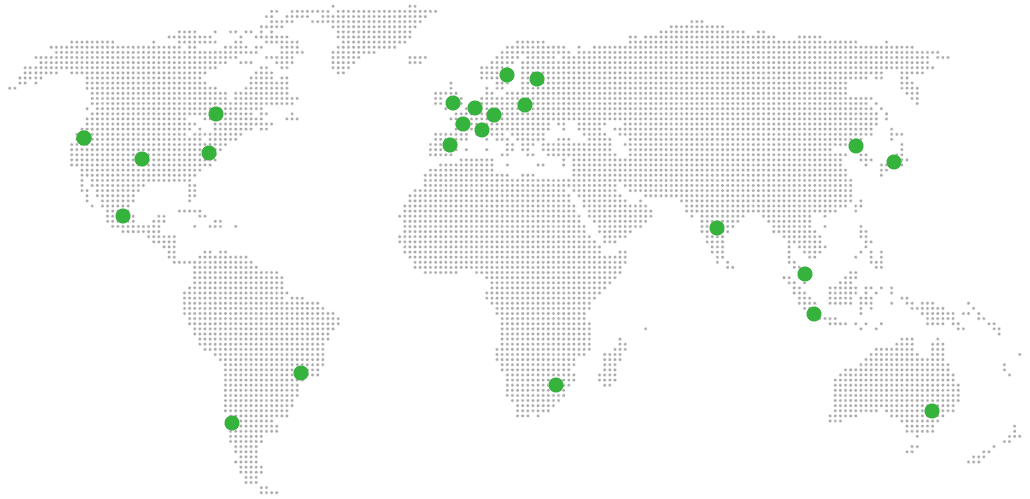
Deploy in your region 21 locations worldwide
GermanyFinlandNetherlandsUKSwedenUnited StatesCanadaSingaporeJapanAustraliaBrazilSouth Africa+9 more →
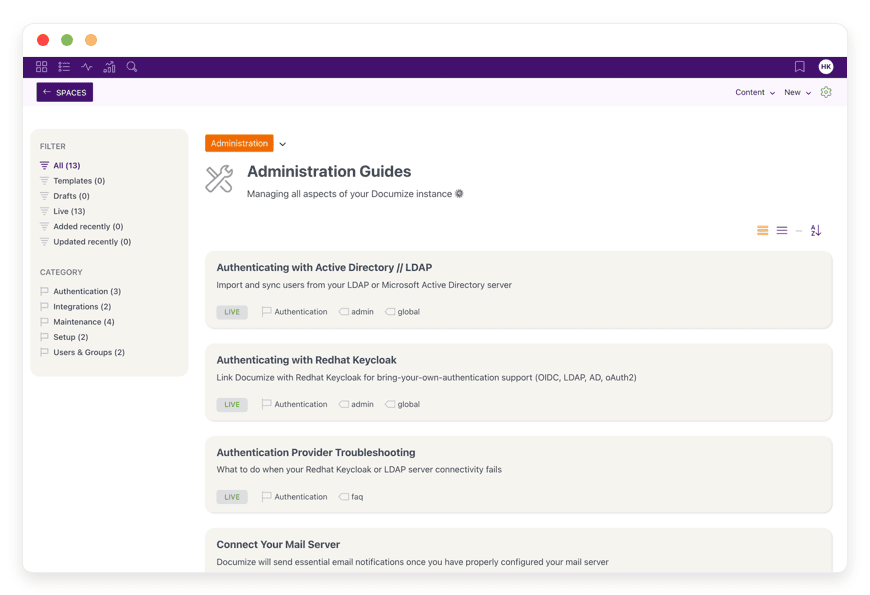
Documize Community Preview Image

ABOUT THE SOFTWARE

What is Documize Community

Documize is an open-source knowledge-management platform that unifies internal team documentation and customer-facing docs in a single workspace. It uses Spaces, Categories, and Labels rather than nested folders, with a section-based editor that mixes rich text, code, Markdown, embedded Jira and Trello, PDFs, and diagrams.

Documize Community is licensed under GNU AGPL v3 and maintained by Documize Inc., the same organisation that publishes the Community+ and Enterprise builds. The project sits at roughly 2,400 GitHub stars and ships every six to nine months; the cadence is slow on purpose. The Ember.js frontend is paired with a Go backend, and the storage layer talks to PostgreSQL, MySQL or MariaDB, or Microsoft SQL Server, with mandatory native full-text search on whichever engine you pick.

Documize positions itself explicitly as a Confluence alternative — the GitHub description reads "Modern Confluence alternative designed for internal & external docs" — and its feature set reflects that: Spaces for containers, two-tier templates for reuse, approvals and revisions for change control, and audit logging restored as a first-class feature in v5.12.0. The buyer-fit profile is teams that want their wiki to stop changing under them, not teams chasing the newest AI features.

FEATURES

What Documize Community does

Documize covers the documentation surface most growing teams actually need — spaces, templates, approvals, search, SSO, an API, and reporting — without the macro ecosystem and per-seat pricing model of larger vendors. The features below are app capabilities, not DANIAN platform extras.

Spaces, labels, and categories

Folderless organisation. Spaces contain documents; labels and categories cross-cut for tagging, navigation, and filtered search.

Approvals, revisions, and lifecycle

Draft → reviewed → published → archived workflow with version history. Maps cleanly to controlled-document and partner-sign-off processes.

Reporting and content analytics

View consumption surfaces underused content and stale documentation, useful for documentation-debt cleanup sprints.

Full-text search on your database

Postgres tsvector, MySQL InnoDB FTS, or SQL Server full-text indexes. No separate search service to operate or pay for.

Two-tier templates

Document templates and a snippets catalog. Teams enforce a house format for postmortems, runbooks, or matter playbooks.

Composable content sections

Rich text, code, Markdown, Jira, Trello, PDF, PlantUML diagrams, and external embeds combine inside a single document.

LDAP, AD, and Keycloak authentication

Native directory integration with optional dual-auth fallback to email and password. SAML and OIDC route via Keycloak.

HTTP/JSON API and audit log

The Ember frontend's API surface is available to external integrations. User-activity logging restored as a first-class feature in v5.12.0.

WHAT'S ALWAYS INCLUDED

Every app. Fully managed.
Nothing extra to pay for.

Every app you deploy includes the full managed service — security, backups, updates, and support from day one.

Automatic updates and patches

Apps run the latest stable version. Security patches applied silently, with rollback if needed.

Daily off-site backups

Multiple daily backups in redundant off-site locations. One-click restore if anything goes wrong.

24/7 uptime monitoring

Continuous monitoring with instant alerting. We respond before you notice.

SSL, firewall, DDoS protection

Auto-renewing SSL, hardened firewall rules, DDoS mitigation on every deployment.

Performance and scaling

We monitor resource usage continuously. When your app needs more headroom, we flag it and upgrade with your explicit approval.

Dedicated engineering support

Real engineers on chat. DNS, SMTP & migration help. All included in €9.

WHY MANAGED

Why teams pick managed Documize Community

Atlassian raised Confluence Cloud list prices on 15 October 2025 — Standard up 5 percent, Premium up 7.5 percent, Enterprise up 7.5 to 10 percent. Teams that already lost Confluence Server in February 2024 are looking again. Documize is the stable, AGPL-licensed alternative for buyers who want the wiki to outlast the next pricing event.

Running Documize yourself is genuinely simple — it is a single Go binary, the schema migrations run on launch, and there is no Elasticsearch or Redis to manage on the side. What it does not include is the operational scaffolding around it. Backups, off-site replication, TLS renewal, OS patching, kernel CVE response, database tuning, SMTP deliverability, SSO bridging, and on-call rotation are all your job once the binary is running.

One specific Documize gotcha is worth knowing about. The official docker-compose.yaml in the upstream repository does not use a pinned Docker image. Instead, it runs debian:latest, installs wget, downloads the binary from an Amazon S3 bucket at every container start, and chmod 777s it. If the S3 bucket is unreachable at restart, Documize will not come up even though your database is fine. We do not run that pattern. We pin a versioned binary into an immutable image at build time and remove the at-boot internet dependency entirely.

REVIEWS

Hear from customers ​like you​​​​​​​

Successful businesses and professionals around the world rely on DANIAN every day

USE CASES

Three teams who run Documize Community on DANIAN

These are representative team types we set up most often. Each starts with the same flat €9 plan.

35-PERSON SRE SQUAD

Replacing a Confluence Server install Atlassian killed in February 2024

An infrastructure team at an industrial manufacturer migrated their runbook and incident-postmortem library off Confluence Server when Atlassian sunset the product. They picked Documize for the MSSQL backend (re-using a DBA-managed cluster), LDAP bind to corporate AD over private link, and a custom wiki.corp.internal domain. We run a single-tenant instance in their primary EMEA region with daily logical backups and 90-day retention.

12-PERSON LEGAL CONSULTANCY

Building a matter-playbook library that never touches a third-party SaaS provider

A 12-lawyer legal-operations consultancy uses Documize as their internal precedent library. Partners enforce house format through document templates; the revisions and approvals workflow gates client-facing memos through partner sign-off before publication. We run the instance in their home jurisdiction with weekly encrypted database snapshots delivered to the firm's own object-storage bucket, and SMTP routed through the firm's existing relay.

50-PERSON ENGINEERING ORG

Locking the wiki cost line before the next Atlassian price hike lands

A distributed engineering organisation moved off Confluence Cloud Standard after the October 2025 pricing change put their five-team setup north of €4,800 per year with another increase forecast. They picked Documize for the AGPL guarantee, single-binary deployability, and the absence of per-seat scaling. We run a Postgres-backed instance with Keycloak federating to their Okta tenant, custom domain, and daily off-site backup.

COMPARISON

Four ways to run Documize Community

Documize itself is free. The cost is in how you run it. The numbers below cover the four realistic paths at small team scale, with the proprietary alternative — Confluence Cloud Standard — shown for reference because it is what most Documize buyers were paying before they migrated.

 PATH1 USER5 USERS 10 USERSWHAT YOU OPERATE
Confluence Cloud Standard
$64/mo$64/mo$64/moNothing — but Atlassian sets the price; 10-user billing floor; SSO needs the Atlassian Guard add-on
Self-host on a VPS
~$44/mo infra + €60–240/mo operator time = €100–280/mo effectivesamesameOS patching, TLS renewal, DB tuning, backup verification, on-call
Home server
€210–667/mo effective (hardware amortised + electricity + business uplink + off-site backup + operator time)samesameEverything above plus the hardware lifecycle
DANIAN Managed Documize Community€9/mo€9/mo€9/moNothing — patches, backups, monitoring, SSL, and support all included

Confluence Cloud Standard billed at the 10-user minimum at $6.40 per user per month (annual), post 15 October 2025 list-price update. VPS reference is a 2 vCPU / 4 GB / 80 GB production-class instance at $24 per month plus $5 per month object-storage backup plus $15 per month monitoring. Home-server reference assumes a business-grade tower (~€700–1,500) amortised over 36 months plus electricity, business internet, and off-site backup target. Operator-time at €60–120 per hour, 2–4 hours per month.

BY INDUSTRY

Documize Community for specific industries

Documentation discipline looks different in different industries. The five below put specific demands on a wiki — controlled-document workflow, jurisdictional residency, audit-friendly history, or retention obligations — and Documize's feature set maps cleanly to each.

Telco, utility, and industrial-infrastructure engineering teams operate under documented change-management discipline: every production change traces to a written runbook, every incident to a postmortem, every recurring task to a procedure. Internal audits check that the documentation exists and that it was reviewed before the change shipped.

We run a single-tenant Postgres-backed instance in the customer's primary engineering region, daily logical backup with 90-day retention, customer-managed KMS for at-rest encryption, and LDAP bind to corporate AD over private link. Inside Documize, the two-tier template library holds the postmortem template and the runbook template; the approvals workflow gates draft → SRE-lead review → published. A typical 8–12 person squad produces 15–25 new or revised runbook documents per quarter; the Postgres FTS configuration handles that scale without database-level tuning.
Firms operating under the ABA Model Rule 1.6 duty of confidentiality want client-confidential drafts and matter playbooks held on infrastructure they can describe to a worried client. Shared multi-tenant SaaS makes that conversation harder than it should be.

We run a single-tenant managed Documize instance in the firm's home jurisdiction with weekly encrypted database snapshots delivered to the firm's own object-storage bucket and SMTP routed through the firm's existing relay. Inside Documize, the revisions and approvals lifecycle gives partners a clean draft → reviewed → published path on every client deliverable; labels segregate by matter, spaces segregate by practice area, and the user-activity log (restored in v5.12.0) provides who-read-what visibility. A mid-size 20-lawyer firm typically maintains 200–400 active matter playbooks and produces 30–60 new versioned documents per month.
Pharmaceutical QA, regulatory-affairs, and medical-writing teams write toward the controlled-document obligations in FDA 21 CFR Part 11: versioned records, audit-logged access, and controlled draft-to-effective transitions on SOPs and validation protocols. Documize's approvals workflow holds the controlled-document lifecycle; the user-activity log provides the record-keeping side. The honest caveat: Documize Community does not ship Part 11 electronic-signature functionality out of the box, so this fit is "supports the workflow," not "certified for Part 11 signature compliance."

We run the instance in the customer's primary GxP region, daily encrypted backups with seven-year retention, and IP allow-listing on the admin panel. A 25-person medical-writing or QA team typically maintains 150–300 controlled SOPs with quarterly review cycles, generating around 80–120 versioned revisions per quarter.
Boutique technology, management, and accounting consultancies use Documize as the central methodology library: delivery framework documents, sales kits, and client-engagement playbooks reused across teams. The pull is enforcing house style without enforcing it manually on every consultant. Two-tier templates lock the document shape; spaces per practice line and labels per industry vertical keep navigation predictable across teams.

We match the region to the firm's primary delivery hub, run daily backup with 30-day retention, configure a custom domain on the firm's own DNS, and bridge corporate IdP through Keycloak. A 50-consultant boutique typically maintains 400–600 reusable methodology artefacts and refreshes around 10 percent of the library per quarter — a volume that Documize's tagging and search handles without administrative overhead.
Government agencies and public-sector internal teams work under records-retention schedules and freedom-of-information disclosure obligations that make documentation a regulated artefact, not a productivity nice-to-have. Sovereign-region single-tenant deployment is often a procurement precondition, not a feature request. Documize's single statically-linked Go binary supports air-gap-ready installation on isolated infrastructure cleanly.

We run a sovereign-region instance with customer-managed encryption keys and monthly disaster-recovery tests; the analytics view surfaces under-read policies, which is a common audit finding. A 200-person agency typically maintains 800–1,500 policy and procedure documents and reviews each at minimum annually, producing 50–100 revisions per month.

FAQ

Frequently asked questions

Everything teams ask before signing up — answered straight, without sales speak.

Three groups: technical setup, migration, and how DANIAN works as a service.

01

Technical and configuration

Technically yes, practically slow. Treat Documize as a stable, maintenance-mode product rather than a fast-moving one. That stability is the reason teams pick it: the v5 schema and behaviour you ship on this year is the schema and behaviour you keep running.
All three are supported equally: PostgreSQL, Microsoft SQL Server (including SQL Azure v12+ since v5.11.2), and any MySQL variant including MariaDB and Percona. Full-text search support in your chosen database is mandatory because Documize uses the database's native FTS rather than a separate search service. We default new instances to PostgreSQL because the FTS tuning and backup story are simplest there.
Documize Community is GNU AGPL v3. Running it commercially inside your own organisation is unrestricted. The AGPL trigger kicks in only if you modify Documize and offer your modified version as a network-accessible service to third parties, in which case you must release your modifications. Documize Inc. also sells a proprietary Community+ license that lifts AGPL constraints for buyers who need it. Running a managed instance for your own team's use is plain AGPL territory and needs no commercial license.
The Community edition ships LDAP, Active Directory, Keycloak, and CAS authentication with optional fallback to email and password. Direct SAML and OIDC are typically reached by putting Keycloak in front of Documize and federating to the customer's SAML or OIDC identity provider from there. That is the pattern we run for customers with Okta, Entra ID, or Auth0 upstream. Some richer SSO modes are gated to Documize's paid Community+ tier; we will tell you up front if your IdP needs that path.
Documize uses the chosen database's native full-text search: Postgres tsvector, MySQL InnoDB FTS, or SQL Server full-text indexes. There is no separate Elasticsearch or Meilisearch service to operate. At small to mid scale this keeps the install simple. At thousands of documents and many concurrent searchers, search becomes a database-tuning problem rather than a Documize problem. We tune FTS configuration per language at provisioning time and size the database instance to the customer's document count; we have not hit a Documize FTS ceiling in production yet.
No. There are no native iOS or Android apps for Documize Community. The web UI is responsive and usable from mobile browsers, but if the buyer expectation is a dedicated mobile app the way Confluence Cloud ships one, Documize does not match it. For teams whose mobile use case is occasional read-only reference, the responsive web app is enough. For teams whose mobile use is heavy authoring, Documize is the wrong choice and we will say so before you sign up.
Yes. Documize exposes an HTTP/JSON API under /api on the same port as the web UI; the Ember frontend uses it for every CRUD operation on documents, spaces, users, and templates. There is no separately hosted, versioned OpenAPI specification, so integrators typically read the source or trace the frontend's requests.
The upstream docker-compose.yaml in the Documize repository runs a plain debian:latest container that, at start, apt-installs wget, fetches documize-community-plus-linux-amd64 from an Amazon S3 bucket, chmod 777s it, and runs it. If the S3 bucket is unreachable at restart, Documize will not come up even though the database is fine. We do not run that pattern. We pin a versioned binary into an immutable image at build time and remove the at-boot internet dependency entirely; restarts on our infrastructure do not require outbound network access to S3.

02

Migration and onboarding

We can activate your app on your own custom domain/subdomain. Examples: mydomain.com, anyword.mydomain.com.
Or, on our randomized free subdomain. Example: 963.apps.danian.cloud
If you wish to use a custom domain/subdomain, select that option when ordering your app (or notify us later). We will send you the required DNS records and if needed, our tech team will modify them for you.
21 datacenter locations across six continents. You choose the region at provisioning. Application data sits in the region you choose; pick whichever is closest to your users or matches your data-residency preference.
Yes. Request a region migration from the dashboard and we run the move in the background. The system emails you when the migration completes; total transfer time depends on data volume but typical instances finish in a few hours. There is no extra charge for a region change.
Yes. Full data export is available at any time, in a portable format you can bring to any infrastructure.
There is no fully automated, lossless Confluence-to-Documize migration tool in the public Documize project. Migration is a manual import of exported HTML or Markdown organised into new spaces. Page content, attachments, and most structure survive. What does not survive cleanly: Confluence macros, page-restriction permission graphs, and inline comment thread history.
Both are self-hosted, open-source Confluence alternatives. BookStack is PHP and Laravel, uses an opinionated Books → Chapters → Pages hierarchy, and is more actively developed in 2026. Documize is a single Go binary, uses Spaces with Labels and Categories rather than nested folders, and ships heavier enterprise features: approvals, revisions, lifecycle, two-tier templates, and three-database support. Documize is the better fit when approval workflow and MSSQL matter. BookStack is the better fit when a faster-moving project and a PHP shop matter.

03

Billing, support, and platform

€9 covers everything we do for that app: hardware in the region you choose, daily off-site backups with one-click restore, automatic security patches and version upgrades, 24/7 monitoring, SSL and firewall, and engineering support on Email/LiveChat. There are no setup fees or hidden line items. For more info see our Pricing page.
If you decide to continue, we charge €9/app/month from day 8. If you don't, the trial ends and you can export your data. No card is required for the trial, and we never auto-charge you without explicit consent.
No. The €9/month is flat regardless of how many users log into your app. Add 5 users or 50; the price doesn't change.
24/7 Live chat and email support, both staffed by engineers who run the systems. We handle DNS configuration, SMTP setup, app integrations, performance tuning, troubleshooting, and migration help. Response time is typically under an hour. There is no tier system — every customer gets the same support.
Yes. Cancel from the dashboard. We don't charge a cancellation fee, we don't lock data, and we will export your data to you on request before deletion. data to you on request before deletion.
Every customer instance is backed up daily to a separate region from the primary. We test restores. You can request a restore at any backup point within the retention window — usually 7 days for daily backups.
Your application data sits in the region you choose at provisioning — 21 datacenter locations across six continents. Account-level data (billing, account email, support ticket history) is processed centrally. Application data region is picked by you, per app.
99.9% uptime SLA on every app, every tenant. Service credits are documented at danian.co/service-level-agreement. The status page is located at status.danian.co.
When your tenant approaches the resource ceiling — the base tier holds 1 vCPU/RAM, 30 GB storage — we notify you. Resource upgrades happen with your explicit consent; we will not upgrade your tenant or charge you without it.
We wait. We don't suspend the app or delete your data on the first failed charge. We email you, you fix the card on file, and we continue.
Invoices can be downloaded from the billing dashboard in PDF the day each charge succeeds. EU VAT is added where applicable and the VAT-reverse-charge regime applies for VAT-registered businesses with a valid number.
150+ open-source apps across automation, team chat, file sync, analytics, AI, password management, email marketing, dev tools, project management, smart home, CMS, and federated social. See the full catalog →
Yes. Every instance comes with a web-based terminal and a file manager in your DANIAN management dashboard. Useful for managing your data and customizations.
Resources scale with your usage. If your app needs more vCPU, RAM, or storage, we add it — and we ask first before any change to your plan. €9 is the floor; resource-heavy workloads may price higher, but you'll always know in advance.
Yes. We have both a Partner program and an Affiliate program available. Anybody can sign up.
No contract. No minimum commitment. Cancel anytime from the dashboard with one click. The 7-day free trial requires no credit card. After the trial converts to paid, you can still cancel at any month without notice or penalty.

DEPLOY IN YOUR REGION

21 datacenter locations on six continents

Pick the region closest to your users.

United States, Germany, Finland, Singapore, Australia, Brazil, Canada, Netherlands, UK, Spain, Italy, France, Sweden, Malaysia, India, Japan, Mexico, Poland, South Korea, Chile, South Africa and more coming soon
Global Reach Map

Try managed Documize Community for 7 days

No card. Cancel from the dashboard.
Documize Community Fully Managed Service. Documentation Software That Empowers Organizations to Convert Knowledge into a Strategic, Collaborative Advantage.