Fully Managed Ctfreak
as a Service

Deploy Ctfreak as a fully managed service starting at €9/mo. Get automated backups, SSL, updates, support and monitoring included.

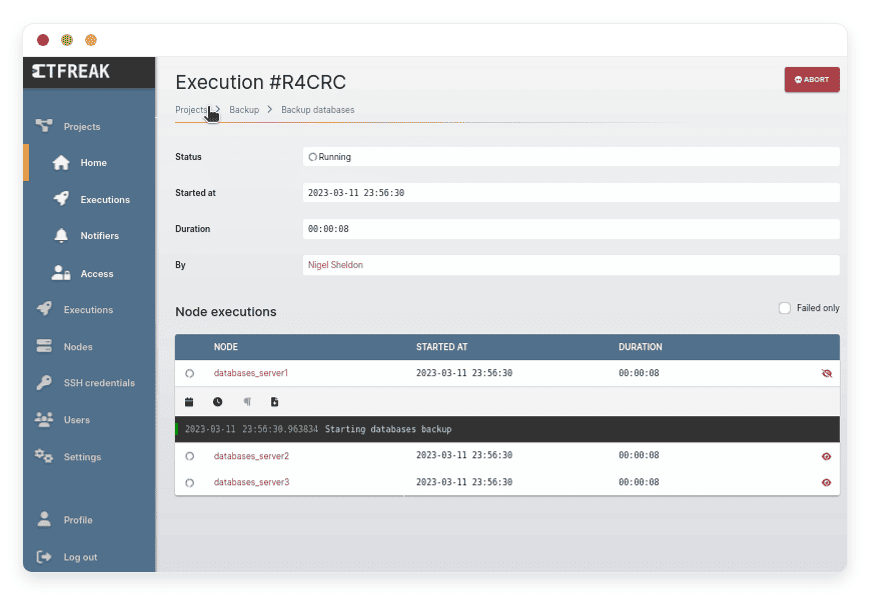
Ctfreak is an IT task scheduler — central place to schedule cron jobs, run bash and PowerShell scripts over SSH or WinRM, execute Ansible playbooks, query databases, and chain everything into workflows — combining the convenience of a hosted runbook platform with the cost and control of self-hosted infrastructure.

Free 7-day trial  99.9% Uptime SLA  No credit card  Cancel anytime

Free 7-day trial  99.9% Uptime SLA
No credit card  Cancel anytime

Ctfreak

Ctfreak

STARTING AT

€9/month
Automated Backups
Monitoring
Automated Updates
Auto SSL

USAGE

Unlimited
Human Support
Custom Domains
Terminal Access
File Manager Access
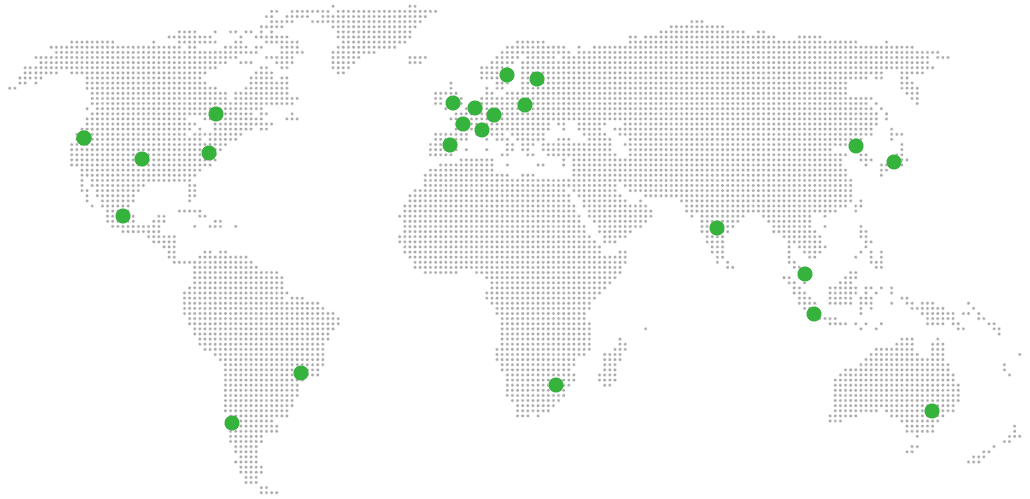
Deploy in your region 21 locations worldwide
GermanyFinlandNetherlandsUKSwedenUnited StatesCanadaSingaporeJapanAustraliaBrazilSouth Africa+9 more →
Ctfreak Preview Image

ABOUT THE SOFTWARE

What is Ctfreak

Ctfreak is an on-premise IT task scheduler from JYP Software, built as a lighter alternative to Rundeck and Windows Task Scheduler. One central UI to schedule cron jobs, run scripts over SSH and WinRM, query databases, and chain tasks into workflows.

Ctfreak is developed by JYP Software, a French independent vendor, under a commercial source-available model. The product ships with a Free edition plus paid Pro (€369/year first year, €299/year thereafter), Business (€599 / €519), and Sovereign (€899 / €799) tiers. The Docker image jypsoftware/ctfreak has passed 200,000 pulls.

The application is small. A typical instance runs in under 2 GB of RAM with negligible CPU at idle. The backend ships with SQLite by default; PostgreSQL is supported on Business and Sovereign for higher concurrency. The web UI is mobile-first — a deliberate design choice from JYP, since Ctfreak's typical operator manages tasks from anywhere. The published customer base includes MSPs, data engineering teams, SREs, the French CNRS research network, and a number of independent sysadmins running infrastructure out of homelabs and small offices.

FEATURES

What Ctfreak does

Nine task types covering local commands, distributed execution, configuration management, database operations, API calls, and workflow chaining. One UI for all of them. Notifications and issue tracking integrations on every task. Built-in REST API and incoming webhooks.

Local Command task

Run a command directly on the host server. Supports per-second cron granularity (added v1.21, October 2024) and parameterizable inputs.

Ansible playbook task

Run playbooks against dynamic inventories generated from selected Ctfreak nodes. Dedicated per-node log files. Linux and FreeBSD installs only.

HTTP Request task

Call API endpoints on schedule — outgoing webhooks, health pings, status checks. Optional response body logging and JSON prettifying.

Incoming webhooks

Trigger any task from external systems. Built-in signature verification for GitHub, GitLab, Gitea, and Forgejo (Gitea and Forgejo added v1.36.1).

Command, Bash, and PowerShell tasks

Execute commands or scripts on remote nodes via SSH or WinRM. Agentless. Concurrent across thousands of nodes per instance.

SQL Script and SQL Report tasks

Run scripts against PostgreSQL, MySQL, MariaDB, Oracle, and SQL Server. Generate reports with Apache ECharts tables and charts.

Workflow tasks

Chain child tasks sequentially or concurrently. Nested workflows supported. Editable per-execution child parameter values on Pro and above.

Notifications and issue tracking

Send to Slack, Discord, MS Teams, Mattermost, Telegram, Ntfy, or email. Auto-create issues in GitHub, GitLab, Jira, Linear, or Youtrack on failure.

WHAT'S ALWAYS INCLUDED

Every app. Fully managed.
Nothing extra to pay for.

Every app you deploy includes the full managed service — security, backups, updates, and support from day one.

Automatic updates and patches

Apps run the latest stable version. Security patches applied silently, with rollback if needed.

Daily off-site backups

Multiple daily backups in redundant off-site locations. One-click restore if anything goes wrong.

24/7 uptime monitoring

Continuous monitoring with instant alerting. We respond before you notice.

SSL, firewall, DDoS protection

Auto-renewing SSL, hardened firewall rules, DDoS mitigation on every deployment.

Performance and scaling

We monitor resource usage continuously. When your app needs more headroom, we flag it and upgrade with your explicit approval.

Dedicated engineering support

Real engineers on chat. DNS, SMTP & migration help. All included in €9.

WHY MANAGED

Why teams pick managed Ctfreak

PagerDuty Process Automation, the commercial Rundeck successor, lists at $125 per user per month plus a platform fee — over $15,000 per year for a 10-person SRE team. Ctfreak handles 80% of the same operational workload at a fraction of that cost, and we run the operational layer.

Running Ctfreak yourself is straightforward — until an update breaks your installation. The SSL needs to be renewed regularly. 24/7 external monitoring is required. Plus a region close to the nodes you are scheduling agains — for SSH-heavy workloads, low latency to target nodes matters more than proximity to your team.

REVIEWS

Hear from customers ​like you​​​​​​​

Successful businesses and professionals around the world rely on DANIAN every day

USE CASES

Three teams who run Ctfreak on DANIAN

These are representative team types we set up most often. Each starts with the same flat €9 plan.

5-PERSON SRE TEAM

Escaping PagerDuty Process Automation, $625/mo → €9/mo

Region: Germany. Migrated 38 runbooks from PagerDuty Process Automation across one quarter. Uses Workflow tasks to chain nightly backup verification across 40 nodes via SSH. Failures route to a Linear notifier; status posts to a Slack channel. Personal access tokens authenticate API calls from their Datadog dashboard.

12-PERSON MSP

Monthly Windows patching across 60+ client nodes

Region: Brazil, closer to most client infrastructure. One Ctfreak project per client; Node Set and Database Set filters enforce per-client isolation. WinRM connections to mixed Windows and Linux fleets. Monthly Windows Update playbook chained to a verification HTTP request task. Failures auto-open Jira issues.

3-PERSON DATA ENGINEERING TEAM

ETL across PostgreSQL, MariaDB, and Oracle

Region: Singapore. Replaces a brittle Jenkins-with-cron setup that broke on every Java update. Regenerate weekly SQL Report task, email PDF to CEO before 7am local time. Read-only DB credentials separated from read-write paths at the project level.

COMPARISON

Four ways to run Ctfreak

The honest tally across the realistic paths. PagerDuty Process Automation scales linearly with users. Self-hosting splits cost between infrastructure, licence, and ops time. Home server pays for hardware and electricity. DANIAN's column lands flat at €9/month regardless of users — the comparison turns on the math, not the marketing.

 PATH1 USER5 USERS 10 USERSOPS TIME
PagerDuty Process Automation
Commercial Rundeck successor, listed at $125 per user per month plus platform fee. Vendor-hosted SaaS. 
$125/mo$625/mo$1,250/mo0 hours
Self-host Ctfreak on a $24/mo production-class VPS
Production-class VPS (2 vCPU, 4 GB RAM) + Ctfreak Pro licence (€369/year first year). Plus your time. 
~€55/mo + €120–480 time~€55/mo + €120–480 time~€55/mo + €120–480 time2–4 hours/mo
Home server (HP ProLiant ML30 Gen10 or Synology DS923+)
Hardware amortised over 36 months + electricity + business internet + off-site backup + Ctfreak licence. 
€240–700/mo total€240–700/mo total€240–700/mo total4–8 hours/mo
DANIAN Managed Ctfreak€9/mo€9/mo€9/mo0 hours

BY INDUSTRY

Ctfreak for specific industries

Four industries that put specific demands on Ctfreak — different node fleets, different cadences, different audit needs. We configure the instance differently in each case. Below: the operational standard each industry runs against, the Ctfreak knobs we tune, a concrete workflow example, and a quantifiable detail.

Operational standard: MSPs typically commit to a monthly patching cadence per client and need strict per-client tenant isolation for credentials, node access, and audit logs. Mixing one client's SSH keys into another client's scope is a contract-breaking event.

DANIAN configuration choice: one Ctfreak project per client. We turn on the Node Set filter and Database Set filter at the project level (the feature added in Ctfreak v1.34, January 2026), so a non-admin user with a role on Client A's project sees only Client A's nodes and credentials. Cross-client visibility is technically impossible, not just discouraged.

Workflow example: a monthly Windows Update playbook task chains to a verification HTTP request task that hits each patched node's status endpoint. On any failure across the fleet, a GitLab notifier opens an issue in the MSP's internal tracker. Each client gets a per-execution PDF report generated by an SQL Report task summarising patched and unpatched nodes.

Quantifiable detail: per-project compartmentalisation is enforced at the data layer — a non-admin user querying the REST API across projects returns 403 on projects they have no role in. The User Information endpoint (POST /userReports) was restricted to admin-only in v1.28 (May 2025), closing a previous information-disclosure path.

Operational standard: data teams typically run read-only access for report generation, separate from read-write extract and load credentials. Reports get distributed on schedule to business users who should not see raw data, only aggregates.

DANIAN configuration choice: two database credential sets per project — one read-only for SQL Report tasks, one read-write for SQL Script tasks. Business users get the project viewer role (added v1.11, August 2023), which exposes only execution results, not log files. Email notifiers fire the PDF on success.

Workflow example: nightly Workflow task chains an SQL Script task (extract from PostgreSQL production replica) → SQL Script task (load into a MariaDB warehouse) → SQL Report task (regenerate the weekly dashboard with five Apache ECharts charts) → email notifier (PDF to the CEO before 7am local time). On extract failure, a Jira notifier opens a P2 issue.

Quantifiable detail: Ctfreak supports six database engines for both task targets and report sources — PostgreSQL, MySQL, MariaDB, Oracle, SQL Server, and the embedded SQLite. Oracle and SQL Server support landed in v1.37 (February 2026). A single SQL Report task can mix multiple data sources in one rendered report.

Operational standard: teams typically migrate off Rundeck for three reasons — JVM heap consumption (4–8 GB at rest), slow UI on Rundeck Enterprise, and the per-user pricing on PagerDuty Process Automation. The transitional state is delicate: schedules cannot drop, runbooks need to keep firing during cutover.

DANIAN configuration choice: OpenID Connect SSO pre-configured against the team's existing identity provider (Google, Microsoft, Onelogin, Salesforce presets supported in Ctfreak since v1.3). Parameterizable bash script tasks replace Rundeck job definitions; the Smart chaining multiple-execution policy (added v1.8.1) queues new runs rather than dropping them when a previous execution is still active.

Workflow example: migrate one Rundeck job per day to Ctfreak; run both schedulers in parallel for two weeks; cut over after a clean run cycle. Workflow tasks reproduce Rundeck's option-passing pattern via task parameters. GitHub incoming webhooks fire CI runbooks directly from PR comments.

Quantifiable detail: Ctfreak runs in under 2 GB of RAM at idle. JYP's published customer testimonials cite two explicit Rundeck migrations — Karl Leicht (Vigie, France) and Graham R. Brewer (Hometown Computer Services, US) — both naming Rundeck's memory consumption and UI complexity as drivers.

Operational standard: retail ops typically need hourly inventory sync windows, multi-region availability during traffic peaks, and tight cron schedules tied to external API rate limits. Missing a sync window means stale inventory shown to customers.

DANIAN configuration choice: Local Command tasks with per-second cron expression granularity (the optional 6-field cron format added v1.21, October 2024) for tight inventory sync windows. HTTP Request tasks hit Shopify, WooCommerce, or BigCommerce APIs on schedule without writing wrapper scripts. Discord and Slack notifiers fire on failure during business hours; SMS-style escalation routes through Telegram off-hours.

Workflow example: Shopify webhook fires an Ctfreak incoming webhook on order events; a Workflow task chains an HTTP Request to validate stock, an SQL Script to update the inventory warehouse, and a notification to the operations Discord channel. A separate hourly task rebuilds the sitemap and pushes it to a CDN endpoint.

Quantifiable detail: Ctfreak's incoming-webhook task type supports signature verification for five source types — Generic, GitHub, GitLab, Gitea, and Forgejo — with Gitea and Forgejo added in v1.36.1 (February 2026). Per-second cron granularity (e.g. 20 * * * * * for execution every minute at the 20th second) is unique among lightweight schedulers.

FAQ

Frequently asked questions

Everything teams ask before signing up — answered straight, without sales speak.

Three groups: technical setup, migration, and how DANIAN works as a service.

01

Technical and configuration

Yes. We run a current Ctfreak release as a central scheduler — one UI for all your jobs, with execution history, structured per-task logs, success and failure notifications, and the ability to re-execute on demand. The vendor's own documentation confirms cron replacement is the canonical Ctfreak use case. We add the operational layer: backups, monitoring, and SSL.
No. Ctfreak is agentless. Bash scripts, PowerShell scripts, Ansible playbooks, and SQL scripts execute over SSH or WinRM. Your nodes only need the relevant SSH or WinRM server reachable from our region.
Yes, over WinRM (Ctfreak's default for Windows since v1.29.1, June 2025) or over SSH with PowerShell 7.2 or later set as the default shell. We have customers running mixed Windows and Linux fleets from a single Ctfreak project. The vendor pulled SSH-with-Windows-PowerShell support after v1.31 — we run a current release that still supports it via the WinRM path.
The vendor's documentation cites thousands of concurrent script executions per instance over SSH or WinRM. We size your instance for your task volume. A typical Ctfreak instance runs in under 2 GB of RAM at idle, but heavy fleets need more headroom. We adjust resources on request — there is no self-service resize, because a misjudged disk resize on a live database is the kind of thing we would rather catch first.
Yes. Ctfreak's incoming webhook types include Generic, GitHub, GitLab, Gitea, and Forgejo, with signature verification on each (Gitea and Forgejo added v1.36.1, February 2026). Payloads, query parameters, and form data can be mapped onto task parameters. We expose these webhooks on your custom subdomain over HTTPS, so your CI or external system can fire tasks securely.
Yes, since v1.3 (December 2022), with built-in presets for Microsoft, Google, Salesforce, and Onelogin. We pre-configure OIDC against your identity provider during onboarding — most teams have SSO working the same day. Local accounts can be disabled once OIDC is in place.
Built into Ctfreak with OpenAPI documentation at the /api/v1/doc/ endpoint of your instance. You can create tasks in bulk, trigger them on demand, generate personal access tokens (added v1.36.1, February 2026) for authentication without OAuth, and integrate Ctfreak with external monitoring tools — Zabbix integration is documented by JYP. We expose the API under your custom subdomain.

02

Migration and onboarding

We can activate your app on your own custom domain/subdomain. Examples: mydomain.com, anyword.mydomain.com.
Or, on our randomized free subdomain. Example: 963.apps.danian.cloud
If you wish to use a custom domain/subdomain, select that option when ordering your app (or notify us later). We will send you the required DNS records and if needed, our tech team will modify them for you.
21 datacenter locations across six continents. You choose the region at provisioning. Application data sits in the region you choose; pick whichever is closest to your users or matches your data-residency preference.
Yes. Request a region migration from the dashboard and we run the move in the background. The system emails you when the migration completes; total transfer time depends on data volume but typical instances finish in a few hours. There is no extra charge for a region change.
Yes. Full data export is available at any time, in a portable format you can bring to any infrastructure.
There is no automated importer — but we walk through the conversion during onboarding. Each cron line becomes one Local command task (for jobs running on the Ctfreak host) or one Command task (for jobs running on remote nodes). Workflow tasks chain related jobs that previously relied on cron sequencing or shell pipes.
The pattern is well documented. Ctfreak's own customer testimonials include several Rundeck migrations. Most teams find that 80% of their Rundeck jobs map cleanly to Ctfreak's Bash script, PowerShell script, Ansible playbook, or SQL script task types.
You transfer them yourself. We never ask you to send credentials over email or chat. You log in to your new Ctfreak instance and add credentials through the UI — they are stored AES-256-GCM-encrypted from that point on. We do not have access to your credentials in plaintext at any stage, including during onboarding.
Most runbooks are shell scripts wrapped in metadata — the scripts transfer cleanly, and the metadata (parameters, schedules, notification targets) is recreated in Ctfreak's task editor. We do not currently offer an automated converter; manual migration is typical and predictable. Plan one engineering day per 20 to 30 runbooks.

03

Billing, support, and platform

€9 covers everything we do for that app: hardware in the region you choose, daily off-site backups with one-click restore, automatic security patches and version upgrades, 24/7 monitoring, SSL and firewall, and engineering support on Email/LiveChat. There are no setup fees or hidden line items. For more info see our Pricing page.
If you decide to continue, we charge €9/app/month from day 8. If you don't, the trial ends and you can export your data. No card is required for the trial, and we never auto-charge you without explicit consent.
No. The €9/month is flat regardless of how many users log into your app. Add 5 users or 50; the price doesn't change.
24/7 Live chat and email support, both staffed by engineers who run the systems. We handle DNS configuration, SMTP setup, app integrations, performance tuning, troubleshooting, and migration help. Response time is typically under an hour. There is no tier system — every customer gets the same support.
Yes. Cancel from the dashboard. We don't charge a cancellation fee, we don't lock data, and we will export your data to you on request before deletion. data to you on request before deletion.
Every customer instance is backed up daily to a separate region from the primary. We test restores. You can request a restore at any backup point within the retention window — usually 7 days for daily backups.
Your application data sits in the region you choose at provisioning — 21 datacenter locations across six continents. Account-level data (billing, account email, support ticket history) is processed centrally. Application data region is picked by you, per app.
99.9% uptime SLA on every app, every tenant. Service credits are documented at danian.co/service-level-agreement. The status page is located at status.danian.co.
When your tenant approaches the resource ceiling — the base tier holds 1 vCPU/RAM, 30 GB storage — we notify you. Resource upgrades happen with your explicit consent; we will not upgrade your tenant or charge you without it.
We wait. We don't suspend the app or delete your data on the first failed charge. We email you, you fix the card on file, and we continue.
Invoices can be downloaded from the billing dashboard in PDF the day each charge succeeds. EU VAT is added where applicable and the VAT-reverse-charge regime applies for VAT-registered businesses with a valid number.
150+ open-source apps across automation, team chat, file sync, analytics, AI, password management, email marketing, dev tools, project management, smart home, CMS, and federated social. See the full catalog →
Yes. Every instance comes with a web-based terminal and a file manager in your DANIAN management dashboard. Useful for managing your data and customizations.
Resources scale with your usage. If your app needs more vCPU, RAM, or storage, we add it — and we ask first before any change to your plan. €9 is the floor; resource-heavy workloads may price higher, but you'll always know in advance.
Yes. We have both a Partner program and an Affiliate program available. Anybody can sign up.
No contract. No minimum commitment. Cancel anytime from the dashboard with one click. The 7-day free trial requires no credit card. After the trial converts to paid, you can still cancel at any month without notice or penalty.

DEPLOY IN YOUR REGION

21 datacenter locations on six continents

Pick the region closest to your users.

United States, Germany, Finland, Singapore, Australia, Brazil, Canada, Netherlands, UK, Spain, Italy, France, Sweden, Malaysia, India, Japan, Mexico, Poland, South Korea, Chile, South Africa and more coming soon
Global Reach Map

Try managed Ctfreak for 7 days

No card. Cancel from the dashboard.