Open-source website change monitoring in 2026
Open-source website change monitoring in 2026 — when watchers charge per page
The short version
- ChangeDetection is the open-source tool for watching web pages and getting alerted when their content changes. More than 30,000 GitHub stars, Apache-2.0 license.
- Page-watch services like Visualping and Distill price by pages, check frequency, and total checks. Real-world use pushes you to $35 a month or higher.
- DANIAN runs a managed ChangeDetection instance for €9 per month, flat. No per-check meter; the only ceiling is your instance resources.
- This watches content changes, not uptime. For up-or-down checks, that is Uptime Kuma's job.
- Pages that render with JavaScript need an extra browser container. We set that up and size the instance for it.
Why teams leave page-watch services in 2026
The tools that watch web pages for you — Visualping, Distill, and similar — charge by the page, the check frequency, and the number of checks each month. The bill grows as your monitoring does. A team watching a handful of pages once a day pays little. A team watching dozens at short intervals pays a lot.
The structure is easy to see once you read the plans. Distill's free tier gives you 25 monitors, but only 5 run in the cloud, at a 6-hour minimum interval. The other 20 are local browser monitors that stop the moment you close the tab. Paid plans start at $15 a month (Starter: 50 monitors, 30,000 cloud checks, a 10-minute floor), then $35 a month (Professional: 100,000 checks, a 5-minute floor), then $80 and up (Flexi: a 2-minute floor).
Visualping works the same way. The free tier covers 5 pages and 150 checks a month. The entry paid tier runs around $10 to $14 a month with a cap near 1,000 checks and a 15-minute floor. Watch more pages, or check them more often, and you move into business pricing past $100 a month. You are renting frequency and capacity by the month.
There is a reliability gap hiding in the free and low tiers. Distill's local monitors only run while your browser is open. Close the laptop, restart the browser, or let it sleep, and those watches stop checking. You find out a page changed because a customer mentions it, not because the tool told you. Continuous, server-side checking is the thing you are paying to move up the tiers for.
The trigger is usually small. A renewal email arrives. You hit the check cap mid-month. You want alerts in Slack and find them behind a higher tier. None of this means the tools are bad. Visualping in particular is polished, needs nothing installed, takes screenshots, and adds a plain-English summary of each change. The friction is the meter, not the product.
The cost is not only the subscription. A competitor move read about late has a real price. So does a supplier term that shifts before your renewal. The point of watching pages is to catch these the day they happen.
What ChangeDetection is — and isn't
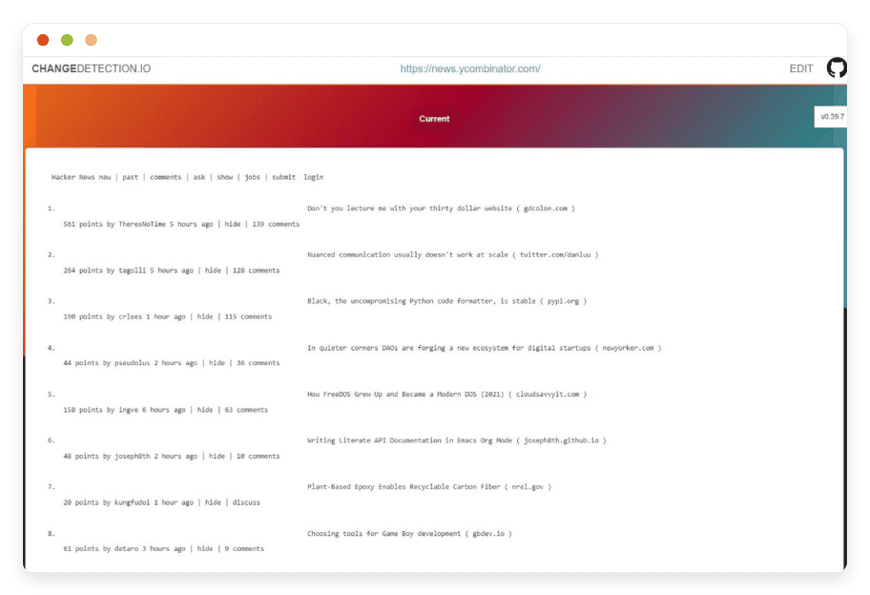
ChangeDetection watches a web page, compares each new version against the last, and shows you what changed. That is the whole job, and it does it well. It is a focused monitoring tool, not a scraping platform or a reporting suite. It will not build dashboards or model your data. It tells you a page changed and shows the diff.
What it does cover is broad enough for most teams. It diffs plain text, reads values out of JSON, and tracks changes inside PDF files. A point-and-click visual selector lets you pick the exact part of a page to watch, so a footer change does not trip an alert about a price. You can set conditions, so an alert fires only when a price drops below a number or a keyword appears. You can schedule checks for business hours only.
When a page changes, ChangeDetection keeps a snapshot of each version. You open the history and see the difference by word, line, or character. You can reopen an older snapshot to check what a page said last week. All of that history sits on your own instance, not a vendor's cloud.
Noise control is part of why the visual selector matters. Watch only the price block and a cookie banner will not trigger an alert. Filter out a rotating ad or a timestamp and the diff stays clean. A watch that cries wolf gets muted, so trimming the target is worth the minute it takes.
One line matters for setting expectations: this is not uptime monitoring. ChangeDetection tells you when a page's content changed, not whether the site is reachable. For up-or-down and response-time checks, run Uptime Kuma for uptime checks instead. The two answer different questions, and many teams run both side by side.
The JavaScript caveat is the honest part. The built-in fetcher reads static HTML quickly and cheaply. Pages that build their content with JavaScript need a separate Chrome browser container, which uses more memory and adds a deployment step. On a managed instance we switch this on per page and size the instance to match. It is built for individuals and small teams, not for crawling thousands of URLs at high frequency.
The self-hosted monitoring shortlist
Three open-source tools cover most web-monitoring needs, and each runs at €9 per month on DANIAN. ChangeDetection watches page content. Uptime Kuma watches whether sites and services are up. ntfy delivers the alerts to your phone or chat. Used together, they replace several metered subscriptions with three flat instances.
ChangeDetection — watch and diff page content
The most-used open-source website change monitor, with more than 30,000 GitHub stars.
License: Apache-2.0 for self-hosting. It diffs text, JSON, and PDFs, with a visual selector and a deep notification list.
DANIAN price: €9 per month.
Best for: price and stock watches, competitor pages, and document changes.
Uptime Kuma — watch whether things are up
A self-hosted uptime and status monitor with a clean dashboard. It checks HTTP endpoints, ports, and services, and alerts you when one goes down.
License: MIT.
DANIAN price: €9 per month.
Best for: knowing your own sites and APIs are reachable. This answers a different question than ChangeDetection, which is why teams often run the pair.
ntfy — get the alert where you'll see it
A self-hosted notification serviceA self-hosted notification service. It pushes simple messages to your phone, desktop, or chat from any script or app, over a topic you choose.
License: Apache-2.0.
DANIAN price: €9 per month.
Best for: routing alerts from ChangeDetection, Uptime Kuma, or your own jobs into one place you control.
What ChangeDetection actually watches
The job sounds narrow until you list what counts as a page that changes. Prices and stock levels. A competitor's pricing or feature page. A supplier's terms or rate card. A restock on a sold-out item. A government, legal, or security page that only ever updates on the site itself. These are the cases teams set up first.
- Price and stock watches. Watch a product page and set a condition so the alert fires only when the price drops below your number, or when the page reads "in stock" again. This is the restock-alert use case in plain form.
- Competitor pages. Track a rival's pricing page, changelog, or careers page. You learn within minutes when they ship a change, instead of finding out weeks later.
- Supplier terms and rate cards. Watch a vendor's terms-of-service or pricing page. You catch a change the day it lands, not at your next renewal call.
- Documents that only live on a site. A PDF that gets updated without notice, a security advisory, a regulator's notice. ChangeDetection tracks text changes inside PDFs as well as on pages.
Here is how that looks in practice. A marketer watches three competitor pricing pages and routes any change to a Slack channel. A procurement lead watches two supplier rate cards once a day. A reseller watches a sold-out product and gets a push the moment it reads in stock.
One honest limit: it watches the page and shows the diff, by word, line, or character. The open-source build does not interpret the change for you the way some services layer a written summary on top. You read the diff yourself. For most of these cases that is enough, and it keeps the watched data on your own instance.
There is also a way to wire changes into your own tools. ChangeDetection can fire a webhook when a page changes, so another system can act on it. A change can open a ticket, post to a channel, or kick off a script. For most teams the built-in notifications are enough, but the hook is there when you need it.
Setting up a watch, in practice
Setting up a watch takes a few minutes and no code. You paste a URL and pick the part of the page to track. You choose how often to check and where the alert should go. The steps below cover a typical price or stock watch, from setup to first alert.
- Add the page. Paste the URL you want to watch and save it.
- Pick the target. Use the visual selector to click the price, the stock label, or the text block that matters.
- Set the interval. Choose how often to check, from minutes to once a day.
- Add a condition (optional). Alert only when a price drops below a number, or a keyword appears.
- Choose the channel. Send the alert to email, Slack, Discord, Telegram, or ntfy.
Some pages hide what you want behind a login. ChangeDetection has Browser Steps for this. You record a short sequence — fill a field, click a button — so it signs in before each check. Login pages render with JavaScript, so this uses the browser container, which we turn on with you.
The cost math — metered service vs €9 flat
Put a real scenario through both models. Say you want to watch 25 pages every 15 minutes, around the clock, with alerts in Slack. On the service side, that frequency and volume push you past the entry tiers. On DANIAN, it is one €9 instance, and the interval is yours to set.
- Distill: 25 monitors at a 15-minute interval, in the cloud, with Slack alerts. Sub-6-hour cloud frequency needs a paid plan, and so do Slack alerts. At 25 pages every 15 minutes you run roughly 72,000 cloud checks a month, past Starter's 30,000. That lands you on Professional at $35 a month.
- Visualping: the entry paid tier caps near 1,000 checks a month with a 15-minute floor. 25 pages every 15 minutes is far past that cap, so you move into business pricing — past $100 a month.
- ChangeDetection on DANIAN: €9 per month, flat. You set the interval, and there is no check counter. The ceiling is the instance resources, and 25 static pages sit well inside a base instance.
Run the same scenario across a year and the gap widens. Distill Professional at $35 a month is $420 a year. Visualping business pricing past $100 a month is $1,200 a year or more. The managed ChangeDetection instance is €9 a month, €108 a year, at the interval you set.
| Feature | Visualping | Distill | ChangeDetection on DANIAN |
|---|---|---|---|
| Pricing model | Per pages + checks + frequency | Per monitors + cloud checks + frequency | €9/month flat, per instance |
| Free tier | 5 pages, 150 checks/mo | 5 cloud monitors, 1,000 checks/mo, 6h floor | Self-host free (you run the server) |
| Entry paid tier | ~$10–14/mo, 1,000-check cap,15-min floor | $15/mo, 50 monitors, 30k checks, 10-min floor | n/a — €9 flat |
| 25 pages every 15 min, 24/7 | Business pricing, $100+/mo | ~$35/mo (Professional) | €9/mo |
| Check frequency limit | By plan | By plan | Yours to set |
| Who runs the server | Them | Them | DANIAN (you don't) |
| Where your watches live | Their cloud | Their cloud, or your browser | The region you choose |
| JavaScript pages | Included | Varies | Extra browser container, we set it up |
| Lock-in | Proprietary | Proprietary | Open-source, export anytime |
The pattern holds at every size. A few pages checked once a day is cheap anywhere, including the free tiers. The moment you want short intervals on more than a handful of pages, the metered plans climb and the flat €9 does not. If you want the managed route, see managed ChangeDetection hosting.
One honest note on the flat price. The €9 instance is not bottomless. Hundreds of JavaScript-rendered pages at one-minute intervals will need a larger instance, and we will say so. For the common case — dozens of pages at sane intervals — a base instance handles it without trouble.
Run it yourself, or let us run it
ChangeDetection is free software, so self-hosting is a real option. The honest cost is not the license — it is the server and the upkeep. A production-class VPS, a browser container for JavaScript pages, off-site backups, patching, and the time to keep it healthy all add up. DANIAN folds those into €9 per month.
The self-host path looks like this. The software costs nothing. A small production-class VPS runs around $24 a month before you add backups and monitoring. A Chrome browser container for JavaScript pages pushes memory use up from there. Then there is your time: updates, certificate renewal, backup checks, the occasional 2am fix. If you have someone in-house who wants control of the box and enjoys this work, self-hosting is a genuinely good path.
Two parts bite hardest when you self-host. The browser container for JavaScript pages wants memory and the occasional restart. Off-site backups only help if you have tested that they restore. Neither is hard; both are easy to skip until the day they matter.
The managed path is €9 per month per instance. We deploy ChangeDetection in the region you pick, from 21 datacenter locations across six continents. We patch it, back it up daily off-site, and answer by email. We switch on the browser container when a page needs it and size the instance for the load. Your time spent on operations is none.
The fit is not the same for everyone, and that is fine. A developer-led team that wants the server under its own control should self-host. A team that wants the alerts without owning a server should let us run it. Either way the software is the same open-source ChangeDetection, and your watches are exportable. You can start a 7-day trial and compare before deciding.
How to pick — three questions
Three questions settle most of this. Do you want to own the server, or just read the alerts? How many pages, how often, and how many render with JavaScript? Are you watching content changes, uptime, or both? Your answers point to self-hosting, a managed instance, or a pair of instances.
- Own the box, or read the alerts? If you want control of the server and enjoy the upkeep, self-host. If you want the diffs without the maintenance, a managed instance fits better.
- How much, how often, how much JavaScript? A few static pages checked daily is light work. Dozens at short intervals, or many JavaScript-rendered pages, need a sized instance — and on the service side, that is where the meter bites hardest.
- Content, uptime, or both? ChangeDetection for content changes, Uptime Kuma for up-or-down. If you need both, run both. Each is €9 per month.
FAQ
What is a self-hosted website change monitor?
A self-hosted website change monitor runs on your own server. It watches web pages and alerts you when their content changes. ChangeDetection is the most-used open-source option, and you own both the data and the server. DANIAN runs a managed instance for €9 per month.
What is ChangeDetection.io?
ChangeDetection.io is an open-source tool that watches web pages and tells you when their content changes. It diffs text, JSON, and PDFs, with a point-and-click visual selector. The license is Apache-2.0 for self-hosting. DANIAN hosts a managed instance for €9 per month.
Is ChangeDetection really free?
Yes. ChangeDetection is open-source under the Apache-2.0 license, free to run yourself. The cost is the server it runs on and the time you spend on upkeep. DANIAN runs a managed instance for €9 per month, so you skip the server and the maintenance.
How do I monitor a web page for changes?
Add the page URL to ChangeDetection, then use the visual selector to pick the part you care about. Set a check interval and choose where alerts go. It compares each new version against the last and notifies you on a change. On DANIAN this runs for €9 per month.
How is this different from uptime monitoring?
Uptime monitoring tells you whether a site is up or down. ChangeDetection tells you when the content on a page changes. They answer different questions. Many teams run both: Uptime Kuma for up-or-down checks, ChangeDetection for content changes. We host each for €9 per month.
Is ChangeDetection a web scraper?
Not really. ChangeDetection watches pages and shows what changed. It does not harvest data into a database for analysis. It can read one value from a page and alert on it. For large datasets or reports use a scraping pipeline; for change alerts, this is the tool.
What is the best open-source alternative to Visualping?
ChangeDetection is the leading open-source alternative to Visualping. It watches pages, diffs the content, and sends alerts, without metering you per check. You trade Visualping's built-in change summaries for full data ownership and a flat price. On DANIAN it is €9 per month, managed.
What is the best open-source alternative to Distill?
ChangeDetection is the strongest open-source alternative to Distill. Distill's free monitors run in your browser and stop when you close the tab. ChangeDetection runs server-side, so it keeps checking around the clock. There is no cloud-check meter, and DANIAN hosts it for €9 per month.
How is this cheaper than Visualping or Distill?
Visualping and Distill price by pages watched, check frequency, and total checks per month. At a real interval across dozens of pages, that climbs to $35 or higher. DANIAN charges €9 per month, flat, for one instance. You are not metered per check; the limit is your instance resources.
Can I self-host ChangeDetection.io?
Yes — ChangeDetection.io ships as a Docker image you can run on any server. Static pages work out of the box; JavaScript pages need a separate browser container. You handle updates, backups, and uptime yourself. If you would rather not, DANIAN runs it managed for €9 per month.
Can ChangeDetection watch JavaScript-heavy pages?
Yes, with an extra step. Static HTML pages work with the built-in fetcher. Pages that render their content with JavaScript need a separate Chrome browser container, which uses more memory. We turn this on for you when a page needs it, and we size the instance to match.
Can ChangeDetection monitor pages behind a login?
Yes, using Browser Steps. You record a short sequence — fill a field, click a button — so ChangeDetection signs in before each check. Pages behind a login render with JavaScript, so this uses the browser container. On a managed instance we turn that on with you.
Can ChangeDetection watch a PDF for changes?
Yes — ChangeDetection reads the text inside a PDF and tracks changes to it. This suits contracts, price lists, and security advisories that only update as a file. You get the diff when the document changes. On DANIAN it is €9 per month.
Can ChangeDetection send price-drop or back-in-stock alerts?
Yes — set a condition on a watch and the alert fires only when it matters. A price that drops below your number triggers it. The same works for a page that reads in stock again. You point ChangeDetection at the product page and pick the price or stock text.
How often can ChangeDetection check a page?
As often as you set, from every few minutes to once a day. ChangeDetection does not cap your check frequency the way metered services do; the limit is your instance resources. Short intervals on many JavaScript pages use more memory. On DANIAN you set the interval and pay €9 per month.
How many pages can I watch on one instance?
Dozens on the base tier, comfortably. A single instance handles many static pages without strain. JavaScript rendering uses more memory per page, so heavy use lowers the count. If you need hundreds of pages, tell us and we size the instance up. There is no per-check meter.
What notifications does ChangeDetection support?
A lot. Email, Slack, Discord, Telegram, Matrix, webhooks, and self-hosted options like ntfy. You can route different watches to different channels. You can also set conditions, so an alert fires only when a price drops below a number or a keyword appears on the page.
Does ChangeDetection have an API or webhooks?
Yes — ChangeDetection can fire a webhook when a page changes, so another system acts on it. A change can open a ticket, post to a channel, or start a script. It also has an API for managing watches. For most teams the built-in notifications are enough.
Where is my monitoring data stored?
On your own ChangeDetection instance, not a shared cloud. Your watches, snapshots, and history live there and nowhere else. With DANIAN you choose the region from 21 datacenter locations across six continents. You can export everything at any time, since the software is open-source.
What happens to my data, and can I leave?
Your watches, history, and settings live on your instance. You can export them and move elsewhere at any time. The software is open-source, so nothing locks you in. If you cancel, we hand over your data. We do not hold it hostage to keep you subscribed.
Should I run ChangeDetection and Uptime Kuma together?
Often, yes. If you need both content-change alerts and up-or-down alerts, run the pair. ChangeDetection covers the first, Uptime Kuma the second. On DANIAN each is a separate €9 instance, and you can send both to the same channel.
Do I need to know Docker or run a server with DANIAN?
No. With DANIAN you do not touch Docker, a terminal, or a server. We deploy ChangeDetection in the region you pick, patch it, back it up daily off-site, and answer by email. You watch pages and read the diffs. We run the rest.
How do I switch from Visualping or Distill to ChangeDetection?
Start a ChangeDetection instance and recreate your watches by pasting the page URLs. Use the visual selector to pick each target, then set intervals and alert channels. Run both tools in parallel for a week to confirm coverage. When you are satisfied, cancel the metered plan. DANIAN can host the new instance for €9 per month.
What to do this week
If a page-watch subscription is creeping up, the move this week is small. List the pages you watch and the interval you actually need. Price that on your current tool. Then run a managed ChangeDetection instance for seven days and compare the two. The math usually favors the flat €9, and your data stays on your own instance.
When you are ready, see managed ChangeDetection hosting, or start a 7-day trial and watch your first page today.
Sources: changedetection.io; github.com/dgtlmoon/changedetection.io; visualping.io; distill.io/pricing. Prices verified June 2026 and may change — check each provider's current pricing page.