Open-source tools for indie podcasters in 2026
Open-source tools for the indie podcast operator in 2026 — six apps for hosting, distribution, and audience
TL;DR
- Six open-source apps cover an indie podcast's operator stack: hosting, live simulcast, newsletter, comments, analytics, sync.
- Managed cost on DANIAN: €54/month for six apps, plus storage above each base allotment.
- Castopod publishes via standard RSS to every major directory, including Apple Podcasts and Spotify.
- One Spotify gap to name up front: the Partner Program's exclusive placements require Spotify-hosted shows.
- The stack pays off at 50+ episodes. Below that, hosted SaaS is genuinely cheaper for the next 12 months.
Who this list is for (and isn't)
This list is for the indie podcast operator with a multi-year archive — or a clear plan to build one. The person who watches their per-episode storage tier climb each quarter. The person wondering what happens if their host changes hands or changes terms. They want the RSS feed they control. The audience data they own. A stack they can move if they need to.
It is not for someone testing the format. Six episodes do not need six apps. Spotify for Creators is genuinely free at that scale, and the audio quality is fine. Come back when the archive is worth protecting and the email list is worth owning.
It is also not for podcasters living entirely on one platform's exclusives or one ad network. Those deals require platform-native hosting. The operator stack works alongside those revenue lines, not as a swap.
The reader this serves is a podcaster three to five years in. Fifty to five hundred published episodes. A four-figure to low five-figure monthly download count. Monetising through a mix of sponsorships, listener support, and a paid tier — tired of every tool being a separate SaaS bill.
Why the operator stack matters in 2026
The trigger this year was small and steady, not a single event. In January 2026, Spotify lowered the Partner Program monetisation thresholds. Favourable on the surface, but the rules still sit on a platform the podcaster does not own. Substack continues to take 10% of subscription revenue plus card processing — roughly 13–16% of gross before any iOS subscribers add Apple's in-app cut on top. Buzzsprout's paid tiers run $19 to $79 per month with audio-hour ceilings; the free tier deletes episodes after 90 days [1].
None of these are wrong choices for every podcaster. They are the wrong choice for the operator whose archive, audience email list, and analytics history are the asset. Once those three sit inside a SaaS that can change pricing, change rules, or get acquired, the show is no longer fully owned. A 13–16% revenue cut on a $5,000/month subscription podcast is roughly $695 every month. Over three years that's about $25,000 — enough to fund the operator stack many times over.
The open-source stack reframes the question. What does it cost to run your own podcast as software you control? For a six-app managed stack, the answer is €54 per month plus storage. The math sits in the cost section below. The trade-offs are honest and worth naming up front.
The shortlist
Castopod — podcast hosting
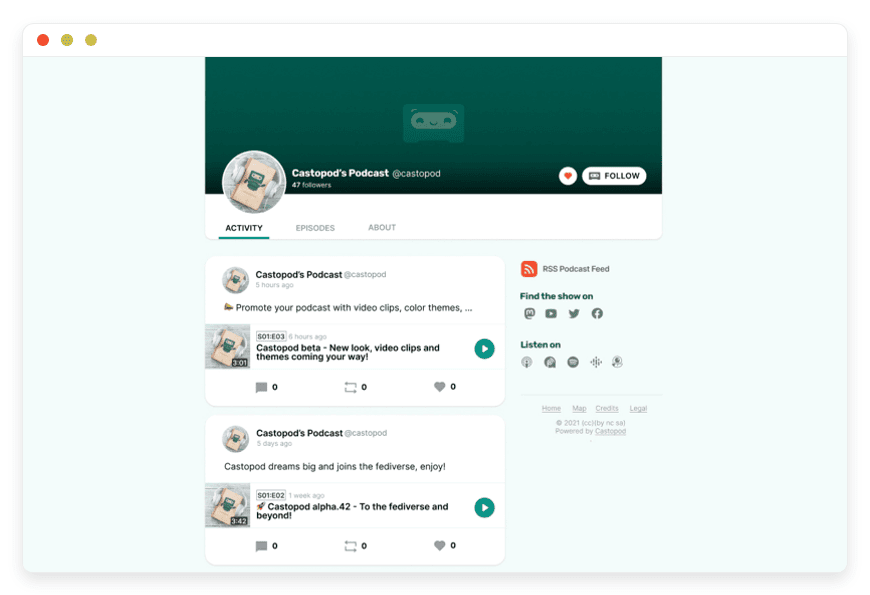
Castopod is a free, open-source podcast host built by Ad Aures and supported by NLnet [2]. It is published under the AGPL v3 licence, which means modifications must stay open if redistributed — the long-term insurance that the codebase cannot be quietly closed. The project is Podcasting 2.0 certified through the Podcast Index community, which is the part most operators undervalue at first [3].
Podcasting 2.0 is a set of RSS extensions that hosted SaaS platforms either do not implement or implement partially. Castopod ships them all: chapters, transcripts, persons, locations, soundbites, value-for-value micropayments, and cross-app comments through ActivityPub. The transcripts and chapters in particular help Apple Podcasts, Overcast, and Podverse surface and rank episodes. The ActivityPub federation means your podcast becomes a follow-able account on Mastodon and the broader Fediverse — every episode can be shared, liked, and commented on without a YouTube or Substack account.
Castopod publishes through standard RSS, which is how every major podcast directory consumes podcasts. Apple Podcasts. Spotify. Amazon Music. Pocket Casts. Overcast. Podcast Addict. Podverse. And the long tail beyond. Spotify lists Castopod-hosted shows in its directory. What it does not do is treat them as eligible for the Spotify Partner Program's exclusive placements or in-app monetisation — those require Spotify for Creators as host. If those placements are a current revenue line, this is the gap to weigh against everything else on this list.
Managed Castopod hosting runs €9/month on DANIAN.
Replaces: Buzzsprout, Spotify for Creators, Transistor, Captivate, Libsyn.
See managed Castopod hosting for the patching, backups, and storage handled.
Owncast — live video and audio simulcast
Owncast is a free, open-source live-streaming server with built-in chat and Fediverse integration [4]. It accepts a standard RTMP stream from OBS, Streamlabs, or any broadcasting software the podcaster already uses. It then serves the stream from your own domain instead of pushing it into Twitch or YouTube Live.
The shape that matters for podcasters: you can do a live record with audience chat, push the cleaned audio into Castopod when the show finishes, and the live recording becomes the next episode. The chat is browser-based, no app install required, with custom emotes and the option to run a chat bot. The live stream becomes a follow-able account on Mastodon, so listeners on the Fediverse see “going live now” alerts without a separate service.
The trade-off is honest. Owncast is your own broadcasting infrastructure, which means no built-in discovery the way Twitch and YouTube have. Listeners arrive because you told them, not because the platform did. For an indie podcaster with an established audience, that's a feature — every viewer is yours. For a new show looking for cold discovery, this is the wrong tool.
Managed Owncast for live simulcasts runs €9/month.
Replaces: Twitch broadcasts (in part), YouTube Live, Riverside live, StreamYard.
Mautic — newsletter automation
Mautic is a free, open-source marketing automation platform. The relevant subset for podcasters: a newsletter list with segmentation, automated welcome sequences, and behavioural triggers on what episodes a subscriber has streamed or clicked [5].
For an indie podcast, the newsletter is the operator's most defensible asset. RSS subscribers move between apps. Spotify subscribers belong to Spotify. Apple Podcasts subscribers belong to Apple. Email subscribers belong to the podcaster, and a five-thousand-person newsletter compounds in a way no platform follow does. Mautic ships the same automation features that Mailchimp's $30/month plan does — without the per-contact cost ramp.
Mautic is heavier than a hobbyist newsletter tool. It assumes you'll set up a sending domain, warm an IP, and watch deliverability. On managed hosting, the warmup and SMTP setup are part of the deployment. On self-host, they're not. Plan accordingly.
Managed Mautic runs €9/month on DANIAN.
Replaces: Mailchimp Essentials, ConvertKit Creator, Substack newsletter, Buttondown.
Comentario — comments
Comentario is a lightweight web comment engine that drops into the podcast site as a single embed script [6]. It is the closest open-source replacement for Disqus and Commento with the privacy posture most podcasters now want: no third-party tracking pixels, no advertising injected by the comment provider, and the comment data sits in a database you control.
For the indie podcaster running a Castopod site, Comentario turns the episode page into a place where listeners actually leave responses. Native Castopod comments via ActivityPub reach the Fediverse audience. Comentario reaches the web audience that does not have a Mastodon account but does have something to say. The two are complementary, not redundant.
The honest trade-off: a self-hosted comment engine is more work than the embed scripts of free, ad-supported alternatives. The work is mostly in moderation — without a vendor sitting between you and spammers, you watch the inbox. Managed hosting handles the patching and backups. It does not moderate for you.
Managed Comentario runs €9/month.
Replaces: Disqus, Commento, Facebook Comments, the comments-via-WordPress route.
Matomo — audience analytics
Matomo is the open-source alternative to Google Analytics 4 that most privacy-conscious websites have already moved to. For a podcast, the relevant features are first-party analytics that stays on your server, no third-party cookies, and event tracking that survives ad-blockers and modern browser privacy defaults better than third-party scripts [7].
A podcaster running Castopod plus a website wants three numbers per episode. Page views. Where the listener came from. Which call-to-action they clicked — newsletter signup, premium tier, sponsor link. Matomo answers all three without sending visitor data to a third party. The dashboard is similar enough to the analytics you already know that the migration is hours, not days.
Matomo is not a podcast analytics tool. Episode download counts, listener-by-app breakdown, and the geographic distribution of plays come from Castopod's built-in analytics, which follow the IAB v2 standard the industry uses for sponsor reporting. Matomo handles the website side of the operation — the funnel from a search query through to a newsletter signup or a paid tier checkout.
Managed Matomo runs €9/month.
Replaces: Google Analytics 4, Fathom Cloud, Plausible Cloud, Simple Analytics.
oPodSync — cross-device subscription sync
oPodSync is a minimalist GPodder-compatible server for self-hosting podcast subscription state [8]. Which episode you've listened to. Where you stopped inside an episode. The full list of podcasts you follow. This is the one most listeners do not realise they need until they switch podcast apps and lose their queue.
For an indie podcaster, this is partly a service to your own audience — every recommended podcast app (AntennaPod, Podverse, Kasts, gPodder) supports adding a sync server URL — and partly insurance for your own listening. The “your queue follows you” experience commercial podcast apps charge for in their premium tiers is something open apps replicate when they have somewhere to sync state to. oPodSync is that somewhere.
The trade-off is the smallest on this list. The codebase is intentionally minimal, written in PHP, easy to read and easy to operate. The audience for the feature is technical-leaning, and most indie podcasters will use it themselves more than their listeners will. That's still a useful outcome.
Managed oPodSync for cross-device sync runs €9/month.
Replaces: paid sync features in commercial podcast apps with subscription tiers.
How they fit together
Castopod is the centre. The RSS feed it publishes is what every podcast directory consumes. The newsletter signup form on your Castopod site posts into Mautic. The comments on each episode page render through Comentario. The website pageviews and CTA clicks flow into Matomo. Live recordings come from Owncast and graduate into Castopod episodes when the live session ends. oPodSync runs alongside, more for the operator's own listening discipline than for the audience.
The stack is loosely coupled by design. If Castopod has a downtime hour, the newsletter and analytics still work. If Matomo's instance needs an upgrade window, the podcast keeps publishing. Six small apps replace one giant SaaS in part because the failure modes are isolated — one piece breaking does not take the whole operation down.
Comparison table
| App | Replaces | DANIAN price | Team-size fit | Region choice |
|---|---|---|---|---|
| Castopod | Buzzsprout, Spotify for Creators | €9/month | 1–5 | Region of your choice |
| Owncast | Twitch Studio, StreamYard, YouTube Live | €9/month | 1–5 | Region of your choice |
| Mautic | Mailchimp, ConvertKit, Substack newsletter | €9/month | 1–10 | Region of your choice |
| Comentario | Disqus, Commento | €9/month | 1–50 | Region of your choice |
| Matomo | Google Analytics 4, Plausible Cloud | €9/month | 1–50 | Region of your choice |
| oPodSync | Paid sync features in podcast apps | €9/month | 1 | Region of your choice |
Six apps × €9/month = €54/month, all-inclusive of patching, backups, monitoring, and 24/7 human support. Pick the region per app from 21 datacenter locations across six continents.
The honest cost math
The €54/month figure is the hosting tier. There's a second number worth naming because podcasts eat storage. Media files for a 30-minute weekly episode at 128 kbps mono run roughly 28 MB each. At one episode per week for a year, that's about 1.5 GB. At five years of weekly publishing, that's 7.5 GB. Add chapter artwork, occasional video clips, and the live-recording backups Owncast keeps, and plan for double.
Storage above each app's base allotment costs €0.50/GB/month. A podcaster with 50 episodes at 60 MB each (longer-form, stereo) sits at 3 GB — well within the base allotment for Castopod. A podcaster with 200 episodes plus video clips might be at 15 GB and pay an extra €5 or so per month. A four-year-old daily news show with video clips can hit 100 GB and pay €40 in storage above the base. Run the numbers for your show before signing up. We're happy to scope it if you reach out.
Total monthly bill at common scales:
- A 50-episode weekly podcast running the full stack: €54/month (storage within allotment).
- A 200-episode podcast with light video clips: €59–€64/month.
- A 500-episode daily show with regular video clips and live archives: €90–€110/month.
The reference comparison: Spotify's revenue cut for a podcast monetising $5,000/month in subscriptions is about $695. Buzzsprout's $79 tier covers hosting only, not newsletter or analytics or comments — those are separate bills. The €9-per-app floor is not the cheapest possible number. It is the cheapest number with a human when an SMTP relay quietly rate-limits at midnight.
See the full catalog and trial any app for 7 days.
Where this stack misses — be honest
Three honest gaps to weigh against the savings.
Spotify Partner Program placements. Castopod publishes to every major directory via standard RSS, Spotify included. What the RSS path cannot do is place a show inside Spotify's exclusive in-app monetisation features or the Partner Program's recommended-podcast slots. Those require Spotify for Creators as host. For a podcast where Spotify-driven listener-supported revenue is currently meaningful, the operator stack means giving up that ceiling for the ownership the rest of the stack provides. There is no clean answer; only the trade-off, named honestly.
Discovery. Substack's recommendation network, where one writer's audience can flow into another's, accounts for 30–50% of new signups for some publications. The open-source stack has no equivalent network effect baked in. The Fediverse partly substitutes — ActivityPub federation means your show appears in feeds on Mastodon, and listeners on Mastodon can follow a Castopod show natively. The audience is smaller and the discovery slower. Plan to bring some of your discovery effort with you.
Premium monetisation without DIY work. Buzzsprout and Spotify both have one-click “set up a paid tier” flows that handle the Stripe integration, the gated RSS feed, and the listener-facing checkout. Castopod ships value-for-value and standard subscription support, but the polish of a SaaS premium-tier flow is not there yet. If a packaged premium experience is the top priority for the next 12 months, the SaaS tier earns its price.
These gaps are real, and they are not minor. They are also why the operator stack is the right answer for podcasters who plan to be operating in five years — and a worse answer for podcasters trying to maximise revenue per minute over the next six months.
How to start — one app, 14 days
Pick Castopod first. It is the centre of the operator stack and replaces the biggest monthly SaaS bill for most indie podcasters. The 7-day free trial gives you enough time to set up the show, point the RSS feed to a custom domain, and verify Apple Podcasts and Spotify pick up the new feed cleanly.
Step one: trial Castopod for 7 days. Import one season of episodes via the RSS migration tool, point a domain, verify the directories. We're there if anything snags.
Step two: at day 7, decide. If Castopod replaces the current host with the same publishing experience, add Mautic the same day. The newsletter list compounds slowly; starting now is worth more than starting later.
Step three: at day 30, add the remaining four apps in the order they earn their place — Comentario when comments matter on the site, Matomo when the website-side analytics matter, Owncast when you schedule a first live recording, oPodSync last.
The full stack works whether activated all at once or rolled out over a quarter. Start where the SaaS bill is biggest and the migration friction is lowest.
FAQ
What is Castopod?
Castopod is an open-source podcast hosting platform released under the AGPL v3 license. It is built by Ad Aures, a French open-source company, with funding support from NLnet. The project is certified for Podcasting 2.0 and supports IAB v2 download analytics, ActivityPub federation for cross-app comments, and standard RSS publishing to Apple Podcasts, Spotify, and other directories.
What is the best open-source alternative to Buzzsprout?
Castopod is the open-source application most directly comparable to Buzzsprout. Both cover dedicated podcast hosting, IAB v2 download analytics, RSS publishing to all major directories, and an episode publishing dashboard. The differences sit in the direction of trade-offs. Buzzsprout includes a discovery layer through its own apps and partnerships. Castopod gives you the full Podcasting 2.0 feature set (chapters, transcripts, value-for-value, cross-app comments through the Fediverse) and ownership of the audio archive and analytics database.
What is the open-source alternative to Substack for paid newsletters?
Mautic, paired with a payment integration, is the open-source application closest to Substack's newsletter and paid-subscriber workflow. Mautic handles list management, segmentation, automation, and scheduled sends. Substack's 10% platform fee and payment-processing markup do not apply on a self-hosted setup. The gap to name honestly is Substack's discovery and recommendation network — there is no direct open-source equivalent.
What is the open-source alternative to Disqus?
Comentario is a lightweight open-source commenting system released under the MIT license. It supports threaded comments, moderation, anonymous or authenticated posting, and a single-script embed on any website. There is no third-party ad tracking. Page load impact is measured in kilobytes, not megabytes — a typical Disqus embed loads dozens of trackers, a Comentario embed loads one script.
What is the open-source alternative to Google Analytics?
Matomo is the open-source web analytics platform most directly comparable to Google Analytics 4. It tracks page views, sessions, visitor flow, goals, events, and ecommerce. The data sits in your own database. Matomo has a no-cookie tracking mode that does not trigger a cookie banner under most European data-protection rules. The trade-off versus GA4 is the absence of Google's cross-property identity graph and the integration with Google Ads attribution.
Can Owncast replace Twitch for livestreaming?
For one-to-many livestreaming on your own domain, yes. Owncast accepts RTMP input from OBS or any standard broadcasting software and serves HLS video to any browser. The features parallel a basic Twitch channel: chat, follower count, viewer count, recording. What Owncast does not have is Twitch's discovery algorithm, the front-page browse experience, and the subscription and bits monetisation. For an audience already pointed at your URL, Owncast covers the broadcast. For audience discovery, it does not replace a marketplace platform.
What is ActivityPub for podcasts?
ActivityPub is the open protocol behind the Fediverse (Mastodon, PeerTube, and others). Castopod implements ActivityPub so each podcast becomes a follow-able account from any ActivityPub-compatible app. A listener on Mastodon can follow your show, comment under episodes, and have those comments appear under the episode on your podcast site. The followers are portable, the comments are portable, and the protocol is not owned by any platform.
Does Castopod support Podcasting 2.0 features like chapters and transcripts?
Yes. Castopod is one of the Podcasting 2.0-certified hosts. Chapters, transcripts, person tags, location tags, soundbites, and value-for-value wallet declarations are all native fields in the publishing interface. The RSS output includes the podcast: namespace tags that Podcasting 2.0 apps (Fountain, Podverse, PodcastGuru) read directly. Apple Podcasts and Spotify ignore the extra tags without breaking the feed, so there is no penalty for including them.
What is value-for-value podcasting?
Value-for-value is a Podcasting 2.0 monetisation model where listeners send Bitcoin micropayments (sats) to the show directly through their listening app, instead of the show running ads. The RSS feed declares a wallet address. The app handles payment streaming during playback. No platform sits between the listener and the show taking a cut. Total revenue is smaller than ad-supported for most shows, but 100% of what is paid reaches the show.
How much does self-hosted podcast hosting cost in 2026?
On a managed open-source service, a single Castopod instance costs €9 per month plus storage at €0.50 per GB per month above the base allotment. A typical weekly show with 50 episodes runs €9–11 per month total. A daily show with 500 episodes and video runs €25–35 per month. The full six-app stack — Castopod, Owncast, Mautic, Comentario, Matomo, oPodSync — is €54 per month plus storage. Buzzsprout's mid-tier sits around $39 per month for hosting alone.
How many downloads per month does it take for self-hosting to pay off?
The break-even depends on which paid tier you would otherwise be on. Versus Buzzsprout's $79 per month tier, the managed Castopod stack at €9 per month plus storage breaks even from episode one. Versus the $19 entry tier, the crossover is around the point you cap out on upload hours — typically a weekly show in its second year. The honest math sits in the cost section earlier in the post. Downloads themselves are not the right variable; storage and upload hours are.
Can I monetize a podcast hosted on Castopod?
Yes, through three paths. Dynamic ad insertion via the host or a third-party ad server. Value-for-value Bitcoin micropayments through Podcasting 2.0-compatible apps. Paid subscriptions through an external newsletter or membership platform, with Castopod hosting the public feed and a private feed for paying subscribers. The honest gap is the Spotify Partner Program — Castopod publishes to Spotify via RSS, but Spotify's revenue-share program is restricted to specific hosts and Spotify Originals exclusives.
Can I add a paid subscription tier to a self-hosted podcast?
Yes, through two patterns. The first is a separate paid feed: a private RSS URL given only to paying subscribers, with Mautic or a payment platform managing the access list. The second is Castopod's premium episode marking, which keeps the episode in the public feed but requires authentication on the audio URL. The first pattern is more common for podcasts moving from Substack or Patreon, because subscribers already understand the private-feed model.
What podcast directories accept a self-hosted RSS feed?
All major directories accept any standards-compliant RSS feed regardless of where it is hosted. Apple Podcasts, Spotify, Amazon Music, YouTube Music, Pocket Casts, Overcast, Fountain, Podverse, PodcastGuru, and Castbox use the same submission path: paste the feed URL into the directory's submission form. The directory's automated check verifies that the feed validates and serves audio over HTTPS. Castopod's published feed validates against all of them out of the box.
Will I lose my Apple Podcasts subscribers if I change podcast hosts?
The mechanism that prevents loss is the HTTP 301 redirect on the RSS feed URL. All major directory apps — Apple Podcasts, Spotify, Overcast, Pocket Casts, Castbox, Fountain — follow the redirect and silently update the source URL on each subscriber's device. The subscription persists. The risk window is the first 72 hours after the directory's next refresh; after that, the directories cache the new URL as canonical. The common failure is removing the old feed before the redirects have propagated.
Will my Apple Podcasts and Spotify listeners notice anything if I switch to Castopod?
If the RSS feed redirect is set correctly during the migration, no. Both directories follow standard RSS redirect headers and silently update the source URL. The listener app continues to fetch new episodes from the new host on the same subscription. The number to watch for the first two weeks is download counts — a clean migration shows no drop. We handle the redirect setup as part of the trial.
Can I migrate my existing podcast feed into Castopod?
Yes. Castopod has an RSS import that pulls episodes, descriptions, cover art, and metadata from any standards-compliant feed. The trial period is the right window for this — you can import, verify, and either commit or roll back without losing the original host.
Do I lose my podcast analytics history?
The historical download counts from your previous host typically stay with that host's dashboard and do not migrate. Castopod's IAB v2 analytics start fresh from the day of switch. Many podcasters export the historical CSV from the old host before cancelling, then keep it as a reference. Sponsor reports going forward use the new analytics.
What happens to my newsletter list if I drop Substack?
You export the subscriber list as CSV and import it into Mautic. Substack's export includes email, signup date, and free-vs-paid tier status. The paid-tier subscribers need a one-time email explaining the move and confirming their subscription continues — most do not even notice the platform change.
Six apps sounds like more to manage than one platform. Is it?
The total operator time per month on managed hosting is close to zero for the apps themselves — patching, backups, and monitoring are included. What does take time is the integration setup at the beginning (one to two hours per app, mostly DNS edits and confirming SMTP works) and the editorial workflow that connects them. The day-to-day publish-an-episode workflow is no slower than a single SaaS once the stack is configured.
Is Castopod-hosted audio quality the same as Buzzsprout's?
Yes. Both serve standard MP3 or AAC files over HTTPS. The audio quality is set by the encoding you choose at upload, not by the host. Castopod supports the same bitrates the established hosts do, and the delivery CDN serves files at the same speeds. The differences are in the publishing features around the audio, not in the audio itself.
Conclusion
The operator stack is six apps that together cover the ground a hosted SaaS solution covers in one platform — at a different trade-off. The hosted platform is simpler and includes a discovery network you cannot replicate. The operator stack is more pieces, and your archive belongs to you. Both are valid choices; the right one depends on whether the show is the asset or the platform is.
For the indie podcaster three to five years in, with 50+ published episodes and a clear intent to keep going, the operator stack pays for itself within the first year. At €54/month plus storage, the entire setup costs less than Substack's revenue cut at $5,000/month, less than Buzzsprout's top tier, and less than the time saved by not migrating again in three years.
This week: trial Castopod, point a domain, see what the publish workflow looks like when the host is something you control. The 7 days are free. Start with Castopod — no card required.
Sources
Buzzsprout — Pricing
Castopod project, https://castopod.org/
Podcast Index / Podcasting 2.0, https://podcastindex.org/
Owncast project, https://owncast.online/
Mautic project, https://mautic.org/
Comentario project, https://comentario.app/en/
Matomo project, https://matomo.org/
oPodSync project, https://github.com/kd2org/opodsync