Open-source private search in 2026 (SearXNG)
Open-source private search in 2026 — SearXNG when you’d rather not be the product
The short version
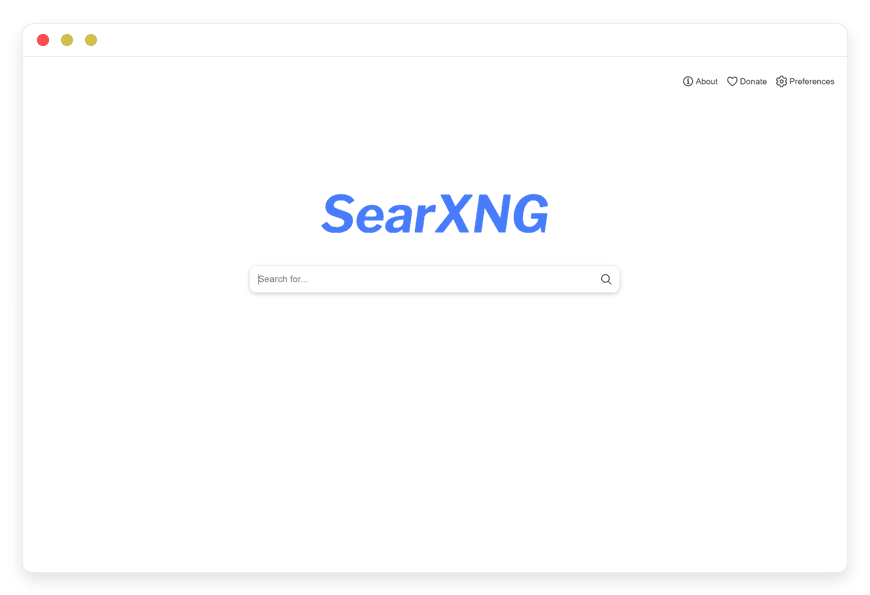
- SearXNG is a metasearch front-end. It queries more than 70 search engines, merges the results, and keeps no profile of you. It has no index of its own.
- The win is privacy and control, not better results. Result quality rides on the engines it queries.
- Against ad-funded Google or Bing, you stop paying with your search history. Against Kagi at $10 a month per person, you trade curated quality for a front-end you own.
- DANIAN runs a managed SearXNG instance for €9 a month, flat. One instance a household or small team can share, with no upkeep on your side.
- Honest limits: no curated ranking, results vary by engine, and heavy use can hit rate limits.
Why “free” search is not free
Every search you run on Google or Bing is logged against you. The query, the time, and the click feed a profile, and that profile is the product those engines sell to advertisers. The search itself is the bait. You pay with the record of what you were curious about.
Kagi built a business on the other side of that trade. It charges money instead of mining your data: on its published pricing, $5 a month on the Starter plan caps at 300 searches, and $10 a month on the Professional plan is unlimited, both before tax. Kagi does not profile you, and for one heavy searcher it is a clean, capable product.
There is a third option that gets less attention. You can run your own search front-end. It sits between you and the engines, asks them on your behalf, and strips the tracking before the results reach you. You own it. SearXNG is the open-source tool that does this, and in 2026 it is the practical choice for most people who want a private front-end they control.
What SearXNG actually is, and what it is not
SearXNG is a free, open-source metasearch engine. The project repository carries more than 30,000 stars and is licensed under the AGPL-3.0, and its documentation is public. When you search, it sends your query to dozens of upstream engines at once, removes the tracking from each request, and merges what comes back into one page. The engines see the request arrive from the instance, not from your browser, and they never tie it to a profile of you.
The honest part matters more than the marketing. SearXNG holds no index of its own and crawls nothing. It is a front-end, not a search company. It has no answer to a query except the answers other engines give it. That has two direct consequences. It is very light to run, since there is no index to store. And its result quality depends entirely on the engines it asks, not on any ranking SearXNG brings.
This is where it parts ways with Kagi. Kagi has its own ranking, saved-domain filters, and a built-in assistant. SearXNG has none of that by default. It will not summarise a page for you, re-rank results by a list of trusted domains, or learn your preferences. If you came looking for a better index, SearXNG is not it. If you came looking for a private window onto the existing engines, owned by you, it is exactly that.
SearXNG does sort results into the categories you would expect, including web, images, videos, news, and a few specialised ones for music, files, and science. It can also expose a clean data feed for automation, which is why people wire it into their own scripts and assistants. Those are useful extras, not the headline.
What you get, and what you give up
The case for SearXNG is short and concrete. Your searches stop feeding an advertising profile. You hold the front-end, so no subscription stands between you and your own search. There is no per-seat fee, so a whole household can share one instance. And because it draws on many engines, no single engine going dark takes the whole thing down with it.
The case against it is just as concrete, and worth reading before you commit. There is no curated ranking, so a noisy query can return a noisy page. The engines SearXNG depends on actively try to block automated traffic, so a busy instance can hit rate limits and serve fewer results for a while. And engines change. When one alters how it responds, the matching part of SearXNG can break until the instance is updated to match.
None of that is hidden in the small print. It is the nature of a front-end that borrows its results. The trade you are making is privacy and ownership in exchange for polish. For a lot of people, that is the right trade. For someone who wants the cleanest possible results for one person and will pay for them, it is not, and the honest answer there is Kagi.
The three ways to run it
SearXNG has no official hosted service. Self-hosting is the only path the project itself ships, which is why a managed option fills a real gap. In practice there are three ways to get a private SearXNG front-end, and they suit different people.
A public instance. Dozens of volunteers run open SearXNG instances, listed at searx.space. You can use one right now, for nothing, with no setup. It is the fastest way to see whether the results work for you. The catch is that you do not control it. A public instance is shared, its reliability varies, and you are trusting whoever runs it. Good for testing, weak as a daily home for your searches.
Self-host it yourself. SearXNG runs in a single container and needs only about half a gigabyte of memory for one user, so an old computer or a Raspberry Pi is plenty. The software is free. On a small rented server it runs at roughly $5 a month, and on hardware you already own it costs little more than the electricity. What it costs is your time. You install it, set up a certificate, keep it updated, and fix it when an engine changes. People who enjoy that work get a free, fully owned setup.
Managed by DANIAN. If you want the front-end you own without the upkeep, DANIAN runs a SearXNG instance for you at €9 a month, flat. That covers the running server, software updates, daily backups, monitoring, and chat help when something looks off. You pick the region it runs in. The point of the €9 is not that the software costs anything, since it does not. The point is that the maintenance, the patching, and the watching for broken engines stop being your job.
If the upkeep is the part you would rather skip, that is what managed SearXNG hosting is for.
The math: SearXNG, Kagi, and ad-funded search
Put the options side by side and the trade-offs get clearer. The numbers below use Kagi’s published prices and DANIAN’s flat rate. Kagi is priced per person; a SearXNG instance is priced per instance, and one instance can serve more than one person.
| Option | What it costs | Who runs it | Where results come from | Profiles you? | Effort to run |
|---|---|---|---|---|---|
| Managed SearXNG (DANIAN) | €9 / month, flat, per instance | DANIAN | 70+ engines, merged | No | None — run for you |
| Self-hosted SearXNG | Free software + ~$5 / month server, or free on your own hardware | You | 70+ engines, merged | No | You patch, update, and watch for breakage |
| YaCy (self-hosted) | Free software + a capable machine | You | Its own peer-to-peer index | No | Heavy on resources; results take time to build |
| Kagi (Professional) | $10 / month + tax, per person | Kagi | Kagi’s own ranking plus sources | No | None — hosted product |
| Ad-funded Google/Bing | No money | Google/Microsoft | First-party index | Yes — your history feeds ad profiles | None |
For one person who searches a lot and wants the best results, Kagi at $10 a month is hard to beat on quality, and this post will not pretend otherwise. The picture changes the moment you count heads. A family of four on Kagi is four subscriptions. The same family on one managed SearXNG instance is €9, total. Ownership tips it further: with SearXNG you hold the software and can move it, while a Kagi subscription is a service you rent. The choice is curated quality for one, against a private front-end the whole house can share and you can keep.
If you want to try that on your own domain before deciding, you can start a 7-day trial.
Where SearXNG fits in 2026, and where Whoogle and YaCy do not
The private-search field looks busy, but most of the self-hosted options are not interchangeable. Two in particular come up often, and the honest read on each has shifted this year.
Whoogle was the popular choice for people who wanted Google’s results without Google’s tracking. It worked by proxying Google directly. In April 2026 it shipped its final release. Google had spent the prior year blocking the no-JavaScript request method Whoogle was built on, the maintainer ran out of workarounds, and the project stopped. The lesson is plain: a front-end that bets everything on one engine fails when that engine decides to block it. SearXNG draws on many engines, so when one degrades, the rest carry on. That resilience is a real reason to start with SearXNG rather than a single-engine tool in 2026.
YaCy is the opposite extreme. It does not query other engines at all. It builds its own index across a peer-to-peer network, with no central server, so no single party controls the data. For people whose bar is full decentralisation, that is the draw. The cost is real, though: YaCy wants meaningful hardware and bandwidth, and its results are slower and patchier than a metasearch front-end gives. It is a project for the decentralisation-minded, not a drop-in private Google.
SearXNG sits in the practical middle. It gives you the breadth of the major engines, the privacy of a front-end that hides who is asking, and a footprint light enough to run on a spare computer. For most people who simply want their searches to stop feeding an ad profile, it is the option that holds up.
One more piece tends to follow. Search finds pages, but it does not keep them, and the good ones slip away. If you want to hold on to what you find, you can save results with Linkwarden, a self-hostable bookmark manager that stores both the link and a copy of the page. Run on an instance you own, your private search and your saved links sit on the same footing.
How to pick: three questions
You can settle this with three honest questions about what you actually want.
Do you want curated quality, or a front-end you own? If the relevance of results shapes your work and you will pay for the best, Kagi is the better buy. If you would rather own the window onto search and accept aggregator-grade results, SearXNG is the fit.
Is it for one person, or for several? One heavy searcher leans toward Kagi’s per-person plan. A household or a small team that can share a single instance leans toward SearXNG, where one €9 instance covers everyone.
Do you want to run it, or have it run? If you enjoy the upkeep, self-host SearXNG and pay nothing for the software. If you want the result without the maintenance, a managed instance hands you the front-end and keeps it running.
The FAQ
What SearXNG is and how it works
What is SearXNG?
SearXNG is a free, open-source metasearch engine. It takes your query, sends it to more than 70 search services at once, and merges the replies into one page. It keeps no profile of you and shows no ads. It holds no index of its own.
How is SearXNG different from Google?
Google runs its own index and ranks results with systems tuned partly by what it knows about you. SearXNG owns no index. It asks other engines, strips the tracking from each request, and shows a merged list. The control and the privacy are the difference, not the ranking quality.
Does SearXNG have its own search index?
No. SearXNG holds no index and crawls nothing itself. Every result comes from an upstream engine such as Google, Bing, or DuckDuckGo. That keeps it light to run, but it also means result quality rides on the engines it queries, not on SearXNG.
Is SearXNG private if it still queries Google and Bing?
Mostly, yes. Your query reaches the engines from the instance, not from your browser, and tracking parameters are removed first. The engines never see a profile tied to you. They do see the query leave the server, so SearXNG hides who is asking, not what is asked.
Result quality and limits
What are the main downsides of SearXNG?
It has no curated ranking, no saved-domain filters, and no built-in answers, so results can feel noisier than a tuned product. Quality rides on the upstream engines. Heavy use can hit rate limits, and an engine occasionally changes and breaks until the instance is updated.
Why do some SearXNG searches show rate-limit errors?
The engines SearXNG queries try to block automated traffic. When one instance sends many searches quickly, an engine may throttle or refuse it for a while. Spreading queries across many engines softens this, and a managed instance is tuned to stay within limits, but no front-end fully escapes it.
Does SearXNG have an AI assistant or summariser?
No, not by default. SearXNG is a search front-end, not an answer engine. It returns links, not written summaries or chat replies. If you want a built-in assistant and tuned ranking, a paid product such as Kagi covers that. SearXNG covers privacy and ownership instead.
Cost and which option fits
How much does SearXNG cost?
The software is free under the AGPL-3.0 licence. You pay only for where it runs. Self-hosting can cost nothing on hardware you already own, or about $5 a month on a small server. DANIAN runs a managed instance for you at €9 a month, flat.
Is managed SearXNG cheaper than Kagi?
It depends on how many people use it. DANIAN charges €9 a month per instance, and one instance can serve a household or team. Kagi charges $10 a month per person on its unlimited plan. At two or more people, the instance wins on price. For one person, the gap is small.
Should I use Kagi instead of SearXNG?
Possibly. Kagi gives one person curated ranking, saved-domain filters, and a built-in assistant for $10 a month, and many heavy searchers find it worth the money. SearXNG gives you a private front-end you own and can share, with no per-person fee. Pick Kagi for polish, SearXNG for ownership.
Can a household or small team share one SearXNG instance?
Yes. One instance can serve everyone who points a browser at it, so a family or a small team pays once, not per seat. The limit is load. If many people search heavily at the same moment, upstream engines may throttle the shared instance, so very busy teams may want more capacity.
Running it, owning it, setting it up
Can I self-host SearXNG myself for free?
Yes. SearXNG runs in a single container and is light, needing roughly half a gigabyte of memory for one user. A Raspberry Pi or an old computer is enough. The software is free; the cost is your time to install it, keep it updated, and fix it when an engine changes.
What does DANIAN’s managed SearXNG include?
DANIAN runs the instance for you at €9 a month. That covers the running server, software updates, daily backups, monitoring, and chat help when you need it. You also choose which region it runs in. You get a private search front-end without the patching that self-hosting asks of you.
Can I set SearXNG as my browser’s default search?
Yes. Most browsers let you add your instance as a search engine from the address bar, then set it as the default. After that, every search you type runs through your own SearXNG instance. Your queries stop flowing to an ad-funded engine that profiles you, with no change to how you search.
Who can see my searches on a managed instance?
Your instance does not build a profile of you, and DANIAN runs the server without mining your queries for advertising. Searches leave for the upstream engines stripped of identifying data. The honest limit is that those engines still receive the query text, from the instance rather than from you.
Can I move my SearXNG instance elsewhere later?
Yes. SearXNG is open-source software, not a closed product, so you are never locked in. You can carry your settings and run the same software on another host or on your own hardware whenever you want. Owning the software is the point, and that ownership moves with you.
Other tools and the bottom line
What happened to Whoogle, and should I use it?
Whoogle, a popular self-hosted front-end for Google results, reached its final release in April 2026 after Google blocked the method it relied on. Because it bet on a single engine, one change ended it. SearXNG spreads queries across many engines, so it does not fail the same way.
What about YaCy?
YaCy takes a different path. Instead of querying other engines, it builds its own index across a peer-to-peer network, so there is no central server at all. That appeals to people who want full decentralisation, but it needs real hardware and bandwidth, and results are slower and patchier than a metasearch front-end.
How do I save the results I find?
SearXNG finds pages but does not store them. To keep the ones that matter, pair it with Linkwarden, a self-hostable bookmark manager that saves links and a copy of the page. DANIAN runs Linkwarden too, so your search front-end and your saved links can both sit on instances you own.
What to do this week
Start by trying it, not buying it. Open a public instance from searx.space and run the searches you make every day. Look at whether the results are good enough for your work. They will not match a tuned product on every query, and that is the test that matters: good enough, in exchange for not being profiled.
If the answer is yes and you want that front-end to be private, owned, and maintained, set up your own instance. Then add it to your browser from the address bar and make it the default, so every search runs through it from then on. Whether you self-host or have it run for you, the searches stop flowing to an engine that profiles you, and the front-end becomes something you hold rather than something you rent.