Atlassian Server alternatives in 2026
Atlassian Server is gone — what small teams did with their Confluence and Jira in 2026
TL;DR
- Atlassian Server reached end of support on 15 February 2024. No more security patches, bug fixes, or vendor support. New Server license sales had already stopped on 2 February 2021.
- Atlassian offered Server customers two paths: Cloud or Data Center. Data Center is now winding down too — sales to new customers ended 30 March 2026, and instances go read-only on 28 March 2029.
- Data Center starts at a 500-user tier: about $51,000 a year for Jira, near $27,000 for Confluence. A 10-person team pays the 500-user price.
- Four open-source tools cover most of what small teams used Confluence and Jira for: BookStack and Wiki.js for the wiki, Redmine and OpenProject for the tracker.
- DANIAN runs any of them for €9 per app per month, with patching, backups, monitoring, and support included. The honest catch: macro-heavy Confluence and deeply Jira-integrated setups do not move cleanly.
What changed, and what didn't
Atlassian Server reached end of support on 15 February 2024. After that date there are no security patches, no bug fixes, and no technical support for Confluence Server or Jira Server. New license sales had already stopped on 2 February 2021. Existing installs kept running — they just stopped being safe.
The end-of-support date didn't switch anything off. A Confluence Server install from 2023 still boots in 2026. What it no longer gets is a single security patch. For a wiki that holds runbooks, customer notes, and internal process, that is the real deadline — not the calendar date. Each disclosed vulnerability stays open.
Atlassian gave Server customers two routes. Move to Atlassian Cloud, or move to Atlassian Data Center, the self-managed product aimed at larger organisations. Server itself was retired. You cannot buy or renew a Server license. The official migration timeline lays out the dates.
Why Data Center bites small teams
Data Center is sold in fixed user tiers, and the smallest tier is 500 users. Jira Data Center lists at about $51,000 a year; Confluence Data Center at roughly $27,000. A 10-person team pays the 500-user price. There is no smaller option, so the entry cost is set for enterprises, not studios.
Data Center is an annual subscription, not the perpetual license Server used to be. Pricing climbs by user tier, and the entry tier is 500 users for both Jira and Confluence. A five-person studio and a 400-person company pay the same floor.
The Jira Data Center entry tier lists around $51,000 a year, rising to roughly $59,000 in February 2026. Confluence Data Center starts near $27,000 a year. Those are list prices for software alone, before the servers, the database, and the admin time you supply yourself.
There is a second problem. Data Center is now on its own end-of-life path. Atlassian stopped selling it to new customers on 30 March 2026. Existing customers lose the ability to buy or expand licenses on 30 March 2028, and instances become read-only on 28 March 2029. A small team migrating to Data Center in 2026 would be moving onto a product with a known shutdown date.
Atlassian Cloud is the path most small teams are steered toward. It is free up to 10 users, then charges per seat — Confluence Cloud around $5 per user per month, Jira Cloud around $8. For a team under 10, Cloud costs nothing. Past that, the per-seat meter is the thing many teams were trying to escape.
Start a 7-day free trial — no card needed.
Four open-source tools that cover the gap
Most small teams used Confluence for documentation and Jira for issue tracking. Four open-source tools cover those jobs. BookStack and Wiki.js replace the wiki; Redmine and OpenProject replace the tracker. All four are free, self-hostable, and carry no per-seat fee. Each fits a different shape of team.
BookStack — the Confluence-shape wiki
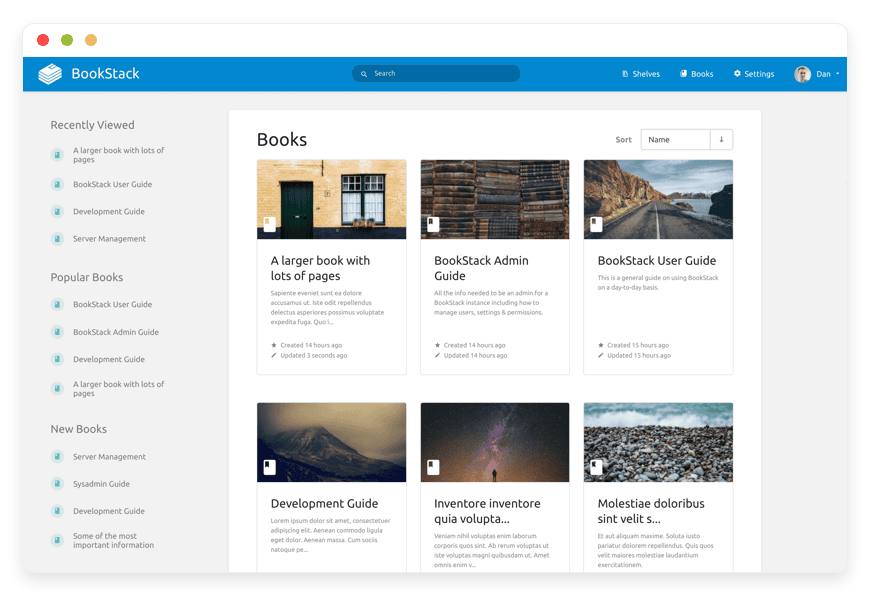
BookStack is a documentation platform organised as shelves, books, chapters, and pages.
It is the closest fit for a Confluence space that holds runbooks, SOPs, and internal knowledge.
Licensed under MIT, it has roughly 18,800 GitHub stars.
Search is fast, pages keep revision history, and SSO is built in.
Run it as managed BookStack hosting for €9 per month.
Best for teams that want a clean, searchable wiki without macros.
See the BookStack project for detail.
Wiki.js — for Markdown-first teams
Wiki.js is a Markdown-native wiki built on Node.js, with Git storage sync and a long list of authentication options.
Engineers who want their docs to read and diff like code prefer it to a WYSIWYG editor.
It is AGPL-licensed, with about 28,000 GitHub stars.
Run it as managed WikiJS hosting for €9 per month.
Best for technical teams that live in Markdown.
The Wiki.js site has the feature list.
Redmine — the Jira-shape tracker
Redmine is a project-management and issue-tracking app that has run production workloads since 2006.
It maps closely to how teams used Jira Server: projects, issues, roles, Gantt charts, and per-project wikis.
It is GPL-licensed, with around 5,800 GitHub stars on its mirror.
It has a built-in CSV importer, which matters for migration.
Try it as Redmine for issue tracking.
Best for teams that want straightforward tracking without a per-seat bill.
The Redmine project hosts the docs.
OpenProject — the heavyweight
OpenProject is a fuller project-management suite: Gantt charts, roadmaps, agile boards, and time tracking in one tool.
It is the closest match for a team that used Jira for planning, not just bug tracking.
Licensed GPLv3, with roughly 15,000 GitHub stars.
Run managed OpenProject for PM at €9 per month.
Best for teams that need real project planning, not just a backlog.
The OpenProject site covers editions.
The four tools at a glance
| Tool | Replaces | License | GitHub stars | DANIAN price | Best for |
|---|---|---|---|---|---|
| BookStack | Confluence (docs) | MIT | ~18,800 | €9/app/month | Clean wiki, no macros |
| Wiki.js | Confluence (docs) | AGPL-3 | ~28,000 | €9/app/month | Markdown-first teams |
| Redmine | Jira (issues) | GPL-2 | ~5,800 | €9/app/month | Straightforward tracking |
| OpenProject | Jira (planning) | GPL-3 | ~15,000 | €9/app/month | Gantt, roadmaps, agile |
GitHub star counts are point-in-time, May 2026, and round to the nearest hundred.
What the migration actually involves
Migration comes down to two moves: export your content from Atlassian, then import it into the new tool. Confluence exports to HTML or XML. Jira exports issues to CSV. Both wikis and both trackers can ingest that. The friction is always the same — attachments, and Confluence macros.
For documentation, Confluence exports a whole space to HTML or XML from its content tools. BookStack has no official Confluence importer, but community tools push exported HTML into it through its API. One open wizard maps a Confluence space to a BookStack shelf, top-level pages to books, and child pages to chapters. Pages that sat loose in a space land in a single catch-all book and need tidying.
Wiki.js is the better target if your team wants Markdown. You export Confluence to HTML or Markdown, clean it up, and load it through Git sync or the API. The structure is freer than BookStack's, which helps for sprawling wikis and hurts for tidy ones.
Either way, two things fight you. Attachments — images and files — usually import as a separate step, and the links to them break and need fixing. And Confluence macros — Jira-issue panels, info boxes, page-property reports, and anything from a Marketplace app — have no equivalent in a simpler wiki. Plain text survives. Dynamic content does not.
For issues, Redmine reads a CSV. You export a Jira project to CSV, then map each column to a Redmine field: summary, description, status, assignee, dates. Logins must match Redmine usernames, and dates need four-digit years. The CSV path has one hard limit — it does not carry attachments at all. Comment history, workflow states, and links between issues also degrade. For a small backlog, that is an afternoon of cleanup. For years of history, it is a real project.
OpenProject ships an official Jira migration tool, available without a feature flag since version 17.4. It moves projects, issues, attachments, users, statuses, and basic custom fields. Two cautions: it supports Jira Server and Data Center, not Jira Cloud, and Atlassian still labels it beta, so it is not for a production cutover without a rehearsal. Macro callouts keep their text but lose their styling.
The honest summary: attachments are the hardest part of every path. Budget time for them, and decide early which files are worth carrying.
Browse the full app catalogue.
When migrating is the wrong call
Not every team should leave. If your Confluence is built on macros and tight Jira integration, the move loses real function. If your team is under 10 people, Atlassian Cloud is free. The open-source tools win on cost and data ownership — not on feature depth or ecosystem.
Stay where you are if your Confluence runs on dynamic content: Jira macros, page-property reports, Marketplace-app panels. Those do not survive the move, and rebuilding them by hand can cost more than the license you would save. BookStack is excellent at simple docs and runbooks. It is not a drop-in for a macro-heavy site.
Stay on Cloud's free tier if your team is under 10 people and a few seats are all you need. At that size there are no licensing savings to capture. The only gain is owning your data and your tools. That can still be the right reason to move. It is just not a money reason.
The open-source tools also give up things Atlassian does well: a large app marketplace, deep native links between Confluence and Jira, and built-in AI features. If those are load-bearing for your team, weigh the loss honestly before you commit.
How DANIAN runs these
DANIAN hosts BookStack, Wiki.js, Redmine, and OpenProject for €9 per app per month. The price covers the server, security patching, daily off-site backups, monitoring, and 24/7 email and ticket support. You pick the region from 21 datacenter locations. You do not run the server, and there are no per-seat fees.
The reason a small team self-hosts and then regrets it is the upkeep. An open-source wiki still needs an operating system, a database, TLS certificates, backups, and a patch every month. Miss the patches and you have rebuilt the exact problem you left Atlassian Server to escape.
We run that layer. We patch on a regular cadence, back up every instance off-site daily, monitor uptime, and reply on support from a named person. Application data sits in the region you choose, across 21 datacenter locations on six continents.
The flat €9 per app per month means the bill does not move when your team grows from 5 people to 25. A managed BookStack plus a managed Redmine is €18 a month. Set against Data Center's annual minimums, the gap is not subtle.
We will not upgrade your resources or charge you without your consent. Card failed? We wait. We don't delete your data.
What stays on your side
A managed host runs the software, not the migration. You still decide what to keep, export your Atlassian content, sort attachments and macros, map users, and brief the team. A host can advise and handle setup, but the content decisions are yours.
Export from Atlassian while you still have access. Pull a full space export and a CSV of every project before any license lapses. Decide which pages and projects are worth carrying and which to archive. A clean migration is usually a smaller one.
Attachments and macros need a human call. Some macros become a static table; some get dropped. Someone on your side decides which. User accounts need mapping from Atlassian identities to the new tool's logins. And the team needs a short orientation on where everything moved.
DANIAN can stand up the target instance, advise on the import, and adjust configuration on request. The judgement about your own content stays with you.
Frequently asked questions
When did Atlassian Server actually reach end of life?
Atlassian Server reached end of support on 15 February 2024. After that date there are no security patches, bug fixes, or technical support for Confluence Server or Jira Server. New Server license sales had already ended on 2 February 2021. Existing installs still run, but every new vulnerability stays unpatched.
Is Atlassian Data Center a safe long-term choice for a small team?
No. Data Center is now on its own end-of-life path. Atlassian stopped selling it to new customers on 30 March 2026, and existing instances become read-only on 28 March 2029. It also starts at a 500-user tier, so a small team pays an enterprise floor for a product with a known shutdown date.
What is the best open-source alternative to Confluence in 2026?
For most small teams it is BookStack — a documentation wiki organised as shelves, books, chapters, and pages, licensed MIT. Teams that prefer Markdown choose Wiki.js instead. BookStack suits runbooks, SOPs, and internal knowledge. Wiki.js suits engineers who want their docs to read and diff like code.
What is the best open-source alternative to Jira in 2026?
Two tools cover most Jira use. Redmine is the closer match for straightforward issue tracking — projects, issues, roles, and Gantt charts, licensed GPL. OpenProject is the heavier option, with roadmaps, agile boards, and time tracking, and it ships an official Jira migration tool. Pick Redmine for tickets, OpenProject for planning.
Is BookStack a good replacement for Confluence?
For a Confluence space that holds documents, runbooks, and notes, yes. BookStack has clean structure, fast search, page revision history, and SSO. The limit is macros: Jira panels, info boxes, and Marketplace-app content have no equivalent. If your wiki is mostly written pages, BookStack fits. If it is mostly dynamic content, it does not.
What's the difference between Redmine and OpenProject?
Both replace Jira, at different weights. Redmine is leaner — issue tracking, projects, and Gantt charts, stable since 2006. OpenProject is broader — roadmaps, agile boards, team planner, and time tracking — and includes an official Jira migrator. Choose Redmine for simple tracking; choose OpenProject if you used Jira for full project planning.
Is Wiki.js or BookStack better for a technical team?
Wiki.js, usually. It is Markdown-native, syncs to Git, and treats pages like files, which engineers prefer. BookStack is friendlier for non-technical writers and has a cleaner default structure. If your team writes in Markdown and wants version control, choose Wiki.js. If a mixed team needs an easy editor, choose BookStack.
How much does Atlassian Data Center cost for a small team?
More than most small teams expect. The entry tier is 500 users, and there is no smaller option. Jira Data Center lists around $51,000 a year, rising to about $59,000 in February 2026; Confluence Data Center starts near $27,000. A 10-person team pays the full 500-user price, before infrastructure and admin costs.
Can I keep running Atlassian Server after end of life?
Technically yes — an existing Server install still boots. But it receives no security patches, so every disclosed vulnerability stays open. For a wiki or tracker holding business data, that risk grows with every month. Running an unpatched install is the situation most teams are migrating to leave behind.
How long does it take to migrate from Confluence to BookStack?
It depends on size and macro use. A small wiki of plain pages can move in a weekend with community import tools. A large space full of attachments and macros takes longer, because attachments import separately and macros need manual decisions. The written content moves quickly; the dynamic content is the slow part.
Will I lose my page history when I move off Confluence?
Some of it. Current page content exports cleanly, and BookStack keeps its own revision history from the point of import forward. But Confluence's full version timeline and per-edit comments do not carry across in most migration paths. If past revisions matter, export and archive the Confluence history before you decommission the instance.
Do BookStack, Redmine, and OpenProject support single sign-on?
Yes. BookStack supports OIDC, SAML 2.0, and LDAP. Wiki.js supports LDAP, SAML, and OAuth. Redmine and OpenProject both integrate with LDAP and common SSO providers. You can connect any of them to your existing identity provider, so logins work the way your team already expects.
Can a non-technical team run these tools without a sysadmin?
Running them yourself means owning the server, the database, backups, TLS certificates, and a monthly patch. That is hard without technical help. A managed host handles that layer for €9 per app per month, so a non-technical team gets the tool without the upkeep. The trade is a small monthly fee for zero operations.
Is my data private if I self-host these tools?
Yes — the data lives wherever you host it, not on a vendor's shared platform. The apps are open source, so the data is yours to export at any time. With DANIAN, application data sits in the region you choose, across 21 datacenter locations, and you can download a full export whenever you want.
What happens to my Atlassian Marketplace apps after migrating?
They do not come with you. Marketplace apps are built for Atlassian's platform and have no equivalent in BookStack, Wiki.js, Redmine, or OpenProject. If a specific app is load-bearing, list what it does before migrating and check whether the new tool covers it natively. Some functions map; many do not.
Should I move to Atlassian Cloud instead of an open-source tool?
If your team is under 10 people, Cloud is free and easy — there is no cost reason to leave at that size. Past 10 users, Cloud charges per seat, around $5 to $8 per user per month, which adds up as the team grows. Open-source tools trade that per-seat meter for a flat managed fee and full data ownership.
Can I migrate from Jira Cloud to OpenProject?
Not with the official tool. OpenProject's Jira migrator supports Jira Server and Data Center, not Jira Cloud. To move from Jira Cloud, export your issues to CSV and import them into Redmine, or use a community script for OpenProject. Cloud-to-open-source migrations rely on CSV and manual mapping rather than the built-in migrator.
Does Redmine still get updates in 2026?
Yes. Redmine is actively maintained, with its 6.1 line updated in March 2026 and older lines still receiving fixes. It has run production workloads since 2006 and remains one of the most stable open-source trackers. Longevity is one of its strengths for teams that want a tool they will not have to replace soon.
What's the cheapest way to replace Confluence and Jira?
The license cost of BookStack, Wiki.js, Redmine, and OpenProject is zero — they are free and open source. The real cost is hosting and upkeep. Self-hosting on a small server is cheapest if you have the skills. Managed hosting at €9 per app per month is cheapest once you count your own time honestly.
Can I run my wiki and issue tracker on the same plan?
You run them as separate apps, each at €9 per month. A managed BookStack for docs plus a managed Redmine for issues is €18 a month total. Each app gets its own instance, its own backups, and its own region choice, so you can keep documentation and tracking independent.
What if I just want to handle the whole migration myself?
That is a reasonable choice for a technical team. Confluence exports to HTML or XML and Jira to CSV; community import tools and the OpenProject migrator are open and documented. You will own the server and the upkeep afterward. If you would rather skip the ongoing operations, a managed host runs the tools for a flat monthly fee.
What to do this week
If you are still on a Server install, export everything now, while it runs. Pull a full Confluence space export and a CSV of every Jira project, and store them somewhere safe. That single step removes the deadline pressure, whatever you decide next.
Then sort your content by shape. Mostly written pages point to BookStack or Wiki.js. An active backlog points to Redmine or OpenProject. Macro-heavy, deeply integrated Confluence points to staying put, or to a careful partial move with eyes open.
If you want the tools without the server work, start a trial and deploy one app first — a wiki or a tracker, not both at once. Move a slice of content, check that search, logins, and links hold, then decide. See pricing for any app.
This is operational guidance, not legal advice. If your content includes regulated or sensitive data, confirm the handling rules that apply to your situation before you move it.