Fully Managed Ampache
as a Service

Deploy Ampache as a fully managed service starting at €9/mo. Get automated backups, SSL, updates, support and monitoring included.

Ampache is an open-source audio and video streaming application — your music library on the web, accessible from any device. Broad Subsonic API client support connects it to phones, cars, and desktop players. You get the convenience of a paid streaming service with the control of self-hosted infrastructure.

Free 7-day trial  99.9% Uptime SLA  No credit card  Cancel anytime

Free 7-day trial  99.9% Uptime SLA
No credit card  Cancel anytime

Ampache

Ampache

STARTING AT

€9/month
Automated Backups
Monitoring
Automated Updates
Auto SSL

USAGE

Unlimited
Human Support
Custom Domains
Terminal Access
File Manager Access
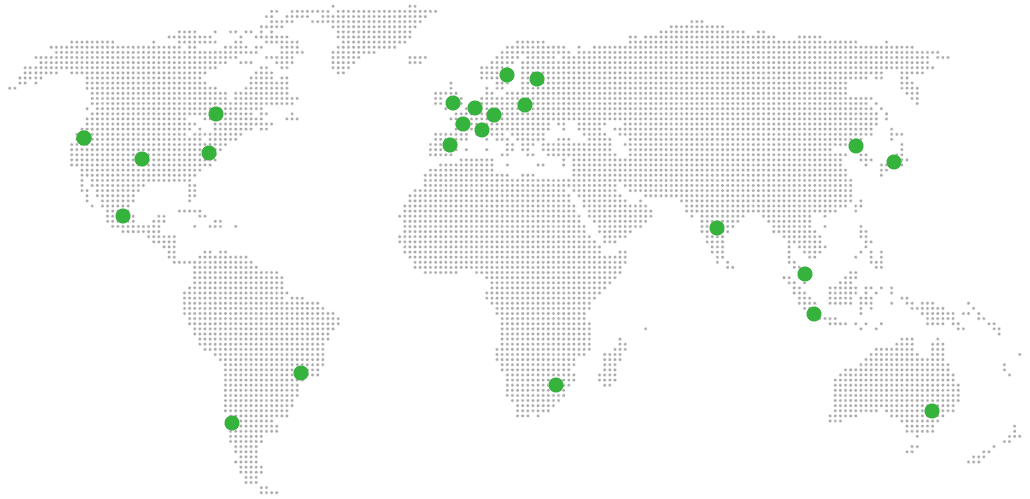
Deploy in your region 21 locations worldwide
GermanyFinlandNetherlandsUKSwedenUnited StatesCanadaSingaporeJapanAustraliaBrazilSouth Africa+9 more →
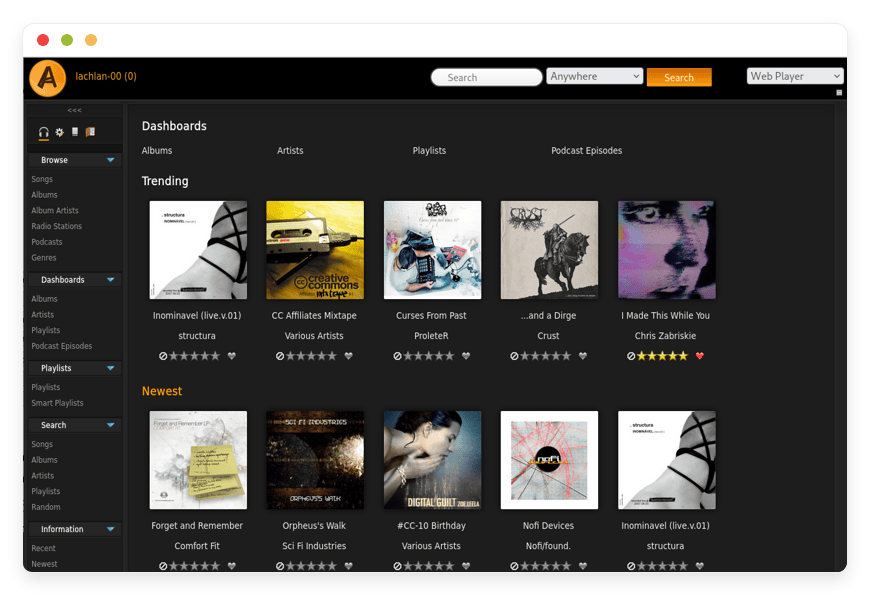
Ampache Preview Image

ABOUT THE SOFTWARE

What is Ampache

Ampache is an AGPLv3-licensed web application for streaming and managing personal audio and video libraries. The project was first released in 2001 by Scott Kveton, with Karl Vollmer leading development from 2003 to 2011. It runs on PHP and MariaDB.

The project's stance is specific. The official README states Ampache is not a media organiser; it is a tool that presents an already organised collection in a useful way. It assumes your library is already organised and presents it sensibly. The Ampache-Develop branch is now staging work for Ampache 8.

The bridge to the mobile and car ecosystem is the Subsonic API. Ampache has been Subsonic-client compatible since version 3.7.0. That single design decision brings compatibility with Symfonium, DSub, Substreamer, Tempo, Power Ampache 2, Submariner, Feishin, Strawberry, web players, and terminal clients. The ampache.org homepage notes the project has been free and open source since 2001 under AGPLv3. Twenty-five years of continuous development sets it apart from newer forks.

FEATURES

What Ampache does

Ampache is a catalog server with a web player and a wide client ecosystem. It indexes your files, exposes them over HTTP and the Subsonic API, and transcodes on the fly when a client cannot play the source format. Multi-user, multi-catalog, AGPLv3.

Web-based audio and video streaming

HTML5 player in any modern browser with per-user themes and queue persistence.

Multi-user catalog

Shared library with per-user playlists, private listening history, and access control lists.

On-the-fly transcoding

FLAC, OGG, and DSD to MP3 or Opus via ffmpeg, lame, and flac binaries.

UPnP/DLNA and DAAP backends

The ampache.org docs confirm Ampache provides a UPnP/DLNA backend compatible with any UPnP/DLNA client.

Subsonic API compatibility

Supported since version 3.7.0 — Symfonium, DSub, Substreamer, Tempo, and many others.

Smart playlists and search rules

Dynamic rules across tag, rating, play count, year, and date added.

Tag-based browsing

Album, artist, genre, year, mood, and MusicBrainz ID for Various Artists correctness.

Per-IP transcoding ACLs

Local network gets lossless passthrough, remote IPs auto-downsample. Source files are never touched.

WHAT'S ALWAYS INCLUDED

Every app. Fully managed.
Nothing extra to pay for.

Every app you deploy includes the full managed service — security, backups, updates, and support from day one.

Automatic updates and patches

Apps run the latest stable version. Security patches applied silently, with rollback if needed.

Daily off-site backups

Multiple daily backups in redundant off-site locations. One-click restore if anything goes wrong.

24/7 uptime monitoring

Continuous monitoring with instant alerting. We respond before you notice.

SSL, firewall, DDoS protection

Auto-renewing SSL, hardened firewall rules, DDoS mitigation on every deployment.

Performance and scaling

We monitor resource usage continuously. When your app needs more headroom, we flag it and upgrade with your explicit approval.

Dedicated engineering support

Real engineers on chat. DNS, SMTP & migration help. All included in €9.

WHY MANAGED

Why teams pick managed Ampache

On January 15, 2026 Spotify announced its third US Premium price hike in four years. Individual rose from $11.99 to $12.99 per month; Family rose from $19.99 to $21.99. For listeners with ripped CDs, FLAC purchases, or DJ libraries, the math has shifted again. Self-hosting Ampache turns that recurring bill into a fixed €9.

Running Ampache yourself does not mean clicking "deploy" and walking away. The work that lands on you afterward includes PHP version pinning, MariaDB tuning for large catalogs, ffmpeg / lame / flac codec installs, SSL certificate renewals, off-site backups, monitoring, and security patches. Each task is small in isolation. Together they accumulate into a recurring evening commitment — roughly five hours a month on a $24 production-class VPS, depending on library size.

The gotcha worth naming: Ampache's default PHP memory_limit is 32MB. The official Ampache catalog documentation describes the failure mode in plain language. The getid3() metadata parser should never use more than 32MB if it is working correctly, but every now and then it hits a file it can't parse and uses a very large amount of memory — the catalog process appears to hang. A single file with corrupt or malformed ID3 tags routinely halts an entire scan. Self-hosters typically only discover this when their first 50,000-track scan dies at hour two with no useful error.

REVIEWS

Hear from customers ​like you​​​​​​​

Successful businesses and professionals around the world rely on DANIAN every day

USE CASES

Three teams who run Ampache on DANIAN

These are representative team types we set up most often. Each starts with the same flat €9 plan.

SOLO DJ

Replacing a fragmented Plex + Plexamp setup after the April 29, 2025 paywall

A Berlin electronic music DJ with 38,000 FLAC tracks across external drives. Wants in-car Android Auto playback through Symfonium. Region: Germany. Lossless stays on the home network; cellular streams transcode to 320k MP3. One container at €9 per month replaces a Plex Media Server plus Plexamp setup, after Plex paywalled remote playback for free users on April 29, 2025.

FOUR-PERSON HOUSEHOLD

Stopping the Spotify Family escalator

Four adults sharing one ripped-CD and downloaded-album library of around 22,000 tracks. The trigger: a Spotify Family bill that reached $21.99 a month in January 2026, plus growing concern about playlist deletions and unavailable albums. Region: UK. Three Subsonic clients — Substreamer on iOS, Tempo on Android, the web player for the grandparent. Custom domain mapped. Composite scenario.

INDIE LABEL A&R TEAM

A private listening server for unreleased masters

A six-person team at a UK independent label. Library of around 12,000 tracks plus a growing demos folder. Region: UK. Per-user access controls separate A&R from the artist liaison. Daily off-site backups protect the demo archive. €9 per month versus a $24-per-month production-class VPS plus ~5 hours a month of ongoing operations time.

COMPARISON

Four ways to run Ampache

There are four honest paths. Stay on a streaming subscription, run Ampache on a VPS yourself, host it on a machine at home, or move it to DANIAN. The table makes the math visible at one, five, and ten users.

FACTORSPOTIFY PREMIUMSELF-HOST ON VPSHOME SERVERDANIAN
Monthly cost (1 user)
$12.99 (Individual, Jan 2026)$24/mo + ops time$500 + electricity (~€8/mo)€9/mo
Monthly cost (5 users)
$21.99 (Family, Jan 2026)$24/mo + ops timeSame hardware€9/mo
Monthly cost (10 users)
$43.98 (two Family plans)Larger VPS, ~$48/moHardware upgrade needed€9/mo
Your music libraryNot yours — their catalogYoursYoursYours
Catalog scope~100M tracks (theirs)Your tracksYour tracksYour tracks
Lossless audioPremium tier only (2026)Yes (full bit-depth)YesYes (per-IP ACL)
Ongoing workNone~5 hrs/month sysadminHardware + power + networkNone — we run it

The math makes the choice obvious for anyone above one user.

BY INDUSTRY

Ampache for specific industries

Music libraries put specific demands on a streaming application. Auditable play logs for licensing, lossless passthrough for HiFi, open formats for archival, broadcast-PC integration for radio. Each industry below pairs a real obligation or standard with a concrete Ampache configuration choice.

Mechanical licensing bodies such as PRS for Music, GEMA, SACEM, and ASCAP require auditable per-track distribution logs when masters are shared with producers, mixing engineers, or reviewers. Cue sheets are the mechanism that lets performing rights organizations pay royalties to the correct rights holders.

DANIAN configures Ampache's play-history logging at user-level granularity and pins MariaDB binary logs to 30-day retention so individual play events can be reconstructed. A typical workflow: A&R sends a Subsonic link to a producer abroad; the producer streams the rough mix in Symfonium without downloading; the play event lands in the label's audit log. Daily off-site backups mean a year of listening history is recoverable from any single corrupted database write, with snapshots retained 30 days in a separate region.
PRS for Music guidance on cue sheets is direct: it is increasingly important that cue sheets are reported accurately, in full, and on time. Only then can rights holders be paid fairly. PPL reporting in the UK and equivalent PRO reporting elsewhere require cue-sheet generation from played tracks.

DANIAN configures Ampache's Localplay support so a broadcast PC can take direct control of playback, and exports the play history as CSV via a cron-scheduled export script. A radio DJ streams a 4-hour set from Ampache to the broadcast console; the next morning, the play log exports to a PRS-formatted CSV ready for upload. Ampache's broadcast and streaming features have been in continuous development since the April 29, 2001 initial release — 25 years of catalog management refinement, including a Localplay backend that predates most current streaming platforms.
The de facto audiophile standard is lossless FLAC preservation at original bit depth, often 24-bit / 96kHz or 24-bit / 192kHz for hi-res masters. DANIAN ships Ampache with the transcoding profile set to lossless passthrough on the local network and downsample only on remote or cellular connections.

A collector with 3TB of HDtracks-purchased FLAC files streams bit-perfect to a DAC at home and to a phone at 320k MP3 over cellular. Ampache supports per-IP transcoding rules, so a local network ACL keeps FLAC bit-perfect while remote IPs auto-downsample. Zero re-encoding of source files — the originals on disk are never touched. The catalog can be re-scanned at any time without altering a single byte of the underlying audio.
Long-term archival practice favours open formats — FLAC, Ogg Vorbis — and avoids lock-in to proprietary platforms that may be discontinued. DANIAN provisions Ampache with per-user playlist privacy and HTTPS enforced via auto-renewing Let's Encrypt SSL, so congregants reach the archive over a custom domain.

A parish music director uploads weekly choir recordings; congregants who could not attend stream the service from any device with a web browser or Subsonic client. The ampache.org homepage confirms the project has been free and open source since 2001 under AGPLv3. The license means the software cannot be silently discontinued by a vendor — 25 years of continuous development since April 29, 2001 demonstrates the model works.

FAQ

Frequently asked questions

Everything teams ask before signing up — answered straight, without sales speak.

Three groups: technical setup, migration, and how DANIAN works as a service.

01

Technical and configuration

Comfortably into six figures. Libraries of 300,000+ files run cleanly on the standard €9 instance once PHP memory_limit is raised from the 32MB default. The bottleneck is rarely Ampache itself; it is the first full catalog scan, which we run as a background worker so the web request never times out.
Yes to FLAC and OGG natively. DSD plays through transcoding to FLAC or MP3. We ship ffmpeg, lame, and flac pre-installed and verified executable by the web server user. Hi-res 24-bit/192kHz files are stored and served at full resolution to local IPs; remote IPs downsample to 320k MP3 by default. The transcoding profile is editable per user.
Through MusicBrainz IDs. Since version 3.7.0 Ampache adds a database constraint based on unique IDs from MusicBrainz metadata, which splits compilations correctly when files were tagged with a tagger that writes MBIDs — Picard or beets, for example. If files lack MBIDs, tag the Album Artist field as "Various Artists" and Ampache will group them.
We set PHP memory_limit to 512MB and max_execution_time to 0 for the catalog worker, so the standard getid3() failure pattern on a single corrupt ID3 tag no longer halts the entire run. We also enable file-level logging, so any single bad file is named in the log and can be excluded on the next scan. The Ampache wiki recommends increasing PHP memory_limit to 128MB or more — we go further.
Ampache has supported the Subsonic API since version 3.7.0. We test with Symfonium, DSub, Substreamer, and Tempo on every release. Authentication uses the API key generated per user. Older clients may need the "Use Legacy Authentication" option set in the client; we document this in the knowledge base. Android Auto works through Symfonium and DSub.
Yes. Every instance gets an auto-renewing Let's Encrypt certificate, a default-deny firewall, and edge DDoS scrubbing. We pin a sane Content-Security-Policy and disable directory listing. You add users one at a time through the admin panel; public registration is off by default. Failed-login throttling is enabled out of the box.
Yes. The catalog is shared; playlists, ratings, play counts, and favourited tracks are per-user. ACLs control which users can transcode, download, and upload. We provision one admin account at signup and you create additional users from the dashboard. Per-user transcoding profiles are also supported.
We run a nightly logical dump of the database, gzip it, and ship it to a separate region. Files are snapshotted on the same schedule. Binary logs are pinned to 7-day retention, so point-in-time recovery is available within that window on request. Restore is a dashboard action or a support ticket.

02

Migration and onboarding

We can activate your app on your own custom domain/subdomain. Examples: mydomain.com, anyword.mydomain.com.
Or, on our randomized free subdomain. Example: 963.apps.danian.cloud
If you wish to use a custom domain/subdomain, select that option when ordering your app (or notify us later). We will send you the required DNS records and if needed, our tech team will modify them for you.
21 datacenter locations across six continents. You choose the region at provisioning. Application data sits in the region you choose; pick whichever is closest to your users or matches your data-residency preference.
Yes. Request a region migration from the dashboard and we run the move in the background. The system emails you when the migration completes; total transfer time depends on data volume but typical instances finish in a few hours. There is no extra charge for a region change.
Yes. Full data export is available at any time, in a portable format you can bring to any infrastructure.
Point Ampache at the same music folder used by Plex. Ampache reads tags directly from files; it does not need Plex's database. Most users see their full library indexed inside the first catalog scan. Plex paywalled remote playback for free users on April 29, 2025. Plexamp playlists do not export cleanly, but any M3U files do — Ampache imports those directly.
Copy your music folder to the DANIAN instance over SFTP, then point Ampache's catalog at it. Both Navidrome and Airsonic read tags from files, so the metadata is already in your files. Playlists exported as M3U import directly. Per-user data — favourites, play counts — needs manual recreation; the Subsonic API does not standardise that schema.
Bring it as-is. Ampache reads ID3v1, ID3v2, Vorbis comments, APE, MP4 atoms, and more. The official README is explicit: Ampache is not a media organiser; it presents an already organised collection in a useful way. Picard or beets handle tagging before the upload.
Typically two to six hours on the €9 instance, depending on file size and tag complexity. The scan runs as a background worker, so you can close the browser and the catalog continues to build. We surface progress in the admin dashboard. With the default 32MB PHP memory_limit it would stall — we ship 512MB.
Spotify does not provide a track-level export. Third-party tools such as Soundiiz, Tune My Music, and Exportify dump playlists to CSV or M3U using the Spotify API. Soundiiz lists M3U as a supported export format, which Ampache imports directly. Match rate against your local library depends on tag quality; expect 70–95% on a well-tagged catalog.

03

Billing, support, and platform

€9 covers everything we do for that app: hardware in the region you choose, daily off-site backups with one-click restore, automatic security patches and version upgrades, 24/7 monitoring, SSL and firewall, and engineering support on Email/LiveChat. There are no setup fees or hidden line items. For more info see our Pricing page.
If you decide to continue, we charge €9/app/month from day 8. If you don't, the trial ends and you can export your data. No card is required for the trial, and we never auto-charge you without explicit consent.
No. The €9/month is flat regardless of how many users log into your app. Add 5 users or 50; the price doesn't change.
24/7 Live chat and email support, both staffed by engineers who run the systems. We handle DNS configuration, SMTP setup, app integrations, performance tuning, troubleshooting, and migration help. Response time is typically under an hour. There is no tier system — every customer gets the same support.
Yes. Cancel from the dashboard. We don't charge a cancellation fee, we don't lock data, and we will export your data to you on request before deletion. data to you on request before deletion.
Every customer instance is backed up daily to a separate region from the primary. We test restores. You can request a restore at any backup point within the retention window — usually 7 days for daily backups.
Your application data sits in the region you choose at provisioning — 21 datacenter locations across six continents. Account-level data (billing, account email, support ticket history) is processed centrally. Application data region is picked by you, per app.
99.9% uptime SLA on every app, every tenant. Service credits are documented at danian.co/service-level-agreement. The status page is located at status.danian.co.
When your tenant approaches the resource ceiling — the base tier holds 1 vCPU/RAM, 30 GB storage — we notify you. Resource upgrades happen with your explicit consent; we will not upgrade your tenant or charge you without it.
We wait. We don't suspend the app or delete your data on the first failed charge. We email you, you fix the card on file, and we continue.
Invoices can be downloaded from the billing dashboard in PDF the day each charge succeeds. EU VAT is added where applicable and the VAT-reverse-charge regime applies for VAT-registered businesses with a valid number.
150+ open-source apps across automation, team chat, file sync, analytics, AI, password management, email marketing, dev tools, project management, smart home, CMS, and federated social. See the full catalog →
Yes. Every instance comes with a web-based terminal and a file manager in your DANIAN management dashboard. Useful for managing your data and customizations.
Resources scale with your usage. If your app needs more vCPU, RAM, or storage, we add it — and we ask first before any change to your plan. €9 is the floor; resource-heavy workloads may price higher, but you'll always know in advance.
Yes. We have both a Partner program and an Affiliate program available. Anybody can sign up.
No contract. No minimum commitment. Cancel anytime from the dashboard with one click. The 7-day free trial requires no credit card. After the trial converts to paid, you can still cancel at any month without notice or penalty.

DEPLOY IN YOUR REGION

21 datacenter locations on six continents

Pick the region closest to your users.

United States, Germany, Finland, Singapore, Australia, Brazil, Canada, Netherlands, UK, Spain, Italy, France, Sweden, Malaysia, India, Japan, Mexico, Poland, South Korea, Chile, South Africa and more coming soon
Global Reach Map

Try managed Ampache for 7 days

No card. Cancel from the dashboard.