
Fully Managed Rybbit
as a Service
Deploy Rybbit as a fully managed service starting at €9/mo. Get automated backups, SSL, updates, support and monitoring included.
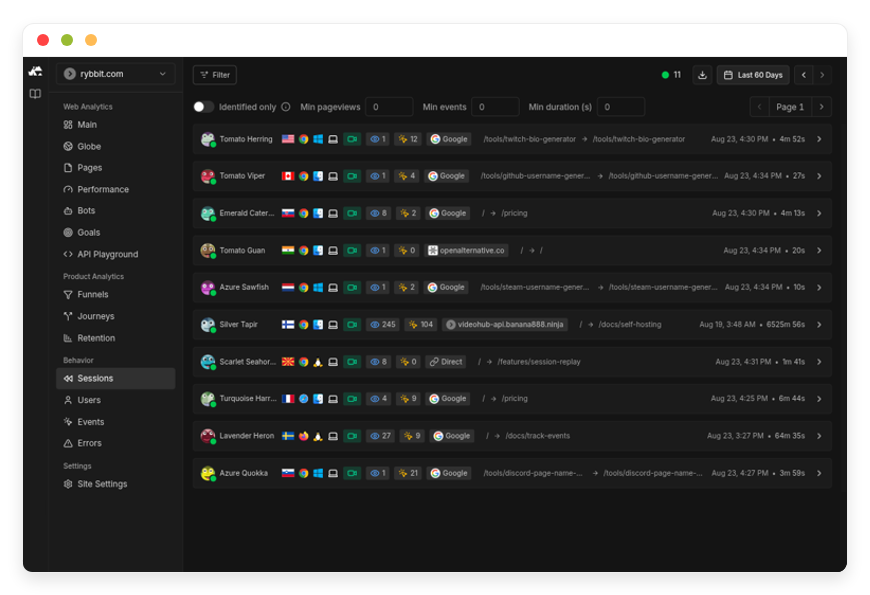
Rybbit is an open-source web and product analytics platform: live traffic dashboards, funnels, user journeys, session replay, goals and error tracking, that counts visitors without writing anything to their browser. It gives you the depth of a product analytics suite with the data ownership of a store you control.
✓Free 7-day trial ✓99.9% Uptime SLA ✓No credit card ✓Cancel anytime
✓Free 7-day trial ✓99.9% Uptime SLA
✓No credit card ✓Cancel anytime

Rybbit
STARTING AT
USAGE
 Germany
 Finland
 Netherlands
 UK
 Sweden
 United States
 Canada
 Singapore
 Japan
 Australia
 Brazil
 South Africa+9 more →
ABOUT THE SOFTWARE
What is Rybbit
FEATURES
What Rybbit does
WHAT'S ALWAYS INCLUDED
Every app. Fully managed.
Nothing extra to pay for.
Every app on DANIAN ships with the same operational baseline. You do not choose a backup add-on or a monitoring tier. Hosting, patching, backups, SSL, and support are part of the €9, and they apply to Rybbit the same way they apply to everything else in the catalog.
WHY MANAGED
Why teams pick managed Rybbit
REVIEWS
Hear from customers like you

No more maintenance headaches!
Finally, I can relax and not bother with maintenance. Each of the softwares that we run on DANIAN is automated and running stable for couple months already. They even assist us with modifying the DNS records. Once we needed to modify the config of Nextcloud so that we are able to upload higher than 5GB files and they assisted us fast. I also love their documentation!

Kevin Blackwell

Best managed service
I previously ran Peertube, Mastodon, Mattermost and Mirotalk on other providers before switching to DANIAN. I was tired of handling the updates and backups myself. Not only that the performance is "out of this world" fast, but their tech support is amazing. Since then I added 5-10 more Apps on my account. I also love how they add more softwares on their list constantly!

William Northfield

Love the personalized service!

George Adams
n8n runs excellent

David Hartmann

Smooth experience
I needed a way to manage the projects and files for my company. This was the first time I learn about opensource. I asked their support team and they assisted me immediately. I started with Openproject. Later I added Nextcloud. My team were able to get used to the apps fast.

Levi Nilsson

Bye GA

Wyatt Mitchell

Love the freedom
I wanted to use a crm for my startup. I signed up for the free trial. Tried out espocrm and dolibar and picked one. Their dashboard is very easy for a beginner. I recommend them and feel confident in choosing them.

Elias Koch
Wow just wow
After discovering DANIAN, I wished I'd found them sooner — their solution is excellent and deserves wider recognition. Very good solution!

Tyler Hollander
Professional tech support!

Bastian Engel
Their support team is the best!
I had a problem with my card and the subscription could not be renewed in time. I notified their support and surprisingly, they showed much understanding. They basically left my apps run until I solved the card issue. Other providers would have deleted my data in a heartbeat. This is the way to build client-vendor trust!
George Adams
Fair price and fast
4 months ago I activated n8n, Uptime kuma, Vaultwarden and Paperlessngx. So far everything is perfect. The performance of all apps is excellent. I contacted their support team couple times for using custom subdomains for the apps and they were fast and kind. I'm constantly recommending them to my network!

Atanas

Vaultwarden 10/10
I wanted to selfhost a passwords manager for my company but I didn't trust the mainstream providers. I tried out Vaultwarden for the free trial. I loved how their support team communicated with me professionally but still kind. I know that I can contact them whenever with whatever question I have. Recommended!

James Smith
Multiple locations options

Edward Nelson
Everything just works!
My focus is on my business, not running servers. I love that I can lauch any app without having to think about the tech behind it. Everything just works!

Tony Roy
Awesome support team!

Filip

Very proactive!
Today couple of the videos on my Peertube got viral. Before I even noticed, their support have notified me via email that they proactively upgraded my app with more cpu & ram so that it continues to work without any downtime. They left the upgraded app with the added resources for couple days until the traffic stabilizes. After that I had the possiblity to stay on the same plan or keep the upgraded plan. Out of gratitude I stayed on the upgraded one.

Luke Hall

Win-win!
I run a web design biz. After I perform the work for my clients, they constantly ask me for more software solutions. So I partnered with DANIAN. Not only I provide the requested softwares for my clients and get the increased revenue boost by delegating all to DANIAN, but also for those clients that wish to order directly from DANIAN, I send them an affiliate link. Win-win on all sides!

Luke Walker

Jeffrey Johnson
Awesome customer service
I needed to add analytics on my website but I didn't know anything about DNS. Their team guided me at all phases and they performed the changes for me. Additionally they were transparent and notified me of every change applied and steps performed.

Gabriele Marino

Good admin dashboard
Not only that I got Chatwoot, I also have access to the management dashboard. I love that I can view my hourly/daily usage and perform manual backups and restorations if needed. I don't need the level of control but it feels good to know that I have it if I need it.

Matthew Turner

Andreas Schmitt
Great service!
I configure custom Matomo tracking for my clients as a monthly service. Many of my clients were asking if they can selfhost Matomo instead of using the Cloud service. My employee recommended DANIAN. Basically, I can activate as much Matomo's in any of 20+ countries the same day. Additionally the affiliate revenue is a nice bonus.

Jacob Turner
Smooth experience
I was listing through youtube tuts on how to install Bookstack myself. Then randomly, I found their video playlist exactly for Bookstack. Got curious and went at their website. For the same price (or higher) that I would pay for just the VPS, with them I'm getting a fully managed Bookstack. It's a no-brainer decision!

Elias Gustafsson


Mason Hayes
Its a great service
Its a great service. I love the performance of my Mastodon community. It keeps on growing and I don't have any worries about backups, secuirity, updates, etc.

Vinícius Rocha

Very intuitive solution!
I wanted to use a nocode software for my company. A friend recommended them so I tried both Baserow and NocoDB, couple days later picked one.

Haruto Hashimoto


Henrik Otto
USE CASES
Three teams who run Rybbit on DANIAN
Analytics buyers rarely arrive because they want analytics. They arrive because a bill moved, a consent prompt became a conversion problem, or a question about user behaviour could not be answered. These three shapes turn up most often.
SIX-PERSON DIRECT-TO-CONSUMER BRAND
Dropping the consent prompt before peak season
Moved off a tag-managed setup where the cookie prompt was measurably costing sessions. Instance runs in the location nearest the warehouse, script served from a subdomain of the shop so blocklists do not eat it, and a four-step checkout funnel wired to the cart and thank-you events.
TWO-TITLE INDEPENDENT PUBLISHER
Numbers an ad buyer will accept
Bot filtering on, crawler traffic excluded before it reaches the reports, and event retention set to cover a full sales year so year-on-year inventory claims hold up. Monthly figures leave as CSV and go straight into the media kit without a reconciliation step.
FOUR-PERSON PRODUCT STUDIO
Three apps, one dashboard, one bill
All three products sit as separate sites under a single organisation on one instance, so the €9 does not multiply. Signup-to-activation funnels per product, session replay kept on a short window, and the query API pulling weekly numbers into the studio's own review document.
COMPARISON
Four ways to run Rybbit
Analytics products are priced by traffic, not by seat, so the honest comparison runs along monthly event volume. The three columns below are the same site growing. Only one of the four paths keeps a flat number all the way across.
| How you run it | 100k events / month | 200k events / month | 500k events / month | What you operate |
|---|---|---|---|---|
| Proprietary hosted analytics (Fathom Analytics)No funnels, no session replay, no access to the underlying rows. | $15/month | $25/month | $45/month | Nothing to run. Custom events count against the same allowance. |
| Self-host on a production-class VPSAbout $24/month for the machine, plus the memory headroom the column store wants. | $24/month + your time | $24/month + your time | $48/month + your time | Updates, certificates, backups, restore tests, retention tuning, on-call. |
| Home serverA 16 GB mini-PC at roughly $250 one-time, plus power and a way in from outside. | ~$250 once | ~$250 once + disk | ~$250 once + disk | Everything above, plus your own uptime, your own power and your own network. |
| DANIAN managed RybbitFlat, whatever the traffic does. Unlimited sites on the instance. | €9/month | €9/month | €9/month | Nothing. Backups, updates, monitoring, certificates and support included. |
The two self-run paths are cheaper on paper at low traffic and stop being cheaper the moment an evening is spent on them. The hosted product is the closest comparison on effort, and the gap that matters there is not price but reach: no replay, no funnels and no route to the raw rows.
BY INDUSTRY
Rybbit for specific industries
What a team needs from analytics changes with what it sells. A shop cares about a broken checkout step, a publisher cares about traffic an advertiser will believe, an agency cares about keeping clients apart. Four cases where those demands shape the setup.
FAQ
Frequently asked questions
Three groups below. The first covers how Rybbit behaves on a managed instance and what we set differently from a default install. The second covers getting off your current tool. The third covers billing, support and the platform itself.
01
Technical and configuration
02
Migration and onboarding
03
Billing, support, and platform
DEPLOY IN YOUR REGION
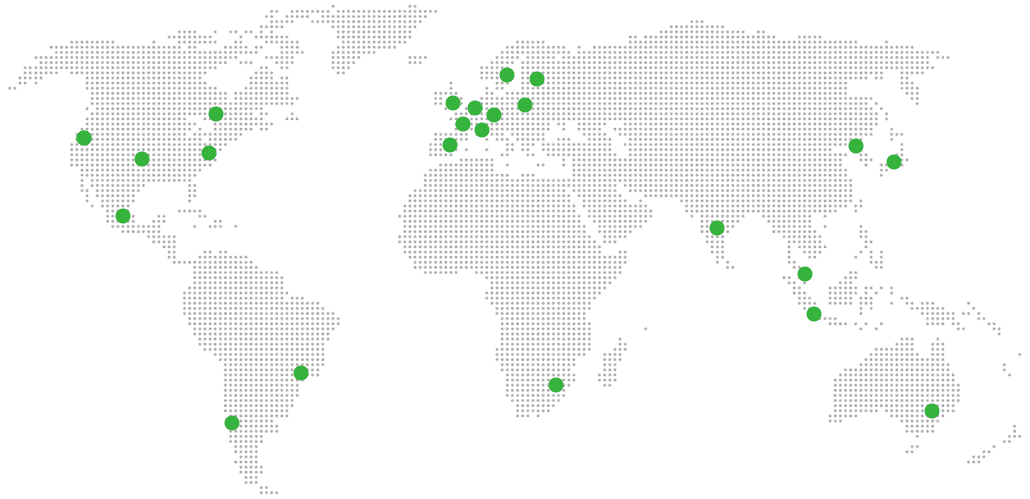
21 datacenter locations on six continents
Pick the region closest to your users.
United States, Germany, Finland, Singapore, Australia, Brazil, Canada, Netherlands, UK, Spain, Italy, France, Sweden, Malaysia, India, Japan, Mexico, Poland, South Korea, Chile, South Africa and more coming soon
Try managed Rybbit for 7 days
SERVICES
COMPANY
RESOURCES
COMPARE


