Fully Managed ReleaseBell
as a Service

Deploy ReleaseBell as a fully managed service starting at €9/mo. Get automated backups, SSL, updates, support and monitoring included.

ReleaseBell is an open-source release-notification service — it watches your starred GitHub repositories plus the GitHub and GitLab projects you add manually, and emails you when a new tag or release ships. It combines the convenience of a hosted release tracker with the data ownership and multi-user control of self-hosted software.

Free 7-day trial  99.9% Uptime SLA  No credit card  Cancel anytime

Free 7-day trial  99.9% Uptime SLA
No credit card  Cancel anytime

ReleaseBell

ReleaseBell

STARTING AT

€9/month
Automated Backups
Monitoring
Automated Updates
Auto SSL

USAGE

Unlimited
Human Support
Custom Domains
Terminal Access
File Manager Access
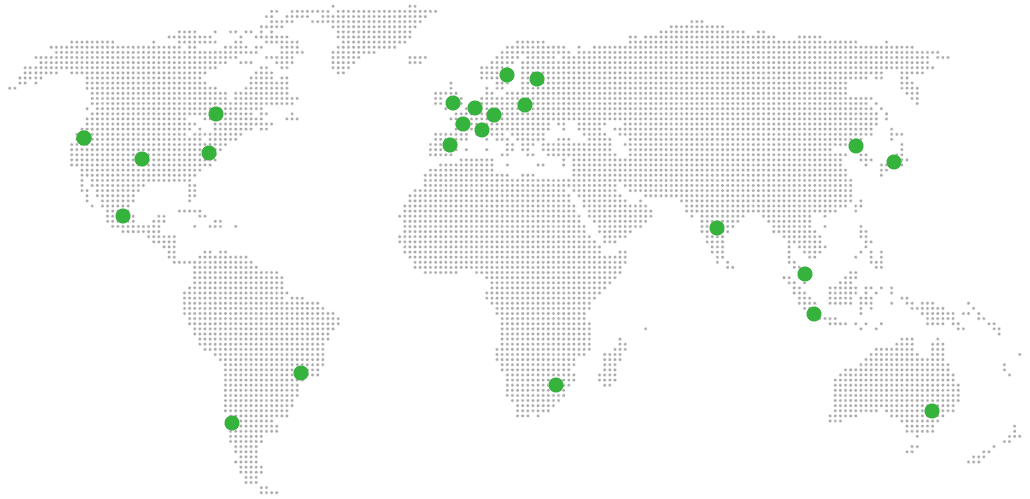
Deploy in your region 21 locations worldwide
GermanyFinlandNetherlandsUKSwedenUnited StatesCanadaSingaporeJapanAustraliaBrazilSouth Africa+9 more →
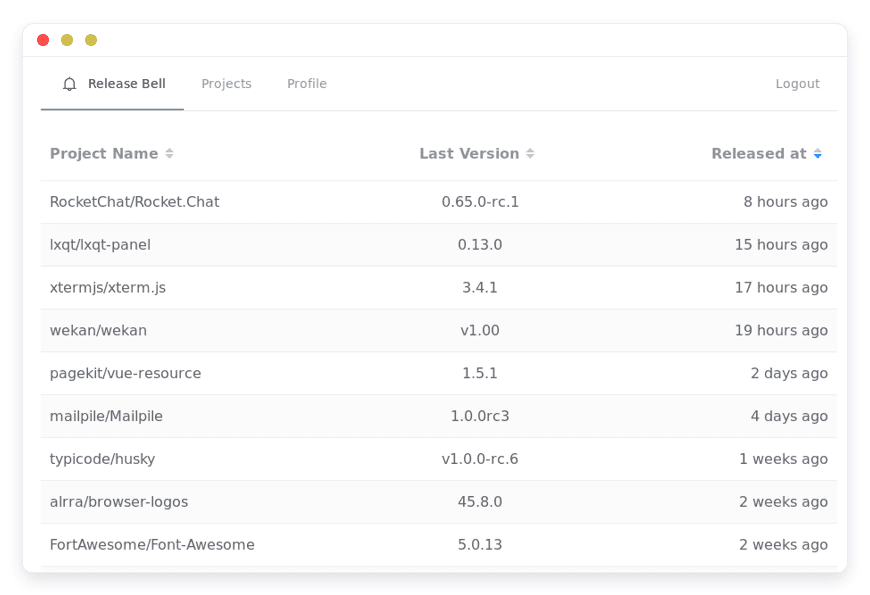
ReleaseBell Preview Image

ABOUT THE SOFTWARE

What is ReleaseBell

ReleaseBell is an open-source, self-hosted release-notification service. It watches the GitHub repositories a user has starred, plus any GitHub and GitLab projects added manually, and emails one notification per new tag or release — with the full release body included.

The project is MIT-licensed and was originally built in 2018 as a replacement for the shut-down Sibbell service. It is written in Node.js with Express on the backend, Vue 3 with PrimeVue on the frontend, MySQL for storage, and standard libraries for the GitHub REST API and outbound SMTP. The codebase is small, single-purpose, and stable — five throttle and retry fixes have been refined into the release-history since the first version shipped, which is why a multi-user ReleaseBell instance stays well under the GitHub API rate limit even at scale.

The project sits in maintenance mode — the upstream repository moved to read-only on its GitHub mirror at the same time, with the canonical source remaining on the maintainer's own Git server. That posture is honest: ReleaseBell does what it does, has a small attack surface, and does not need ongoing feature churn. We run vanilla upstream and tune only the operational layer around it.

FEATURES

What ReleaseBell does

ReleaseBell turns "I starred a project on GitHub" into a managed release inbox. Eight features describe what it actually does — no marketing slop, no inflated capability list, just the surface that ships in version 1.13.0.

GitHub starred-repo auto-sync

Connect a personal access token and ReleaseBell imports every repository you have starred. New stars are picked up on the next poll cycle.

Manual GitLab project tracking

Add GitLab projects by URL. GitLab has no equivalent of GitHub stars, so all GitLab tracking is manual-add — by design and by API constraint.

OpenID Connect single sign-on

Standard OIDC against whichever identity provider you use. Redirect handled at /api/v1/callback. Each user supplies their own personal access token after first login.

Hourly polling with rate-limit handling

Hourly poll cadence per user, serially processed, with Octokit's throttling and retry plugins enabled. Stays comfortably under the 5,000-request-per-hour authenticated GitHub limit.

Manual GitHub project tracking

Add specific GitHub repositories you have not starred. Useful for organization repos, private projects, or upstream dependencies you want to watch without committing to a star.

Per-user email notifications with release body

One email per new tag or release per project, sent to the address tied to the user's OIDC identity. The release body is included so triage does not require a click-through.

Personal access token management

Per-user PAT storage with scoped permissions. PATs are managed in the user's own settings — no admin can read another user's token. We send the 90-day rotation reminder.

Multi-user instance with isolated settings

One ReleaseBell instance serves your whole team. Each user has an isolated project list, their own PAT, and their own notification address — users do not see each other's data.

WHAT'S ALWAYS INCLUDED

Every app. Fully managed.
Nothing extra to pay for.

Every app you deploy includes the full managed service — security, backups, updates, and support from day one.

Automatic updates and patches

Apps run the latest stable version. Security patches applied silently, with rollback if needed.

Daily off-site backups

Multiple daily backups in redundant off-site locations. One-click restore if anything goes wrong.

24/7 uptime monitoring

Continuous monitoring with instant alerting. We respond before you notice.

SSL, firewall, DDoS protection

Auto-renewing SSL, hardened firewall rules, DDoS mitigation on every deployment.

Performance and scaling

We monitor resource usage continuously. When your app needs more headroom, we flag it and upgrade with your explicit approval.

Dedicated engineering support

Real engineers on chat. DNS, SMTP & migration help. All included in €9.

WHY MANAGED

Why teams pick managed ReleaseBell

Upstream moved ReleaseBell's GitHub mirror to read-only in March 2025 — the project is solid but no longer accepting new feature work. That leaves teams with a clear choice: stand up the operational layer yourself, or have us run it. The math favors us at almost every team size.

Running ReleaseBell yourself means standing up Node.js, MySQL, and an outbound SMTP path; configuring OpenID Connect against your identity provider; provisioning personal access tokens for every user and rotating them on a schedule; tuning the hourly poll behavior against the GitHub API rate limit of 5,000 requests per hour per token; and keeping the whole stack patched. None of it is hard. All of it takes time, every month, forever.

The specific gotcha worth naming: SMTP delivery. ReleaseBell ships email-only notifications — there are no built-in webhooks, no Slack integration, no Discord. That means outbound mail through your own relay or a transactional provider, with DKIM, SPF, and DMARC alignment, ongoing reputation management, and a fallback path when a notification batch lands in a spam folder. We have done this for every ReleaseBell instance we run. You will probably get it right on the second or third try; we have it set up by the time you log in.

REVIEWS

Hear from customers ​like you​​​​​​​

Successful businesses and professionals around the world rely on DANIAN every day

USE CASES

Three teams who run ReleaseBell on DANIAN

These are representative team types we set up most often. Each starts with the same flat €9 plan.

12-PERSON PLATFORM TEAM

Tracking 60 infrastructure dependencies for the patch calendar

The team watches releases across Postgres, Redis, NGINX, Traefik, Node LTS, the Go runtime, and a long list of operator charts. ReleaseBell sits in the region closest to their primary office. OIDC ties into their identity provider so PAT ownership is per-engineer. Notification email flows into a shared inbox and triggers low-severity tickets in their on-call system.

6-PERSON SECURITY TEAM

Watching CVE-relevant releases for the components in their SBOM

The team tracks OpenSSL, libcurl, the Linux kernel, Node LTS, the Go runtime, and the third-party packages their products ship. PATs are rotated on the 90-day reminder. Notification emails feed an inbound-email worker that enriches the message against the SBOM and opens a ticket when a tracked component publishes an advisory release.

SOLO OPEN-SOURCE MAINTAINER

Watching upstream changes for the 40 projects they package downstream

An independent maintainer running an alternate-package channel. They watch every upstream they repackage, in a region close to the build mirrors that produce their downstream artifacts. PAT scope is narrow — read-only against the watched repositories. Notifications feed into their packager queue and kick off the rebuild script.

COMPARISON

Four ways to run ReleaseBell

ReleaseBell is open-source software, so there are four honest ways to run it. The biggest hosted SaaS in this space is free, so the comparison turns on data control, multi-user support, custom domains, and the operational time you spend on each path — not on raw subscription cost.

 PATHCOSTWHAT YOU DOWHAT IT DOES NOT GIVE YOU
Hosted SaaS
(NewReleases.io)

Free · donation-supportedSign up with an email, paste a GitHub token, follow projects in the UI.Multi-tenant shared instance. Data stored on the provider's servers. No SSO, no custom domain, no terminal access, no control over poll cadence, no exportable database.
Self-host on a VPS
≈ $24/mo VPS
+ 3–5 hr/mo ops time
Stand up Node.js and MySQL, configure outbound SMTP, wire OIDC, run database migrations, manage PATs, tune the poll behavior.Backup pipeline, monthly patching, SSL renewal, deliverability monitoring, and on-call coverage — all yours to build and maintain.
Home server
≈ $650 one-time
+ electricity
Buy a small NAS or mini-PC, install the OS, run the container, configure your home network.Single point of failure, no off-site backup unless you build one, residential-grade reliability, hard to share with a distributed team.
DANIAN Managed
ReleaseBell
€9 / month flatPick a region from 21 locations, click deploy, sign in via OIDC, connect your GitHub PAT.Nothing. SMTP, SSL, backups, monitoring, OIDC wiring, PAT rotation reminders, and human support on chat are all included.

BY INDUSTRY

ReleaseBell for specific industries

Release tracking shows up wherever someone has to know an upstream version changed. Five team types put real demands on it — different watched lists, different downstream workflows, different operational defaults. The same ReleaseBell, configured five different ways.

Platform teams use ReleaseBell to drive their patch calendar. The watched list is usually 50–100 infrastructure dependencies — databases, caches, ingress, runtime, observability stack. Internal SRE patch SLAs typically run 30 days for non-security updates and 7 days or less for critical CVEs.

DANIAN configuration: instance in the region closest to the platform team's primary timezone, outbound SMTP routed through a transactional relay for reliable delivery into a shared inbox, OIDC tied to the company identity provider so personal-access-token ownership is per-engineer. The workflow is straightforward — ReleaseBell tags trigger an inbound-email parse into the on-call system, which opens a low-severity ticket; the on-call assesses whether the release moves the patch window.

A team tracking 50 dependencies typically receives 20–40 release notifications per month. Triage time per notification is under five minutes.
Security teams use ReleaseBell to watch CVE-relevant releases for the components in their SBOM. Internal vulnerability disclosure SLAs commonly range from 24 hours for critical advisories to 30 days for low-severity. The watched list usually mixes core runtimes (OpenSSL, libcurl, Linux kernel, Node LTS, Go) with the third-party packages the team's products ship.

DANIAN configuration: hourly poll cadence kept intact — the GitHub API budget is comfortable for the typical security-team repo list of under 100 watched projects per user. Outbound mail through a relay with DKIM alignment so high-volume notifications stay out of spam. Daily off-site backups capture the project list and the historical release log, which doubles as an evidence trail for audit-style reconstruction.

A team tracking 200 components across a product line typically sees 80–150 release notifications per month. Roughly 5–10% map to advisory updates worth opening a ticket on.
Compliance and SBOM teams use ReleaseBell as part of post-market vulnerability handling. The internal SBOM update cadence is the operational driver — when an open-source component ships a release, the team needs to know fast enough to update the manifest and trigger downstream review.

DANIAN configuration: 90-day personal-access-token rotation runbook with a calendar reminder (we send it). Daily backup of the project list provides the evidence trail for what was watched and when — useful for any internal audit. Per-container isolation keeps the SBOM watch instance separate from production systems on the security boundary. The workflow: ReleaseBell emails feed into the SBOM watch tool, get matched against the components shipped in product manifests, and kick off the post-market vulnerability handling process when the match is in-scope.

For a mid-sized product team shipping a manifest of 400–800 open-source components, ReleaseBell typically tracks the 80–120 highest-risk ones directly — the long tail is handled by the SBOM platform itself.
Maintainers and downstream packagers use ReleaseBell as the upstream watcher for their downstream channel — a Homebrew tap, a package archive, a curated build pipeline. There is no external regulation here; the operational driver is downstream-channel reputation, which depends on how quickly upstream changes propagate.

DANIAN configuration: instance in the region closest to the build mirrors used for downstream artifact production, personal access token scoped narrowly to the repositories actually being tracked, backup retention aligned to release-history needs. The workflow: upstream release notification triggers the packager's build script, which produces the new downstream package and pushes it to the channel.

A packager maintaining 40 downstream packages typically sees 60–100 upstream release notifications per month. Build kickoff is automated; manual review is the gate.
Internal platform teams use a single shared ReleaseBell instance to watch a curated approved-OSS catalog. Internal platform-engineering SLAs typically run 7–14 days behind upstream for non-security releases and 24 hours for security-bearing ones — those numbers are the metric the team publishes back to the engineering organization.

DANIAN configuration: one shared instance across the platform team rather than per-engineer instances; OIDC enforced so personal-access-token ownership is auditable; outbound SMTP delivery to the team's shared inbox. The workflow: ReleaseBell tracks the curated approved-OSS list, notifications feed into the catalog-update process, and freshness metrics are published in the internal developer portal.

A 250-engineer organization with a curated catalog of 80 approved open-source components watches the full list from one ReleaseBell instance — about 100–160 notifications a month, all in one inbox, one set of credentials, one source of truth for "what we approved and when".

FAQ

Frequently asked questions

Everything teams ask before signing up — answered straight, without sales speak.

Three groups: technical setup, migration, and how DANIAN works as a service.

01

Technical and configuration

ReleaseBell is a Node.js application using Express on the backend, Vue 3 with PrimeVue on the frontend, and MySQL for storage. It uses Octokit's REST client with throttling and retry plugins for the GitHub API, and Nodemailer for outbound email. It listens on port 3000 with a /api/v1/status health endpoint.
We run ReleaseBell with Octokit's throttling and retry plugins enabled, which is what the upstream changelog has been refining since 2018 — there are five separate throttle-related fixes in the history. Authenticated GitHub API calls are capped at 5,000 per hour per token, and ReleaseBell polls hourly, serially per user, which keeps an active multi-user instance well under the ceiling for typical repo counts.
Yes, if your personal access token carries the repo scope and your organization does not block it via SAML SSO. We recommend classic PATs over fine-grained PATs for this use case — fine-grained tokens currently have known issues authenticating against the /releases.atom endpoint that ReleaseBell relies on.
GitLab projects are supported, but only via manual add — GitLab has no equivalent of GitHub's starred-repo concept, so the auto-sync path does not exist on that side. Gogs and Gitea are not supported upstream. If you need release notifications from a self-hosted Git platform, ReleaseBell is not the right tool; reply on chat and we will recommend a better-fit app from our catalog.
No. ReleaseBell ships email-only by design — there are no built-in webhooks, no Slack integration, no Discord, no Telegram. We treat that as a feature, not a limitation. Email-only keeps the notification surface low-noise and easily routable into a ticketing inbox, a SOAR pipeline, or a chat channel via inbound-email parsing.
Yes. ReleaseBell is multi-user by design — each user logs in via OIDC, supplies their own GitHub personal access token, and gets their own list of starred and manually-tracked projects. Users do not see each other's tracked lists. Notification email goes to the address tied to the OIDC user. We provision the OIDC redirect at /api/v1/callback as part of setup.
We run the latest stable upstream version. We continue to apply security patches to the Node.js runtime, the MySQL database, and the underlying container base image on the platform-wide schedule. The application code stays vanilla upstream.
No. We run vanilla upstream. ReleaseBell is MIT-licensed; the version we run is exactly the version you would deploy yourself if you stood it up on your own infrastructure. We do tune the operational layer — backup schedule, SMTP relay, OIDC wiring, hourly poll behavior under load, PAT rotation cadence — but the application code is untouched, which keeps your data fully portable.

02

Migration and onboarding

We can activate your app on your own custom domain/subdomain. Examples: mydomain.com, anyword.mydomain.com.
Or, on our randomized free subdomain. Example: 963.apps.danian.cloud
If you wish to use a custom domain/subdomain, select that option when ordering your app (or notify us later). We will send you the required DNS records and if needed, our tech team will modify them for you.
21 datacenter locations across six continents. You choose the region at provisioning. Application data sits in the region you choose; pick whichever is closest to your users or matches your data-residency preference.
Yes. Request a region migration from the dashboard and we run the move in the background. The system emails you when the migration completes; total transfer time depends on data volume but typical instances finish in a few hours. There is no extra charge for a region change.
Yes. Full data export is available at any time, in a portable format you can bring to any infrastructure.
There is no formal NewReleases.io export endpoint, but ReleaseBell's primary signal is your GitHub stars list — which already lives in your GitHub account. Connect your personal access token and your starred projects appear automatically. Any additional projects you were tracking manually on NewReleases.io can be added in the UI in a few minutes.

03

Billing, support, and platform

€9 covers everything we do for that app: hardware in the region you choose, daily off-site backups with one-click restore, automatic security patches and version upgrades, 24/7 monitoring, SSL and firewall, and engineering support on Email/LiveChat. There are no setup fees or hidden line items. For more info see our Pricing page.
If you decide to continue, we charge €9/app/month from day 8. If you don't, the trial ends and you can export your data. No card is required for the trial, and we never auto-charge you without explicit consent.
No. The €9/month is flat regardless of how many users log into your app. Add 5 users or 50; the price doesn't change.
24/7 Live chat and email support, both staffed by engineers who run the systems. We handle DNS configuration, SMTP setup, app integrations, performance tuning, troubleshooting, and migration help. Response time is typically under an hour. There is no tier system — every customer gets the same support.
Yes. Cancel from the dashboard. We don't charge a cancellation fee, we don't lock data, and we will export your data to you on request before deletion. data to you on request before deletion.
Every customer instance is backed up daily to a separate region from the primary. We test restores. You can request a restore at any backup point within the retention window — usually 7 days for daily backups.
Your application data sits in the region you choose at provisioning — 21 datacenter locations across six continents. Account-level data (billing, account email, support ticket history) is processed centrally. Application data region is picked by you, per app.
99.9% uptime SLA on every app, every tenant. Service credits are documented at danian.co/service-level-agreement. The status page is located at status.danian.co.
When your tenant approaches the resource ceiling — the base tier holds 1 vCPU/RAM, 30 GB storage — we notify you. Resource upgrades happen with your explicit consent; we will not upgrade your tenant or charge you without it.
We wait. We don't suspend the app or delete your data on the first failed charge. We email you, you fix the card on file, and we continue.
Invoices can be downloaded from the billing dashboard in PDF the day each charge succeeds. EU VAT is added where applicable and the VAT-reverse-charge regime applies for VAT-registered businesses with a valid number.
150+ open-source apps across automation, team chat, file sync, analytics, AI, password management, email marketing, dev tools, project management, smart home, CMS, and federated social. See the full catalog →
Yes. Every instance comes with a web-based terminal and a file manager in your DANIAN management dashboard. Useful for managing your data and customizations.
Resources scale with your usage. If your app needs more vCPU, RAM, or storage, we add it — and we ask first before any change to your plan. €9 is the floor; resource-heavy workloads may price higher, but you'll always know in advance.
Yes. We have both a Partner program and an Affiliate program available. Anybody can sign up.
No contract. No minimum commitment. Cancel anytime from the dashboard with one click. The 7-day free trial requires no credit card. After the trial converts to paid, you can still cancel at any month without notice or penalty.

DEPLOY IN YOUR REGION

21 datacenter locations on six continents

Pick the region closest to your users.

United States, Germany, Finland, Singapore, Australia, Brazil, Canada, Netherlands, UK, Spain, Italy, France, Sweden, Malaysia, India, Japan, Mexico, Poland, South Korea, Chile, South Africa and more coming soon
Global Reach Map

Try managed ReleaseBell for 7 days

No card. Cancel from the dashboard.