Fully Managed Nextcloud Talk HPB
as a Service

Deploy Nextcloud Talk HPB as a fully managed service starting at €9/mo. Get automated backups, SSL, updates, support and monitoring included.

The High Performance Backend is the signaling and media layer behind Nextcloud Talk. It swaps mesh calling for central media routing, so a room holds 30 to 50 active speakers instead of the three to five a mesh call manages. It is an add-on: you need a Nextcloud server with Talk already running.

✓Free 7-day trial  ✓99.9% Uptime SLA  ✓No credit card  ✓Cancel anytime

✓Free 7-day trial  ✓99.9% Uptime SLA
✓No credit card  ✓Cancel anytime

Nextcloud Talk HPB

Nextcloud Talk HPB

STARTING AT

€9/month
Automated Backups
Monitoring
Automated Updates
Auto SSL

USAGE

Unlimited
Human Support
Custom Domains
Terminal Access
File Manager Access
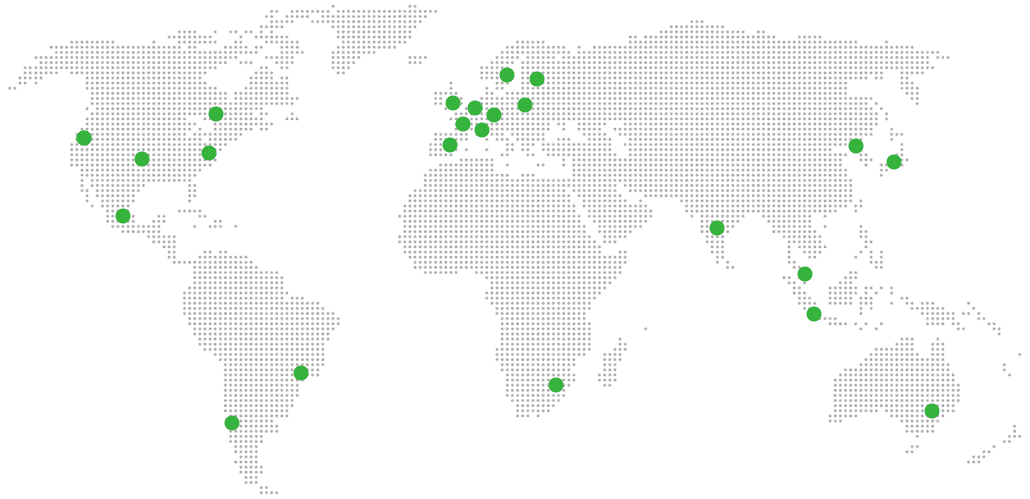
Deploy in your region — 21 locations worldwide
GermanyFinlandNetherlandsUKSwedenUnited StatesCanadaSingaporeJapanAustraliaBrazilSouth Africa+9 more →
Nextcloud Talk HPB Preview Image

ABOUT THE SOFTWARE

What is Nextcloud Talk HPB

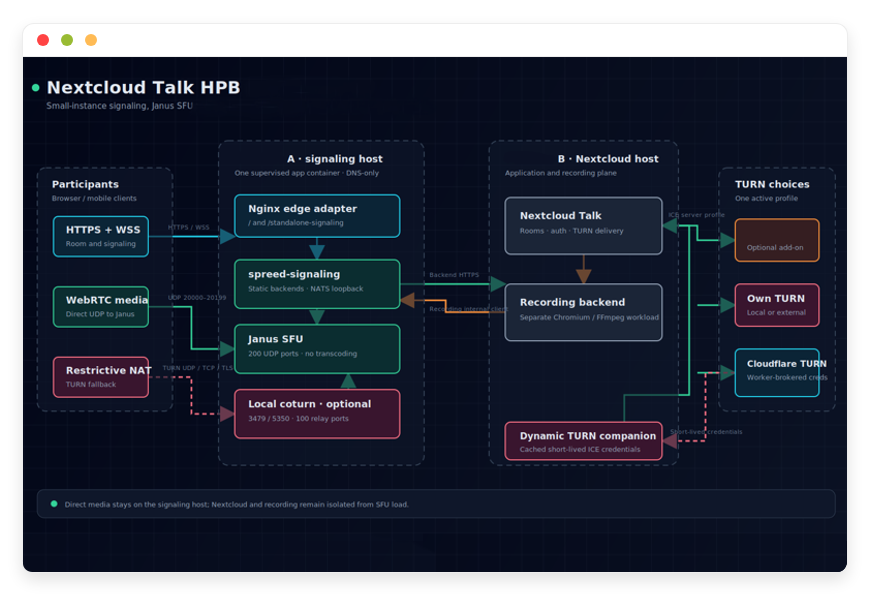
The High Performance Backend is a standalone signaling server plus a WebRTC media gateway. It sits beside Nextcloud rather than inside it, takes over call setup from Talk's built-in signaling, and routes media centrally so bandwidth stops climbing with every participant added.

The signaling server is published under AGPL-3.0 and maintained by struktur AG, the company behind the calling stack Nextcloud Talk is built on. It was opened up alongside a Talk release after several years as a subscriber-only component, and it is now free to deploy. A working deployment is really four pieces: the signaling server, the Janus media gateway running its VideoRoom plugin, NATS for passing messages between signaling instances, and a TURN relay for participants stuck behind restrictive networks.

Only signaling passes through the signaling server. Media is exchanged directly between the gateway and the clients, and gateway details are never exposed to the browser or the mobile app. The backend is wired to Nextcloud by a URL and a shared secret in Talk's admin settings, and one backend can serve several Nextcloud servers at once, with rooms kept isolated per backend entry.

FEATURES

What Nextcloud Talk HPB does

The backend does four jobs: it sets up calls, routes media, relays participants who cannot connect directly, and carries the live signals Talk needs for presence and typing. Everything below is a capability of the software itself, not of the platform it runs on.

Central media routing

Each participant publishes one stream to the gateway instead of one to every other participant, which is what lifts a room from a handful of people to dozens.

WebSocket signaling

Call setup moves off Nextcloud's built-in PHP signaling onto a dedicated persistent connection, which is faster to establish and far cheaper for the web server.

Relay for restricted networks

A STUN and TURN relay carries participants whose network blocks direct peer connections, including mobile carriers and networks doing symmetric address translation.

Multiple backends, isolated rooms

One deployment can serve several Nextcloud servers. Each is listed with its own URL and secret, and rooms belonging to one are invisible to the others.

Per-stream bitrate ceilings

Video and screen sharing carry separate configurable ceilings, so a screen-share-heavy team can be given headroom without letting every camera stream expand to match.

Live presence and typing signals

Typing indicators and other live room signals ride the backend's data channel and are not available from Talk's built-in signaling at all.

Calls between separate servers

Federated calling between two Nextcloud servers depends on both ends running a signaling server that supports it, which is what turns cross-organisation rooms into working calls.

Region hints for client routing

Geographic overrides steer clients toward the nearest available server, which matters once a single room contains people on different continents.

WHAT'S ALWAYS INCLUDED

Every app. Fully managed.
Nothing extra to pay for.

Every app on DANIAN ships with the same operational baseline. You do not choose a backup add-on or a monitoring tier. Hosting, patching, backups, SSL, and support are part of the €9, and they apply to Nextcloud Talk HPB the same way they apply to everything else in the catalog.

Automatic updates and patches

Apps run the latest stable version. Security patches applied silently, with rollback if needed.

Daily off-site backups

Multiple daily backups in redundant off-site locations. One-click restore if anything goes wrong.

24/7 uptime monitoring

Continuous monitoring with instant alerting. We respond before you notice.

SSL, firewall, DDoS protection

Auto-renewing SSL, hardened firewall rules, DDoS mitigation on every deployment.

Performance and scaling

We monitor resource usage continuously. When your app needs more headroom, we flag it and upgrade with your explicit approval.

Dedicated engineering support

Real engineers by email and ticket. DNS, SMTP & migration help. All included in €9.

WHY MANAGED

Why teams pick managed Nextcloud Talk HPB

Public bodies are moving off SharePoint and Teams, and Microsoft has raised list prices on its business tiers. Once files and chat are self-hosted, video is the last piece still pointing at a proprietary vendor. The backend is what makes that last piece hold more than five people.

Running the backend is not one service. It is a signaling server, a media gateway, a message bus and a relay, each with its own configuration file, its own release cadence and its own failure signature. The pieces are version-coupled in ways that are not obvious from the outside, and the failure mode when they drift is not a crash. It is a call that connects, shows both participants, and never carries a word.

Two examples people hit repeatedly. Build the signaling server from source without the correct version flags and it reports its version as unknown, at which point Talk either refuses it or declares that the server needs updating, with nothing in the logs pointing at the real cause. Separately, the media gateway has shipped a data-channel label change between major lines: the signaling connection looks healthy, the room opens, and the messages that ride the data channel simply never arrive. Neither is hard to fix once you know. Both cost an evening the first time.

What we ship by default is the boring version of all of that. The media gateway is pinned to a release the signaling server has been tested against. The backend allowlist is closed rather than open, so a Nextcloud server has to be named with its own secret before it can connect. Relay is offered over TLS on 443 alongside the usual UDP port, because plenty of corporate and hospital networks permit nothing else. And the gateway's event handler is capped on reconnect, so a broken link to the signaling server produces a reconnect rather than unbounded memory growth until something gets killed.

Media gateway pinned to a signaling-server-tested release

Closed backend allowlist, one secret per Nextcloud server

Relay offered over TLS on 443 as well as UDP

Queued gateway events capped at reconnect

Signaling WebSocket endpoint monitored, not just the port

REVIEWS

Hear from customers ​like you​​​​​​​

Successful businesses and professionals around the world rely on DANIAN every day

USE CASES

Three teams who run Nextcloud Talk HPB on DANIAN

Three shapes of team account for most of the demand for this backend: one outgrowing mesh calling, one that cannot record, and one running more than a single Nextcloud server. Each pushes on a different part of the configuration.

40-PERSON ARCHITECTURE PRACTICE

Design reviews that mesh calling could not hold

Weekly reviews put twelve people in a room with a drawing on screen. Mesh calling broke down past the fifth participant. The screen-share ceiling is raised above its default so linework and dimension text stay legible, while camera streams stay capped.

WORKS COUNCIL, 900-STAFF MANUFACTURER

Sixty site representatives, nothing recorded

Monthly sessions run with roughly sixty representatives joining from plant networks that permit very little outbound traffic. Relay runs over TLS on 443 so those joins succeed. The recording component is deliberately not deployed at all.

RESEARCH NETWORK, THREE NEXTCLOUD SERVERS

One backend behind three separate institutions

Three institutions keep their own Nextcloud servers and their own user directories. One backend serves all three, listed as three entries with three secrets against a closed allowlist, so no room from one institution is reachable from another.

COMPARISON

Four ways to run Nextcloud Talk HPB

Video is the workload where the four paths diverge hardest, because the cost is not only money. It is upstream bandwidth. A central gateway sends every stream out again to every other participant, which is exactly what a home connection cannot do.

Path1 user5 users10 usersWhat it costs beyond money
Proprietary SaaS (Zoom Workplace Pro)$14.16/mo$70.80/mo$141.60/moPriced per host, not per attendee. Free tier caps group meetings at 40 minutes. Recordings and rooms live on the vendor's platform, under the vendor's rules.
Self-host on a VPS~$40/mo~$40/mo~$40/moFour cores and 8 GB is the documented floor. You own gateway version pinning, relay configuration, certificate renewal and the memory behaviour of a broken event link. Budget ongoing hours, not a one-off setup.
Home server (HP ProLiant ML30 Gen10)~$900 once~$900 once~$900 onceHardware is not the wall. Upstream is. A ten-person room asks the gateway for roughly 90 Mbit/s outbound at default bitrates, which most domestic uplinks cannot supply.
DANIAN managed Nextcloud Talk HPBEUR 9/moEUR 9/moEUR 9/moFlat, regardless of how many people join. Gateway pinning, relay over TLS on 443, closed allowlist and endpoint monitoring are the defaults, not an upgrade.

The row that decides most cases is not the price column. Paths one and four both hand you a working call. Paths two and three hand you a project whose first bad evening arrives the week a gateway release and a signaling release disagree. The difference between path one and path four is where the room lives and who sets the rules about what is kept.

BY INDUSTRY

Nextcloud Talk HPB for specific industries

These four are on the page because each puts a named constraint on video, not because they are large markets. In every one of them the interesting configuration decision is about what the backend is told not to do.

German practices work under section 43e BRAO, which governs how outside IT providers may handle confidential client material, alongside the professional-secrecy duty in section 203 StGB. The configuration decision follows directly: the recording component is not deployed, so no call artefact is written anywhere on the platform and there is nothing to hand over or delete later. Relay runs over TLS on 443, which matters because opposing counsel and court-appointed experts routinely join from corporate networks that allow outbound traffic on ports 80 and 443 and nothing else. A typical hearing preparation puts a partner, two associates, a client and an external expert in one room, five active streams that mesh calling handles badly and central routing handles without comment.


Section 203 StGB names doctors and hospitals explicitly among the professions whose patient material carries a criminal-law secrecy duty, which is why routing case discussions through a consumer video product is a poor idea regardless of what the product's marketing says. Recording stays off unless a practice asks for it and confirms its own consent process. Hospital networks are among the most restrictive in ordinary use, so relay over TLS on 443 is the default rather than an escalation. A multidisciplinary case conference with twelve clinicians, several joining from different sites, sits comfortably inside the 30 to 50 active participants central routing supports, and nowhere near what mesh calling can carry.


Section 87 paragraph 1 number 6 of the Betriebsverfassungsgesetz gives a works council co-determination rights over technical systems capable of monitoring employee behaviour or performance, and section 201 StGB makes recording the spoken word without consent a criminal matter. Both point the same way, so the recording component is left undeployed and its absence is a fact the council can verify rather than a promise. Sessions with sixty site representatives are ordinary, well inside the passive-participant capacity central routing provides, and joins from plant networks succeed because relay is offered over TLS on 443.


Examination regulations at most institutions require that oral examinations proceed without recording, and section 201 StGB makes consent a legal question rather than an interface toggle. The recording component is therefore not deployed for examination workloads, while the screen-share ceiling is raised for seminar rooms where slides and code are the content. Research networks tend to arrive with several institutions and several servers: one Dutch cooperative offers 30 institutions a Nextcloud workspace including video calls, used by between 1,500 and 2,000 people. A single backend serving three or four member institutions with isolated rooms is the same pattern at a smaller scale.


FAQ

Frequently asked questions

Three groups below. The first covers how the backend behaves and how we configure it, the second covers moving an existing Nextcloud onto it, and the third covers billing, support and how the platform works regardless of which app you run.

01

Technical and configuration

Not for small calls. Nextcloud Talk works without it by connecting participants directly to each other, but each person then sends a stream to every other person, so bandwidth climbs with every join. Three to five participants is the practical ceiling on ordinary connections.
Yes. The signaling server takes a list of backends, each with its own URL and shared secret, and keeps rooms isolated between them. We run that allowlist closed rather than open, so a Nextcloud server has to be named in the configuration before it is allowed to connect at all.
We pin the gateway to a release the signaling server has been tested against. The two projects have shipped a data-channel label change between major lines that breaks call features silently: the room opens, the connection looks healthy, and messages never arrive. Pinning is cheaper than debugging that.
None for the backend itself. Your Nextcloud server needs only outbound HTTPS to reach it, and participants connect to the relay on our side rather than yours. On locked-down corporate networks, relay over TLS on 443 is what keeps a call up when nothing else gets out.
Yes. It answers on its own subdomain with its own certificate, and that address is what goes into Talk's external signaling field. Sharing a hostname with Nextcloud creates reverse-proxy conflicts on the WebSocket upgrade path, which is a tedious thing to debug later.
Chat, files, calendars and everything else keep working, because none of them touch it. Calls fall back to built-in signaling, which means direct connections, which means small calls only. We monitor the signaling WebSocket endpoint itself rather than trusting that an open port means a working service.
No. Recording needs a separate recording server running alongside the backend, and in several countries recording a conversation without everyone's consent is a criminal matter rather than a settings question. We deploy it when a customer asks for it and confirms how consent is handled.
The gateway queues events it cannot deliver. Left unbounded, a broken link turns into steady memory growth until the process is killed under pressure. We cap queued events at reconnect, so the failure stays a reconnect instead of becoming an outage.
Camera streams are capped near 1 Mbit per second and screen sharing near 2 Mbit per second by default. We raise the screen-share ceiling for teams doing design review or code review, where the default makes small text mushy and the call becomes useless for its actual purpose.

02

Migration and onboarding

21 datacenter locations across six continents. You choose the region at provisioning. Application data sits in the region you choose; pick whichever is closest to your users or matches your data-residency preference.
Yes. Request a region migration from the dashboard and we run the move in the background. The system emails you when the migration completes; total transfer time depends on data volume but typical instances finish in a few hours. There is no extra charge for a region change.
Yes. Full data export is available at any time, in a portable format you can bring to any infrastructure.
Two fields in Talk's admin settings: the backend URL and the shared secret. Talk switches from internal to external signaling as soon as it validates them. No data moves, no rooms are recreated, and no client update is required for it to take effect.
Yes. The backend does not care who hosts the Nextcloud server it serves, as long as that server is reachable over HTTPS and its URL is on the allowlist with a matching secret. Hosting the two in the same region does reduce the round trip on call setup.
The change on your side is two fields. Ahead of it sit DNS for the backend hostname and the certificate that follows. Calls in progress reconnect when the setting flips, so it is worth picking a quiet slot rather than doing it mid-meeting.
No. The Talk mobile clients read signaling settings from the server they log in to, so they pick up central media routing on the next call without anyone touching a phone. The same applies to desktop clients and browsers.
Yes. Point a staging Nextcloud at the backend as its own entry with its own secret. Because rooms are isolated per backend entry, a staging server cannot see production rooms, and a mistake in test configuration cannot affect live calls.
Add them to the backend list with their own secrets. Rooms stay separate per entry. Calls federated between two servers additionally require both ends to be running a signaling server that supports federation, which is worth checking before promising it to anyone.

03

Billing, support, and platform

€9 covers everything we do for that app: hardware in the region you choose, daily off-site backups with one-click restore, automatic security patches and version upgrades, 24/7 monitoring, SSL and firewall, and engineering support on email and the ticket section in the client portal. There are no setup fees or hidden line items. For more info see our Pricing page.
If you decide to continue, we charge €9/app/month from day 8. If you don't, the trial ends and you can export your data. No card is required for the trial, and we never auto-charge you without explicit consent.
No. The €9/month is flat regardless of how many users log into your app. Add 5 users or 50; the price doesn't change.
24/7 email and ticket support, both staffed by engineers who run the systems. We handle DNS configuration, SMTP setup, app integrations, performance tuning, troubleshooting, and migration help. Response time is typically under an hour. There is no tier system — every customer gets the same support.
Yes. Cancel from the dashboard. We don't charge a cancellation fee, we don't lock data, and we will export your data to you on request before deletion. data to you on request before deletion.
Every customer instance is backed up daily to a separate region from the primary. We test restores. You can request a restore at any backup point within the retention window — usually 7 days for daily backups.
Your application data sits in the region you choose at provisioning — 21 datacenter locations across six continents. Account-level data (billing, account email, support ticket history) is processed centrally. Application data region is picked by you, per app.
99.9% uptime SLA on every app, every tenant. Service credits are documented at danian.co/service-level-agreement. The status page is located at status.danian.co.
When your tenant approaches the resource ceiling — the base tier holds 1 vCPU/RAM, 30 GB storage — we notify you. Resource upgrades happen with your explicit consent; we will not upgrade your tenant or charge you without it.
We wait. We don't suspend the app or delete your data on the first failed charge. We email you, you fix the card on file, and we continue.
Invoices can be downloaded from the billing dashboard in PDF the day each charge succeeds. EU VAT is added where applicable and the VAT-reverse-charge regime applies for VAT-registered businesses with a valid number.
150+ open-source apps across automation, team chat, file sync, analytics, AI, password management, email marketing, dev tools, project management, smart home, CMS, and federated social. See the full catalog →
Yes. Every instance comes with a web-based terminal and a file manager in your DANIAN management dashboard. Useful for managing your data and customizations.
Resources scale with your usage. If your app needs more vCPU, RAM, or storage, we add it — and we ask first before any change to your plan. €9 is the floor; resource-heavy workloads may price higher, but you'll always know in advance.
Yes. We have both a Partner program and an Affiliate program available. Anybody can sign up.
No contract. No minimum commitment. Cancel anytime from the dashboard with one click. The 7-day free trial requires no credit card. After the trial converts to paid, you can still cancel at any month without notice or penalty.

DEPLOY IN YOUR REGION

21 datacenter locations on six continents

Pick the region closest to your users.

United States, Germany, Finland, Singapore, Australia, Brazil, Canada, Netherlands, UK, Spain, Italy, France, Sweden, Malaysia, India, Japan, Mexico, Poland, South Korea, Chile, South Africa and more coming soon
Global Reach Map

Try managed Nextcloud Talk HPB for 7 days

No card. Cancel from the dashboard.