Fully Managed Miniflux
as a Service

Deploy Miniflux as a fully managed service starting at €9/mo. Get automated backups, SSL, updates, support and monitoring included.

Miniflux is an open-source feed reader — RSS, Atom, JSON Feed, and YouTube subscriptions — combining the convenience of Feedly with the security and control of self-hosted infrastructure. The project is written in Go by Frédéric Guillot, released under the Apache 2.0 license, and runs as a single binary against PostgreSQL.

Free 7-day trial  99.9% Uptime SLA  No credit card  Cancel anytime

Free 7-day trial  99.9% Uptime SLA
No credit card  Cancel anytime

Miniflux

Miniflux

STARTING AT

€9/month
Automated Backups
Monitoring
Automated Updates
Auto SSL

USAGE

Unlimited
Human Support
Custom Domains
Terminal Access
File Manager Access
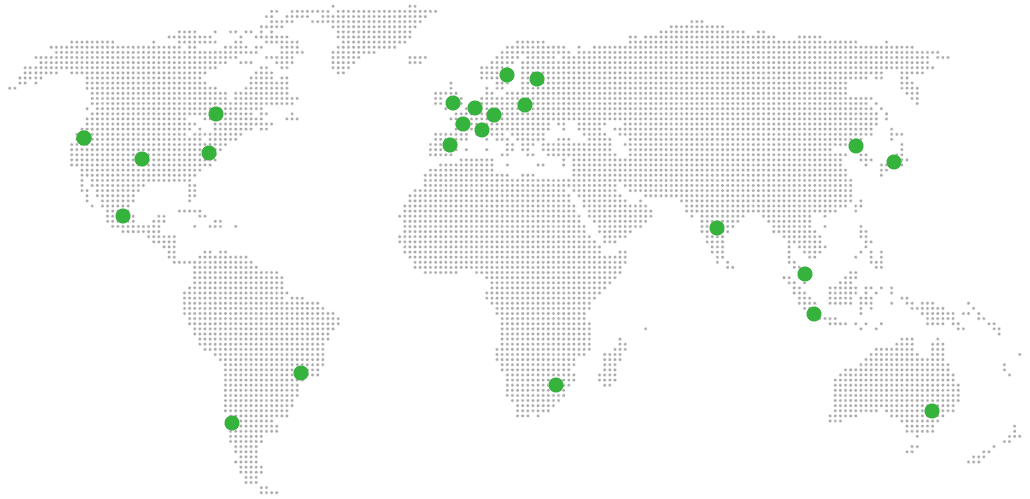
Deploy in your region 21 locations worldwide
GermanyFinlandNetherlandsUKSwedenUnited StatesCanadaSingaporeJapanAustraliaBrazilSouth Africa+9 more →
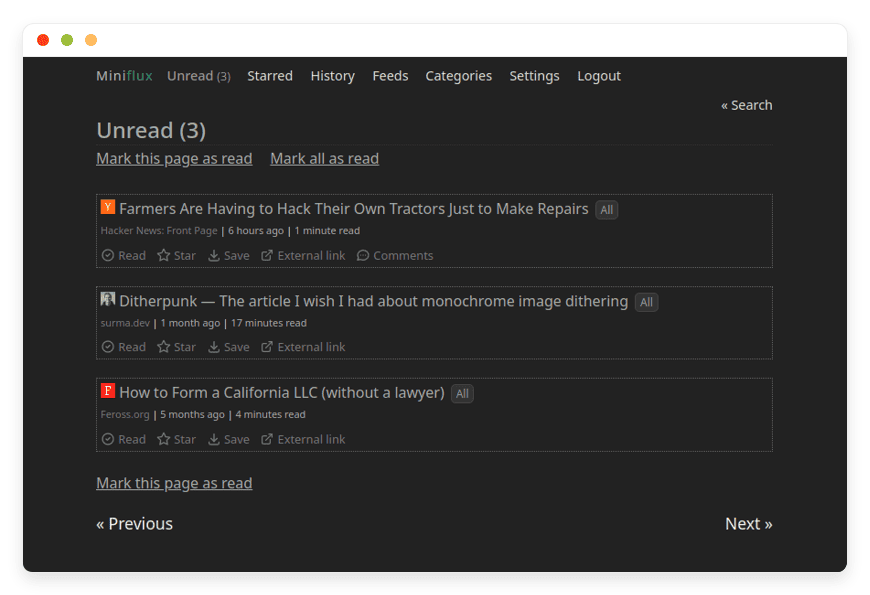
Miniflux Preview Image

ABOUT THE SOFTWARE

What is Miniflux

Miniflux is a minimalist, opinionated, self-hosted feed reader written in Go and released by Frédéric Guillot under the Apache 2.0 license. It speaks RSS, Atom, RDF, and JSON Feed, handles YouTube channels and podcasts as enclosures, and exposes a JSON REST API plus Fever and Google Reader compatibility shims.

The repository on GitHub holds 9,200+ stars across 283 contributors and 2,700+ commits to main, with monthly releases since the v2 Go rewrite shipped in 2018. The single statically linked binary measures around 7 MB; idle memory sits at 5–20 MB; the typical 100-feed deployment uses about 70 MB once PostgreSQL is included.

Unlike most self-hosted readers, Miniflux supports only PostgreSQL — full-text search depends on the tsvector type and the project has consistently declined SQLite and MySQL backends to keep the search behaviour predictable. The binary follows the Twelve-Factor App pattern: no local filesystem state, configuration via environment variables, a metrics endpoint for Prometheus, and structured JSON logs.

FEATURES

What Miniflux does

Miniflux fetches feeds in RSS, Atom, RDF, and JSON Feed; turns YouTube channels and podcasts into readable timelines; extracts full-text content with 59 predefined scraper rules; filters with Go regex; integrates with 25+ read-later and bookmarking services; and exposes everything through a JSON REST API and two compatibility shims for mobile clients.

Multi-format feed support

Subscribes to RSS, Atom, RDF, and JSON Feed sources; YouTube channels via youtube.com/feeds/videos.xml; podcasts and video enclosures via standard RSS extensions.

OIDC SSO and passkeys

WebAuthn-only first-factor login as of release 2.3.0. Generic OIDC via OAUTH2_PROVIDER="oidc" with documented recipes for Authentik, Authelia, Keycloak, Zitadel, and Kanidm.

Regex-based filtering rules

Block and keep lists use Go RE2 syntax. Filters apply globally or per-feed; entry-date conditions limit to recent items; future-dated entries can be auto-ignored.

Notification dispatch

Apprise, Ntfy, Pushover, Slack, Matrix, Telegram, and Discord targets fire on save_entry webhook events. Each tenant configures its own destinations from the integrations panel.

Full-text content extraction

Fetches the original article when a feed only ships a summary. 59 predefined CSS-selector rules ship in the binary; custom rules go per-feed via the settings UI.

Mobile-client compatibility

JSON REST API at /v1/, a read-only Fever API for older clients, and a Google Reader API shim used by NetNewsWire, Reeder Classic 5, and Fiery Feeds.

25+ save-to integrations

Wallabag, Readwise Reader, Linkding, Linkwarden, Shiori, Readeck, Cubox, Notion, Pinboard, Raindrop, Instapaper, Archive.org snapshot, and Karakeep reach from the entry action menu.

Built-in media proxy

Optionally proxies images, audio, and video through Miniflux to enforce HTTPS, defeat referrer leakage, and strip tracking pixels embedded in newsletter and ad-network feeds.

WHAT'S ALWAYS INCLUDED

Every app. Fully managed.
Nothing extra to pay for.

Every app you deploy includes the full managed service — security, backups, updates, and support from day one.

Automatic updates and patches

Apps run the latest stable version. Security patches applied silently, with rollback if needed.

Daily off-site backups

Multiple daily backups in redundant off-site locations. One-click restore if anything goes wrong.

24/7 uptime monitoring

Continuous monitoring with instant alerting. We respond before you notice.

SSL, firewall, DDoS protection

Auto-renewing SSL, hardened firewall rules, DDoS mitigation on every deployment.

Performance and scaling

We monitor resource usage continuously. When your app needs more headroom, we flag it and upgrade with your explicit approval.

Dedicated engineering support

Real engineers on chat. DNS, SMTP & migration help. All included in €9.

WHY MANAGED

Why teams pick managed Miniflux

On July 8, 2025, Mozilla shut down Pocket — a product with more than 10 million users. Miniflux 2.2.10 removed its Pocket integration in direct response. Every former Pocket user looking for a durable, self-controlled read-later workflow needs a new feed reader, and Miniflux is the natural destination.

Running Miniflux yourself sounds simple. The binary is 7 MB, the database is one Postgres instance, and the docs are 12 pages long. What does not fit on those 12 pages is the operational discipline: monthly security advisories from the maintainer (three in the year ending May 2026 — GHSA-cq88-842x-2jhp, GHSA-wqv2-4wpg-8hc9, GHSA-xwh2-742g-w3wp), regular PostgreSQL maintenance, off-site backup verification, and the certificate rotation cycle for whatever subdomain you point at it.

There is a specific gotcha worth naming. Miniflux runs on Go's net/http client, which has a TLS fingerprint that Cloudflare, Reddit's edge, and a growing list of publishers — Heise, FierceBiotech, ExtremeTech, the Bundesregierung press page — actively block. The maintainer acknowledges it in upstream discussion #3306, and feature request #3811 is the long-running effort to register Miniflux as a Verified Bot. Until that ships, every blocked feed needs a per-feed User-Agent override, an HTTP/2 disable, or a proxy hop. A solo operator does this manually. A managed service does it once for everyone.

REVIEWS

Hear from customers ​like you​​​​​​​

Successful businesses and professionals around the world rely on DANIAN every day

USE CASES

Three teams who run Miniflux on DANIAN

These are representative team types we set up most often. Each starts with the same flat €9 plan.

10-PERSON INVESTIGATIVE NEWSROOM

Ten reporters, 600 feeds, zero third-party telemetry

An eight-reporter newsroom plus two editors, running Miniflux in the EU region. Around 600 feeds: court filings, regulator press rooms, freelance Substacks, beat-source blogs. OIDC tied to the newsroom Okta tenant. Per-feed User-Agent overrides on Cloudflare-fronted publishers. Webhooks fire into a Slack #breaking channel on keyword-keep matches. Reeder Classic 5 on phones via the Google Reader API.

12-PERSON CYBERSECURITY SOC

CVSS ≥7 advisories routed in under 15 minutes

A 12-analyst managed-security operations team tracking 250 sources: NVD, CISA KEV, vendor PSIRTs, GitHub Security Advisories, researcher blogs. 5-minute polling interval. Keep-list regex on CVE and CVSS terms. Webhook fires Ntfy push to on-call. Volume runs at 10,000 entries per day; PostgreSQL grows about 1 GB per year. US region; OIDC via Okta with WebAuthn enforced.

6-PERSON COMPETITIVE INTELLIGENCE AGENCY

Six strategists, 30 client brands, 1,200 feeds

A boutique agency: five strategists plus a director tracking ~30 client brands across news, regulators, conference proceedings. 1,200 feeds at 15-minute polling, entry-frequency scheduler so consumer news samples hourly and quarterly reports daily. Per-client regex filters route mentions to Readwise Reader for client-deliverable capture. Feedly Teams equivalent: $1,296/year. DANIAN tenant: €108/year.

COMPARISON

Four ways to run Miniflux

The honest comparison for Miniflux is against Feedly, which sits at $72 per user per year on the Pro tier and $99 on Pro+. Self-hosting on a VPS or home server is workable, but each adds operational hours the per-seat math rarely accounts for.

 PATHAT 1 USERAT 5 USERSAT 10 USERSWHAT'S ACTUALLY INVOLVED
Feedly Pro
Proprietary SaaS
$72 / yr$360 / yr$720 / yrLinear per-seat scaling. 1,000 sources per user on Pro. AI features gated behind Pro+ at $99/yr/user. No API on the Pro tier. Feedly Teams is $18 per user per month for shared boards.
Self-host on a VPS
$24/mo production-class VPS
€100–280 / mo€100–280 / mo€100–280 / mo
+ DB tuning
$24/mo for a 2 vCPU / 4 GB production-class VPS, $5/mo for object-storage backup, $15/mo for production-grade monitoring, plus 1–2 hours per month of operational work at a €60–120/hr freelance sysadmin rate.
Home server
Synology DS923+ or equivalent
€210–667 / mo€210–667 / mo€210–667 / moSynology DS923+ hardware around €650 amortised over 36 months, 80–150 W electricity at €0.30/kWh, €40–80/mo for business-grade internet with a static IP, €10–20/mo for an off-site backup target, plus 2–4 hours of monthly operational work.
DANIAN Managed Miniflux€9 / month€9 / month€9 / monthOne flat price for the tenant. Add as many Miniflux users as you want inside it. Patching, backups, monitoring, certificate rotation, OIDC, and human support all included. Zero operational hours per month on your side.

BY INDUSTRY

Miniflux for specific industries

Five industries put distinct demands on a feed reader: cybersecurity wants sub-15-minute latency on vulnerability feeds; newsrooms want zero telemetry leakage; legal teams want SEC EDGAR with keep-list filtering and seven-year retention; academic researchers want adaptive scheduling for slow journal cadences; financial services want regulator-feed staleness alerting.

Cybersecurity teams use feed readers as the front end of their threat-intelligence pipeline. The operational reference is NIST SP 800-53 Rev. 5 control CA-7 (Continuous Monitoring) and the vulnerability-management control families that govern enterprise security programmes. The data sources are NVD 2.0 API, CISA KEV, MITRE CVE List v5, GitHub Security Advisories, vendor PSIRTs from Microsoft MSRC, Cisco, VMware, and Atlassian, plus the free filtered CVE feed at cve.assurestart.co.

DANIAN defaults for SOC tenants: 5-minute polling interval, WebAuthn-only first-factor, OIDC via Okta or Azure AD, Prometheus metrics scraped by Grafana, retention extended to 365 days for incident-response audit trails. A typical SOC tenant ingests 10,000 entries per day; PostgreSQL grows by roughly 1 GB per year. Webhook fires Ntfy push to on-call when keep-list regex matches CVSS ≥7 or a watched product family.
Newsrooms run feed readers as source-protection infrastructure. Source-diversity logging, zero third-party telemetry, and no vendor data exfiltration are the table stakes. Operational standards reference the Reporters Committee for Freedom of the Press source-protection guidance and the data-minimization discipline embedded in European data-protection law.

DANIAN defaults for newsrooms: EU region with the choice of Germany, Finland, Netherlands, or others; OIDC tied to the newsroom Okta or Google Workspace tenant; rotated HTTP_CLIENT_USER_AGENT to defeat publisher Cloudflare fingerprinting; CSS-selector scraper rules per beat-source blog; webhook to a Slack #breaking channel on regulator-keyword matches. A typical newsroom tenant runs around 600 feeds — court filings, regulator press rooms, freelance Substacks — at 3,000 entries per day, with seven-year retention for editorial audit. The URL strip removes utm_*, fbclid, and similar tracking parameters before storage.
Law firms use feed readers as the regulatory-tracking arm of their practice. The SEC EDGAR 8-K feed at sec.gov/cgi-bin/browse-edgar publishes roughly 700 filings per business day across the entire US market. With a 200-ticker client portfolio and a keep-list regex on company names and CIK numbers, around 30 filings per day route to assigned attorneys.

The operational reference is ABA Model Rule 1.1 Comment 8 on technology competence and the seven-year retention many state bars expect for client-related communications. DANIAN defaults for legal tenants: US region for proximity to EDGAR, retention extended to 2,555 days for litigation hold, WebAuthn-only enforced for partner-level access, per-feed scraper rules on EDGAR XBRL exhibits, webhook to a Linkding instance for client-matter file capture, and quarterly compliance reports generated from the Prometheus metrics endpoint.
University labs and research groups use feed readers to keep up with preprint servers and journal RSS. arXiv set a monthly submission record of 24,226 papers in October 2024, with Computer Science the leading subject — cs.LG, cs.CV, and cs.CL together exceeded 6,000 submissions in that one month. A 50-feed scholar setup across arXiv, bioRxiv, medRxiv, PubMed E-utilities, and Crossref yields several thousand abstracts per day before filtering.

DANIAN defaults for academic tenants: entry-frequency scheduler with the maximum interval raised to 4,800 minutes for slow journal cadences, full-text fetch enabled, retention extended to five years for grant audit, Readwise Reader webhook on star to capture highlights, ORCID profile field exposed, and OIDC tied to the university's Shibboleth or SAML-via-OIDC bridge. Custom CSS selectors handle non-standard journal feeds that ship only abstracts.
Buy-side desks and equity research teams use feed readers as the alpha-capture arm of their workflow. The retention reference is MiFID II Article 16(7) — five years on communications, often extended to seven internally — alongside FINRA Rule 3110 on supervisory record retention. Sources include SEC EDGAR firehoses for 8-K, 10-K, and 10-Q filings, central-bank RSS from the FOMC, ECB, and Bank of Japan, the Federal Reserve Beige Book, and licensed Reuters or Bloomberg feeds.

DANIAN defaults: lowest-latency region for the trading desk, 5-minute polling, Prometheus alerting on feed staleness exceeding ten minutes, encrypted-at-rest PostgreSQL, immutable audit log of feed-add and rule-change events. A 400-feed buy-side tenant ingests around 12,000 entries per day. Rule-based webhooks route regulator filings to the internal alpha-capture tool inside the sub-15-minute SLA the desk operates against.

FAQ

Frequently asked questions

Everything teams ask before signing up — answered straight, without sales speak.

Three groups: technical setup, migration, and how DANIAN works as a service.

01

Technical and configuration

The full-text search depends on PostgreSQL's tsvector type. The maintainer has consistently declined SQLite and MySQL backends to keep the search predictable. Release 2.2.14 removed the long-standing hstore dependency, so the schema is now plain Postgres tables with no extensions required at install time.
We run the entry-frequency scheduler with a 5-minute floor and a 4,800-minute ceiling, 32 worker threads, 250-feed batches, a per-host concurrency limit of 4, and a 30 MB body size cap. The defaults sit between the upstream documentation values and what we have measured under multi-tenant load over the past 14 months.
Yes. Subscribe to https://www.youtube.com/feeds/videos.xml?channel_id=CHANNEL_ID. Release 2.2.15 added separate feed types for channels, videos-only, shorts, and live streams. Setting FETCH_YOUTUBE_WATCH_TIME="1" uses video duration as reading time. A custom Invidious instance can replace YouTube's edge via the INVIDIOUS_INSTANCE environment variable.
YouTube occasionally returns 404 to Miniflux's User-Agent. The default POLLING_PARSING_ERROR_LIMIT is 3, which is enough to trigger disabling. We raise it to 10 on every DANIAN tenant by default and offer a one-click Invidious proxy toggle if the issue persists. Upstream tracks this as issue #4261.
Yes. Miniflux ships a Google Reader API shim plus a read-only Fever API. NetNewsWire connects via the FreshRSS account type using your DANIAN custom domain (no trailing slash). Reeder Classic 5 connects as a Reader account. Fiery Feeds and RSS Guard support both shims.
Toggle "Fetch original content" per feed. Miniflux ships 59 predefined CSS-selector scraper rules in internal/reader/scraper/rules.go covering Ars Technica, The Verge, and others. Custom rules go in feed settings; URL rewrites use the @@@ separator, for example ^(.+\.html).*$@@@$1?seite=all for printer-friendly versions.
Miniflux uses Go RE2 regex, not a Bayesian classifier. Block and keep rules apply globally or per-feed. Common patterns: EntryTitle=(?i)\b(deals?|sponsored)\b to ignore listicles, EntryDate=max-age:7d to limit to the past week, EntryDate=future to filter out time-shifted publishing.
We monitor the upstream security advisory page and the maintainer's GitHub Security tab. Three advisories shipped in the year ending May 2026: GHSA-cq88-842x-2jhp (April 3, 2025), GHSA-wqv2-4wpg-8hc9 (December 10, 2025), and GHSA-xwh2-742g-w3wp (January 7, 2026). We patched within 24 hours of each release and emailed every affected tenant the same business day.

02

Migration and onboarding

We can activate your app on your own custom domain/subdomain. Examples: mydomain.com, anyword.mydomain.com.
Or, on our randomized free subdomain. Example: 963.apps.danian.cloud
If you wish to use a custom domain/subdomain, select that option when ordering your app (or notify us later). We will send you the required DNS records and if needed, our tech team will modify them for you.
21 datacenter locations across six continents. You choose the region at provisioning. Application data sits in the region you choose; pick whichever is closest to your users or matches your data-residency preference.
Yes. Request a region migration from the dashboard and we run the move in the background. The system emails you when the migration completes; total transfer time depends on data volume but typical instances finish in a few hours. There is no extra charge for a region change.
Yes. Full data export is available at any time, in a portable format you can bring to any infrastructure.
Export your Feedly OPML from the Feedly settings → Organize → Export OPML. In Miniflux, go to Feeds → Import → Choose File. Folder structure converts to Miniflux categories. Feedly Boards, Highlights, and per-feed rules do not survive — only feed URLs and folder structure transfer.
Yes. Both ship OPML export. Read-status does not transfer; star-status does not transfer. Tiny Tiny RSS users sometimes also bring custom themes — those are not portable to Miniflux.
Yes. NetNewsWire, Reeder Classic 5, Fiery Feeds, Lire, Unread, and RSS Guard all reconnect by editing the account URL to your new DANIAN domain. The Fever and Google Reader API endpoints stay at /fever/ and /reader/api/0/ respectively. Existing read-status survives only if you migrate via pg_dump rather than OPML.

03

Billing, support, and platform

€9 covers everything we do for that app: hardware in the region you choose, daily off-site backups with one-click restore, automatic security patches and version upgrades, 24/7 monitoring, SSL and firewall, and engineering support on Email/LiveChat. There are no setup fees or hidden line items. For more info see our Pricing page.
If you decide to continue, we charge €9/app/month from day 8. If you don't, the trial ends and you can export your data. No card is required for the trial, and we never auto-charge you without explicit consent.
No. The €9/month is flat regardless of how many users log into your app. Add 5 users or 50; the price doesn't change.
24/7 Live chat and email support, both staffed by engineers who run the systems. We handle DNS configuration, SMTP setup, app integrations, performance tuning, troubleshooting, and migration help. Response time is typically under an hour. There is no tier system — every customer gets the same support.
Yes. Cancel from the dashboard. We don't charge a cancellation fee, we don't lock data, and we will export your data to you on request before deletion. data to you on request before deletion.
Every customer instance is backed up daily to a separate region from the primary. We test restores. You can request a restore at any backup point within the retention window — usually 7 days for daily backups.
Your application data sits in the region you choose at provisioning — 21 datacenter locations across six continents. Account-level data (billing, account email, support ticket history) is processed centrally. Application data region is picked by you, per app.
99.9% uptime SLA on every app, every tenant. Service credits are documented at danian.co/service-level-agreement. The status page is located at status.danian.co.
When your tenant approaches the resource ceiling — the base tier holds 1 vCPU/RAM, 30 GB storage — we notify you. Resource upgrades happen with your explicit consent; we will not upgrade your tenant or charge you without it.
We wait. We don't suspend the app or delete your data on the first failed charge. We email you, you fix the card on file, and we continue.
Invoices can be downloaded from the billing dashboard in PDF the day each charge succeeds. EU VAT is added where applicable and the VAT-reverse-charge regime applies for VAT-registered businesses with a valid number.
150+ open-source apps across automation, team chat, file sync, analytics, AI, password management, email marketing, dev tools, project management, smart home, CMS, and federated social. See the full catalog →
Yes. Every instance comes with a web-based terminal and a file manager in your DANIAN management dashboard. Useful for managing your data and customizations.
Resources scale with your usage. If your app needs more vCPU, RAM, or storage, we add it — and we ask first before any change to your plan. €9 is the floor; resource-heavy workloads may price higher, but you'll always know in advance.
Yes. We have both a Partner program and an Affiliate program available. Anybody can sign up.
No contract. No minimum commitment. Cancel anytime from the dashboard with one click. The 7-day free trial requires no credit card. After the trial converts to paid, you can still cancel at any month without notice or penalty.

DEPLOY IN YOUR REGION

21 datacenter locations on six continents

Pick the region closest to your users.

United States, Germany, Finland, Singapore, Australia, Brazil, Canada, Netherlands, UK, Spain, Italy, France, Sweden, Malaysia, India, Japan, Mexico, Poland, South Korea, Chile, South Africa and more coming soon
Global Reach Map

Try managed Miniflux for 7 days

No card. Cancel from the dashboard.