Fully Managed Linkding
as a Service

Deploy Linkding as a fully managed service starting at €9/mo. Get automated backups, SSL, updates, support and monitoring included.

Linkding is a minimal, Docker-first open-source bookmark manager — tags, search, HTML snapshots, REST API, and browser extensions. It combines the convenience of Pocket or Raindrop with the security and control of self-hosted infrastructure. We run the current stable release on managed PostgreSQL, with snapshot storage on dedicated asset volumes you don't have to think about.

Free 7-day trial  99.9% Uptime SLA  No credit card  Cancel anytime

Free 7-day trial  99.9% Uptime SLA
No credit card  Cancel anytime

Linkding

Linkding

STARTING AT

€9/month
Automated Backups
Monitoring
Automated Updates
Auto SSL

USAGE

Unlimited
Human Support
Custom Domains
Terminal Access
File Manager Access
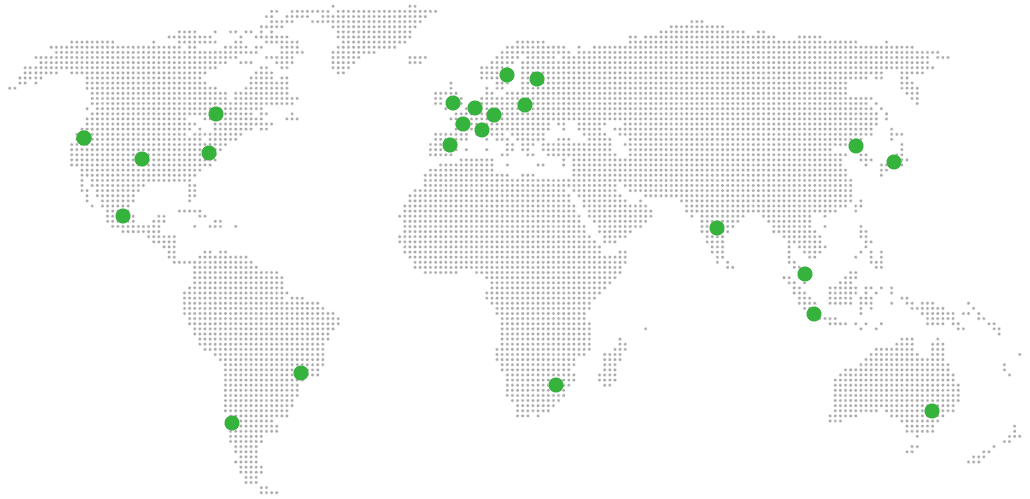
Deploy in your region 21 locations worldwide
GermanyFinlandNetherlandsUKSwedenUnited StatesCanadaSingaporeJapanAustraliaBrazilSouth Africa+9 more →
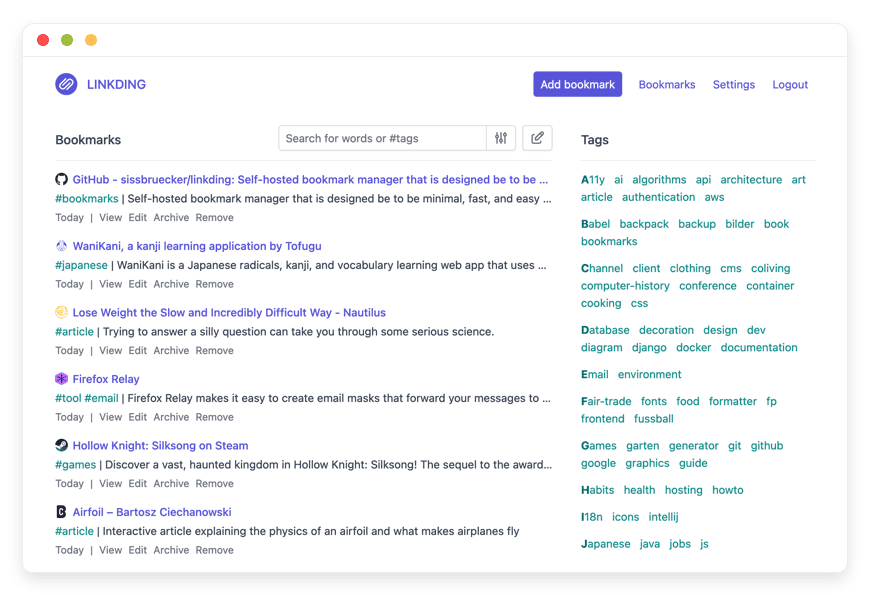
Linkding Preview Image

ABOUT THE SOFTWARE

What is Linkding

Linkding is an open-source bookmark manager — tags, search, HTML snapshots, Markdown notes, sharing, and a full REST API — combining the speed of Pinboard with the polish of Raindrop, in a single Docker container you can host anywhere.

The project ships under an MIT license and is maintained by Sascha Ißbrücker (GitHub @sissbruecker), with contributions from 116 community developers. The repository holds roughly 10,400 stars and 540 forks.. Linkding runs on Django with uWSGI as the application server, Lit web components on the front end, and SQLite by default — PostgreSQL is a supported option via LD_DB_ENGINE=postgres.

The project began in 2019 as the maintainer's response to Pinboard's stagnation, and adoption accelerated after Mozilla's May 2025 announcement that Pocket would shut down. Linkding has been on the Hacker News front page multiple times; the official documentation site is linkding.link. There is no official mobile app, but Linkding installs as a Progressive Web App, ships official Firefox and Chrome extensions, and exposes a full REST API for third-party integrations.

FEATURES

What Linkding does

Linkding handles the full life of a saved link: capture, tag, annotate, archive, search, share, and export. The feature surface stays small on purpose — every shipped feature has a real operational need behind it — but covers the work most teams want from Pocket, Raindrop, or Pinboard.

Tags and bookmark bundles

Flat tag system with auto-tagging rules that match URL patterns. Bundles, added in v1.41.0, group bookmarks beyond tags — by project, sprint, or research thread.

Full-text logical search

Search across title, description, notes, URL, and tags with and, or, not operators (added v1.44.0, October 2025). Search runs over metadata, not snapshot bodies.

Browser extensions and PWA

Official extensions for Firefox and Chrome, a SingleFile-CLI companion mode, and a bookmarklet. Installs as a Progressive Web App on iOS and Android.

Multi-user with selective sharing

Multiple user accounts per instance. Per-bookmark shared flag exposes selected bookmarks to other users or guests. Default-shared mode added in v1.43.0.

Self-contained HTML snapshots

Single-file-cli renders each saved page into a self-contained HTML archive with inlined CSS, JS, and images. Stored on disk per bookmark, viewable offline. Internet Archive submission is the fallback path.

Markdown notes per bookmark

Each bookmark gets a Markdown notes field. Useful for annotation, lit-review write-ups, or paragraph-level fact-checking against the snapshot archive.

REST API with token management

Full Django REST framework API with per-user token management (UI added in v1.45.0). Date filters, bookmark bundle operations, and asset endpoints all exposed.

OIDC and auth-proxy SSO

Generic OIDC integration plus auth-proxy mode for Authelia, Authentik, Keycloak, and Cloudflare Access. OIDC-only login (no local password) supported in v1.45.0.

WHAT'S ALWAYS INCLUDED

Every app. Fully managed.
Nothing extra to pay for.

Every app you deploy includes the full managed service — security, backups, updates, and support from day one.

Automatic updates and patches

Apps run the latest stable version. Security patches applied silently, with rollback if needed.

Daily off-site backups

Multiple daily backups in redundant off-site locations. One-click restore if anything goes wrong.

24/7 uptime monitoring

Continuous monitoring with instant alerting. We respond before you notice.

SSL, firewall, DDoS protection

Auto-renewing SSL, hardened firewall rules, DDoS mitigation on every deployment.

Performance and scaling

We monitor resource usage continuously. When your app needs more headroom, we flag it and upgrade with your explicit approval.

Dedicated engineering support

Real engineers on chat. DNS, SMTP & migration help. All included in €9.

WHY MANAGED

Why teams pick managed Linkding

On May 22, 2025, Mozilla announced Pocket's shutdown. Pocket stopped working on July 8, and the export window finally closed on November 12, 2025, when all remaining user data was queued for permanent deletion. Linkding became the migration target — and the moment for many teams to leave hosted bookmark SaaS behind.

Running Linkding in production is not difficult, but the work doesn't stop after docker compose up. The container ships with single-file-cli (a headless-Chrome HTML snapshotter) that has to be patched in step with Chromium CVEs. PostgreSQL needs connection pooling once a team is writing concurrently. The LD_CSRF_TRUSTED_ORIGINS variable needs to match every reverse-proxy hostname — miss one and every POST fails silently. SSL certificates renew every 90 days; OIDC tokens need rotation; and the official Linkding docs warn that copying SQLite while the database is live can corrupt it.

Linkding's biggest operational surprise is that the assets/ directory containing HTML snapshots is decoupled from the database. The DB only stores filename references; the actual archived pages live on disk. Operators who rsync just the SQLite file, or who dump only the PostgreSQL database, silently lose every snapshot they ever took. Upstream issues #678, #761, #817, and #1210 also document silent snapshot failures against cookie-walled sites — the save succeeds, the file isn't there. We run the asset volume on dedicated storage with its own backup cycle and verify weekly that snapshots restore.

By default we provision Linkding on managed PostgreSQL (no LD_DB_ENGINE connection-timing trap — see upstream issue #1043), pre-set LD_CSRF_TRUSTED_ORIGINS to your DANIAN subdomain, and run the snapshot worker under v1.45.0's supervisor-as-main-process mode on its own CPU quota so single-file-cli bursts don't starve the web server. The asset volume is sized against bookmark count and snapshotted nightly off-host.

REVIEWS

Hear from customers ​like you​​​​​​​

Successful businesses and professionals around the world rely on DANIAN every day

USE CASES

Three teams who run Linkding on DANIAN

These are representative team types we set up most often. Each starts with the same flat €9 plan.

6-PERSON INVESTIGATIVE DESK

Replacing Pocket and a Slack #sources channel after the November 12 deletion

Germany region for source-residency reasons. HTML snapshots forced on every save (single-file-cli + Internet Archive fallback). Tag conventions: case:, verification:, source:. Authentik OIDC bound to the newsroom IdP. Asset volume sized at 8× bookmark count to absorb image-heavy news pages.

ACADEMIC RESEARCH GROUP, 12 USERS

Replacing a shared Zotero group used for URL-only references

Sweden region close to the institutional identity provider (Keycloak). Managed PostgreSQL for multi-writer reliability across PI, postdocs, and grad students. Bundles per chapter of the systematic review. REST API integration pushing DOIs in from Zotero. Bulk snapshot enabled (v1.42.0+) for FAIR-data citation preservation.

4-PERSON THREAT-INTEL TEAM

Replacing a Pinboard archival account and Confluence "IOC URLs" pages

Singapore region, isolated egress so headless Chrome doesn't crawl IOCs from corporate IPs. LD_DISABLE_URL_VALIDATION="True" so defanged URLs save. MITRE ATT&CK technique IDs as tags (T1566, T1071). Custom user-agent on the snapshot worker. Asset volume on object storage with object-lock for evidence retention.

COMPARISON

Four ways to run Linkding

Linkding works on a laptop, a $24/month VPS, a home NAS, or fully managed. The math below compares them honestly at one, five, and ten users — including the operational hours that don't show up on an invoice.

 PATH1 USER5 USERS 10 USERSNOTES
Proprietary SaaS
(Raindrop.io Pro)
$28/year$140/year$280/yearPer-user, linear scaling. Bookmarks live on Raindrop's servers. Export via JSON or HTML. Service depends on a single vendor's continued operation — see Pocket, May 2025.
Self-host on a VPS
~€500/year infra

+ €60–240/mo time
same infra

+ €60–240/mo time
same infra

+ €60–240/mo time
$24/mo production-class VPS, $5/mo backup target, $15/mo monitoring. Plus operator time: 5–10 hours setup, then 1–2 hours per month for patching, certificate renewal, snapshot worker tuning, backup verification. DB tuning at 25+ active users.
Home server
€210–667/mo
effective
€210–667/mo
effective
€210–667/mo
effective
Synology DS923+ (~€650) or HP ProLiant ML30 Gen10 (~€800–1,500) amortised 36 months, plus electricity (€17–32/mo), business-grade internet with static IP (€40–80/mo), off-site backup target (€10–20/mo), and 2–4 hours/month operator time. ISP terms must allow inbound HTTPS.
DANIAN Managed Linkding€9/mo€9/mo€9/moFlat €9 regardless of user count. Backups, snapshots, SSL, monitoring, updates, and chat with a named engineer included. Your operational hours: 0.

BY INDUSTRY

Linkding for specific industries

The link-rot crisis lands differently in different industries. The five sections below pick out where Linkding's snapshot subsystem, REST API, and tag taxonomy do real work — and where the choice of DANIAN region, asset volume size, and OIDC integration matters.

A 2014 Harvard Law Review study by Jonathan Zittrain, Kendra Albert, and Lawrence Lessig found that more than 70% of the URLs in three Harvard law journals and 50% of URLs in U.S. Supreme Court opinions had already suffered reference rot — the linked content was gone or replaced. The standard mitigation, Perma.cc, captures a permanent archive at citation time. Linkding does the equivalent on every matter URL a paralegal saves: the snapshot is a self-contained HTML file you control.

On DANIAN, we provision the latest-plus image with the snapshot worker on a dedicated CPU quota, mount the asset volume on object storage with object-lock enabled for write-once retention, and bind OIDC to the firm's identity provider. Matter-prefixed tags (matter:2026-0341) let paralegals filter snapshots per case; the REST API can push snapshot UUIDs back into the firm's matter-management system on save.
The Hiberlink research project (Sanderson, Phillips, Van de Sompel) examined 3.5 million scholarly articles published between 1997 and 2012. In 2012 alone, 22% of Elsevier article hyperlinks had already rotted, and four out of five papers contained at least one reference that suffered reference rot. The FAIR data principles — Findable, Accessible, Interoperable, Reusable — call for archiving on capture, not on retrieval. Linkding's HTML snapshot feature does exactly this.

On DANIAN, we run managed PostgreSQL (multi-writer reliability across PIs, postdocs, and grad students), bind OIDC to the institutional identity provider (Keycloak, or Shibboleth via OIDC), and pre-size the asset volume against the per-paper average of cited URLs. Bundles per chapter make the lit-review export straightforward; the REST API ingests DOIs from Zotero on the way in.
The Pew Research Center's When Online Content Disappears (May 17, 2024) found that 25% of all webpages that existed between 2013 and 2023 were unreachable by October 2023. The decay is steepest for older pages: 38% of webpages from 2013 were dead by 2023, and 23% of news webpages contained at least one broken link. For reporters this isn't an inconvenience — it's a fact-checking failure mode.

Linkding's snapshot subsystem captures the source at the moment of reporting, and the SingleFile browser extension lets a reporter clip a page they're reading without leaving the browser. On DANIAN, we run snapshots mandatory on every save, route through an isolated egress IP to protect source jurisdiction, and bind per-reporter accounts to the newsroom's OIDC. Story-slug tags pull the bundle URL into the CMS for editorial fact-check.
Threat-intel work generates URL collections at high volume: phishing kits, command-and-control infrastructure, leak-site mirrors, and reporting URLs from CERTs and vendors. Attacker infrastructure rotates fast — by some industry estimates the median URL has a half-life under 30 days — so capture-at-save is the only workable archival strategy. Linkding handles the defanged URL convention (hxxp://malicious[.]example) once LD_DISABLE_URL_VALIDATION="True" is set.

On DANIAN, we provision an isolated egress network for the snapshot worker so headless Chrome never visits IOCs from corporate IPs, set a custom snapshot user-agent, and bind tags to MITRE ATT&CK technique IDs (T1566, T1071, T1486). The REST API pushes IOC URLs into the team's threat-intelligence platform for cross-correlation. Asset volume on object storage with object-lock supports evidence retention referenced in NIST SP 800-150 cyber-threat-information-sharing practice.
Competitive-intelligence work means watching competitor pricing pages, ad creative archives, integration partner pages, and product changelogs. Pages get redesigned monthly, pricing tiers get reshuffled quietly, and the screenshot you took in February is the only proof a tier existed by August. Industry research has placed the typical web link's half-life at roughly two years — pricing pages tend to be faster.

Linkding's auto-tagging rules (added v1.40.0) match URL patterns: every URL under competitor-x.com/pricing gets tagged automatically, and the snapshot worker captures the page on save. Bundles group "Competitor X Q2 2026 pricing changes" for the team meeting. On DANIAN, we provision a large asset volume sized for full-page snapshots of marketing pages (which run heavy on inlined images), pre-configure the snapshot worker user-agent, and pin the region close to the team.

FAQ

Frequently asked questions

Everything teams ask before signing up — answered straight, without sales speak.

Three groups: technical setup, migration, and how DANIAN works as a service.

01

Technical and configuration

Linkding's latest-plus Docker image ships with single-file-cli — a headless-Chrome-based Node tool — to render each saved page into one self-contained HTML file with inlined CSS, JavaScript, and images, gzipped. The snapshot file lives in /etc/linkding/data/assets/ on disk; the database only stores the filename reference. Storage grows with each save. We size the asset volume per customer at provisioning and monitor utilisation so the volume gets resized before it fills.
Search runs over title, description, Markdown notes, URL, and tags, with and, or, not logical operators added in v1.44.0 (October 2025). It does not search inside snapshot HTML bodies. If you need full-content search across archives, pair Linkding with an external search index pointed at the asset directory — we'll wire it up if that's the workflow.
SQLite is Linkding's default (WAL mode), fine for one user. We default new DANIAN instances to managed PostgreSQL — multi-writer reliability, transaction-safe backups against a live writer, and better headroom for teams. Upstream issue #1043 documents the common psycopg2 connection-timing trap when self-hosters switch LD_DB_ENGINE=postgres on a running container; we pre-configure around it.
Generic OIDC via LD_ENABLE_OIDC="True" with the four OIDC endpoint variables (OIDC_OP_AUTHORIZATION_ENDPOINT, OIDC_OP_TOKEN_ENDPOINT, OIDC_OP_USER_ENDPOINT, OIDC_OP_JWKS_ENDPOINT). Auth-proxy mode (LD_ENABLE_AUTH_PROXY=True) works with Authelia, Authentik, Keycloak, and Cloudflare Access. v1.45.0 added an OIDC-only mode that hides the local password form.
Tags are flat — no parent/child hierarchy. v1.40.0 introduced auto-tagging rules that match URL patterns and URL fragments, which most teams use to emulate hierarchies (e.g., every URL under github.com auto-gets the github tag). A basic tag-management UI shipped in v1.43.0. Many teams use prefix conventions (topic:method, client:acme) to keep tags organised.
Full coverage via Django REST framework: bookmarks, tags, bundles, assets, user profile. Per-user Bearer tokens added in v1.39.0; a token-management UI shipped in v1.45.0. Date filters (added_after, modified_after) added in v1.41.0. An official JavaScript client library shipped alongside v1.44.2. Rate limits and quotas are platform-side, set generously and surfaced in dashboard metrics.

02

Migration and onboarding

We can activate your app on your own custom domain/subdomain. Examples: mydomain.com, anyword.mydomain.com.
Or, on our randomized free subdomain. Example: 963.apps.danian.cloud
If you wish to use a custom domain/subdomain, select that option when ordering your app (or notify us later). We will send you the required DNS records and if needed, our tech team will modify them for you.
21 datacenter locations across six continents. You choose the region at provisioning. Application data sits in the region you choose; pick whichever is closest to your users or matches your data-residency preference.
Yes. Request a region migration from the dashboard and we run the move in the background. The system emails you when the migration completes; total transfer time depends on data volume but typical instances finish in a few hours. There is no extra charge for a region change.
Yes. Full data export is available at any time, in a portable format you can bring to any infrastructure.
Mozilla's Pocket export ended November 12, 2025. If you still have your CSV, the community tool hkclark/Pocket2Linkding (added to Linkding's official community docs in v1.42.0, August 2025) converts it to Netscape HTML format. Drop the resulting file in Settings > General > Import.
Raindrop's export includes both HTML (Netscape) and CSV. Linkding imports the Netscape HTML format directly — Settings > General > Import. Tags, notes, and collection names map over; Raindrop's nested-collection hierarchy collapses to flat Linkding tags using prefix conventions (parent:child).
Pinboard exports JSON and the standard Netscape HTML format. Import the HTML; tags and notes carry over. Pinboard archival URLs do not transfer — the snapshots live on Pinboard's servers and aren't included in the export. We can re-snapshot the imported bookmarks against current URLs as a post-import job using Linkding's bulk snapshot feature (v1.42.0+).

03

Billing, support, and platform

€9 covers everything we do for that app: hardware in the region you choose, daily off-site backups with one-click restore, automatic security patches and version upgrades, 24/7 monitoring, SSL and firewall, and engineering support on Email/LiveChat. There are no setup fees or hidden line items. For more info see our Pricing page.
If you decide to continue, we charge €9/app/month from day 8. If you don't, the trial ends and you can export your data. No card is required for the trial, and we never auto-charge you without explicit consent.
No. The €9/month is flat regardless of how many users log into your app. Add 5 users or 50; the price doesn't change.
24/7 Live chat and email support, both staffed by engineers who run the systems. We handle DNS configuration, SMTP setup, app integrations, performance tuning, troubleshooting, and migration help. Response time is typically under an hour. There is no tier system — every customer gets the same support.
Yes. Cancel from the dashboard. We don't charge a cancellation fee, we don't lock data, and we will export your data to you on request before deletion. data to you on request before deletion.
Every customer instance is backed up daily to a separate region from the primary. We test restores. You can request a restore at any backup point within the retention window — usually 7 days for daily backups.
Your application data sits in the region you choose at provisioning — 21 datacenter locations across six continents. Account-level data (billing, account email, support ticket history) is processed centrally. Application data region is picked by you, per app.
99.9% uptime SLA on every app, every tenant. Service credits are documented at danian.co/service-level-agreement. The status page is located at status.danian.co.
When your tenant approaches the resource ceiling — the base tier holds 1 vCPU/RAM, 30 GB storage — we notify you. Resource upgrades happen with your explicit consent; we will not upgrade your tenant or charge you without it.
We wait. We don't suspend the app or delete your data on the first failed charge. We email you, you fix the card on file, and we continue.
Invoices can be downloaded from the billing dashboard in PDF the day each charge succeeds. EU VAT is added where applicable and the VAT-reverse-charge regime applies for VAT-registered businesses with a valid number.
150+ open-source apps across automation, team chat, file sync, analytics, AI, password management, email marketing, dev tools, project management, smart home, CMS, and federated social. See the full catalog →
Yes. Every instance comes with a web-based terminal and a file manager in your DANIAN management dashboard. Useful for managing your data and customizations.
Resources scale with your usage. If your app needs more vCPU, RAM, or storage, we add it — and we ask first before any change to your plan. €9 is the floor; resource-heavy workloads may price higher, but you'll always know in advance.
Yes. We have both a Partner program and an Affiliate program available. Anybody can sign up.
No contract. No minimum commitment. Cancel anytime from the dashboard with one click. The 7-day free trial requires no credit card. After the trial converts to paid, you can still cancel at any month without notice or penalty.

DEPLOY IN YOUR REGION

21 datacenter locations on six continents

Pick the region closest to your users.

United States, Germany, Finland, Singapore, Australia, Brazil, Canada, Netherlands, UK, Spain, Italy, France, Sweden, Malaysia, India, Japan, Mexico, Poland, South Korea, Chile, South Africa and more coming soon
Global Reach Map

Try managed Linkding for 7 days

No card. Cancel from the dashboard.