
Fully Managed Laminar
as a Service
Deploy Laminar as a fully managed service starting at €9/mo. Get automated backups, SSL, updates, support and monitoring included.
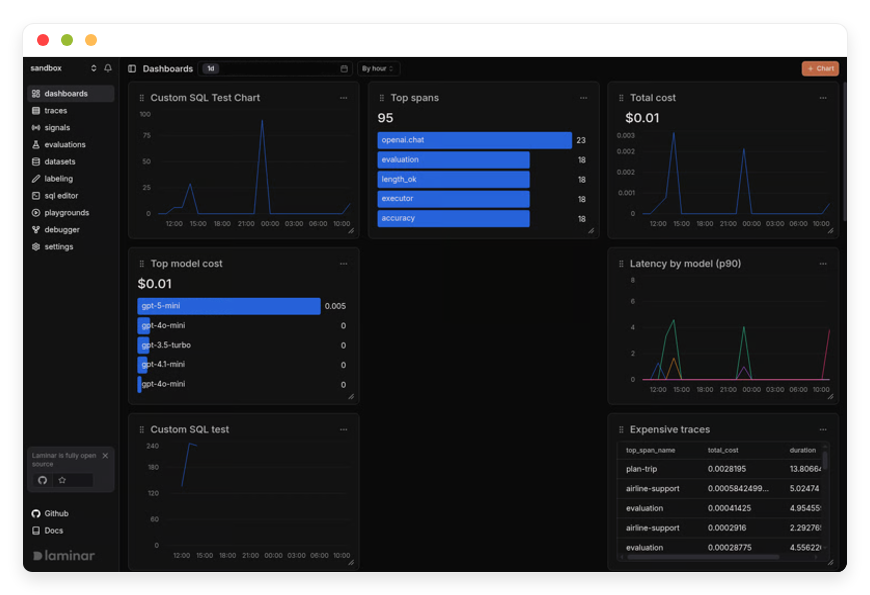
Laminar is an open-source observability platform built for AI agents. It records the full execution tree of an agent run, stores the spans in a column store, and layers evaluations, datasets and browser session replay on the same data.
✓Free 7-day trial ✓99.9% Uptime SLA ✓No credit card ✓Cancel anytime
✓Free 7-day trial ✓99.9% Uptime SLA
✓No credit card ✓Cancel anytime

Laminar
STARTING AT
USAGE
 Germany
 Finland
 Netherlands
 UK
 Sweden
 United States
 Canada
 Singapore
 Japan
 Australia
 Brazil
 South Africa+9 more →
ABOUT THE SOFTWARE
What is Laminar
FEATURES
What Laminar does
WHAT'S ALWAYS INCLUDED
Every app. Fully managed.
Nothing extra to pay for.
Every app on DANIAN ships with the same operational baseline. You do not choose a backup add-on or a monitoring tier. Hosting, patching, backups, SSL, and support are part of the €9, and they apply to Laminar the same way they apply to everything else in the catalog.
WHY MANAGED
Why teams pick managed Laminar
REVIEWS
Hear from customers like you

No more maintenance headaches!
Finally, I can relax and not bother with maintenance. Each of the softwares that we run on DANIAN is automated and running stable for couple months already. They even assist us with modifying the DNS records. Once we needed to modify the config of Nextcloud so that we are able to upload higher than 5GB files and they assisted us fast. I also love their documentation!

Kevin Blackwell

Best managed service
I previously ran Peertube, Mastodon, Mattermost and Mirotalk on other providers before switching to DANIAN. I was tired of handling the updates and backups myself. Not only that the performance is "out of this world" fast, but their tech support is amazing. Since then I added 5-10 more Apps on my account. I also love how they add more softwares on their list constantly!

William Northfield

Love the personalized service!

George Adams
n8n runs excellent

David Hartmann

Smooth experience
I needed a way to manage the projects and files for my company. This was the first time I learn about opensource. I asked their support team and they assisted me immediately. I started with Openproject. Later I added Nextcloud. My team were able to get used to the apps fast.

Levi Nilsson

Bye GA

Wyatt Mitchell

Love the freedom
I wanted to use a crm for my startup. I signed up for the free trial. Tried out espocrm and dolibar and picked one. Their dashboard is very easy for a beginner. I recommend them and feel confident in choosing them.

Elias Koch
Wow just wow
After discovering DANIAN, I wished I'd found them sooner — their solution is excellent and deserves wider recognition. Very good solution!

Tyler Hollander
Professional tech support!

Bastian Engel
Their support team is the best!
I had a problem with my card and the subscription could not be renewed in time. I notified their support and surprisingly, they showed much understanding. They basically left my apps run until I solved the card issue. Other providers would have deleted my data in a heartbeat. This is the way to build client-vendor trust!
George Adams
Fair price and fast
4 months ago I activated n8n, Uptime kuma, Vaultwarden and Paperlessngx. So far everything is perfect. The performance of all apps is excellent. I contacted their support team couple times for using custom subdomains for the apps and they were fast and kind. I'm constantly recommending them to my network!

Atanas

Vaultwarden 10/10
I wanted to selfhost a passwords manager for my company but I didn't trust the mainstream providers. I tried out Vaultwarden for the free trial. I loved how their support team communicated with me professionally but still kind. I know that I can contact them whenever with whatever question I have. Recommended!

James Smith
Multiple locations options

Edward Nelson
Everything just works!
My focus is on my business, not running servers. I love that I can lauch any app without having to think about the tech behind it. Everything just works!

Tony Roy
Awesome support team!

Filip

Very proactive!
Today couple of the videos on my Peertube got viral. Before I even noticed, their support have notified me via email that they proactively upgraded my app with more cpu & ram so that it continues to work without any downtime. They left the upgraded app with the added resources for couple days until the traffic stabilizes. After that I had the possiblity to stay on the same plan or keep the upgraded plan. Out of gratitude I stayed on the upgraded one.

Luke Hall

Win-win!
I run a web design biz. After I perform the work for my clients, they constantly ask me for more software solutions. So I partnered with DANIAN. Not only I provide the requested softwares for my clients and get the increased revenue boost by delegating all to DANIAN, but also for those clients that wish to order directly from DANIAN, I send them an affiliate link. Win-win on all sides!

Luke Walker

Jeffrey Johnson
Awesome customer service
I needed to add analytics on my website but I didn't know anything about DNS. Their team guided me at all phases and they performed the changes for me. Additionally they were transparent and notified me of every change applied and steps performed.

Gabriele Marino

Good admin dashboard
Not only that I got Chatwoot, I also have access to the management dashboard. I love that I can view my hourly/daily usage and perform manual backups and restorations if needed. I don't need the level of control but it feels good to know that I have it if I need it.

Matthew Turner

Andreas Schmitt
Great service!
I configure custom Matomo tracking for my clients as a monthly service. Many of my clients were asking if they can selfhost Matomo instead of using the Cloud service. My employee recommended DANIAN. Basically, I can activate as much Matomo's in any of 20+ countries the same day. Additionally the affiliate revenue is a nice bonus.

Jacob Turner
Smooth experience
I was listing through youtube tuts on how to install Bookstack myself. Then randomly, I found their video playlist exactly for Bookstack. Got curious and went at their website. For the same price (or higher) that I would pay for just the VPS, with them I'm getting a fully managed Bookstack. It's a no-brainer decision!

Elias Gustafsson


Mason Hayes
Its a great service
Its a great service. I love the performance of my Mastodon community. It keeps on growing and I don't have any worries about backups, secuirity, updates, etc.

Vinícius Rocha

Very intuitive solution!
I wanted to use a nocode software for my company. A friend recommended them so I tried both Baserow and NocoDB, couple days later picked one.

Haruto Hashimoto


Henrik Otto
USE CASES
Three teams who run Laminar on DANIAN
Three shapes of team come to managed Laminar: a product studio watching a metered tracing bill outgrow its seat bill, an automation shop that needs one instance per client, and an engineering team that has to keep the records of what a model decided.
6-PERSON AI PRODUCT STUDIO
Moving off metered tracing before the next pricing change
Traces from a support agent were costing more than the seats. They moved to a managed instance in a region close to their inference provider, kept the OTLP exporter they already had, and set the ingest rate limit per project so a runaway retry loop cannot flood the queue.
4-PERSON AGENT AUTOMATION SHOP
One instance per client, on one predictable line item
They build browser agents for retail clients and cannot mix client data in one workspace. Each client gets its own instance at EUR 9, in the region that client asks for, with browser session replay switched on and the redaction service in front of span storage.
12-PERSON LENDING PLATFORM TEAM
Keeping the record of what the model was asked and answered
Their bank partner asks for evidence of ongoing monitoring on any model in the decision path. Traces, evaluation scores and the dataset each score was computed against live on one instance, in a single region, with daily off-site copies held under the retention window their partner sets.
COMPARISON
Four ways to run Laminar
Four paths, the same software underneath. A hosted tracing platform charges per seat and then again per trace. A server you rent is cheap until the column store needs attention. A machine at home is cheapest on paper. DANIAN is EUR 9.
| Path | 1 user | 5 users | 10 users | What you also carry |
|---|---|---|---|---|
| Proprietary SaaS (LangSmith) | USD 39/mo | USD 195/mo | USD 390/mo | Per-seat price plus a metered charge per thousand traces, and a retention window that is priced separately from ingest. |
| Self-host on a rented server | USD 24/mo | USD 24/mo | USD 24/mo | A production-class server, sized up once ClickHouse, search and the queue are all resident. Storage keys, index locations, upgrades and backups are yours. |
| Home server | USD 900 once | USD 900 once | USD 900 once | An HP ProLiant ML30 Gen10 or similar, plus electricity. No off-site copy, a residential address on the certificate, and your own uptime. |
| DANIAN managed Laminar | EUR 9/mo | EUR 9/mo | EUR 9/mo | Nothing. Region of your choice, daily off-site backups, updates applied, and support from the people running it. |
BY INDUSTRY
Laminar for specific industries
Some buyers want Laminar for debugging. Others need it because a supervisor, a regulator or a partner bank asks what the model was given and what it returned. Those four settings put different demands on retention, region and who can read a span.
FAQ
Frequently asked questions
Three groups of questions. What the software does and how we run it, what moving an existing setup across involves, and how billing, regions and support work on the platform underneath. Anything not answered here gets a reply from an engineer, not a form.
01
Technical and configuration
02
Migration and onboarding
03
Billing, support, and platform
DEPLOY IN YOUR REGION
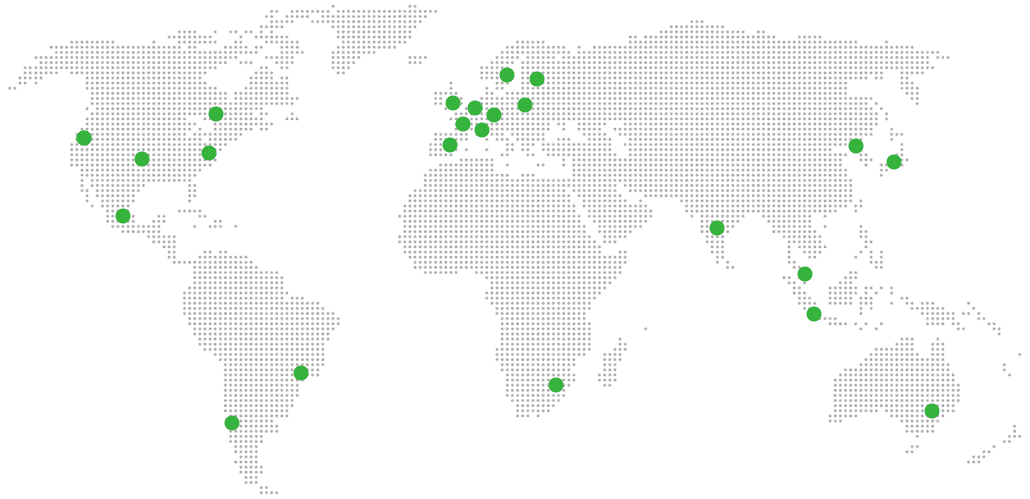
21 datacenter locations on six continents
Pick the region closest to your users.
United States, Germany, Finland, Singapore, Australia, Brazil, Canada, Netherlands, UK, Spain, Italy, France, Sweden, Malaysia, India, Japan, Mexico, Poland, South Korea, Chile, South Africa and more coming soon
Try managed Laminar for 7 days
SERVICES
COMPANY
RESOURCES
COMPARE


