Fully Managed Funkwhale
as a Service

Deploy Funkwhale as a fully managed service starting at €9/mo. Get automated backups, SSL, updates, support and monitoring included.

Funkwhale is an open-source music and podcast streaming platform — your own library, channels for artists and shows, and federation across the Fediverse — combining the convenience of Spotify or SoundCloud with the ownership and control of software you run yourself. It speaks the Subsonic API, so the mobile apps you already use keep working.

✓Free 7-day trial  ✓99.9% Uptime SLA  ✓No credit card  ✓Cancel anytime

✓Free 7-day trial  ✓99.9% Uptime SLA
✓No credit card  ✓Cancel anytime

Funkwhale

Funkwhale

STARTING AT

€9/month
Automated Backups
Monitoring
Automated Updates
Auto SSL

USAGE

Unlimited
Human Support
Custom Domains
Terminal Access
File Manager Access
Deploy in your region — 21 locations worldwide
GermanyFinlandNetherlandsUKSwedenUnited StatesCanadaSingaporeJapanAustraliaBrazilSouth Africa+9 more →
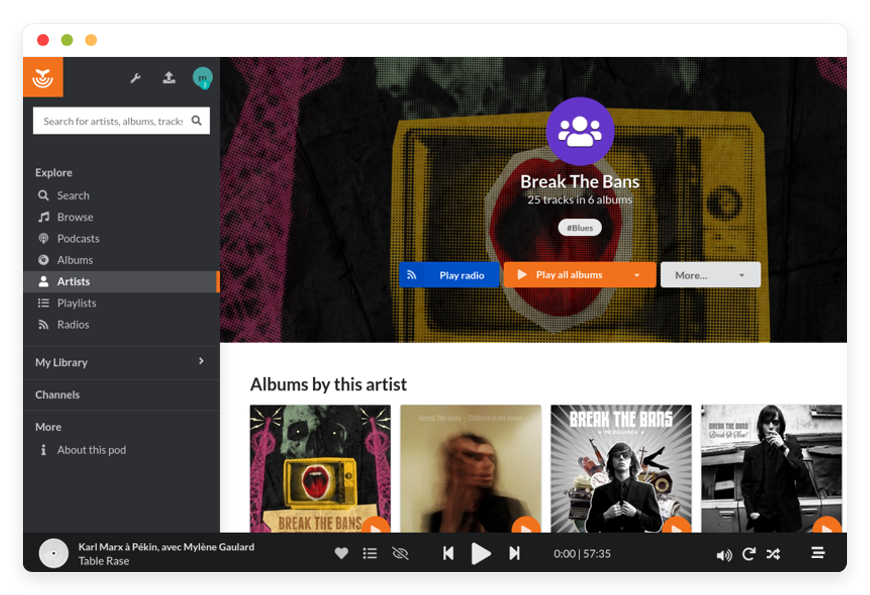
Funkwhale Preview Image

ABOUT THE SOFTWARE

What is Funkwhale

Funkwhale is a self-hosted platform for streaming and publishing audio — your own music library, podcast and artist channels, and federation with other servers across the Fediverse, run on infrastructure you control.

Funkwhale is free and open-source software, licensed under the AGPL-3.0 and maintained by a non-profit called the Funkwhale Collective, with development supported over the years by public-interest grants from NLnet. It started in 2015 as a response to the shutdown of Grooveshark, and it sits alongside Mastodon, PeerTube, and Pixelfed as part of the federated Fediverse rather than a single company's platform.

The current stable line is Funkwhale 2.0, released in March 2026 — a major rewrite after a long 1.x cycle that introduced a new API, a responsive interface, ListenBrainz scrobbling, and multi-artist album support. We run the current tagged stable release. Funkwhale runs as a multi-process Django, PostgreSQL, Redis, and Celery stack behind Nginx. It is a real, actively maintained project — and a genuinely involved one to operate, which is the part we take off your plate.

FEATURES

What Funkwhale does

Funkwhale is a full audio platform, not just a player: libraries and uploads, artist and podcast channels, federation, and a Subsonic API that connects to the mobile apps you already use.

Your own library

Build per-user libraries with storage quotas, upload by drag-and-drop, or run an in-place import that reads a directory without copying files.

Artist and podcast channels

Publish your own music as an Artist channel or a show as a Podcast channel — each a Fediverse actor others can follow.

Federation over ActivityPub

Each server is a pod that can follow other pods' public libraries and channels. Mastodon users can follow your channels too.

Subsonic and OpenSubsonic API

Connect Ultrasonic, DSub, substreamer, play:Sub, Symfonium, or Tempo. Funkwhale 2.0 added OpenSubsonic extensions for newer clients.

Lossless and lossy formats

FLAC, MP3, Ogg, Opus, AAC, M4A, and AIFF are supported. Lossless FLAC streams in the web player as you uploaded it.

On-demand transcoding

FFmpeg transcodes on the fly when a mobile client requests a lighter stream, so playback works on slower connections.

Podcatcher and RSS

Subscribe to external podcast RSS feeds inside Funkwhale, and publish your own shows as standard RSS any podcatcher can read.

MusicBrainz and ListenBrainz

Reads MusicBrainz tags for cover art and clean metadata; Funkwhale 2.0 added ListenBrainz scrobbling.

WHAT'S ALWAYS INCLUDED

Every app. Fully managed.
Nothing extra to pay for.

Every app on DANIAN ships with the same operational baseline. You do not choose a backup add-on or a monitoring tier. Hosting, patching, backups, SSL, and support are part of the €9, and they apply to Funkwhale the same way they apply to everything else in the catalog.

Automatic updates and patches

Apps run the latest stable version. Security patches applied silently, with rollback if needed.

Daily off-site backups

Multiple daily backups in redundant off-site locations. One-click restore if anything goes wrong.

24/7 uptime monitoring

Continuous monitoring with instant alerting. We respond before you notice.

SSL, firewall, DDoS protection

Auto-renewing SSL, hardened firewall rules, DDoS mitigation on every deployment.

Performance and scaling

We monitor resource usage continuously. When your app needs more headroom, we flag it and upgrade with your explicit approval.

Dedicated engineering support

Real engineers by email and ticket. DNS, SMTP & migration help. All included in €9.

WHY MANAGED

Why teams pick managed Funkwhale

Music streaming subscriptions never stop charging, and when you stop paying, the access ends and you own nothing. A self-hosted library inverts that — but Funkwhale is one of the heavier self-hosted apps to run, so most people would rather own the music than babysit the server.

Running Funkwhale yourself is not one program. It is a Django API, a Vue.js front end, a PostgreSQL database, a Redis cache and broker, a Celery worker, a Celery beat scheduler, and an Nginx reverse proxy — five long-running processes and two stateful services that all have to stay healthy together. Add SMTP for account confirmations and password resets, and FFmpeg for transcoding.

The part that bites people is media protection. Funkwhale serves audio behind an internal Nginx location and an X-Accel-Redirect handoff so that a track cannot be fetched directly without an authorised session. Miss that one block in the reverse-proxy config and you get one of two failure modes: every file returns a 404, or every file is public. It is the single most common Funkwhale self-hosting mistake, and it is invisible until someone hits it.

REVIEWS

Hear from customers ​like you​​​​​​​

Successful businesses and professionals around the world rely on DANIAN every day

USE CASES

Three teams who run Funkwhale on DANIAN

Funkwhale fits people who want a shared, owned, federated audio platform rather than a single-user music player. Three common shapes, with the configuration choices that make each one work.

INDEPENDENT NETLABEL

Publishing releases that land in Mastodon feeds

A small netlabel hosts in our France region with Artist channels public and federation on. Each release federates over ActivityPub, so the label's Mastodon followers see new music in their timeline. Masters stay FLAC; we keep transcoding tuned for mobile listeners.

AUDIOPHILE HOUSEHOLD

Replacing a Spotify Family plan with an owned library

A family of five runs one pod in our Germany region, each member with their own account, playlists, and history.

PODCAST COLLECTIVE

Self-hosting several shows with their own RSS feeds

A community media group hosts in our Canada region with a Podcast channel per show. Each channel generates standard RSS for AntennaPod and Pocket Casts and federates to other pods. Per-user quotas keep contributors inside their allocation on a shared pod.

COMPARISON

Four ways to run Funkwhale

Streaming and self-hosting are not the same product: a subscription rents you access to a catalogue, while Funkwhale hosts a library you own and grow. For anyone who values ownership — or shares music across a household — the math and the control both point one way.

PathOne listenerHousehold (up to 6)Over 3 yearsYour ops timeYou own it?
Music streaming subscription$12.99/moSpotify Premium$21.99/moSpotify Family~$791 (family) ~$468 (solo)NoneNo — access ends when you stop paying
Self-host on a VPS~$24/mo production-class VPS, plus object-storage backup and monitoring~$860 + your time5–10h setup, 1–2h/moYes — if you keep it running
Home serverSynology DS923+ or HP ProLiant ML30 Gen10, plus electricity and a static-IP lineHardware + power + time2–4h/moYes — and the maintenance
DANIAN managed Funkwhale€9/mo€9/mounlimited household accounts€324NoneYes — your files, export anytime

Streaming prices are 2026 US list prices and vary by region; €9 is under $10 at current rates. Streaming gives you a 100-million-song catalogue you rent; Funkwhale gives you a library you build from files you own — purchases, ripped CDs, or your existing collection.

BY INDUSTRY

Funkwhale for specific industries

Funkwhale's federation, channels, and per-library permissions put it to work in fields built around publishing and sharing audio — independent music, podcasting, community broadcasting, and open archives. Each places different demands on the pod.

Independent artists and netlabels publish through Artist channels, which are exposed as ActivityPub actors — so a new release appears directly in the feeds of followers on Mastodon and other Fediverse software, with no platform algorithm deciding who sees it. Licensing is the artist's call, from Creative Commons through all-rights-reserved, and Funkwhale itself ships under the AGPL-3.0. We provision the pod with channels public and federation enabled by default, and we keep FFmpeg transcoding tuned so listeners on slower connections still get clean playback while masters stay lossless. A FLAC track runs roughly 30 to 50 MB, so a 500-track catalogue sits around 15 to 25 GB — small enough that a label's whole back catalogue fits comfortably on one managed pod.

Podcast channels generate a standard RSS 2.0 feed for every show, so listeners subscribe in AntennaPod, Pocket Casts, Apple Podcasts via OPML, or inside any other Funkwhale pod — publish once, distribute everywhere. We set each channel's feed to refresh automatically so new episodes appear without manual republishing, and we keep audio behind the protected-file delivery chain so private or members-only feeds stay private. Because the output is plain RSS, there is no lock-in: a listener can point any podcatcher at the feed. A publisher running several shows keeps a separate feed, artwork, and subscriber relationship per channel, all under one managed pod, which is cleaner than juggling separate hosting accounts per show.

Collectives, co-ops, and community radio projects use per-library permissions and per-user storage quotas to let many contributors share one catalogue without giving everyone unrestricted control. We provision multi-user accounts and private libraries that require manual follow approval — the Funkwhale-specific extension to ActivityPub that keeps a shared library invite-only. A typical workflow has members uploading to a staging library, a moderator approving, and approved tracks federating to followers; quotas stop any single member filling the disk. Moderation and account controls live in the admin area, and we run the PostgreSQL, Redis, and Celery services underneath so the group spends its time on programming rather than on patching a server at 2am.

Publishing freely-licensed and public-domain audio is the use case Funkwhale was funded to support — its development has been backed by public-interest grants from NLnet. Archives and educators publish open-access collections as public libraries that automatically accept follow requests, so other pods and Mastodon users can discover and stream the material. We configure the instance to read MusicBrainz identifiers from file tags, which pulls cover art and keeps metadata consistent across a large catalogue.

FAQ

Frequently asked questions

Three groups of questions: the technical detail of running Funkwhale, what migrating in and out involves, and how billing, support, and the platform work.

Three groups: technical setup, migration, and how DANIAN works as a service.

01

Technical and configuration

Funkwhale imports and plays FLAC, Ogg Vorbis, MP3, Opus, AAC, M4A, AIFF, and AIF. Lossless FLAC streams in the web player exactly as you uploaded it. AAC and M4A support was added during the 1.x series, so older guides that list only Ogg, FLAC, and MP3 are out of date.
Transcoding happens on demand through FFmpeg when a Subsonic client asks for a particular format or bitrate; the web player streams the original file untouched. We install FFmpeg and set the default Subsonic transcode format on every Funkwhale pod, so mobile apps that request a lighter stream get one without you configuring anything.
Any Subsonic-compatible app works through Funkwhale's Subsonic endpoint. The documented clients include Ultrasonic and DSub on Android and substreamer and play:Sub on iOS, plus desktop players like Sublime Music. Funkwhale 2.0 added OpenSubsonic extensions, so newer apps such as Symfonium and Tempo behave better. The official Funkwhale Android app exists but has not been updated since early 2024, so a maintained Subsonic app is the smoother path. There is no official iOS app — iOS listeners use a Subsonic client.
As a rule of thumb, a four-minute FLAC track is about 30 to 50 MB and a 320 kbps MP3 is about 10 MB, so a 5,000-track lossless library lands around 150 to 250 GB.
Funkwhale is a Django API with a Vue.js front end, PostgreSQL for data, Redis as cache and broker, and Celery worker and beat processes for background jobs, all behind Nginx. We run PostgreSQL latest stable with the unaccent and citext extensions Funkwhale requires, and we supervise the Celery processes so a stalled worker is restarted rather than left to silently drop imports.
Funkwhale protects audio behind an internal Nginx location and an X-Accel-Redirect handoff, so a track URL cannot be fetched directly without an authorised session. This is the single most common thing self-hosters get wrong — miss the protected-media block and either every file 404s or every file is public. We configure that delivery chain correctly on every pod so private libraries stay private and public ones still stream.
We take a PostgreSQL snapshot before every Funkwhale migration and run the upgrade on a tested window. That matters here: Funkwhale 2.0 was a major rewrite, and the project itself warned that the database migration could fail and risk data loss without manual intervention. We run the current tagged stable release and carry pods across the 2.x line so you never hit a half-finished migration on your own.
Yes. Funkwhale reads MusicBrainz identifiers from file tags and uses them to fetch cover art and keep metadata tidy; the project recommends tagging with MusicBrainz Picard before import. Funkwhale 2.0 added ListenBrainz scrobbling and an admin option to accept only MusicBrainz-tagged files, which we can enable on request for catalogues where metadata consistency matters.
Funkwhale is AGPL-3.0 with no ads, no third-party analytics, and no tracking, and it runs on infrastructure you control in the region you pick. Exit is clean: your audio sits in standard formats on disk, the database is standard PostgreSQL, and the API is documented, so you can move to another Subsonic-compatible server with low friction whenever you want.

02

Migration and onboarding

21 datacenter locations across six continents. You choose the region at provisioning. Application data sits in the region you choose; pick whichever is closest to your users or matches your data-residency preference.
Yes. Request a region migration from the dashboard and we run the move in the background. The system emails you when the migration completes; total transfer time depends on data volume but typical instances finish in a few hours. There is no extra charge for a region change.
Yes. Full data export is available at any time, in a portable format you can bring to any infrastructure.
Yes, two ways. You can upload through the web interface, or use an in-place import that points Funkwhale at a directory of files it reads without copying or duplicating them — the better route for a large existing collection.
Funkwhale reads standard ID3 and Vorbis tags. The project recommends running files through MusicBrainz Picard first, because the import looks up cover art from MusicBrainz using the identifier embedded in each file's tags. Clean tags going in mean clean artist, album, and artwork data coming out — we are happy to advise on a tagging pass before import.
Honestly, not directly — Spotify does not let you export its audio. What you can do is export your playlists and liked songs with a tool like Free Your Music, then build your Funkwhale library from files you own: purchases from Bandcamp or Qobuz, ripped CDs, or your existing collection. Funkwhale hosts a library you own and grow, which is a different model from renting access to a streaming catalogue.
It is straightforward — your tagged file tree is exactly what Funkwhale ingests, so the same library imports cleanly, and mobile apps keep working through Funkwhale's Subsonic endpoint. You gain federation, channels, podcasts, and multi-user quotas; you may lose a few Subsonic-specific niceties like folder-mode browsing, which does not map to Funkwhale's internal model. If you only want a single-user music player, Navidrome is lighter — and we host that too.
With other Funkwhale 2.x pods, yes. The honest caveat: a version 2 pod does not federate with version 1 pods, a split the project flagged with the 2.0 release. As older pods upgrade, the v2 network keeps growing. We run current-stable pods so you are on the right side of that transition, and federation is opt-in per library — you can also run a fully closed pod.
Yes. Point your domain at your pod and we issue and renew SSL automatically. If you would rather not touch DNS, send us the records and we will guide the change or make it with you. A custom domain is included at the base price — no add-on tier for putting your pod on your own name.

03

Billing, support, and platform

€9 covers everything we do for that app: hardware in the region you choose, daily off-site backups with one-click restore, automatic security patches and version upgrades, 24/7 monitoring, SSL and firewall, and engineering support on email and the ticket section in the client portal. There are no setup fees or hidden line items. For more info see our Pricing page.
If you decide to continue, we charge €9/app/month from day 8. If you don't, the trial ends and you can export your data. No card is required for the trial, and we never auto-charge you without explicit consent.
No. The €9/month is flat regardless of how many users log into your app. Add 5 users or 50; the price doesn't change.
24/7 email and ticket support, both staffed by engineers who run the systems. We handle DNS configuration, SMTP setup, app integrations, performance tuning, troubleshooting, and migration help. Response time is typically under an hour. There is no tier system — every customer gets the same support.
Yes. Cancel from the dashboard. We don't charge a cancellation fee, we don't lock data, and we will export your data to you on request before deletion. data to you on request before deletion.
Every customer instance is backed up daily to a separate region from the primary. We test restores. You can request a restore at any backup point within the retention window — usually 7 days for daily backups.
Your application data sits in the region you choose at provisioning — 21 datacenter locations across six continents. Account-level data (billing, account email, support ticket history) is processed centrally. Application data region is picked by you, per app.
99.9% uptime SLA on every app, every tenant. Service credits are documented at danian.co/service-level-agreement. The status page is located at status.danian.co.
When your tenant approaches the resource ceiling — the base tier holds 1 vCPU/RAM, 30 GB storage — we notify you. Resource upgrades happen with your explicit consent; we will not upgrade your tenant or charge you without it.
We wait. We don't suspend the app or delete your data on the first failed charge. We email you, you fix the card on file, and we continue.
Invoices can be downloaded from the billing dashboard in PDF the day each charge succeeds. EU VAT is added where applicable and the VAT-reverse-charge regime applies for VAT-registered businesses with a valid number.
150+ open-source apps across automation, team chat, file sync, analytics, AI, password management, email marketing, dev tools, project management, smart home, CMS, and federated social. See the full catalog →
Yes. Every instance comes with a web-based terminal and a file manager in your DANIAN management dashboard. Useful for managing your data and customizations.
Resources scale with your usage. If your app needs more vCPU, RAM, or storage, we add it — and we ask first before any change to your plan. €9 is the floor; resource-heavy workloads may price higher, but you'll always know in advance.
Yes. We have both a Partner program and an Affiliate program available. Anybody can sign up.
No contract. No minimum commitment. Cancel anytime from the dashboard with one click. The 7-day free trial requires no credit card. After the trial converts to paid, you can still cancel at any month without notice or penalty.

DEPLOY IN YOUR REGION

21 datacenter locations on six continents

Pick the region closest to your users.

United States, Germany, Finland, Singapore, Australia, Brazil, Canada, Netherlands, UK, Spain, Italy, France, Sweden, Malaysia, India, Japan, Mexico, Poland, South Korea, Chile, South Africa and more coming soon
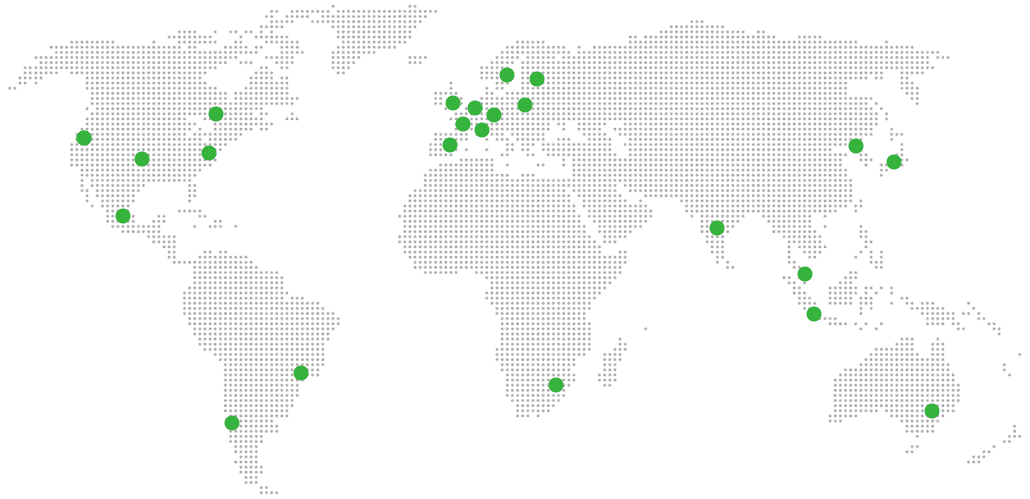
Global Reach Map

Try managed Funkwhale for 7 days

No card. Cancel from the dashboard.