Fully Managed FreshRSS
as a Service

Deploy FreshRSS as a fully managed service starting at €9/mo. Get automated backups, SSL, updates, support and monitoring included.

FreshRSS is an open-source RSS feed aggregator — multi-user, with mobile API support, full-text scraping, and content filtering — combining the convenience of Feedly or Inoreader with the privacy and source-confidentiality of self-hosted infrastructure. It runs comfortably on a small server and scales to 50,000 feeds and a million articles per the project's own benchmarks.

Free 7-day trial  99.9% Uptime SLA  No credit card  Cancel anytime

Free 7-day trial  99.9% Uptime SLA
No credit card  Cancel anytime

FreshRSS

FreshRSS

STARTING AT

€9/month
Automated Backups
Monitoring
Automated Updates
Auto SSL

USAGE

Unlimited
Human Support
Custom Domains
Terminal Access
File Manager Access
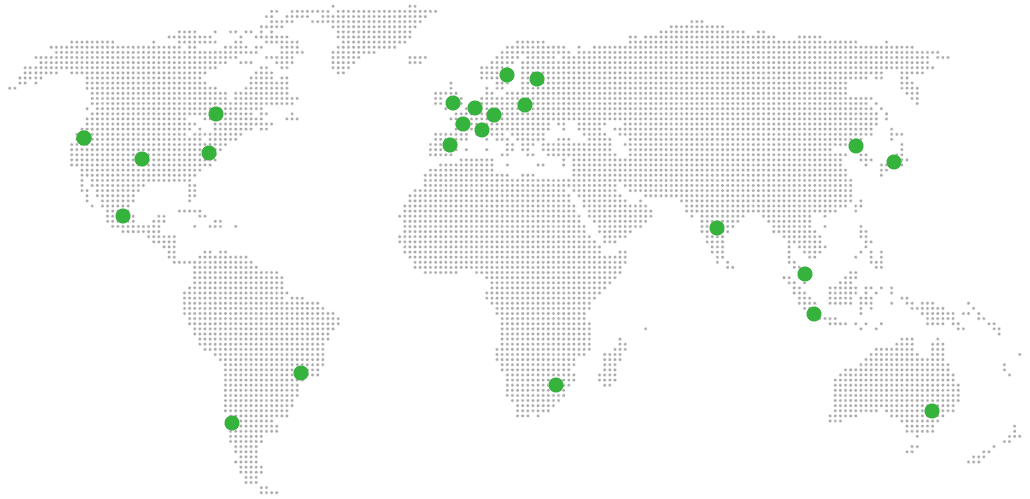
Deploy in your region 21 locations worldwide
GermanyFinlandNetherlandsUKSwedenUnited StatesCanadaSingaporeJapanAustraliaBrazilSouth Africa+9 more →
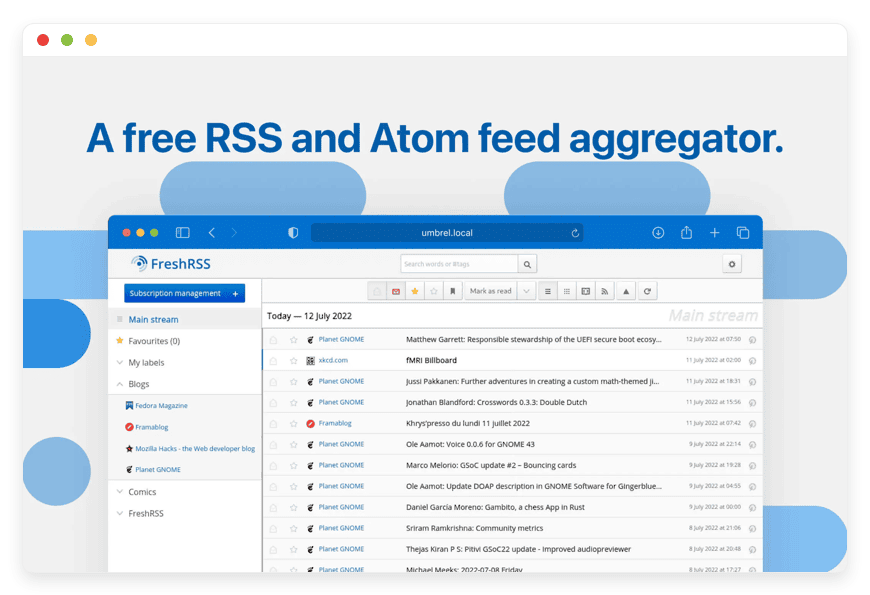
FreshRSS Preview Image

ABOUT THE SOFTWARE

What is FreshRSS

FreshRSS is a self-hosted news aggregator — RSS, Atom, and JSON Feed — written in PHP and licensed under the AGPL. It supports multiple users, mobile reading via the Google Reader and Fever APIs, OpenID Connect single-sign-on, content filtering, full-text article extraction, and XPath scraping for sites that don't publish a feed. It scales to roughly 50,000 feeds and a million articles in a single instance.

The project is community-led, with active contributions from project lead Alexandre Alapetite (GitHub handle @Alkarex), @Frenzie, @Inverle, @aledeg, and dozens of regular contributors. The codebase sits at github.com/FreshRSS/FreshRSS under AGPL-3.0 — around 15,000 commits, 14,000+ GitHub stars, and 64 contributors active in the past year.

FreshRSS runs comfortably on small hardware — the project README documents a working install on a Raspberry Pi 1 with 150 feeds and 22,000 articles at sub-second response times — and scales to large research deployments. The README states the engine handles a million articles and 50,000 feeds without complaining. Supported databases are SQLite, MariaDB, MySQL, and PostgreSQL, served by Apache, nginx, or lighttpd on PHP.

FEATURES

What FreshRSS does

FreshRSS reads, organizes, filters, and surfaces feeds at scale. It pulls from RSS, Atom, and JSON Feed sources; it extracts full article bodies from publishers that ship only summaries; it scrapes structured data from sites that don't publish a feed; and it exposes everything to mobile and desktop clients through two open APIs.

Multi-user with per-account API tokens

Run dozens of analysts or journalists in the same instance. Each user maintains their own subscriptions, categories, filters, and starred items. API passwords rotate independently per user.

Google Reader and Fever APIs

Read on Reeder, FeedMe, FluentReader, NetNewsWire, ReadKit, or any third-party client that speaks the Google Reader protocol. Standard endpoint at /api/greader.php.

Web scraping for feedless sites

XPath and JSON selectors turn any structured page into a working feed. Vendor security advisory pages, court-document indexes, and broker research lists become subscribable.

OpenID Connect single-sign-on

Tie authentication to your organization's identity provider. Standard OIDC, supported natively since FreshRSS 1.20.

OPML import and export

Move in from Feedly, Inoreader, NewsBlur, Tiny Tiny RSS, or Miniflux using their OPML export. Move out the same way. No migration tax in either direction.

Full-text article extraction

Per-feed XPath rules pull complete article bodies from publishers that ship truncated summaries. Useful for IR pages, regulator press feeds, and trade publications.

Content filters and saved queries

Filter rules keep noise out via regex, keyword, or per-feed match. A saved user-query — say, a search for a covered ticker — becomes its own subscribable RSS endpoint.

WebSub push for compatible sources

Sites that emit WebSub (PubSubHubbub) ping FreshRSS the moment they publish, so you don't wait for the next cron tick.

WHAT'S ALWAYS INCLUDED

Every app. Fully managed.
Nothing extra to pay for.

Every app you deploy includes the full managed service — security, backups, updates, and support from day one.

Automatic updates and patches

Apps run the latest stable version. Security patches applied silently, with rollback if needed.

Daily off-site backups

Multiple daily backups in redundant off-site locations. One-click restore if anything goes wrong.

24/7 uptime monitoring

Continuous monitoring with instant alerting. We respond before you notice.

SSL, firewall, DDoS protection

Auto-renewing SSL, hardened firewall rules, DDoS mitigation on every deployment.

Performance and scaling

We monitor resource usage continuously. When your app needs more headroom, we flag it and upgrade with your explicit approval.

Dedicated engineering support

Real engineers on chat. DNS, SMTP & migration help. All included in €9.

WHY MANAGED

Why teams pick managed FreshRSS

Through 2025, Google AI Overviews halved the click-through rate from search to publisher sites — a Pew Research Center study reported by NPR in July 2025 measured an 8% click rate with AI Overviews against 15% without. Newsrooms, analysts, and OSINT teams responded by rebuilding direct-from-source feed monitoring. FreshRSS is the open-source backbone many of them picked. The piece they don't want to run themselves is the operational layer.

Running FreshRSS in production is not the same as installing it. The application is straightforward; the operating layer is where teams get caught.

Cron is the first place. FreshRSS does not pull feeds itself when the web UI is idle. Unless an external scheduler hits the actualizer endpoint on a regular cadence — twice an hour is the upstream recommendation — feeds quietly thin out. The web interface keeps working. The manual refresh button keeps working. But high-volume publishers emit only their last 10 to 100 items, so when cron silently drops out at 9pm on a Friday, you lose Saturday morning's stories without noticing until Monday. Issue threads on the FreshRSS repository are full of variations on "manual refresh works, automated refresh doesn't."

REVIEWS

Hear from customers ​like you​​​​​​​

Successful businesses and professionals around the world rely on DANIAN every day

USE CASES

Three teams who run FreshRSS on DANIAN

These are representative team types we set up most often. Each starts with the same flat €9 plan.

4-PERSON INVESTIGATIVE-JOURNALISM DESK

Tracking court documents, regulator press releases, and subject-of-investigation blogs from 800+ sources

Germany region for source confidentiality, MySQL backend, the upstream CRON_MIN='13,43' cadence, full-text scraping enabled on slow-publishing court feeds, OPML version-controlled in a shared Git repo. Reads on Reeder via the Greader API; a "Boards" category exports into Slack as a roll-up feed.

SOLO-EQUITY-RESEARCH ANALYST AT A SMALL FUND

420 feeds across central-bank speeches, SEC EDGAR filings, IR pages, and earnings releases

Netherlands region, SQLite acceptable at single-user scale, cron at */15 because earnings-window timing matters, max-articles-per-feed raised from 200 to 500 on high-volume sources. Saved user-queries on covered tickers become subscribable RSS that pipes into a Telegram bot.

2-PERSON THREAT-INTEL FUNCTION AT A MANAGED-SECURITY PROVIDER

NIST NVD, CISA KEV, vendor advisories, and adversary blogs at ~600 sources

Sweden region, MySQL, XPath scraping enabled for vendor advisory pages that don't publish proper feeds, OpenID Connect tied to the corporate identity provider, per-user API password rotated quarterly. FeedMe on Android for on-call alerting; starred items export to the team's TIP via cron.

COMPARISON

Four ways to run FreshRSS

Four paths cover almost every team. The proprietary SaaS path is fast to start and expensive to scale. The VPS path is cheap on paper and expensive in operator time. The home-server path looks free until you cost the electricity, the static IP, and the off-site backup. The managed path collapses the math at every team size.

 PATH1 USER5 USERS 10 USERSOPERATOR TIMEMULTI-USER OUT OF THE BOX
Feedly Pro+ (annual)
$99/yr$495/yr$990/yrNone — vendor runs it
 No — single seat
Self-host on a $24/mo
production-class VPS
~$44/mo infra
+ 1–2 hrs/mo ops
Same infra, more ops
Larger VPS at ~$60/mo
+ more ops
5–10 hrs initial,
1–2 hrs/mo
 Yes — FreshRSS feature
Home server
(NAS or small tower)

€210–667/mo all-inn/a (single-household typical)n/a2–4 hrs/moYes
DANIAN Managed FreshRSS€9/mo€9/mo€9/mo0 hrs/moYes

The cost lines tell one story; the operator-time lines tell a different one. At 1 user, Feedly Pro+ runs slightly less than DANIAN on paper. At 5 or 10 users the gap widens by an order of magnitude, because FreshRSS is multi-user by design and DANIAN's €9/month covers an instance, not a seat. The self-hosted paths look cheaper on the infrastructure line until you cost the operator time. The home-server path also needs a static IP, business-grade uplink, and an off-site backup target — three line items most household broadband contracts don't include and that turn a "free" home server into something that runs €200–600/month all in.

BY INDUSTRY

FreshRSS for specific industries

FreshRSS fits four kinds of work especially well — where reading activity is itself sensitive, where source-list size outgrows commercial reader caps, where regulatory frameworks make a vendor-hosted reader uncomfortable, or where a research workflow depends on feeds the major aggregators don't carry. Each pattern looks slightly different in production.

Journalist–source confidentiality is codified differently across jurisdictions — France's 2010 loi Dati, Germany's Pressegeheimnis under StPO §53, the UK's PACE Act, and state-by-state shield laws across the US — but the operational principle converges: what a reporter reads can itself be source-revealing metadata. A vendor-hosted reader keeps reading activity inside the vendor's analytics.

Our default for newsroom tenants is a single-region instance in Germany, France or other, TLS-terminating reverse proxy with strict-transport headers, OpenID Connect tied to the newsroom identity provider, and anonymous-reading disabled so individual reporters maintain their own session.

A four-person investigations team subscribes to 800+ court-document, regulator, and subject-of-investigation feeds; full-text scraping is enabled on slow-publishing court feeds; OPML rolls are version-controlled in a shared Git repo. Per Pew Research reported by NPR (July 2025), AI Overviews halve click-rates on Google Search results — direct-feed monitoring is no longer optional.
EU Market Abuse Regulation (MAR Articles 7–8) requires investment firms to evidence that recommendations were based on properly sourced public information. MiFID II Article 16(2) record-keeping rules extend the obligation across the full research workflow. A reading log against named public sources is often the cleanest way to meet both.

Our default for fund tenants is MySQL underneath, per-analyst accounts (no shared logins), starred-items backed up off-site nightly, and API passwords for read-out into the firm's research platform.

A solo equity analyst covering small-cap industrials tracks 420 sources — central-bank-speech feeds, SEC EDGAR full-text filings via RSS, company IR pages, and trade-press feeds. Saved user-queries on covered tickers become their own subscribable RSS endpoints, so a mention of a covered name in a trade publication shows up wherever the analyst is reading. Feedly's market-intelligence tier starts at $1,600/month; a managed FreshRSS instance covers the same multi-analyst workload at €9/month.
NIS2 Directive (EU 2022/2555) Article 21 obliges essential and important entities to implement vulnerability-handling processes — which in practice means systematic monitoring of vendor advisories, CISA Known Exploited Vulnerabilities, and NIST NVD-style sources. Most threat-intel functions cite Article 21 plus their corporate information-security policy as the operating mandate.

Our default for threat-intel tenants is MySQL, XPath scraping enabled for vendor pages that don't publish clean feeds, OpenID Connect tied to the corporate identity provider, and the Greader API enabled for analyst client apps.

A two-person threat-intel function at a managed-security provider subscribes to around 600 sources — NIST NVD JSON, CISA Known Exploited Vulnerabilities, every CVE-numbering-authority feed, ransomware-leak-site monitoring, and adversary-blog feeds. Saved user-queries auto-flag mentions of products in the corporate asset inventory. NIST NVD publishes thousands of CVE entries per month; FreshRSS's own README documents 50,000-feed capacity in a single instance — far above a typical threat-intel shop's source budget.
In the US, FERPA (20 U.S.C. § 1232g) restricts the disclosure of student education records, and the Association of College and Research Libraries' privacy guidelines counsel against vendor-hosted readers that broker patron reading activity. EU institutions face similar obligations under their national data-protection acts.

Our default for university tenants is a multi-user instance with anonymous-reading mode enabled for shared preprint feeds, OpenID Connect tied to Shibboleth or eduGAIN, per-research-group categories, and OPML rolls shared between cohort students.

A 30-researcher lab tracks 200 feeds per researcher — arXiv, bioRxiv, ChemRxiv, SSRN, OSF Preprints, plus journal-issue feeds in the lab's specialty. Full-text scraping is enabled per-feed where licensing permits. arXiv alone publishes ~20,000 preprints monthly; a single FreshRSS instance handles the combined 6,000-feed load comfortably.

FAQ

Frequently asked questions

Everything teams ask before signing up — answered straight, without sales speak.

Three groups: technical setup, migration, and how DANIAN works as a service.

01

Technical and configuration

This is the most reported FreshRSS issue and the most reliable way to lose articles without noticing. FreshRSS does not poll feeds when the web UI is idle. It relies on an external scheduler hitting the actualizer endpoint. On a vanilla install, if the CRON_MIN environment variable isn't set, the cron daemon stays disabled and feeds refresh only when someone clicks the manual button. We ship CRON_MIN='13,43' (twice an hour, staggered minutes so the fleet doesn't stampede public feed origins at the top of the hour) and a health check against the actualizer, so a stalled cron pages us rather than disappearing quietly into your feed.
Use the Google Reader API endpoint at https://yourdomain/api/greader.php. Set an API password under Settings → Profile → API access. Each FreshRSS user has their own API password; the account password is separate. Reeder, FeedMe, FluentReader, ReadKit, NetNewsWire (using the Feedbin- or Inoreader-style account that speaks Google Reader), and most modern RSS clients work this way out of the box.
FreshRSS has it built in. Per-feed XPath or CSS selectors pull complete article bodies from publishers that ship truncated summaries. Edit the feed, set "Article CSS selector on the original website" to the right expression, save. The community wiki and the FreshRSS documentation list working selectors for the most common publishers.
The project README documents 50,000 feeds and over a million articles in a single instance without complaining. A realistic working ceiling for most teams is in the low thousands. The bottleneck shows up at the database layer rather than the application — which is part of why we run MySQL underneath rather than SQLite.
Yes. FreshRSS includes XPath and JSON scraping. Vendor security advisory pages, court-document indexes, broker research lists, and other structured pages become subscribable. Set the URL, define XPath selectors for item, title, and content, and FreshRSS treats it like a normal feed. Brittle in the sense that the source's HTML can change underneath you, but a useful escape hatch for important sources.
Yes. FreshRSS supports OIDC natively. We set up the connection to your identity provider — Okta, Google Workspace SSO, Microsoft Entra ID, Authelia, Keycloak, or any standard OIDC provider — and confirm the scope mapping. Send us the provider's discovery URL on chat and we'll wire it up.
The xExtension-YouTube extension turns YouTube channel URLs into watchable feeds, embedding the video player directly inside FreshRSS. We can enable it on your instance from chat. It's not active by default because most teams don't want the embedded player consuming bandwidth on every channel-feed refresh.
Reddit periodically tightens access on its public RSS endpoints. The workaround that holds is to use old.reddit.com rather than www.reddit.com and to set a recognizable User-Agent header on the feed. We configure this on managed instances; an open issue on the FreshRSS repository tracks the underlying upstream behaviour.

02

Migration and onboarding

We can activate your app on your own custom domain/subdomain. Examples: mydomain.com, anyword.mydomain.com.
Or, on our randomized free subdomain. Example: 963.apps.danian.cloud
If you wish to use a custom domain/subdomain, select that option when ordering your app (or notify us later). We will send you the required DNS records and if needed, our tech team will modify them for you.
21 datacenter locations across six continents. You choose the region at provisioning. Application data sits in the region you choose; pick whichever is closest to your users or matches your data-residency preference.
Yes. Request a region migration from the dashboard and we run the move in the background. The system emails you when the migration completes; total transfer time depends on data volume but typical instances finish in a few hours. There is no extra charge for a region change.
Yes. Full data export is available at any time, in a portable format you can bring to any infrastructure.
Export an OPML file from your current reader — every modern reader supports this in the account or export settings. Upload it on your FreshRSS instance under Subscription management → Import/Export. Subscriptions, folder structure, and feed metadata transfer over. Starred items, read-state, and tags don't travel through OPML — those need an API-level migration if they matter to your workflow.
OPML covers subscriptions and folders only. Starred items and read-state move through the Google Reader API — the same protocol your mobile reader uses. Send us the source instance details on chat and we'll help script the transfer. Most migrations take an hour or two of elapsed time and end in a clean handoff.
Yes. FreshRSS is multi-user by design, and our €9/month covers the instance, not the seat. A four-person investigative desk and a twenty-person research lab pay the same per-month price. Each user has their own login, subscriptions, categories, filters, and API password.

03

Billing, support, and platform

€9 covers everything we do for that app: hardware in the region you choose, daily off-site backups with one-click restore, automatic security patches and version upgrades, 24/7 monitoring, SSL and firewall, and engineering support on Email/LiveChat. There are no setup fees or hidden line items. For more info see our Pricing page.
If you decide to continue, we charge €9/app/month from day 8. If you don't, the trial ends and you can export your data. No card is required for the trial, and we never auto-charge you without explicit consent.
No. The €9/month is flat regardless of how many users log into your app. Add 5 users or 50; the price doesn't change.
24/7 Live chat and email support, both staffed by engineers who run the systems. We handle DNS configuration, SMTP setup, app integrations, performance tuning, troubleshooting, and migration help. Response time is typically under an hour. There is no tier system — every customer gets the same support.
Yes. Cancel from the dashboard. We don't charge a cancellation fee, we don't lock data, and we will export your data to you on request before deletion. data to you on request before deletion.
Every customer instance is backed up daily to a separate region from the primary. We test restores. You can request a restore at any backup point within the retention window — usually 7 days for daily backups.
Your application data sits in the region you choose at provisioning — 21 datacenter locations across six continents. Account-level data (billing, account email, support ticket history) is processed centrally. Application data region is picked by you, per app.
99.9% uptime SLA on every app, every tenant. Service credits are documented at danian.co/service-level-agreement. The status page is located at status.danian.co.
When your tenant approaches the resource ceiling — the base tier holds 1 vCPU/RAM, 30 GB storage — we notify you. Resource upgrades happen with your explicit consent; we will not upgrade your tenant or charge you without it.
We wait. We don't suspend the app or delete your data on the first failed charge. We email you, you fix the card on file, and we continue.
Invoices can be downloaded from the billing dashboard in PDF the day each charge succeeds. EU VAT is added where applicable and the VAT-reverse-charge regime applies for VAT-registered businesses with a valid number.
150+ open-source apps across automation, team chat, file sync, analytics, AI, password management, email marketing, dev tools, project management, smart home, CMS, and federated social. See the full catalog →
Yes. Every instance comes with a web-based terminal and a file manager in your DANIAN management dashboard. Useful for managing your data and customizations.
Resources scale with your usage. If your app needs more vCPU, RAM, or storage, we add it — and we ask first before any change to your plan. €9 is the floor; resource-heavy workloads may price higher, but you'll always know in advance.
Yes. We have both a Partner program and an Affiliate program available. Anybody can sign up.
No contract. No minimum commitment. Cancel anytime from the dashboard with one click. The 7-day free trial requires no credit card. After the trial converts to paid, you can still cancel at any month without notice or penalty.

DEPLOY IN YOUR REGION

21 datacenter locations on six continents

Pick the region closest to your users.

United States, Germany, Finland, Singapore, Australia, Brazil, Canada, Netherlands, UK, Spain, Italy, France, Sweden, Malaysia, India, Japan, Mexico, Poland, South Korea, Chile, South Africa and more coming soon
Global Reach Map

Try managed FreshRSS for 7 days

No card. Cancel from the dashboard.