Reselling managed FreeScout helpdesk in 2026
How agencies resell managed FreeScout without becoming a hosting company
TL;DR
- A client running even a small support team pays per agent on Zendesk, Freshdesk, or Help Scout — roughly $25–$55 per agent per month, every month, climbing with each hire.
- FreeScout is an open-source shared-inbox helpdesk with no per-agent fee: unlimited agents, unlimited tickets, and unlimited mailboxes in the free core, under the AGPL-3.0 licence.
- Managed on DANIAN, one FreeScout instance is €9/month, all-in. An agency resells it at €25–€45/month per client and keeps the difference.
- At 20 clients that is about €180/month in hosting against €500–€900/month in retail — roughly €320–€720/month recurring before support time.
- DANIAN does not ship a white-label agency control plane or client billing automation yet. This post is honest about that, and about which FreeScout features sit behind one-time paid modules.
The pitch in one paragraph
A client asks you to run their support inbox, and you do not want to become a hosting company.
The model is one managed FreeScout instance per client at €9/month, resold at €25–€45/month.
FreeScout charges nothing per agent, so the client's team can grow without the bill growing.
You keep the relationship and the margin.
This is written for the 3–25-person agency — web, marketing, growth, or boutique dev — that already touches client support and wants a recurring line it controls. FreeScout is, in plain terms, a self-hosted version of Help Scout: a shared inbox where every email becomes a conversation a team can assign, reply to, and resolve together. The headline that makes it work for resale is the absence of per-seat fees. The honest parts — where DANIAN's setup has gaps today — are below, not buried.
Why per-agent helpdesk pricing breaks agency margins
Per-agent pricing is the problem you are routing around.
Zendesk Suite Team runs $55 per agent per month on annual billing; Freshdesk Pro is $55 per agent; Help Scout Standard is $25 per user.
A three-person client desk is $75–$165/month before any add-ons, and every new hire adds another seat to the meter.
The full picture is worse than the entry price. Zendesk starts at $19 per agent on the entry Support tier, but the Suite tiers most teams actually use run $55, $89, and $115 per agent per month, and the AI add-ons stack another $50 per agent on top. Freshdesk has a limited free tier and then climbs from roughly $15–$19 per agent on Growth to $55 on Pro and $79–$89 on Enterprise, with a separate $29-per-agent AI copilot charge. Help Scout, as of April 2026, lists Standard at $25, Plus at $45, and Pro at $75 per user per month, with the top tier requiring a ten-user minimum.
The shape is the same across all three: the cost scales linearly, and painfully, with headcount. A client that grows from three support agents to six does the same kind of work and pays roughly double for the tool. When you are the agency reselling "we will run your support desk," that per-seat meter sits underneath your margin and squeezes it every time the client hires.
This is not theoretical. A WordPress plugin maker, WP Fusion, published that a three-user Help Scout plan would have cost about $1,440 a year before they moved to FreeScout. A web-design agency, Watchful, moved its own support desk to FreeScout and wrote that it would seriously recommend the same to any agency taking client support tickets. The trigger is consistent — a renewal quote or a per-seat sticker shock that no longer fits the client's budget — and it is exactly the moment an agency can step in with a better-priced, managed alternative.
What FreeScout actually is — and what is free versus paid
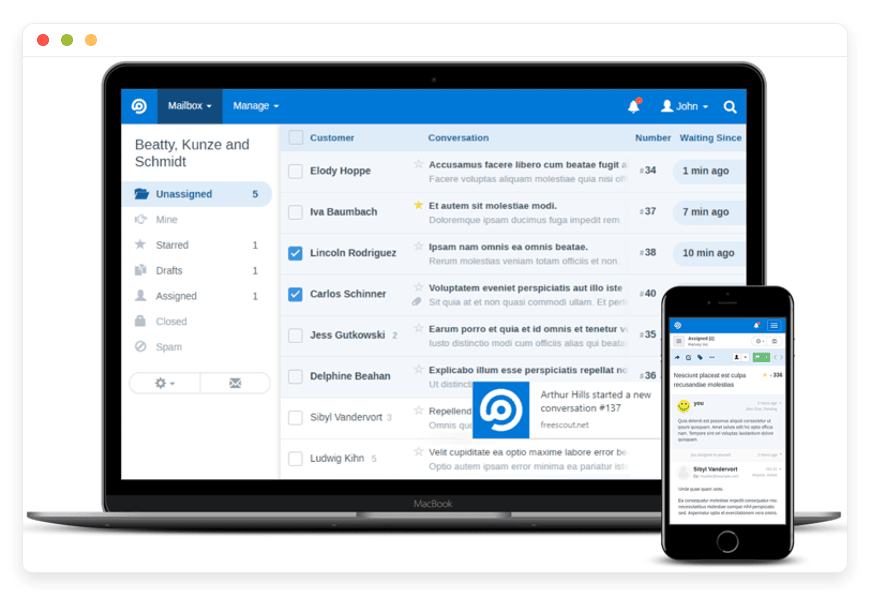
FreeScout is a free, open-source helpdesk and shared mailbox built in PHP and Laravel — in practice, a self-hosted Help Scout. The free core, under the AGPL-3.0 licence, gives unlimited agents, tickets, and mailboxes, plus email-to-ticket conversion, collision detection, assignments, internal notes, and mobile apps. Some advanced features are optional paid modules.
The free core is genuinely usable as a client helpdesk on its own. You connect any IMAP/SMTP mailbox — Gmail, Microsoft 365, a Postfix server — and every incoming message becomes a conversation. Agents assign conversations, reply, leave internal notes, and see a collision warning when two of them open the same ticket at once. The interface is multilingual across more than 25 languages, there are iOS and Android apps, and there is no cap on the number of agents, tickets, or mailboxes. The whole application is small enough to run comfortably in a single container. You can read the project on GitHub and the feature list on freescout.net.
The honest part a reseller has to understand is the module model. The FreeScout team funds the project by selling official add-on modules, the way a WordPress shop sells plugins. These are one-time purchases with lifetime licences, also AGPL-3.0, and most cost between roughly $2 and $15 each. The catch for resale is that several capabilities a client may expect from Zendesk are modules, not core: a public knowledge base, reporting dashboards, satisfaction ratings, automation and aging-conversation workflows, saved replies, a CRM panel, and the white-label widget branding all sit behind paid modules. The current module catalogue prices the Knowledge Base at $12, Workflows at $14.99, the End-User Portal at $12.99, and Tags at $6.99, with Reports, Saved Replies, Satisfaction Ratings, Time Tracking, Teams, Custom Fields, and API & Webhooks in the same modest range.
None of this is expensive, but it is not zero, and it changes how you scope each client. A full client-ready desk usually needs three to six modules. One agency reported spending about $25 in lifetime module licences to run its support desk; a plugin maker reported about $68 total. Budget a one-time module kit of roughly $25–$70 per client instance, recover it in the first month or two of retail, and pick only the modules each client genuinely needs. Module licences are generally tied to one installation, so with the one-instance-per-client model below, plan the kit per instance rather than buying once and reusing across clients.
For an agency, the unspoken question is whether the software is safe to put in front of a paying client. FreeScout has been in active development since 2018, ships frequent releases, and is the support desk that real businesses — the plugin maker and the web-design agency above among them — migrated to and stayed on. It is mature enough to run client support on, which is the bar that matters here.
The agency math
The unit is one client. Hosting costs €9/month per FreeScout instance.
You resell at €25–€45/month. Subtract a small one-time module cost of about €25–€65 and your own support time.
The recurring margin is €16–€36 per client per month — and, unlike the SaaS it replaces, it does not erode when the client adds support agents.
The building block is deliberately simple:
- DANIAN managed FreeScout: €9/month per instance, all-in (patching, backups, monitoring, support).
- Retail to the client: €25–€45/month, set by you.
- Gross recurring margin: €16–€36/month per client.
- One-time per instance: a module kit of about €25–€65, recovered inside the first one to three months.
Scaled across a book of clients, the totals are what make the line worth running:
| Scale | Hosting cost / month | Retail revenue / month | Gross margin / month |
|---|---|---|---|
| 1 client | €9 | €25–€45 | €16–€36 |
| 10 clients | €90 | €250–€450 | €160–€360 |
| 20 clients | €180 | €500–€900 | €320–€720 |
Adjust the gross down for your own time, honestly. A managed instance moves patching, backups, and uptime to the host, but you still own first-line client communication, the initial mailbox setup, and module configuration. Budget an hour or two per client per month at your blended rate; the net lands below the gross but stays positive and recurring. Compared with the block-fee reseller programs in this space — a managed-helpdesk reseller plan can run around $400/month for roughly 30 instances as a flat block — the per-instance €9 model scales down to a single client cleanly, which suits an agency adding the line one client at a time rather than committing to a block up front.
What "white-label" actually requires — and what DANIAN does and does not do today
White-label has three parts: a branded helpdesk on the client's domain, suppressed vendor branding, and billing the client under your name. FreeScout handles the first two through a custom domain and two inexpensive modules. The third — billing automation wired into the host — DANIAN does not provide today. You invoice clients yourself.
A branded helpdesk on the client's domain.
Each FreeScout instance can run on a custom domain such as help.clientdomain.com, and the knowledge base supports its own custom domain per mailbox. Our support sets up the DNS records and the domain mapping with you, so the client sees their own brand at their own address, not a generic host URL.
Suppressed vendor branding.
The Customization & Rebranding module sets a custom logo and favicon, and the Widgets White-Labeling module removes the "Powered by FreeScout" line from chat and contact widgets. Both are one-time module purchases, so end-to-end the client-facing surface carries the client's brand or yours, not the software's.
Billing the client.
You bill the client at your retail price under your own brand, through your own Stripe account or invoicing. DANIAN bills you the €9 wholesale price per instance. There is no client-billing pass-through wired into the host today — no Stripe Connect or WHMCS integration — so the invoice and the client relationship stay entirely yours.
The honest gap: the control plane.
DANIAN does not yet ship a single agency dashboard for provisioning and monitoring many client instances from one screen, and the partner program does not yet carry a formal commission tier. Today you manage instances individually and lean on our 24/7 support from a named human when a client's instance needs attention. We set up new instances fast — often the same day — and we add catalog apps on request. If a unified white-label control plane is a hard requirement before you start, contact us at: partners@danian.co and we can see what can be done. Check our Partner program for more info.
One instance per client — the isolation model
The clean architecture is one FreeScout per client, not one shared install with many clients crammed inside it. Separate instances mean separate databases, separate domains, separate branding, and no path for one client's tickets to surface in another's inbox. On DANIAN each instance is its own hardened container at €9/month.
FreeScout is built as a single-company shared inbox. Stretching one installation to serve many clients invites data-bleed risk and a single blast radius: one bad update or one mistake touches every client at once. One container per client removes both problems. Each instance has its own data, its own custom domain, its own modules, and its own region — a problem on one is contained to one.
That isolation maps directly to the pricing. Because each instance is a separate €9 app, your cost scales with the number of clients rather than a tier you grow into, and you can place each client's instance in the region closest to their users, choosing from 21 datacenter locations across six continents. You and the client get access scoped to that instance — to debug, export data, or change a config — without server-level access you would otherwise have to manage yourself.
The €9 also covers the operational work you would rather not own per client: we patch each instance on our schedule, monitor it 24/7, and back it up daily, off-site. When you tell a client their helpdesk is in safe hands, that is the operational reality behind the sentence — and it is the same for every instance you resell, whether you run one or fifty.
Three apps that resell well
Three open-source support tools resell cleanly at €9 wholesale each. FreeScout is the email shared inbox. Chatwoot adds live chat and social inboxes. osTicket is the form-and-portal alternative for structured ticketing. Bundle one or more, mark each up, and you have a small recurring support-tooling line rather than a single product.
FreeScout — the shared-inbox helpdesk
FreeScout is the lead and the resale core: an email-first shared inbox with no per-agent cost. It suits clients whose support is email-driven and who want a clean agent experience without paying per seat. At €9 wholesale and €25–€45 retail, it is the instance most agencies will sell first. Note that we can add live chat to FreeScout via the custom module.
Start here with managed FreeScout at €9/month and add the others when a client needs them.
Chatwoot — add live chat
Chatwoot is an open-source live-chat and omnichannel inbox: a website chat widget plus shared inboxes for social channels, sitting alongside the email desk. It fits a client who wants a chat bubble on their site and a single place to handle chat and social conversations. It is another €9 instance you can bundle with FreeScout and mark up — a retail uplift of roughly €15–€25/month. If chat and social are the priority rather than an add-on, add Chatwoot live chat as its own managed instance. FreeScout also offers a paid chat module, but Chatwoot is the dedicated tool when those channels lead.
osTicket — the form-based alternative
osTicket is open-source ticketing centered on web forms and a customer portal, with SLA handling and routing — closer to an IT service desk than an email inbox. It fits clients who want structured intake: forms, ticket numbers, and queues rather than a Gmail-style shared inbox. At €9 wholesale and €25–€40 retail, it is the right instance when intake needs structure.
The choice between the two is simple: email shared inbox and conversational support points to FreeScout; form-and-portal intake with structured queues points to osTicket.
When this works (and when it does not)
This fits agencies that already touch client support and want recurring revenue without running servers. It does not fit agencies that need a unified multi-client control plane, host-level billing automation, or phone-first omnichannel support today. Three signals point each way.
It works when:
- You already manage client inboxes or support and want a recurring line you control, not a one-off setup fee.
- Your clients' support teams grow over time — per-seat SaaS punishes that, and a flat per-instance cost does not.
- You value per-client isolation and want to offer each client a branded helpdesk on their own domain.
It does not work when:
- You need one dashboard to provision and watch dozens of client instances today. That unified control plane is not built yet, so you would manage each instance on its own.
- You want client cards charged through the platform via Stripe Connect or WHMCS. Today you invoice clients yourself and we bill you wholesale.
- Your clients need phone or voice as the primary channel, or a heavy form-and-SLA workflow out of the box. FreeScout is shared-inbox-first; osTicket or a full contact center will fit those better.
How to start
Pick one client whose support is email-driven and whose team is likely to grow. Start a 7-day trial of a managed FreeScout instance, connect their support mailbox, add only the modules they need, and set a retail price with margin. Then ask us about partner pricing before you scale to the rest of your book.
Four concrete moves:
- Scope the offer.
List the capabilities the client expects — knowledge base, reporting, satisfaction ratings — and map each to the free core or a one-time module. Price the module kit into your setup fee so the one-time cost is covered on day one. - Trial one instance.
Spin up a managed FreeScout on a 7-day free trial with no card required, connect the client's IMAP/SMTP mailbox, set the custom domain, and load the modules you scoped. - Set retail and bill.
Price at €25–€45/month per client under your brand. You invoice the client; we bill you €9 wholesale per instance. - Talk to us about partner pricing.
The agency this post describes is one we are actively trying to learn from. If you run an agency and this model fits, email us — we would rather hear what would make it work than guess. For more info, see our Partner program.
FAQ
Does FreeScout really have no per-agent fee?
Yes. The free core has no limit on agents, tickets, or mailboxes, so you can add support staff without the bill changing. The FreeScout team funds the project by selling optional one-time modules, not per-seat subscriptions. Managed on DANIAN, the cost is €9 per instance per month, flat, no matter how many agents the client adds.
Is FreeScout free for commercial use and reselling?
Yes. FreeScout uses the AGPL-3.0 licence, which permits commercial use and reselling hosted instances to clients. The free core costs nothing, and the optional modules are one-time purchases under the same licence. There is no per-seat royalty, so you can resell a managed instance at €25–€45/month and keep the margin.
Which features cost extra?
The shared inbox, email-to-ticket, assignments, internal notes, collision detection, and mobile apps are free. A knowledge base, reporting, automation workflows, saved replies, satisfaction ratings, a CRM panel, and white-label widget branding are paid official modules — one-time lifetime licences, most around $2–$15 each. Scope each client offer around the modules that client actually needs.
Do I buy FreeScout modules once, or separately for each client?
Module licences are one-time purchases, not subscriptions, but each is generally tied to a single installation. With one FreeScout instance per client, budget a separate module kit per instance — usually €25–€70 for the three to six modules a client needs. You recover that one-time cost inside the first month or two of retail.
What margin can an agency realistically expect reselling FreeScout?
Hosting is €9 per instance per month, and agencies resell at €25–€45, a gross margin of €16–€36 per client. At 20 clients that is roughly €320–€720/month before your support time. Unlike per-seat SaaS, the margin holds as a client adds agents, since FreeScout charges no per-agent fee.
Is there a minimum number of clients or a setup commitment to start?
No. Each instance is a standalone €9/month app, so you can start with one client and add more as you sign them. There is no block of instances to buy up front and no minimum commitment. That suits an agency adding the line one client at a time rather than committing to a tier.
Is FreeScout a solid alternative to Zendesk for small businesses?
For email-driven support, yes. FreeScout covers the shared inbox, assignments, internal notes, and collision detection most small teams use Zendesk for, without the $55-per-agent Suite pricing. Zendesk still leads on built-in phone, advanced automation, and its large app marketplace. For a small business whose support is mostly email, FreeScout fits well.
Why resell a managed helpdesk instead of self-hosting FreeScout myself?
Self-hosting on a VPS works if you have a developer who enjoys patching, certificate renewal, backups, and on-call. A production VPS runs about $44/month plus your time. A managed instance is €9/month with operations handled, so you resell a working helpdesk rather than taking on server maintenance yourself.
Do I need technical or sysadmin skills to resell a managed helpdesk?
No. In the managed model, patching, backups, monitoring, and uptime are handled for you. You handle the client relationship, the mailbox setup, and choosing modules. If something needs a server-level change, our 24/7 support takes care of it. No Linux or DevOps experience is required to resell a helpdesk this way.
How do I move a client from a SaaS helpdesk to FreeScout?
You connect the client's support mailbox over IMAP/SMTP, and new email becomes conversations in FreeScout from day one. Historical tickets from Zendesk, Help Scout, or Freshdesk can be brought across by export, and FreeScout has migration modules for them. Run both in parallel briefly, then cut the mailbox over once the team is comfortable.
How long does it take to set up a client's helpdesk?
It depends on the client's DNS, the mailbox connection, and how many modules they need. A straightforward email-only desk can be ready the same day; a custom domain plus several modules takes a little longer. We set up the DNS and domain mapping with you, so most desks go live without a long project.
Can I put a client's helpdesk on their own domain and branding?
Yes. Each instance can run on a custom domain such as help.clientdomain.com, and the knowledge base supports its own custom domain per mailbox. Two inexpensive modules set a custom logo and remove the "Powered by FreeScout" line from widgets. Our support handles the DNS and domain setup with you so the client sees their brand, not the software's.
Who handles updates and backups on a managed FreeScout instance?
We do. Each instance is patched on our schedule, monitored 24/7, and backed up daily, off-site. FreeScout and its modules are kept current, and the underlying container is maintained for you. That removes the patch cycle and backup checks an agency would otherwise own for every client it hosts.
Is each client's data isolated from other clients?
Yes. Each client runs in its own FreeScout instance — a separate container with its own database, domain, and modules. There is no shared installation where one client's tickets could surface in another's inbox. One container per client also limits the blast radius, so a problem on one instance stays contained to that one.
Can each client's helpdesk run in a different region or country?
Yes. You choose the region per instance from 21 datacenter locations across six continents, so each client's helpdesk can sit close to their users or their market. Because every instance is a separate €9 app, mixing regions across your client book adds no complexity to the pricing.
What happens to my client's data if I stop reselling or cancel?
The data stays yours to take. FreeScout stores conversations in a standard database you can export, and we can provide a backup or a dump on request. There is no proprietary lock-in on the helpdesk data, so a client can be migrated elsewhere or handed back to you cleanly.
Does FreeScout integrate with other tools like a CRM or store?
Yes, through paid modules and its API. FreeScout has integrations for CRM panels, WooCommerce and Shopify order context, Slack notifications, and similar tools, plus an API and webhooks module for custom links. Scope the integrations a client needs into the module kit, the way you scope the knowledge base or reporting.
Can I resell other open-source apps to clients alongside the helpdesk?
Yes. The helpdesk is one of 150+ open-source apps you can run at €9/month each — analytics, CRM, project tools, file storage, and more. Bundle a client's helpdesk with the other tools they need, mark each up, and build a small recurring software line rather than reselling one product. We add catalog apps on request.
Does DANIAN have a white-label agency dashboard or commission program?
Not today. There is no single control plane for managing many client instances from one screen, and no formal commission tier yet. You manage instances individually, bill clients under your own brand, and lean on our 24/7 support when an instance needs a human. If that gap is a dealbreaker for your agency, tell us before you start so we can be honest about fit.
How do I bill my clients?
You bill the client directly at your retail price, through your own invoicing or Stripe. DANIAN bills you the €9 wholesale price per instance per month. There is no client-billing pass-through wired into the host today — no Stripe Connect or WHMCS integration — so the client relationship and the invoice both stay yours.
What if a client outgrows the shared inbox?
FreeScout scales to large inboxes and many agents without per-seat cost. If a client needs live chat or social channels, add a managed Chatwoot instance; if they need form-based intake with queues and SLAs, osTicket fits better. Each is another €9 instance you can resell, and we add catalog apps on request.
What to do this week
Pick one client whose support runs on email and whose team is growing. Price a managed FreeScout instance at a retail number with margin, start a 7-day trial, and connect their mailbox. The math works for one reason: FreeScout never charges per agent.
And €9 per instance leaves real room to mark up. If the model fits your book, email us about partner pricing — we are building this offer with agencies, and we would rather hear what you need than guess.