Open-source Zendesk alternatives for small teams
Zendesk Suite Team starts at $55 per agent per month, billed annually. The minimum sits at three agents. That is where the renewal email lands for a five-person company that just wanted shared email and a few automations. The bill is now $165 per month, $1,980 per year, and the team has not added a single feature.
Three open-source projects cover the helpdesk shape that small teams actually use: FreeScout for the shared inbox, osTicket for ticket forms and SLAs, and Chatwoot for live chat plus WhatsApp, Instagram and Messenger. This post compares them, runs the cost math at five and ten agents, and explains where each one fits.
TL;DR
- Zendesk Suite Team is $55 per agent per month with a 3-agent minimum — $165/month, $1,980/year before any add-on.
- At 5 agents that becomes $275/month, $3,300/year. Add the AI Copilot at $50/agent and the bill clears $500/month.
- FreeScout, osTicket and Chatwoot are mature open-source helpdesks. Self-hosting is free; the operational cost is the time and the patching cycle.
- DANIAN runs any of them at €9 per app per month, flat — patching, daily backups, monitoring and 24/7 support included.
- Annual saving on FreeScout vs Zendesk Suite Team at 5 agents: around €2,950. Switching usually fits in a weekend.
Why small teams are leaving Zendesk in 2026
The trigger is rarely a single feature. It is the renewal quote. Zendesk Suite Team sits at $55 per agent per month on annual billing, with a three-agent minimum. A five-person support team pays $275 per month, or $3,300 a year, before any add-on. Once the AI Copilot at $50 per agent is added, the bill clears $500 per month. (Zendesk pricing, May 2026.)
The math gets steeper before it gets simpler. Suite Growth is $89 per agent. Suite Professional, which adds skills-based routing and advanced reporting, is $115 per agent. A 10-person team on Professional with Copilot is paying close to $1,950 per month. None of those numbers cover WhatsApp Business API fees, SMS delivery through Twilio, or the implementation hours most teams need to configure routing.
There is a second pressure. Per-seat pricing scales faster than the team. Hiring two more agents adds $1,320 to the annual bill on Suite Team. The cost is linear in headcount, but the ticket volume rarely is. Small teams with shared inboxes and an email volume that doubled twice in two years end up paying for capacity they will only need at peak.
The third pressure is data ownership. Zendesk runs on AWS in the United States. For teams under tightened data-transfer scrutiny in Europe, that is increasingly a board-level question rather than an IT preference. Open-source alternatives keep the data on infrastructure the team chooses — including the regions that match your customer base.
None of this means Zendesk is bad software. It means a small team paying $3,300 a year for a shared inbox should at least see what the alternative looks like.
What “alternative” actually means here
"Alternative to Zendesk" can mean four different decisions. Picking the wrong frame is how teams end up paying $300 a month for the wrong tool. The four real paths a five-person support team has in 2026: stay on Zendesk; switch to a cheaper SaaS; self-host an open-source helpdesk; or pay someone to host the open-source helpdesk for them.
Path 1 — Stay on Zendesk
The honest case for Zendesk: large marketplace, deep automation, good reporting, an AI Copilot that does measurable work in 2026. If the team handles tens of thousands of tickets a month and the per-seat cost is dwarfed by saved agent time, staying makes sense. For a five-agent team handling under 1,000 tickets a month, the math is harder to defend.
Path 2 — Switch to a cheaper SaaS
Freshdesk Growth at $29 per agent, Help Scout at $20–$50 per user, HubSpot Service Hub Pro at higher tiers. Cheaper than Zendesk, still per-seat, still hosted on the vendor's infrastructure. The pricing-treadmill problem returns at the next renewal. The data ownership question stays open.
Path 3 — Self-host an open-source helpdesk
FreeScout, osTicket and Chatwoot are all free under permissive open-source licenses. Spin up a 2 vCPU / 4 GB production-class VPS at around $24 per month, install the helpdesk, point the DNS, configure SMTP, and the per-seat bill is gone. The cost moves from billing line to the calendar of whoever patches the server. Honest reference: a $24 VPS plus an object-storage backup at $5 plus monitoring at $15 is $44 per month in infrastructure. Add 1–2 hours per month of patching and SMTP debugging, at €60–€120 per hour for a freelance sysadmin, and the real cost is €100–€280 per month effective.
Path 4 — Pay someone to run the open-source helpdesk for you
This is the path most small teams want. Open-source software, predictable price, no Linux administration. DANIAN runs FreeScout, osTicket or Chatwoot for €9 per app per month, flat. Hardware, security patches, daily off-site backups, monitoring, SMTP and DNS — all included. The operational time per month is zero hours.
The shortlist — three open-source helpdesks
Three projects cover the helpdesk shape small teams need. They are not interchangeable. FreeScout looks and feels like Help Scout. osTicket looks and feels like a classic IT-style ticketing system. Chatwoot looks and feels like Intercom for small teams. Pick by the channel mix that matches how your customers actually contact you.
FreeScout — the email-first shared inbox
Built by the FreeScout team since 2018.
License: AGPL-3.0.
GitHub stars: ~4,200.
DANIAN price: €9/month.
Best for: teams who run support out of a shared inbox today and want a Zendesk-shape replacement without the per-seat math.
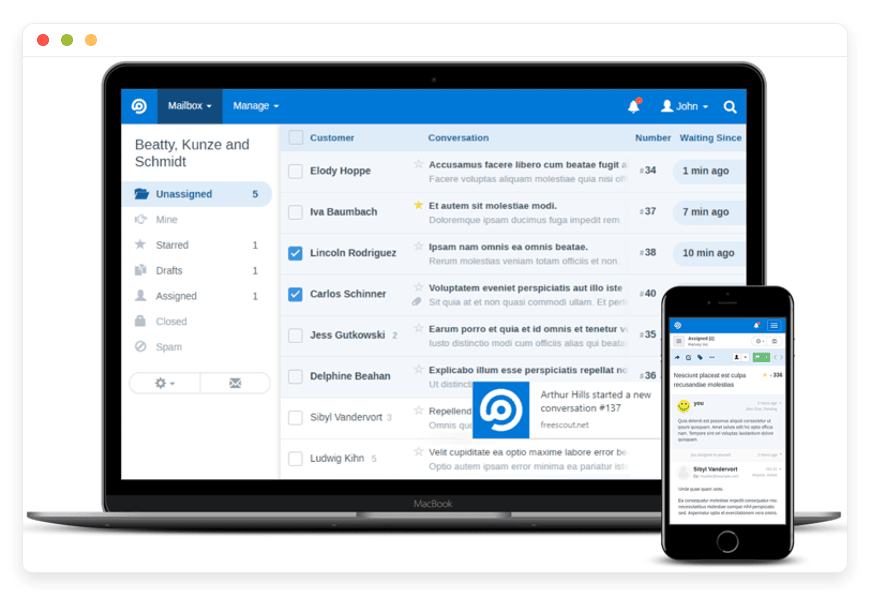
FreeScout is the Help Scout / Zendesk shape, rebuilt as open source. The interface is a shared inbox — conversations on the left, the message thread in the middle, customer details on the right. Multiple mailboxes, internal notes, saved replies, customer satisfaction ratings, basic reporting. No per-agent pricing, no ticket cap, no mailbox cap.
Be honest about the module ecosystem. The FreeScout core is genuinely free under AGPL-3.0. The FreeScout team also sells official paid modules from freescout.net for features some teams will need. The list includes a customer-facing portal with a knowledge base, time tracking, satisfaction-rating refinements, Kanban workflow boards, two-factor authentication, custom-domain branding, deeper reporting, and WhatsApp and Telegram channels. Modules are one-time purchases, typically $20–$80 each. There is also a community-module catalog of free third-party additions on GitHub.
The honest framing: FreeScout core covers the shared-inbox job. Buy a module when a specific gap appears. Most five-agent teams ship with the core plus two or three modules, and the total cost is under what one Zendesk seat costs in a single month.
On DANIAN, the FreeScout setup includes the application, daily backups, security patches, SMTP, monitoring and 24/7 support from a named human at €9 per month. See managed FreeScout hosting for the per-app deployment detail.
osTicket — the classic ticketing workflow
Built by the osTicket project, in active maintenance since 2010.
License: GPL-2.0.
GitHub stars: ~3,800.
Latest release: v1.18.3, January 2026.
DANIAN price: €9/month.
Best for: teams that need ticket forms, SLAs, departments and ticket-routing rules — the classic IT-helpdesk workflow.
osTicket is the longest-running open-source helpdesk in the catalog. It came out of the era when "ticketing system" meant a structured form on a customer portal. The pattern: auto-assignment, queues, agent collision avoidance, custom fields, an SLA timer per category. That shape still fits IT, MSP and product-support teams. Customers expect to log in to a portal, fill in a structured form, and watch the ticket move through a workflow.
The interface is functional rather than fashionable. Reviews on Capterra and G2 in 2026 still describe it as "looks like 2015". For some teams that is a feature — agents move quickly because the layout is dense and predictable. For others it is a deal-breaker. The honest test: open the live demo and watch your support lead navigate it for ten minutes.
What osTicket gets right: stability. It runs on PHP and MySQL, the install is straightforward, and the project ships security patches on a regular cadence. There is no premium tier, no paid modules, no upsell screen — the entire thing is free under GPL-2.0. For teams who want predictable open source without a sales conversation in the future, osTicket is the safest pick.
On DANIAN, managed osTicket hosting covers the application, the database, the backup target, monitoring and human support at €9 per month.
Chatwoot — live chat plus WhatsApp, Instagram, Messenger
Built by Chatwoot Inc., commercial open source since 2019.
License: MIT (Community Edition).
GitHub stars: ~29,000.
DANIAN price: €9/month.
Best for: teams whose customers reach them on multiple channels — website chat, WhatsApp Business, Instagram DMs, Facebook Messenger, email and SMS in one inbox.
Chatwoot is the broadest of the three. The shape is modern multi-channel. Agents work from a single inbox that aggregates conversations from a website chat widget, WhatsApp through the Business API, Instagram, Messenger, email, SMS through Twilio, and a custom-channel API. Built on Ruby on Rails and Vue. Around 29,000 GitHub stars and an active 2026 release cycle.
Be honest about Community Edition vs Enterprise Edition, because this confuses every Chatwoot evaluation. The Community Edition is MIT-licensed, free, fully self-hostable, and covers the multi-channel inbox, conversations, basic reporting, contacts, the Captain AI assistant, and most of the features small teams need. The Enterprise Edition is a separate license that adds SLA management, audit logs, agent capacity controls, custom dashboards and IP block-listing — features that mostly matter at 50+ agents. Both editions are built from the same GitHub repository; the Enterprise folder is proprietary. Per the Chatwoot project documentation, Community will always remain free; Enterprise sustains the commercial side of the project.
For a five-agent team, Community Edition is almost always the right tier — and it is what DANIAN deploys by default. If a team later needs Enterprise features, the upgrade path is in-place.
On DANIAN, managed Chatwoot hosting covers PostgreSQL, Redis, the Rails app, the message workers and an S3-compatible attachment store at €9 per month, regardless of channel mix. WhatsApp Business API and SMS delivery still bill per-message through Meta and Twilio respectively — those are infrastructure-level costs no managed helpdesk can absorb.
Side-by-side at 5 agents and 10 agents
Cost per year for the same support team at five and ten agents. Zendesk numbers are Suite Team at $55 per agent per month, billed annually. DANIAN numbers assume one app deployed (the helpdesk itself); add €9 for each additional app. Conversion uses an indicative rate of $1 = €0.93.
Cost matrix at 5 support agents
| Path | Per month | Per year | Ops time / month | Region choice |
|---|---|---|---|---|
| Zendesk Suite Team | $275 | $3,300 (~€3,070) | 0 hours | US (AWS) |
| Self-host on a VPS | $44 + 1–2h time | ~€1,200–€3,360 | 1–2 hours | Provider regions |
| Self-host at home | €210–€667 | €2,520–€8,000 | 2–4 hours | Your basement/home |
| DANIAN — FreeScout | €9 | €108 | 0 hours | 21 regions, 6 continents |
| DANIAN — osTicket | €9 | €108 | 0 hours | 21 regions, 6 continents |
| DANIAN — Chatwoot | €9 | €108 | 0 hours | 21 regions, 6 continents |
Cost matrix at 10 support agents
| Path | Per month | Per year | Ops time / month | Region choice |
|---|---|---|---|---|
| Zendesk Suite Team | $550 | $6,600 (~€6,140) | 0 hours | US (AWS) |
| Self-host on a VPS | $44 + 2–3h time | ~€1,800–€4,400 | 2–3 hours | Provider regions |
| Self-host at home | €210–€667 | €2,520–€8,000 | 2–4 hours | Your choice |
| DANIAN — single helpdesk app | €9 | €108 | 0 hours | 21 regions, 6 continents |
The math holds at every team size on a per-app price model. Zendesk costs more for every agent added. DANIAN does not. The trade-off is real and it is not the price: Zendesk has a deeper feature surface, more integrations and larger third-party tooling. For small teams whose support volume sits inside what FreeScout, osTicket or Chatwoot natively does, the saving is the right call.
How to pick — three questions to ask yourself
The picking process is shorter than most blog posts make it. Three questions usually settle it. Answer them honestly and one of the three will fit better than the others.
Question 1 — How do your customers actually contact you today?
Pull the last 30 days of support volume. Sort by channel. If 90% of it lands in a shared mailbox, FreeScout fits the workflow your team already has, and the migration is mostly DNS plus mailbox import. If most of it is a customer-facing form on a portal, with departments and routing rules, osTicket is the closer match. If it is a mix of website chat, WhatsApp and Instagram DMs, Chatwoot is the only one of the three that handles those natively. Picking the wrong shape is how teams end up rebuilding the helpdesk twice.
Question 2 — Do you have someone who patches Linux servers monthly?
Self-hosting on a VPS is genuinely cheaper if you have a developer or sysadmin in-house who is comfortable on the command line. The cost is a $24 VPS, a $5 backup target, $15 of monitoring, and 1–3 hours per month of patching, certificate renewal and on-call rotation. Most small teams do not have that person. They have a founder who does some of everything, or an agency relationship that bills hourly. For those teams, a managed setup at €9 per app removes the patching cycle from the calendar entirely.
Question 3 — Is the gap from $275 a month to €9 a month worth a weekend?
A migration from Zendesk to FreeScout, osTicket or Chatwoot is rarely longer than a weekend for a five-agent team. Export the customers and tickets from Zendesk via the standard CSV/API export. Import into the new helpdesk. Repoint the support email DNS. Train the team on the new layout — usually a 30-minute walkthrough. The saving in year one is around €2,950 on FreeScout vs Suite Team. In year two, the saving compounds. The only honest answer for most small teams is yes.
FAQ
What these open-source helpdesks are
What does "open-source customer support software" actually mean?
Open-source customer support software is a helpdesk where the source code is published under a license that permits use, modification and self-hosting at no software cost. FreeScout, osTicket and Chatwoot all qualify. The license matters: AGPL-3.0 (FreeScout), GPL-2.0 (osTicket) and MIT (Chatwoot Community Edition) each grant different rights for derivative work. "Open source" does not always mean "all features free" — Chatwoot, for example, gates SLA management behind a paid Enterprise Edition license even when self-hosted.
What is FreeScout?
FreeScout is a free open-source help desk and shared mailbox built in PHP on the Laravel framework. It is licensed under AGPL-3.0 and has roughly 4,200 GitHub stars as of May 2026. The project positions itself explicitly as a Zendesk and Help Scout alternative, with no per-agent pricing, no ticket cap and no mailbox cap. Core features include shared inboxes, internal notes, saved replies, customer satisfaction ratings and basic reporting. Advanced features sit in a paid module catalog with one-time purchases typically priced $20–$80.
What is osTicket?
osTicket is an open-source support ticket system in active development since 2010. It runs on PHP and MySQL under the GPL-2.0 license, with around 3,800 GitHub stars and a v1.18.3 release in January 2026. The shape is the classic IT-helpdesk workflow: structured ticket forms, custom fields, departments, queues, agent collision avoidance, SLA timers per category and a customer-facing portal. There is no premium tier. The entire project is free; the project sells commercial support hours separately for teams that want it.
What is Chatwoot?
Chatwoot is an open-source customer support platform with two editions. The Community Edition is MIT-licensed, free and self-hostable, with around 29,000 GitHub stars. The Enterprise Edition is a separate proprietary license that adds SLA management, audit logs, agent capacity controls and IP block-listing. Both are built from the same GitHub repository. The platform aggregates conversations from website chat, the WhatsApp Business API, Instagram, Messenger, email, SMS through Twilio and a custom-channel API into a single agent inbox.
Is FreeScout really a Zendesk alternative, or is it more of a Help Scout clone?
FreeScout is closer in shape to Help Scout — a shared inbox with conversations, internal notes and saved replies. It covers the support job a small team uses Zendesk Suite Team for, but does not replicate the deeper marketplace and AI features of Suite Professional or Enterprise. For a five-agent team on Suite Team, FreeScout is a direct replacement. For a team using Zendesk’s skills-based routing, it is not.
Comparing your options
Zendesk Suite Team vs Suite Professional — what is the difference?
Suite Team is the entry tier at $55 per agent per month on annual billing, with a 3-agent minimum. It includes ticketing, omnichannel messaging and a help center. Suite Professional adds skills-based routing, advanced analytics, custom dashboards and AI Copilot eligibility, at $115 per agent per month. The gap is $60 per agent per month — for a 5-agent team, the Professional upgrade adds $300 per month, $3,600 per year. (Zendesk pricing, May 2026.)
Is FreeScout vs Zendesk a fair comparison, or am I downgrading?
FreeScout matches Zendesk Suite Team on the core support job: shared inbox, conversations, internal notes, saved replies, satisfaction ratings, basic reporting. The downgrade is real for teams using Zendesk’s deeper features — skills-based routing, the AI Copilot, the marketplace of 1,000+ apps, advanced analytics. For a 5-agent team handling under 1,000 tickets a month with email as the primary channel, FreeScout is a fair like-for-like swap. For a 50-agent team using Zendesk’s full feature surface, it is not.
How does Chatwoot compare to Zendesk for live chat and WhatsApp?
Chatwoot covers website live chat and the WhatsApp Business API natively, and runs Instagram, Messenger, email and SMS through the same agent inbox. The Captain AI assistant in 2026 handles reply suggestions and conversation summaries. The gap from Zendesk is mostly in the marketplace breadth and in some enterprise features that sit in Chatwoot’s Enterprise Edition. For multi-channel small-team support, Chatwoot is the closest open-source match.
Can osTicket really replace Zendesk for IT and product support?
osTicket has handled IT and product support for over 15 years. It covers ticket forms, custom fields, SLAs, departments, agent assignment and a customer portal. The interface is functional rather than modern. The trade-off is no per-seat cost, no upsell tier and a stable codebase under GPL-2.0. For teams whose customers expect a structured ticket form rather than a conversational inbox, osTicket is the right pick.
FreeScout vs osTicket — which one fits a 5-person support team?
FreeScout fits teams whose support already lives in a shared email inbox. The interface mirrors Help Scout — conversations on the left, message thread in the middle, customer details on the right. osTicket fits teams whose customers expect to log into a portal and submit a structured ticket form. Custom fields, SLAs and departments are built in. Both run free under different open-source licenses. The shape of how customers contact you — email versus form — is the deciding factor.
Chatwoot vs Intercom — what is the real cost difference?
Intercom’s Essential plan starts at around $39 per seat per month for the basic shared inbox; advanced plans climb past $99 per seat. Chatwoot Community Edition is free and covers website chat, WhatsApp Business, Instagram, Messenger and email in a single inbox. On DANIAN, managed Chatwoot runs at €9 per month for the application regardless of seat count. The trade-off: Intercom has deeper marketing automation and a larger app marketplace; Chatwoot covers the multi-channel inbox job at a fraction of the cost.
Migration, setup, risk and what’s next
What if I want to self-host the helpdesk myself instead of using DANIAN?
Self-hosting is a real option and the right choice for some teams. You will need a 2 vCPU / 4 GB production-class VPS at around $24 per month, an off-site backup target, monitoring, and someone on the team who patches the server. Plan for 1–2 hours per month of operational work plus the initial 5–10 hours of setup. The honest cost is $44 per month in infrastructure plus €60–€240 per month in time, depending on your hourly rate.
Should I switch from Zendesk if I only have 3 agents?
The 3-agent minimum on Zendesk Suite Team is $165 per month, $1,980 per year. Switching to a managed open-source helpdesk at €9 per month saves around €1,830 per year at this scale. The migration takes a weekend. The trade-off is real: Zendesk has a deeper marketplace and AI features. For a 3-agent team handling email-shaped support and watching the renewal bill rise, the switch typically pays for itself in the first quarter. The saving compounds every year afterward.
How do I migrate ticket history from Zendesk?
All three projects support migration from Zendesk in 2026. Chatwoot ships official migration tooling that imports tickets, contacts and historical conversations through the Zendesk API. FreeScout has a community migration script that imports mailboxes and conversations through IMAP plus the Zendesk export. osTicket accepts CSV imports of tickets, agents and customers. Budget 2–4 hours for a clean migration of under 10,000 tickets, longer for larger archives.
How long does it take to migrate from Zendesk to FreeScout?
A 5-agent team with under 10,000 tickets typically completes the migration in a weekend. The steps: export tickets, contacts and conversations from Zendesk via the standard API. Import into FreeScout using the community migration script, which handles mailboxes through IMAP plus the Zendesk JSON export. Repoint the support email DNS. Train the team on the new layout — usually a 30-minute walkthrough. Larger archives over 50,000 tickets typically need 4–8 hours of additional API throughput.
How do I set up the WhatsApp Business API on Chatwoot?
Chatwoot supports WhatsApp through the official Business API, which requires a Business Solution Provider (BSP) account with Twilio, 360dialog, MessageBird or similar. The configuration in Chatwoot: add a new inbox, select WhatsApp Cloud API or your BSP, paste the API credentials and webhook URL, verify the phone number through Meta. WhatsApp charges per conversation — typically $0.005–$0.07 depending on country and category. Those fees are paid directly to Meta through the BSP, separate from the Chatwoot license cost.
How many agents can osTicket handle on one instance?
osTicket has no built-in agent cap. Real-world deployments support 50+ agents on a single PHP/MySQL instance with adequate hardware. The practical bottleneck is database performance under heavy ticket volume, not the agent count itself. For 5–25 agents on a 2 vCPU / 4 GB VPS, osTicket runs without strain. For 50+ agents or 100,000+ tickets per month, the database tier needs to be sized up — typically 4 vCPU / 8 GB RAM with a tuned MySQL configuration.
Which open-source helpdesk has the best AI features in 2026?
Chatwoot ships the Captain AI assistant in 2026 — reply suggestions, conversation summaries and a knowledge-base auto-responder. It uses OpenAI GPT models under the hood and requires API credits for cloud use. Captain is included in the Community Edition. FreeScout has community-maintained AI modules that integrate ChatGPT for thread summarisation. osTicket has no native AI at this stage. For teams who specifically want AI-assisted replies as a core feature, Chatwoot is the clearer pick of the three.
Is osTicket still actively maintained in 2026?
Yes. osTicket shipped v1.18.3 in January 2026, with security patches and dependency upgrades. The project is in active maintenance on GitHub with around 3,800 stars and a public roadmap repository. The core team ships releases on a roughly quarterly cadence. The codebase is conservative — major architecture changes are rare, which some teams see as stability and others see as slow movement. For a helpdesk the team plans to run for 3–5 years, the maintenance cadence is reliable.
Where does the data live, and can I pick the region?
On DANIAN, application data sits in the region you choose at deployment, across 21 datacenter locations spanning six continents. You pick the region per app at signup. Zendesk runs on AWS in the United States. Self-hosted deployments live wherever you put the VPS or home server. Region choice is one of the practical reasons teams move from Zendesk to a managed open-source helpdesk; it is also a reason some teams choose to self-host.
What happens to my data if I leave DANIAN?
Customer data belongs to the customer. At any time, you can export the full database, attachment store and configuration of FreeScout, osTicket or Chatwoot using each project’s standard export tooling. There is no data hostage; the open-source licenses guarantee portability. On request, DANIAN delivers a full snapshot of your instance — database dump, file archive and configuration — that can be restored on any compatible host. The 7-day free trial includes the export tooling so you can verify the workflow before committing.
What to do this week
Pull the last invoice from Zendesk. Multiply the monthly cost by 12. Compare that to €108 — the annual cost of running one DANIAN-managed open-source helpdesk. The gap is the size of the decision.
Then open the catalog at managed FreeScout hosting, managed osTicket hosting or managed Chatwoot hosting and start a 7-day free trial. No credit card. The trial deploys the helpdesk in your chosen region with backups and monitoring already running. You can import tickets from Zendesk during the trial, and you only continue if it fits the way your team works.
Start a 7-day free trial of FreeScout, osTicket or Chatwoot at danian.co — and if anything is unclear during setup, the support comes from the same person who built it.
Sources
- Zendesk pricing — https://www.zendesk.com/pricing/ (verified May 2026)
- FreeScout — https://freescout.net/ and GitHub repository
- osTicket — https://osticket.com/
- Chatwoot — https://www.chatwoot.com/ (Community vs Enterprise Edition documentation)