Open-source Trello & Asana alternatives in 2026
TL;DR
- Trello Premium is $10 per user per month; Asana Starter is $10.99. At ten seats, that is $1,200 and $1,318.80 per year before any seat creep.
- Five mature open-source replacements cover the spectrum: Wekan as a near drop-in for Trello, Kanboard for minimalist task tracking, Vikunja for a to-do/kanban hybrid, Taiga for product teams running Scrum or Kanban, and Leantime for strategy-first teams that need OKRs alongside boards.
- Self-hosting any of them on a managed plan removes the per-seat axis entirely. On DANIAN, each app is a flat €9 per month with unlimited users on a single instance.
- Trello’s JSON export imports into Wekan cleanly. Asana’s CSV export to Taiga is workable but rougher — comments and attachments do not come along, and the SaaS-only Asana importer is not in the self-hosted build.
- Two of the five are AGPL-licensed (Vikunja, Taiga, Leantime); two are MIT (Wekan, Kanboard). For most teams this only matters when they plan to modify the code.
Why teams are leaving Trello and Asana in 2026
The reason is rarely the product. It is the renewal letter.
Trello and Asana both price by the seat. Trello Premium is published at $10 per user per month on annual billing, $12.50 on monthly. Asana Starter is $10.99 per user per month annual, $13.49 monthly. The numbers feel small at three or four people. They stop feeling small at ten.
Ten seats on Trello Premium is $100 per month or $1,200 per year. Ten seats on Asana Starter is $109.90 per month or $1,318.80 per year. Twenty-five seats moves Trello Premium past $3,000 annually and Asana Starter past $3,300. The jump to Asana Advanced — needed for portfolios, goals, and unlimited automation — more than doubles the bill at $24.99 per user per month, which is $7,497 per year at twenty-five seats.
Two other dynamics push the same way:
- Guest seat math. Trello bills “multi-board guests” at the same rate as workspace members. Inviting a client or contractor to two boards turns them into a paid seat. Asana counts most external collaborators the same way once they cross from “comment-only guest” to active participant.
- Feature gating moving up the ladder. Both platforms have steadily pushed admin controls, advanced views, AI features, and integrations into higher tiers. Teams that started on Standard often find the renewal quote on Premium.
Open-source replacements break the per-seat axis. On a self-hosted instance, the price is the cost of the box the software runs on — not a function of how many people use it. On a managed open-source plan like ours, that becomes a flat €9 per month per app, with the team size on top set by the app itself, not by the bill.
What "alternative" actually means here
Three meanings travel under this phrase. They are not the same decision.
Self-hosted, run by you. You install the software on a server you own or rent. You patch it, back it up, monitor it, and answer at 2am when it stops responding. The licence is free; the time is not. Realistic monthly cost for a production VPS plus backup, monitoring, and a few hours of sysadmin time lands in the hundreds of euros once labour is honest.
Managed open-source. The same software, but somebody else handles patching, backups, monitoring, and on-call. You still own the data and can export it whenever you like. The price is per app rather than per seat, which is the entire point.
A cheaper SaaS. Switching Trello for a competitor that also charges per seat just defers the renewal-letter problem. Worth comparing, but it is a different category of decision.
This article covers the first two — open-source software you can either self-host or have managed for you. The five tools below are the ones that have held up across a decade of teams trying to leave Trello or Asana.
The shortlist
Wekan — the Trello drop-in
Wekan is the closest visual and conceptual replacement for Trello. Boards, lists, cards, drag-and-drop, labels, members, checklists, attachments, comments, due dates, swimlanes, WIP limits. The vocabulary maps almost one-to-one.
Built with Meteor on MongoDB, released under the MIT licence, with around 20.5k stars on GitHub. The project is actively developed and translated into more than a hundred languages. Wekan also ships with a native Trello importer that reads Trello’s JSON board export directly — labels, lists, cards, comments, and attachments all come across in one paste.
Best for: teams that liked Trello, used Trello well, and want the same shape of tool without the per-seat bill. Managed Wekan on DANIAN is €9 per month, full feature set, unlimited boards, unlimited users on the instance.
Trade-off: Meteor is not the busiest framework in 2026. Wekan inherits some of that quietness. Performance is fine for typical SMB load; ten thousand cards on one board is a different conversation.
Read more on the managed Wekan kanban page.
Kanboard — minimal and focused
Kanboard takes the opposite design stance from most modern project tools. It is small, fast, written in PHP, and exposes only what a Kanban workflow needs: boards, columns, tasks, sub-tasks, time tracking, swimlanes, and a simple query language for filtering.
Around 9.6k stars on GitHub, MIT licensed. The project’s maintainer has explicitly placed it in “maintenance mode” — small fixes and security patches continue, but no major new features are planned. For some teams that is a dealbreaker. For others it is the point: a tool that does its job and does not change underneath them every six weeks.
Best for: lean teams, individual-developer shops, and operations teams that want a board with no animations, no AI, and no feature pressure. Particularly strong fit for industrial, legal, and finance teams running well-defined repeatable workflows.
Trade-off: there is no Trello importer. Bringing existing boards across is a CSV-and-API job. There is also no mobile app — the web UI is responsive but not native.
Read more on the managed Kanboard page.
Vikunja — to-do list and kanban in one
Vikunja sits between a personal to-do app and a small-team project board. The same task can be viewed as a list, a kanban board, a Gantt chart, or a sortable table. Subtasks, repeats, reminders, labels, filters, and saved searches are all standard. Apps for the web, desktop, and mobile (in alpha) all talk to the same self-hosted backend.
About 4.2k stars on GitHub, written in Go, AGPL-3.0 licensed, with a Vue.js frontend. Vikunja ships with native importers for Todoist, Trello, Microsoft To-Do, and its own JSON format. The Trello import is intentional and well-supported.
Best for: small teams that want one tool to cover both individual to-do lists and shared boards. Also useful for individual operators who want a personal task manager that scales when a second person joins.
Trade-off: the team-collaboration features are lighter than Taiga or Leantime. Vikunja is closer to “Todoist plus Trello” than to “Asana minus the bill”. Power-user agile features — story points, sprint velocity, burndown — are not the focus.
See managed Vikunja for to-dos and lists.
Taiga — for product teams running Scrum or Kanban
Taiga is the most “agile-shaped” tool on this list. Backlog, sprints, user stories, story points, epics, sub-tasks, burndown charts, sprint task boards with swimlanes per story, and a Kanban view that lives alongside the Scrum side rather than competing with it.
The classic Taiga codebase (taigaio) has around 6.4k stars on GitHub and is AGPL-3.0 licensed; the project’s newer rewrite under Kaleidos Ventures is licensed under MPL-2.0. Python and Django on the back, AngularJS on the front of the classic build. The official SaaS reports more than 400,000 users, and named adopters include RedHat, Orange, and Lockheed Martin — useful context for buyers who want to know the tool has been pushed at scale.
Best for: software, design, and product teams that already think in sprints, stories, or release trains. Also a real Jira alternative for teams that find Jira too heavy without wanting to give up the agile structure.
Trade-off: the Asana importer is only available on Taiga’s official SaaS, not in the self-hosted build. Migrating from Asana to a self-hosted Taiga means a CSV export from Asana plus manual mapping. Trello, GitHub, and Jira importers do work on self-hosted instances.
Read more on the Taiga for product teams page.
Leantime — strategy plus boards, for the non-PM
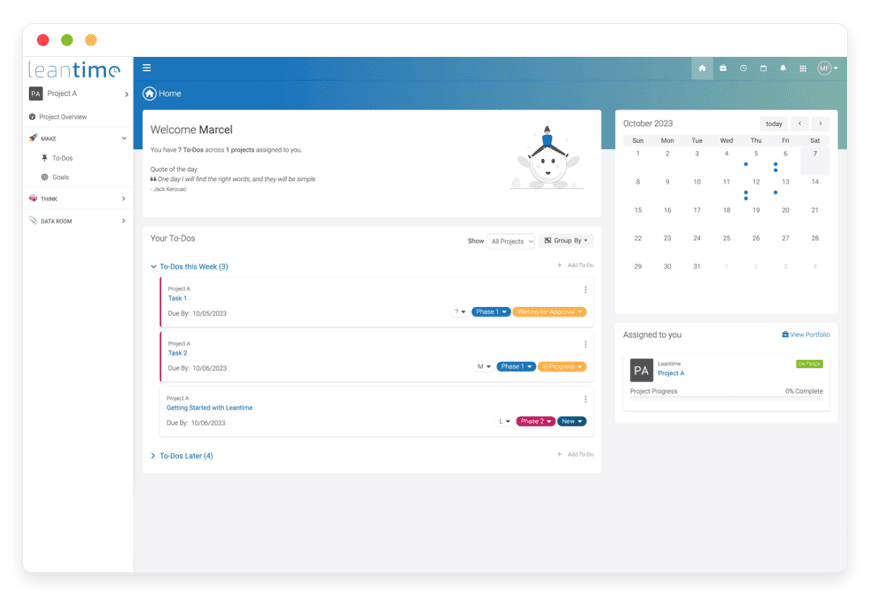
Leantime is the outlier on this list, and the most interesting if you are running a small business rather than a software team. It pairs the usual Kanban and list views with strategy tools you would not find inside Trello or Asana: OKRs, goal trees, Lean Canvas, SWOT, business model canvas, idea boards, and time tracking.
Around 9.8k stars on GitHub, PHP, AGPL-3.0 licensed with a plugin exception that allows proprietary extensions. The project is openly designed for “non-project managers” and explicitly built with neurodiversity in mind — ADHD, dyslexia, and autism are referenced directly in the design choices, from optional dyslexia-friendly fonts to a reduced-cognitive-load UI.
Best for: agencies, founders, and small business owners who want one tool to connect strategy ("what are we trying to do this quarter") with execution ("what is on the board this week"). Strong fit for marketing studios, consultancies, and small R&D groups.
Trade-off: native mobile apps do not exist yet — the web UI is responsive, but if mobile is a hard requirement, this is not the pick. Portfolio-level resource scheduling is also lighter than Taiga or a dedicated PM tool.
Read more on the Leantime page.
Comparison at a glance
| App | Replaces | License | GitHub stars | DANIAN price | Trello import | Switching effort |
|---|---|---|---|---|---|---|
| Wekan | Trello | MIT | ~20.5k | €9 /month | Native JSON | Low |
| Kanboard | Trello (minimal) | MIT | ~9.6k | €9 /month | CSV / API only | Medium |
| Vikunja | Todoist + Trello | AGPL-3.0 | ~4.2k | €9 /month | Native importer | Low |
| Taiga | Asana, Jira | AGPL-3.0 / MPL-2.0 | ~6.4k | €9 /month | Native importer | Medium |
| Leantime | Asana, Notion, ClickUp | AGPL-3.0 | ~9.8k | €9 /month | Manual / API | Medium |
Read the table left to right and the picture is consistent: every option lands at €9 per app per month on a managed plan, regardless of team size. At ten seats, Trello Premium is $100 per month and Asana Starter is $109.90 per month for the same logical surface. At twenty-five seats, Trello is $250 and Asana Starter is $274.75. The break-even arrives between the first and second seat.
How to pick — three questions
1. What were you actually using on Trello or Asana? If the answer is "boards, lists, cards, due dates, and the occasional checklist", Wekan or Kanboard cover the workflow without surprise. If you were running sprints with story points and burndowns, look at Taiga. If your boards were a wrapper for the real work — quarterly goals, OKRs, strategy docs — Leantime is the better fit. If you used Trello mostly as a personal to-do list that occasionally turned into a shared board, Vikunja is the closest match.
2. How important is "looks and feels modern"? Wekan and Vikunja have the most polished interfaces in this group. Taiga is clean but obviously designed for an agile audience first. Kanboard is functional and fast but visibly older. Leantime is modern and warm but optimised for clarity rather than density. If your buying signal is "the team has to like opening it in the morning", weight this question heavily.
3. Are you a software team or a business team? Software teams skew toward Taiga (Scrum/Kanban for product work) or Vikunja (lighter, developer-friendly). Business teams skew toward Wekan (Trello DNA), Kanboard (lean operations), or Leantime (strategy + execution). The line is fuzzy, but the wrong side of it usually means six weeks of "why does this tool think in user stories?"
Migration realism
The honest version of "easy to switch" varies by source and target.
Trello → Wekan is the cleanest path on this list. Open a Trello board, go to the board menu, choose "Print and Export", then "Export JSON". Save the file. In Wekan, click "Add a new board", pick "Import from Trello", and paste the JSON content. The official Wekan migration guide walks the same path. Labels, lists, cards, comments, and attachments come across. Members are mapped manually — Wekan shows the Trello users found in the board and lets you assign each to a Wekan account.
Two known limits to plan for: Trello does not export comments older than around December 2014, and the attachment download can time out on very heavy boards. For a typical board with a few hundred cards, the whole process takes minutes.
Trello → Vikunja follows the same shape. Vikunja’s native Trello importer reads the JSON export and maps boards into projects, lists into kanban buckets, and cards into tasks. The mapping is slightly less one-to-one than Wekan’s because Vikunja has a richer task model (subtasks, repeating tasks, multiple views), but data loss is minimal.
Trello → Taiga also has a native importer that ships in both the SaaS and self-hosted builds. Boards, lists, cards, and members map across. Story points and sprint metadata do not exist in Trello, so those start empty.
Asana → Taiga is the rough one. Asana lets you export each project to CSV or JSON from the project’s dropdown menu. The CSV contains tasks, sections, assignees, due dates, custom fields, and completion state. It does not contain comments or attachments — those need to be exported separately via the Asana API. Taiga’s Asana importer is only enabled on the official SaaS instance, not in the self-hosted build. Migrating from Asana to a self-hosted Taiga means CSV-import scripting or manual mapping, project by project.
Asana → Leantime follows the same pattern — Asana CSV out, manual or API mapping in. Leantime has no native Asana importer.
The practical advice: pick one project as the test migration. Run it end-to-end. Decide whether the data loss is acceptable before promising a full cutover.
Frequently asked questions
Is Wekan really a Trello replacement, or just close?
It is close enough that a Trello-fluent user can find every common feature within a few minutes of opening it. Boards, lists, cards, labels, due dates, checklists, comments, attachments, swimlanes, WIP limits, and member assignment all map directly. The visual style is different, and there is no equivalent to Trello’s Butler automation engine on the Wekan free side. Power-Ups have no direct equivalent — most of what they did is built into the core.
Can I run any of these for a one-person team without it feeling overbuilt?
Vikunja is the natural pick for one. It treats a single user with the same fidelity as a team, and the list-plus-kanban combination matches how most individual operators actually work. Wekan also works fine for one, though some of its team-focused features (member assignment, swimlanes) sit unused. Leantime works for one but is heavier than the use case usually needs.
What about ClickUp, Monday, Notion, or Jira?
This article is about open-source replacements. ClickUp, Monday, and Notion are proprietary SaaS in the same per-seat category as Trello and Asana, so swapping into them solves a feature problem but not the renewal-cost problem. Jira is a closer parallel to Taiga in shape but priced and positioned for larger organisations. If "open-source" is not a hard requirement, the comparison set widens; if it is, the five tools above are the durable answers in 2026.
Will I lose Trello’s automations (Butler) if I move to Wekan?
Yes, in the literal sense — Butler rules do not export. Most workflows can be rebuilt using Wekan’s own rules engine or by routing actions through n8n, which DANIAN also hosts. Webhooks and a REST API are available on the Wekan side, so most "when card moves to Done, post to chat" patterns are recreatable in an evening.
How does the AGPL affect me as a normal user?
For most teams, not at all. The AGPL only meaningfully constrains you if you intend to modify the software and offer it as a network service to third parties. Running it internally — even with hundreds of users — is unaffected. The MIT-licensed options (Wekan, Kanboard) are more permissive if you ever plan to fork, embed, or commercialise the code.
What does €9 per app actually include on a managed plan?
Hardware, security patching, version updates, daily off-site backups, monitoring, the chat-based support that handles DNS, SMTP, and configuration questions, and a 7-day free trial up front. There is no per-seat charge on top — a Wekan instance for a team of fifty pays the same €9 as a Wekan instance for a team of three. The cap is the per-app resource ceiling (512 GB RAM, 64 vCPU, 16 TB storage), well above what any of these tools needs for SMB-scale boards.
What is the best open-source alternative to Trello in 2026?
Wekan is the closest visual and conceptual match — same boards/lists/cards vocabulary, MIT licensed, around 20.5k GitHub stars, with a native Trello JSON importer. Kanboard and Vikunja are the runners-up depending on use case. Wekan covers the drop-in scenario, Kanboard fits minimalist workflows, Vikunja suits to-do plus board hybrid use.
What is the best open-source alternative to Asana in 2026?
Taiga is the closest match for teams that ran Asana as a project board with sprints, portfolios, or release planning. For strategy-led use — OKRs, quarterly goals, business model canvas alongside execution — Leantime fits better. Both replace the per-seat axis: managed on DANIAN, each is a flat €9 per month, unlimited users.
What is the best open-source Jira alternative?
Taiga is the closest match — sprints, user stories, story points, epics, sub-tasks, burndowns, and issue tracking in one workspace, with both Scrum and Kanban views. Named adopters include RedHat, Orange, and Lockheed Martin. Around 6.4k GitHub stars on the classic AGPL-3.0 codebase; a newer MPL-2.0 rewrite from Kaleidos Ventures is also live.
How much does Trello cost for a team of 20?
Trello Premium is $10 per user per month on annual billing, so 20 seats is $200 per month or $2,400 per year. On monthly billing, it rises to $12.50 per user — $3,000 per year. Multi-board guests count as paid seats. Trello Standard at $5 per user covers basic Kanban for $100 per month at 20 seats.
How much does Asana cost per year for 10 users?
Asana Starter is $10.99 per user per month on annual billing — $109.90 per month or $1,318.80 per year for 10 users. On monthly billing it rises to $13.49 per user, $1,618.80 annually. Asana Advanced at $24.99 per user per month works out to $2,998.80 per year for 10 users.
Is Kanboard still maintained in 2026?
Yes, with a caveat. The project is in “maintenance mode” by the author’s explicit choice — security patches and small fixes ship regularly, but no major new features are planned. The codebase has around 9.6k GitHub stars, recent releases address active CVEs, and the documentation is current. Stable rather than abandoned.
Does Wekan have a mobile app?
Wekan has no native mobile app in 2026. The web UI is responsive and works on mobile browsers, but there is no official iOS or Android client. For native mobile in this group, Vikunja is the better pick — it ships official desktop apps and a mobile app in alpha, all talking to the same self-hosted backend.
Does Taiga support both Scrum and Kanban?
Yes, and the same project can use both side by side. Taiga ships dedicated Scrum modules — backlog, sprint planning, sprint task boards with swimlanes per story, burndown charts, story-point estimation — and Kanban modules with customisable columns and WIP limits, inside one workspace. Teams can run a Scrum backlog and a Kanban board at the same time.
Does Leantime support OKRs and goal tracking?
Yes — OKRs are a core part of Leantime’s design. Goals link to milestones, milestones link to to-dos, and the dashboard shows progress at each level. It also ships SWOT, Lean Canvas, business model canvas, and idea boards alongside the usual Kanban and Gantt views. AGPL-3.0 licensed with a plugin exception for proprietary extensions.
Can Vikunja replace Todoist?
For a single user, yes — Vikunja covers Todoist’s core surface: lists, subtasks, repeating tasks, reminders, priorities, labels, and saved filters. It also adds kanban, Gantt, and table views that Todoist does not offer. Vikunja ships a native Todoist importer that pulls projects, tasks, due dates, and labels across in one step.
What is the best open-source project management tool for an agency?
Leantime is the strongest fit. OKRs and goal tracking connect client objectives to deliverables, time tracking handles billable hours, and the Kanban and Gantt views handle execution. Wekan is the lighter alternative when board-and-list work is enough. For software-development agencies, Taiga’s Scrum modules fit teams already running user stories and sprints.
How do I migrate from Trello to a self-hosted kanban tool?
Export each Trello board as JSON from its “Print and Export” menu. For Wekan, paste the JSON into the “Import from Trello” form on a new board — labels, lists, cards, comments, and attachments come across in one step. Vikunja and Taiga both ship the same native importer. Members are mapped manually after import.
What server specs do I need to host Wekan myself?
Wekan recommends a minimum 4 GB RAM production server with at least one dedicated CPU core for typical small-team load. MongoDB sits underneath and benefits from SSD storage with room to grow. Heavier deployments run multiple front-end containers behind a load balancer, with a dedicated backend database server and daily backups.
Can I host Wekan, Kanboard, Vikunja, or Taiga on a Raspberry Pi?
Technically yes — the projects ship ARM-compatible containers. In production, none are a good fit on a Pi. SSD-backed databases, off-site backups, a static IP, and uninterrupted power matter more than CPU speed. For production, use a real server or a managed plan; Pis work for evaluation, not for a team’s daily project board.
Can I export my data from Wekan or Taiga to leave later?
Yes. Wekan exports each board to JSON or CSV from the board menu, with cards, lists, labels, comments, and members included. Taiga exports projects to JSON via the API and to CSV from the user-stories view. Vikunja and Leantime both expose JSON exports too. Open-source licences and public APIs prevent lock-in by design.
What to do this week
Three practical steps if any of this lands.
First, pull last month’s Trello or Asana invoice and multiply by twelve. That is the number any alternative has to beat to be worth the switching effort.
Second, pick the tool that matches how your team actually works — not the one with the longest feature list. Wekan if you liked Trello. Taiga if you run sprints. Leantime if your boards were a stand-in for strategy. Vikunja if a single shared tool needs to serve solo workflows and small-team boards. Kanboard if you want something quiet that will still be there in five years.
Third, run one project as a test migration before announcing anything. The 7-day trial on a managed plan exists for this.
Browse the full DANIAN catalog to see what else might come along on the same €9 footing.