Open-source subscription tracking in 2026 (Wallos)
Open-source subscription tracking in 2026: see every renewal coming
Most people pay less attention to subscriptions than to almost any other expense, until the charges add up. A self-hosted subscription tracker like Wallos gives you a clear renewal calendar without linking your bank. You enter each subscription once, and it shows the next charge, the monthly total, and the yearly total. Managed by DANIAN, it runs for €9 per month.
The short version
- Wallos is an open-source, self-hosted subscription tracker. You record your subscriptions once and see every renewal coming.
- It needs no bank access. Rocket Money auto-detects charges, but only after you link your accounts through Plaid.
- Wallos is manual. It will not detect charges for you, and it cannot cancel a subscription on your behalf.
- On price, Wallos does not win. Rocket Money has a free tier and a one-time app like Bobby costs a few dollars, while managed Wallos hosting is €9 per month.
- The reason to run it is privacy and ownership. Your records sit on an instance you control and can export.
Why people are rethinking subscription trackers in 2026
Subscriptions have quietly become a large monthly expense, and most people underestimate how much they spend. The tools meant to help often ask for your bank login or a subscription fee of their own. In 2026, more people want the renewal overview without handing over account access. That tension is the real story.
The free options changed first. Mint, the long-running budgeting app, shut down in March 2024. Many of its users moved to bank-linked apps that read every transaction to work.
Rocket Money is the best known of these. It scans your linked accounts, lists recurring charges, and on its paid tier cancels some of them for you. Premium runs on a sliding scale of about $7 to $14 per month.
That model works, but it carries a cost beyond money. To detect charges, the app needs ongoing read access to your bank and cards through Plaid. For some people that is a fair trade. For others it is the problem itself.
There is also the irony of the category. Paying a monthly subscription to track your subscriptions sits oddly with anyone trying to cut recurring spend. A tracker you own sidesteps that loop.
The underlying pattern is familiar. People sign up for a trial, forget it, and find the charge months later. Surveys keep finding that most of us underestimate our subscription spend, often by more than double. A tracker's real job is to make every renewal visible before it bills, so each one becomes a choice rather than a surprise.
What open source changes for a subscription tracker
Open source changes three things for a tracker: privacy, ownership, and durability. You run the software yourself, so it needs no access to your accounts. Your data lives on an instance you control rather than a company's cloud. And the project cannot quietly shut down the way a hosted app can.
Privacy comes from the architecture, not a promise. A self-hosted tracker has no reason to touch your bank, because you type subscriptions in by hand. Nothing is shared unless you switch it on. There is no third party reading your transactions, because there is no third party in the loop at all. There are also no ads and nothing to upsell, because the software is not trying to monetise your attention or your data.
Ownership means the data is portable. Wallos keeps everything in a standard SQLite database file you can download. You are never locked into one vendor or one phone.
Durability matters after Mint. When a hosted finance app closes, its users scramble to export and migrate. An open-source project lives on as long as someone runs it, and popular ones attract many contributors. Mint is the cautionary case: a free app with millions of users closed, and everyone had to leave. Code you can run yourself has no such off switch.
The honest catch is that self-hosting means someone has to run the server. You either do that yourself or pay someone to do it. That is where managed hosting comes in, and it is the part DANIAN handles.
Wallos, the open-source subscription tracker
Wallos is a self-hosted subscription tracker built by Henrique and released under GPL-3.0. It has around 8,000 stars on GitHub. You record subscriptions by hand, and it shows renewal dates, totals, and per-category spend. DANIAN hosts it for €9 per month.
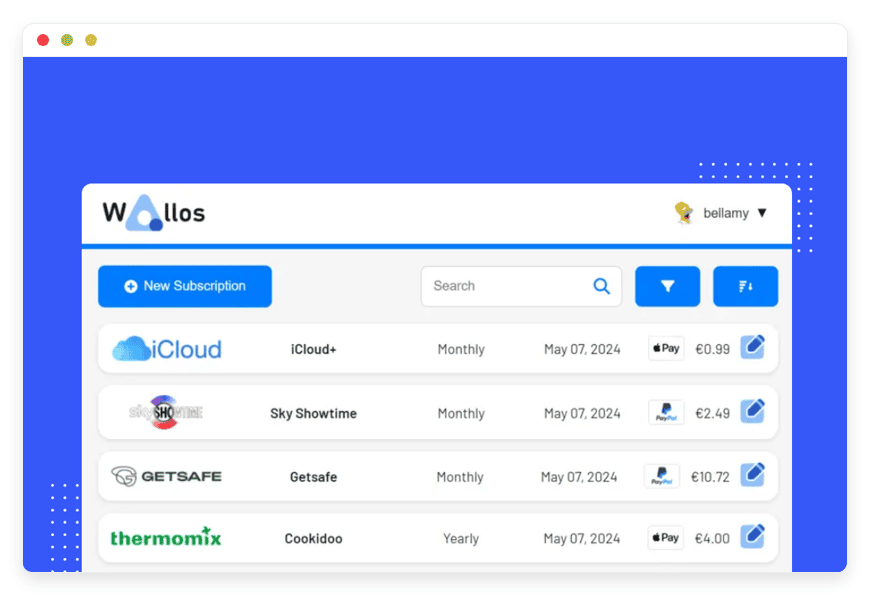
What it tracks. Each subscription carries a price, a billing cycle, a next payment date, a category, and a payment method. Wallos supports many currencies and converts them to one main currency using the Fixer API. The dashboard shows your next three payments and your weekly, monthly, and yearly totals. Version 4.9, released in May 2026, added lifetime subscriptions and a statistics page that sorts spending by category and usage.
Reminders. Wallos sends payment alerts through email, Discord, Telegram, Pushover, Gotify, or a webhook. You choose how many days of warning you want, and you can set it per subscription, so a large annual renewal can warn you earlier than a small monthly one. This is the one feature most people actually need, because it ends surprise renewals.
Extras. It runs as a web app and as a mobile-friendly progressive web app. It supports household members, single sign-on through OIDC, and a REST API. A recent version can pull spending suggestions from a local language model, so that work stays on your own hardware too.
What Wallos does not do. Wallos will not scan your bank or email to find subscriptions for you. It cannot cancel a subscription on your behalf. It is a manual tracker, and that is the point: the privacy comes from never needing your accounts. If you want automatic detection, a bank-linked app fits you better.
Wallos vs Rocket Money vs Bobby
Three tools cover most of this space, and they make different trades. Rocket Money automates detection and cancellation but needs your bank. Bobby is a clean, cheap manual tracker, but it lives on one iPhone with no export. Wallos is manual like Bobby, yet your data is portable and reachable from any browser.
The table below lays out what each one is, without spin.
| What you compare | Wallos (managed by DANIAN) | Rocket Money | Bobby |
|---|---|---|---|
| Monthly cost | €9/month | $7–$14/month (Premium); free tier | Free + ~$3 one-time |
| Bank account access required | No | Yes, through Plaid | No |
| Auto-detects subscriptions | No (manual entry) | Yes | No (manual entry) |
| Cancels subscriptions for you | No | Yes, on Premium | No |
| Your data | On an instance you own, exportable | On the vendor's cloud | On one iOS device, no export |
| Platform | Web and mobile browser | iOS, Android, Web | iOS only |
| Open source | Yes (GPL-3.0) | No | No |
Rocket Money is the most hands-off. It finds charges automatically and, on Premium, cancels some for you. The price is account access through Plaid plus a monthly fee.
Bobby is the simplest and cheapest. It is a well-designed iOS app with a one-time purchase of a few dollars and no bank access. The limits are real: iOS only, no data export, and updates have been infrequent.
Wallos sits between them on effort and ahead of both on ownership. You enter subscriptions yourself, as in Bobby, but your records live in a database you can move, and you reach them from any device. If a vendor changes its price or closes, your Wallos records are a file you already hold. That is the practical meaning of ownership.
The real cost, honestly
On headline price, Wallos does not win, and pretending otherwise would be dishonest. Rocket Money has a free tier, and Bobby costs a few dollars once. Managed Wallos hosting is €9 per month, which is €108 a year. You pay that for privacy and ownership, not for a lower sticker price.
Rocket Money. The free tier costs nothing and tracks subscriptions, provided you link your accounts. Premium runs on a sliding scale of about $7 to $14 per month, which is $84 to $168 a year. Bill negotiation is separate and takes a cut of any savings it wins.
Bobby. The base app is free, and a one-time purchase of around $3 unlocks unlimited subscriptions and a few extras. There is no recurring fee.
Managed Wallos hosting. DANIAN runs your Wallos instance for €9 per month. That covers the server, security patches, daily off-site backups, monitoring, and human support. There are no per-subscription fees and no paywalled features. A 7-day free trial runs without a credit card.
So the comparison is not really about price. Rocket Money and Bobby use different currencies and different models, and both can come in under €9 per month. The real question is what you want to pay with: money, or read access to your bank, or a single phone you can never move off.
Pair Wallos with Firefly III for the full picture
Wallos answers one question: which subscriptions am I paying, and when. It does not track the rest of your money. For income, spending, and where it all goes, pair it with Firefly III, a self-hosted double-entry finance manager released under AGPLv3. Wallos is the renewal radar; Firefly III is the full ledger.
Firefly III records every transaction with a source and a destination, which keeps the books balanced. It supports budgets, categories, tags, multiple currencies, and detailed reports. Like Wallos, it never contacts outside servers unless you set that up.
The two work well side by side. Wallos keeps the subscription view sharp and the reminders flowing. Firefly III holds the broader budget. Both run on instances you own, so neither needs your bank to function.
DANIAN hosts both. You can run Firefly III for budgeting alongside managed Wallos hostingmanaged Wallos hosting, each at €9 per month, in the region you choose.
How to pick: three questions to ask yourself
The choice comes down to three honest questions. Each one points you toward a tool, and there is no wrong answer, only the one that fits how you work. Read them in order, and the right pick usually falls out by the third.
- Do you want detection or privacy? If you want charges found for you, link a bank-aware app. If you would rather keep your accounts to yourself, enter subscriptions by hand in Wallos.
- Do you want one vendor's cloud, or data you own? A hosted app keeps your records on its servers. Wallos keeps them on an instance you control and can export at any time.
- Do you need cancellation, or just a clear calendar? Rocket Money Premium cancels some subscriptions for you. Wallos shows you what to cancel and when, then leaves the click to you.
Whatever you pick, the worst option is no tracker at all. An unread bank statement is how forgotten subscriptions survive. Even a manual list you check once a month puts those charges back under your control.
Frequently asked questions
What Wallos is and what it does
What is Wallos?
Wallos is an open-source, self-hosted subscription tracker. You record each recurring payment once, and it shows you renewal dates, monthly and yearly totals, and per-category spend. It is licensed under GPL-3.0 and runs as a web app you reach from any browser.
Does Wallos automatically detect my subscriptions from my bank?
No. Wallos is a manual tracker: you enter each subscription yourself. It never connects to your bank or scans your transactions, which is the trade-off for needing no account access at all. Rocket Money auto-detects charges, but only after you link your accounts through Plaid.
Can Wallos cancel a subscription for me?
No. Wallos shows you what you pay and when the next charge lands, but it does not contact providers or cancel anything. Cancellation stays your job. Rocket Money offers concierge cancellation, but only on its paid tier, and it cannot cancel every provider either.
What does Wallos actually track?
Wallos tracks recurring payments with their price, billing cycle, next payment date, category, and payment method. It supports multiple currencies and converts them to one main currency. The dashboard surfaces the next three payments and your weekly, monthly, and yearly spend at a glance.
Privacy and data ownership
Is Wallos private?
Yes, by design. Because you enter subscriptions by hand, Wallos needs no access to your bank, cards, or email. Your financial data stays on the instance you control rather than a vendor's cloud. Nothing leaves that instance unless you switch on a notification or the optional currency lookup.
Where is my data stored with managed Wallos hosting?
On the instance we run for you, in the region you choose from 21 locations across six continents. You pick the location at signup. The data sits in a hardened, isolated container, and we keep daily off-site backups so a single failure does not lose your records.
Can I export my data and leave?
Yes. Wallos stores everything in a standard SQLite database file you can download and keep. There is no lock-in: you can move your instance elsewhere or run it on your own hardware later. That portability is the main thing a one-time app like Bobby, which has no export, cannot give you.
Switching and setup
How do I move from Rocket Money to Wallos?
Open Rocket Money, read off your active subscriptions, then add each one to Wallos with its price and next billing date. There is no automated import, so budget 15 to 30 minutes for a typical list. You keep the renewal overview and drop the bank linking.
Does Wallos handle subscriptions in different currencies?
Yes. Each subscription can use its own currency, and Wallos converts everything to your main currency using exchange rates from the Fixer API. You add a free Fixer key in settings to enable live rates. This suits anyone paying for services billed in several currencies at once.
How does Wallos remind me before a charge?
Wallos sends payment reminders through your choice of channel: email, Discord, Telegram, Pushover, Gotify, or a webhook. You set how many days ahead you want the warning. That covers the one job most people actually want from a tracker, which is never being surprised by a renewal.
Can more than one person use the same Wallos?
Yes. Wallos supports multiple household members under one instance, so a couple or a family can track shared subscriptions together. It also supports single sign-on through OIDC providers. A phone-only app like Bobby keeps everything on one device, which makes shared tracking harder.
Cost and running it
How much does managed Wallos hosting cost?
Managed Wallos hosting is €9 per month at DANIAN. That covers the server, security patches, daily off-site backups, monitoring, and human support. There are no per-subscription fees and no paywalled features. A 7-day free trial runs without a credit card.
Is Wallos cheaper than Rocket Money?
Not on sticker price. Rocket Money has a free tier, and a one-time app like Bobby costs only a few dollars, while managed Wallos hosting is €9 per month. You pay for privacy, data you own, and no account linking, rather than for a lower headline price.
Why not just self-host Wallos myself?
You can. Wallos is free software and ships as a container, so a developer comfortable with servers can run it cheaply. Managed hosting at €9 a month makes sense when you would rather not patch, back up, and monitor it yourself. We run those parts for you.
Who runs the server, and who do I contact for help?
We do. DANIAN runs the instance, applies updates, and keeps daily off-site backups, so there is no server for you to maintain. When something needs attention, you reach a person. Resource and region changes go through that same channel when you need them.
Is it right for you
When is Wallos the wrong choice for me?
Wallos is wrong for you if you want charges detected automatically and cancelled on your behalf. If you will not enter subscriptions by hand, a bank-linked app like Rocket Money fits better. Wallos rewards people who value privacy and a clear renewal calendar over hands-off automation.
Is the free version of Rocket Money enough instead?
For many people, yes. Rocket Money's free tier tracks subscriptions and needs no payment, if you are comfortable linking your bank through Plaid. Choose Wallos when you would rather not grant that access and want your records on an instance you own. Both surface forgotten charges.
Does Wallos replace a full budgeting app?
No. Wallos focuses on recurring subscriptions, not your whole budget. For income, expenses, and where the rest of your money goes, pair it with Firefly III, a self-hosted double-entry finance manager. Wallos is the renewal radar; Firefly III is the full ledger.
What to do this week
If subscriptions keep catching you out, the fix is a tracker you actually trust. Try Wallos free on the public demo, then decide. If you want it running without managing a server, start a 7-day trial of managed Wallos hosting at DANIAN. No credit card is needed to begin.
Start small. List your active subscriptions once, add them to Wallos, and set a reminder a few days before each renewal. Within a month you will see the real total, and a few charges you had forgotten about. From there, cancelling one unused service often covers the cost of running the tracker for a year.
The demo at demo.wallosapp.com resets every two hours, so it is a safe place to try the interface. When you are ready for your own instance, start a 7-day trial and pick your region.
Owning your subscription data is a small act of control. It also tends to pay for itself the first time you catch a renewal you meant to cancel.
Sources
- Wallos project and source code: github.com/ellite/Wallos
- Wallos live demo: demo.wallosapp.com
- Rocket Money pricing: help.rocketmoney.com
- Bobby on the App Store: apps.apple.com
- Firefly III: firefly-iii.org