Open-source stack for software agencies in 2026
Most software agencies don't go shopping for new tools. They go shopping for a smaller bill. The bill that starts the search is usually the per-seat one: code hosting, CI minutes, monitoring, e-signatures. Each line grows every time you hire someone or take on another client.
This piece walks six open-source tools that cover an agency's core stack, what each one replaces, and what it costs to run on DANIAN.
The short version
- Six open-source apps cover an agency's core dev stack: Gitea for code, Woodpecker CI for pipelines, n8n for automation, Grafana for monitoring, Bugsink for error tracking, and Documenso for sign-off.
- On DANIAN, that's €9 per app — €54 a month, flat, no matter how many people you hire.
- The proprietary bundle they replace (GitHub Team, CI minutes, Datadog, DocuSign, Sentry) clears $280 a month for a ten-person shop, and climbs with every seat.
- Each tool here is open source, self-hostable, and yours to export. You rent the operating, not a license.
Who this list is for (and who it isn't)
This is for the founder or technical lead at a 3-to-25-person software agency, choosing the tools the team runs on. It assumes you bill clients, hire as you grow, and watch per-seat costs do the same. It is not a list for a solo developer on a free tier, who already pays nothing and should stay there.
Two other people should skip parts of this. If your pipelines are deep in GitHub Actions and nobody has time to rewrite them, the CI section below names the friction honestly before you commit. And if a client contract requires a vendor's signed security attestations today, a certified SaaS is the right fit for that account — run the open-source stack for everything else.
For everyone in the middle — a growing shop where the software bill scales faster than revenue — the math is the reason to read on. The per-seat lines climb with every hire; the per-app cost does not. That gap is exactly what widens as you take on more people and more clients.
The shortlist
Six tools, six jobs. Each one is open source, each runs on DANIAN at €9 a month, and each replaces a per-seat or metered SaaS line. For each: what it replaces, what it does well, the team it suits, and the honest catch.
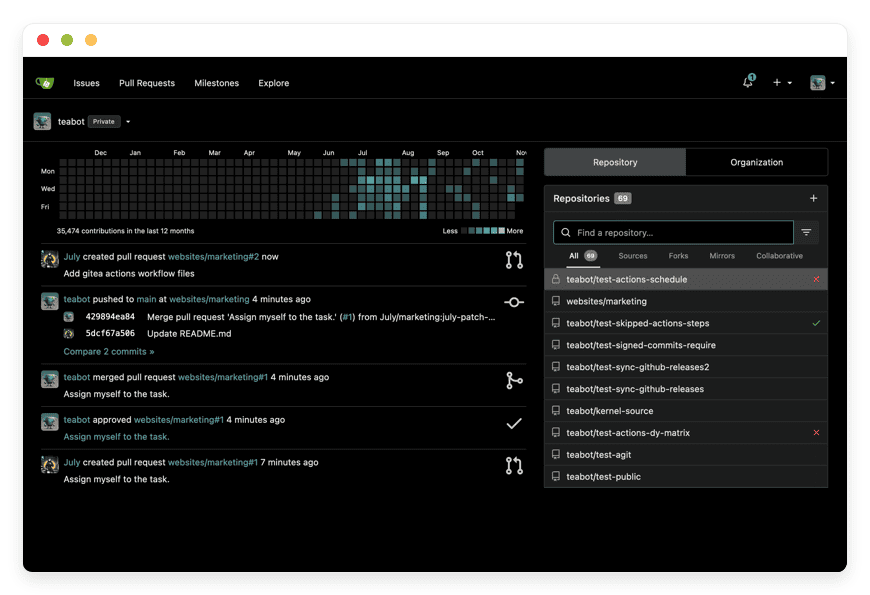
Gitea — code hosting and repositories
Gitea replaces the code-hosting seat — GitHub Team, in most agencies.
It is an MIT-licensed, self-hosted Git platform: repositories, code review, pull requests, issues, kanban boards, and a package registry for more than twenty formats.
It also ships built-in CI, called Gitea Actions, that is compatible with GitHub Actions and can reuse existing Actions workflows.
It runs on Linux, Windows, macOS, FreeBSD, and Kubernetes, and backs onto SQLite, MySQL, or PostgreSQL.
What it does well: it is light and fast, the interface is familiar to anyone who knows GitHub, and it mirrors or imports repositories from GitHub in one pass. The import carries issues and pull requests across, not just the code, so a repository move keeps its history intact. It runs as a single binary, which keeps it simple to operate and quick to back up. And there is no seat math: the price is the app, not the number of developers pushing to it.
On DANIAN it is managed Gitea hosting at €9 a month, in the region you choose.
The honest catch: GitHub's ecosystem is bigger — the Marketplace, Codespaces, Copilot, and the simple fact that contributors are already there. GitHub Team lists at $4 per user, per month on annual billing, with 3,000 shared Actions minutes. Its Enterprise tier, where the heavier controls live, lists higher at $21 per user. If client work depends on a public GitHub presence, keep a GitHub account for that and run Gitea for the team's own repositories.
Woodpecker CI — build and deployment pipelines
Woodpecker replaces metered CI — GitHub Actions minutes, or a hosted plan like CircleCI.
It is an Apache-2.0 CI/CD engine, a community fork of Drone.
Pipelines run as steps in Docker containers, are defined in a YAML file, and extend through plugins.
It is small: about 100 MB of memory for the server and 30 MB per agent.
It runs the CI at Codeberg, a privacy-focused Git host, which is a fair stress test.
What it does well: it is simple and container-native, and there is no per-minute meter. Your runner, your minutes, no overage email. Pipelines are plain YAML and every step is just a container, so what runs in CI is the same thing that runs on a developer's laptop.
On DANIAN it is managed Woodpecker CI at €9 a month.
The honest catch: if your pipelines live in GitHub Actions today, moving to Woodpecker is a rewrite. Woodpecker uses its own YAML and does not run Actions workflows as they are. Gitea's built-in Actions does run them — so if minimal migration matters more than a separate CI engine, the lower-friction path is Gitea Actions, and you can skip Woodpecker entirely. GitHub bills private-repo minutes past the free 3,000 at about $0.008 each, and from March 2026 self-hosted runners start consuming plan minutes too. Budget the pipeline-rewrite time before you switch.
n8n — automation glue
n8n replaces per-task automation — the kind metered by Zapier or Make.
It is a workflow tool that mixes a visual canvas with code: you can write JavaScript or Python in any step.
It has more than 500 ready integrations and a generic HTTP node for everything else, and it is among the most-starred projects on GitHub, at 190,000 stars and counting.
You self-host it with Docker, with the full source on GitHub.
A license note, to be straight about it: n8n ships under the Sustainable Use License — "fair-code," source-available rather than a classic OSI-approved open-source license. You can self-host and use it freely for your own work; what the license restricts is reselling it as a hosted product to others. For an agency's internal glue, that line doesn't get crossed.
What it does well: it chains the rest of the stack together. A push to Gitea triggers a Woodpecker build; n8n turns the result into a chat message, an issue, or a client update. Because any step can run code, the awkward integration that stalls a no-code tool is just a short script here. On DANIAN it is €9 a month. For reference, Zapier Professional runs about $73 a month for roughly 2,000 tasks; n8n's meter is your server, not your task count.
The honest catch: a workflow engine is logic you own and maintain, so complex flows need testing and version discipline, the same as code.
Grafana — monitoring and dashboards
Grafana replaces the dashboards-and-alerting layer of Datadog.
It is an AGPL-3.0 observability platform that connects to Prometheus, Loki, Elasticsearch, InfluxDB, Postgres, and many more, and renders metrics, logs, and traces with alerting built in.
It first shipped in 2014 and reached version 13.0 in April 2026, so it is mature and well-documented.
What it does well: it is the dashboard layer most engineers already recognize, and it speaks to data wherever that data lives. Point it at one source or a dozen, and it renders them on a single screen, with alerts that fire to chat, email, or a webhook. Years of shared community dashboards mean a starting board for a common service is often a copy-and-paste away.
On DANIAN it is €9 a month, in the region you choose.
The honest catch, and it matters: Grafana is the pane of glass, not the data store. To replace Datadog's full stack you still need a metrics source behind it — Prometheus for metrics, Loki for logs — either alongside Grafana or pointed at data you already collect. Grafana at €9 gives you the dashboards and alerts; the backend is a separate decision. Datadog, by contrast, lists Infrastructure Pro at $15 per host per month on annual billing ($18 on-demand), with APM adding $31 per host and logs billed on top. The per-host, per-module meter is what makes a small agency's Datadog invoice jump.
Documenso — client SOWs and sign-off
Documenso replaces DocuSign.
It is an AGPL-3.0 e-signature platform, "the open-source DocuSign alternative."
You upload a PDF, place signature fields, send it, the recipient signs, and you get a sealed, tamper-evident PDF with a complete signing record. It has templates, shareable signing links, teams, an API, and webhooks, and its signatures are legally recognized under the US ESIGN Act and UETA. It sits near 12,700 GitHub stars today. Reusable templates mean a standard statement of work goes out without rebuilding the document each time.
On DANIAN it is €9 a month.
The honest catch: it is a younger project than DocuSign, with a smaller integration ecosystem. And the AGPL network clause matters in one specific case — if you embed Documenso inside a product you sell to clients, that triggers source-disclosure or a separate commercial license. For internal use, which is sending your own statements of work and getting them signed, the network clause asks nothing of you.
DocuSign's Standard plan, for comparison, lists at $25 per user per month on annual billing ($54 monthly), capped near 100 envelopes per user per year.
Documenso on DANIAN is €9 flat, with no document ceiling.
How the six fit together
On their own, six tools are six logins. The value is the loop between them. A commit in Gitea triggers a build in Woodpecker; n8n turns the result into a notification, an issue, or a client update; Grafana watches the services in production; Documenso closes the contract that started the work.
The code path. Gitea holds the repositories. A push fires a Woodpecker pipeline. Build and test run in containers, on your own runners, with no minute meter ticking.
The glue path. n8n listens for the build result. A green build posts to chat, tags the client's issue, or updates a status sheet. A failed build opens a ticket and pings whoever is on call.
The watch path. The deployed app sends metrics and logs to a backend. Grafana renders the dashboard and fires an alert when something drifts before the client notices.
The paper path. When the work is scoped or delivered, Documenso sends the statement of work or the sign-off and seals the signed PDF for your records.
The combination most agencies land on: Gitea and Woodpecker as the code-and-CI spine, n8n as the connective layer, Grafana for visibility, Documenso for contracts, error-tracking with Bugsink. Each tool is replaceable on its own. Together they cover the dev-shop workflow end to end, on infrastructure you control, at a cost that doesn't move when you grow. The loop also removes the manual hand-offs between them — the copy-paste from build log to chat, the reminder to send a contract — which is where small teams quietly lose hours.
What the stack costs
Six apps on DANIAN is €54 a month, flat — about the price of one DocuSign seat plus a couple of Datadog hosts. The proprietary bundle they replace clears $280 a month for a ten-person shop. And unlike the €54, that number grows with every seat, host, and envelope you add.
First, what replaces what, and the DANIAN price for each:
| Tool | Replaces | DANIAN | Best for | Region |
|---|---|---|---|---|
| Gitea | GitHub Team (code hosting) | €9/mo | Any agency past a few seats | You pick (21) |
| Woodpecker CI | GitHub Actions / CI minutes | €9/mo | More than hobby CI | You pick |
| n8n | Zapier / Make (automation) | €9/mo | Stitching tools together | You pick |
| Grafana | Datadog dashboards | €9/mo | Watching live services | You pick |
| Documenso | DocuSign | €9/mo | Sending client SOWs | You pick |
| Bugsink | Sentry (error tracking) | €9/mo | — | — |
Now the math, for a ten-person dev shop. Figures are list rates on annual billing, May 2026, kept deliberately conservative — minimal hosts, minimal seats, no add-ons.
| Job | Proprietary SaaS (10-person shop) | Per month | On DANIAN |
|---|---|---|---|
| Code hosting | GitHub Team, 10 seats × $4 | $40 | Gitea — €9 |
| CI / CD | Actions minutes past the 3,000 shared (≈$0.008/min) | ~$25 | Woodpecker — €9 |
| Automation | Zapier Professional, ≈2,000 tasks | ~$73 | n8n — €9 |
| Monitoring | Datadog Infra Pro, 3 hosts × $15 | $45 | Grafana — €9 |
| Contract sign-off | DocuSign Standard, 3 seats × $25 | $75 | Documenso — €9 |
| Error tracking | Sentry Team | $26 | Bugsink — €9 |
| Total | ~$284/mo | €45/mo (5 apps) |
The arithmetic is plain. GitHub Team is 10 × $4, which is $40. Three Datadog hosts on Infrastructure Pro is 3 × $15, which is $45. Three DocuSign seats on Standard is 3 × $25, which is $75. Add Zapier Professional near $73, Sentry Team at $26, and the CI overage once the free minutes run out. That clears $280 a month — before APM, before log fees, before envelope overages, before a single Copilot seat.
The six live DANIAN apps are €54 a month, flat. Hire your eleventh person and it is still €54. The proprietary lines are per-seat or per-host: at twenty-five people, GitHub Team alone is $100, DocuSign climbs with every signer, monitoring climbs with every host. The integrated alternative doesn't escape this either — GitLab lists its Premium tier at $29 per user, per month, so the all-in-one route climbs with headcount the same way. The €54 doesn't move. That is the difference between renting per head and renting per app. DANIAN's pricing is €9 per app, per month, with a 7-day free trial.
Two honest notes on this comparison. The tools are not drop-in identical to the SaaS — Grafana needs a metrics backend behind it, and GitHub's ecosystem is wider than Gitea's. And the €45 is the hosting; the migration and the day-one adoption are work you still do. The saving is real. It is not free. Prices are list rates on annual billing as of May 2026; SaaS figures are in US dollars and DANIAN in euros, and the gap is wide enough that the exchange rate doesn't change the conclusion.
How to start
Don't migrate the whole stack in a weekend. Pick the tool whose bill annoys you most, run it on a 7-day trial, and move one real workload onto it. Prove it, then add the next one.
- Start with the loudest invoice. For most agencies that is monitoring or sign-off, not code. If Datadog or DocuSign is the line that stings, start there — both migrate cleanly and the saving lands immediately.
- Move one real thing. One client's repository to Gitea. One contract through Documenso. One live workflow into n8n. A trial with nothing real on it tells you nothing.
- Give it 14 days. Run the open-source version next to the incumbent, not instead of it, for two weeks. Keep the SaaS until the new tool has handled a real cycle.
- Then chain it. Once two tools are live, wire them together with n8n. That is the point where the stack starts paying for itself.
- Follow the order that works: sign-off and monitoring first for the clean wins, then code and CI where the migration is heavier, then automation as the connective layer, then error tracking with Bugsink.
What you can count on while the apps run: we patch them, back them up, monitor them, and stay on call when something needs a human. We won't raise your resources or your bill without asking you first.
FAQ
What's the best open-source stack for a software agency in 2026?
A practical core is six tools: Gitea for code, Woodpecker CI for pipelines, n8n for automation, Grafana for monitoring, Bugsink for error tracking, and Documenso for sign-off. Each is open source and self-hostable. On DANIAN the six run for €54 a month, flat, replacing a per-seat SaaS bundle that clears $280 for a ten-person shop.
Is this stack really free?
The software is open source and free to run yourself. What costs money is the running of it: a server, patching, backups, monitoring, and someone on call when it breaks. DANIAN does that part for €9 per app, per month. You are paying for the operating, not for a license.
How much does a self-hosted dev stack cost compared to SaaS for a ten-person agency?
The six live apps on DANIAN are €9 each, €54 a month total, no matter how many people you hire. The proprietary bundle they replace — GitHub Team, CI minutes, Datadog, DocuSign, Sentry — clears about $280 a month for a ten-person shop, and it grows with every seat and host.
At what team size does open source beat per-seat SaaS?
Usually around the fifth hire or the tenth client, when per-seat lines stack up. The €54 flat cost doesn't move as you grow. The proprietary bundle does: at twenty-five people, GitHub Team alone is $100, and monitoring and signing climb with every host and signer on top.
Do I have to run all six?
No. Each app stands alone at €9 per month, and nothing assumes you run the rest. Most agencies start with one, the tool replacing their most painful invoice, and add others once the first proves out. The stack is a menu, not a bundle, and you can stop at one.
Do I have to migrate everything at once, or can I switch gradually?
Switch gradually. Pick the tool whose invoice annoys you most, run it on a 7-day trial, and move one real workload onto it. Keep the SaaS running alongside for two weeks. Prove the new tool on a real cycle, then add the next one. Nothing here demands a big-bang migration.
How long does it take to set up a self-hosted dev stack?
On DANIAN each app deploys within minutes, and you never touch a server. The longer work is migration: moving repositories, rewriting pipelines, and rebuilding dashboards on the new tools. That part is your team's effort, not the hosting. Most agencies move one tool at a time rather than all six at once.
Do I need to know Docker to run these tools?
Not on DANIAN. Self-hosting these apps normally means Docker, a server, and command-line setup. On DANIAN that layer is handled: you pick a region, the app deploys within minutes, and you manage it from a dashboard. If you would rather run the containers yourself, every image here is public.
How does this compare to running these tools on my own VPS?
On your own VPS the software is still free, but you own the operating: provisioning, patching, backups, security, and monitoring, plus being on call when something breaks. DANIAN does that part for €9 per app. A bare VPS can be cheaper in raw server cost; the difference is whose weekend the maintenance lands on.
What does the open-source stack not do as well as the SaaS?
Two things, honestly. GitHub's ecosystem and reach are wider than Gitea's, so a public, contributor-heavy project may still want it. And Grafana shows you data without storing it, so a full Datadog replacement needs a metrics backend behind it. Everything else here sits close to parity.
Is Gitea a good replacement for GitHub for a professional team?
For a team's own repositories, yes. Gitea is a light, MIT-licensed Git platform with code review, issues, and built-in Actions that reuse most GitHub workflows. The honest gap is reach: GitHub's marketplace, contributors, and integrations are wider. Many agencies run Gitea internally and keep a GitHub account for public, contributor-facing work.
How hard is it to move off GitHub Actions?
Moving to Woodpecker means rewriting pipelines in its own YAML; it will not run your Actions workflows as they are. If you want minimal migration, Gitea's built-in Actions is compatible with GitHub Actions and reuses most existing workflows. Budget the rewrite time before you commit to Woodpecker, or stay on Gitea Actions.
Can Grafana fully replace Datadog?
Partly. Grafana replaces the dashboards-and-alerting layer, the part most teams look at daily. But Grafana shows data without storing it, so a full replacement also needs a metrics backend — Prometheus for metrics, Loki for logs. Budget that backend as a separate piece, not an afterthought, and Grafana covers the rest at €9.
Is n8n a real replacement for Zapier?
For self-hosted automation, yes. n8n has more than 500 integrations, a visual canvas, and code steps for anything missing, so an awkward integration becomes a short script. Its meter is your server, not a task count. Zapier Professional, by comparison, runs about $73 a month for roughly 2,000 tasks. Complex flows still need testing.
Is Documenso legally valid for signing client contracts?
Yes. Documenso produces a sealed, tamper-evident PDF with a complete signing record, and its signatures are recognized under the US ESIGN Act and UETA. You upload a PDF, place fields, and send it for signature. For internal use — your own statements of work and sign-offs — its AGPL license asks nothing extra of you.
What about error tracking, like Sentry?
Bugsink serves that purpose.
Can these self-hosted tools integrate with each other?
Yes, and that is the point. A push to Gitea triggers a Woodpecker build; n8n turns the result into a chat message, an issue, or a client update; Grafana watches the running service; Documenso closes the contract. n8n is the connective layer, with more than 500 integrations and a generic HTTP node for the rest.
Are these tools actually open source, and what licenses do they use?
Mostly classic open source: Gitea is MIT, Woodpecker is Apache-2.0, and Grafana and Documenso are AGPL-3.0. n8n is the one nuance. It ships under a source-available "fair-code" license, free to self-host for your own use but restricted from being resold as a hosted product. All six give you the full source and your data.
Can I use these open-source tools for paid client work?
Yes, for running your own agency. Gitea is MIT and Woodpecker is Apache-2.0, both permissive. Grafana and Documenso are AGPL-3.0. Their network clause only bites if you embed them in a product you resell. Internal use is fine. n8n's license restricts reselling it as a hosted product, which agency glue never does.
Can I get my data out if I leave?
Yes. Each app is open source and the data inside it is yours. You can export repositories, automation workflows, dashboards, and signed documents using standard formats and tools. DANIAN operates the apps and the servers; it does not own what is inside them, and leaving does not strand your data.
What if I want to move off DANIAN later?
You can, without a rebuild. Every app here is standard open source, so the same software runs on another host or on your own server. There is no proprietary format to convert and no lock-in. If DANIAN ever stopped fitting, you would move the instance, not re-platform your whole stack.
The bottom line
Agencies rarely switch tools for the features. They switch when the per-seat math stops making sense, usually around the fifth hire or the tenth client.
This open-source stack doesn't win on polish in every category — GitHub's ecosystem is wider, and Grafana needs a backend.
It wins on ownership, and on a bill that doesn't grow with your headcount.
Every tool here is open source, and the data inside it leaves with you if you ever go.
Six apps, €54 a month, flat, in the region you choose.
Start with the one invoice that annoys you most.
Run it for a week alongside what you have.
Keep what earns its place.