Open-source Salesforce alternatives for SMBs
Open-source alternatives to Salesforce for small businesses — EspoCRM and Dolibarr in 2026
TL;DR
- Salesforce Sales Cloud Pro Suite costs $100/user/month in 2026 (verified against the official Salesforce pricing page, April 2026). A 5-seat team pays $500/month — $6,000/year — before any add-ons.
- EspoCRM and Dolibarr are mature open-source applications that cover the SMB sales pipeline: leads, accounts, contacts, opportunities, forecasting.
- Managed by DANIAN, each runs at €9/app/month — flat. Not per seat. Break-even against Pro Suite arrives below one seat.
- The honest gap: Salesforce's value is the AppExchange ecosystem and the built-in Agentforce AI tooling. Open source matches the core CRM workflow at roughly one-tenth the cost; it does not match that breadth.
- This post covers the 2026 pricing math, what each open-source tool actually does, a side-by-side comparison, and three questions to ask before switching.
Why people are leaving Salesforce in 2026
Sales Cloud Pro Suite reached $100 per user per month in 2026, billed annually. Salesforce announced a 6% increase across Enterprise and Unlimited editions in August 2025 (Method, January 2026). Starter Suite sits at $25/user/month for basic contact and opportunity management; Enterprise runs $175/user/month; Unlimited $350; Agentforce 1 Sales $550. The pricing tiers and 2026 numbers are visible on the Salesforce Sales Cloud pricing page.
The per-seat math is what triggers the search. Five seats on Pro Suite is $500/month, $6,000/year. Ten seats is $1,000/month, $12,000/year. Twenty-five seats is $2,500/month, $30,000/year — and that is before Einstein analytics add-ons, Tableau Next, sandboxes, Premier Success, or implementation labour.
The sticker shock typically arrives at renewal. A team signed at low headcount three years ago, added five seats in 2024, three more in 2025, and now opens a renewal quote pushing past €10,000 a year for sales-team software. The CRM is doing useful work; the per-seat curve is doing harm. That is the buyer who lands on this page.
Three patterns repeat across the migration conversations DANIAN support has fielded since late 2024. First, edition creep — a team signs at Starter Suite, runs into a customisation ceiling, gets upsold to Pro or Enterprise, and the bill triples without the workflow getting much better. Second, add-on accumulation — Premier Success Plan, Tableau Next, Einstein analytics, sandbox licences, all of which sit on top of the per-seat base and are renegotiated separately. Third, contract opacity — annual billing requirements, written cancellation notices 30 to 60 days before renewal, and auto-renewal as the default. Some buyers discover the cancellation window has closed the week they open their renewal quote.
This article focuses on Sales Cloud — the lead, account, opportunity, and pipeline workflow. Service Cloud, Marketing Cloud, and Commerce Cloud are different products with different alternative shortlists. They get their own posts.
What "alternative" actually means here
A team replacing Salesforce typically considers three real paths.
Path one — cheaper SaaS. Pipedrive, HubSpot Sales Hub, Zoho CRM, Freshsales. Solves the price problem partially. Pipedrive Advanced is $29/user/month; HubSpot Sales Hub Professional is $90/user/month; Zoho CRM Professional is $23/user/month. Cheaper than Salesforce. Still per-seat. Still a vendor with control of the data.
Path two — self-hosted open source. Download EspoCRM, Dolibarr, SuiteCRM, or Twenty. Run on a $24/month production-class VPS. Patch monthly, back up daily, monitor uptime, handle email deliverability. The licence cost is zero. The operational cost is five to ten hours of setup and one to two hours of monthly maintenance at sysadmin labour rates.
Path three — managed open source. The same EspoCRM or Dolibarr application, deployed and operated by a managed-hosting service. €9/app/month, flat. No per-seat tax. Patching, backups, monitoring, and 24/7 support included. This is DANIAN.
This article is about path three. Paths one and two are real and discussed honestly where they fit.
What you give up by leaving Salesforce: the AppExchange — roughly 7,000 verified third-party integrations across marketing, support, finance, and industry-specific workflows. The Agentforce AI tooling layered into recent editions. The labour-market depth of certified Salesforce administrators. Open-source CRM does not replicate those at parity. It replicates the core sales workflow — which is what most 5-to-25-seat SMB teams actually use.
The shortlist
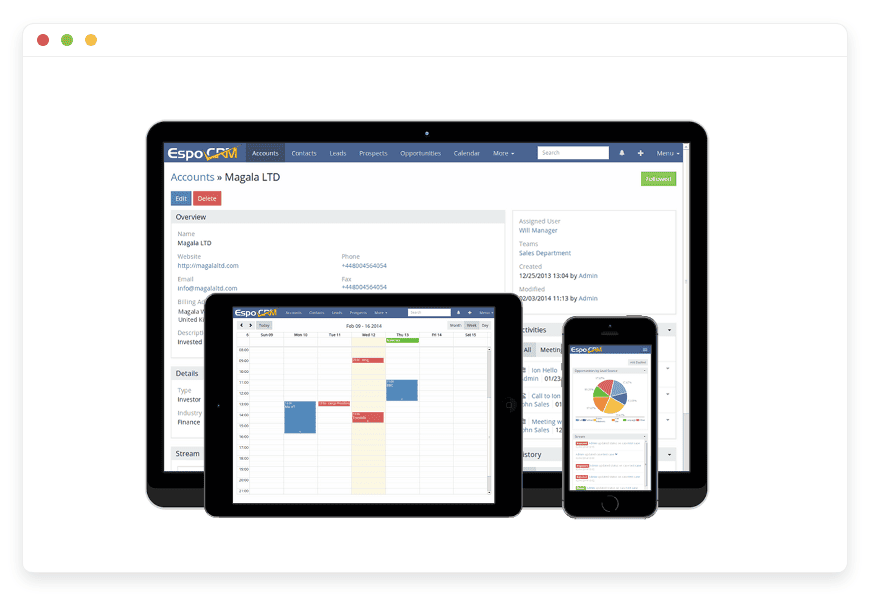
EspoCRM — the focused CRM
EspoCRM is a clean, focused customer relationship management application.
Leads, accounts, contacts, opportunities, pipeline forecasting, email campaigns, a customer portal, a Cases module for light support work, and a REST API.
Built and maintained by Letrium since 2014.
Licensed under GNU AGPLv3, with a commercial licence available for non-copyleft deployments.
The main GitHub repository shows roughly 3,000 stars and active development through 2026.
- Stack: PHP backend, single-page JavaScript frontend, MySQL / MariaDB / PostgreSQL.
- DANIAN price: €9/month — covers 1 vCPU, 30 GB storage, 1000 GB traffic, 24/7 email and ticket support, daily off-site backups, security patching, monitoring, SMTP, and DNS.
- Best for: SMB teams that want a clean CRM and nothing else — a direct replacement for Sales Cloud's core workflow without the rest of the platform.
- Honest weakness: ecosystem is thinner than SuiteCRM, marketing automation depth is lighter than HubSpot, the customer-portal UX is functional rather than polished.
Migration in is straightforward. EspoCRM imports CSV per object (Lead, Account, Contact, Opportunity), with field mapping and a custom-field editor in the admin UI. Most Salesforce exports map cleanly to EspoCRM's default schema; the friction is in re-implementing validation rules and workflows, not in moving the data.
If your team's job-to-be-done is "manage the sales pipeline cleanly without paying $100 per person per month," EspoCRM is the close swap. The product page at managed EspoCRM hosting covers deployment, included resources, and the 7-day trial.
Dolibarr — open-source ERP and CRM combined
Dolibarr is a modular ERP and CRM suite that combines the sales pipeline with invoicing, quotes, project management, timesheets, inventory, accounting, and HR modules — all in one application.
Started in 2002 by Rodolphe Quiédeville, maintained today by the Dolibarr Foundation and a contributor base of 800+.
Licensed under GPL-3.0.
The main repository shows roughly 7,200 stars with continuous commits.
- Stack: PHP, MySQL / MariaDB / PostgreSQL. Modular — enable only the modules you use, disable the rest.
- DANIAN price: €9/month base; same inclusions as EspoCRM.
- Best for: SMB teams that need CRM plus invoicing, quotes, and project management in one tool — not five tools.
- Honest weakness: the UI shows its age in places; module quality varies (core invoicing and CRM are mature, newer modules less so); the learning curve is steeper than EspoCRM because the surface is larger.
Dolibarr's strength is consolidation. A 5-person consultancy paying Salesforce $500/month plus QuickBooks $90/month plus Asana $100/month plus Calendly $50/month often replaces three or four of those line items with one Dolibarr instance. The arithmetic gets uncomfortable for the incumbent stack quickly.
The product page at managed Dolibarr ERP+CRM covers module selection, the standard deployment, and the same 7-day trial.
Comparison at 5 seats — the cost math
Numbers below verified against the Salesforce 2026 pricing page in April 2026 and DANIAN's published see DANIAN pricing structure.
| Option | Monthly (5 seats) | Annual | Pricing model | License / data |
|---|---|---|---|---|
| Salesforce Starter Suite | $125 | $1,500 | Per seat | Proprietary / vendor |
| Salesforce Pro Suite | $500 | $6,000 | Per seat | Proprietary / vendor |
| Salesforce Enterprise | $875 | $10,500 | Per seat | Proprietary / vendor |
| Salesforce Unlimited | $1,750 | $21,000 | Per seat | Proprietary / vendor |
| EspoCRM on DANIAN | €9 | €108 | Per application | AGPL-3.0 / customer |
| Dolibarr on DANIAN | €9 | €108 | Per application | GPL-3.0 / customer |
Break-even against Pro Suite arrives below one seat — at €9/month, the open-source-on-DANIAN path is cheaper than a single $100 Salesforce seat. Against Enterprise the gap widens further. The per-app pricing means a 5-seat team and a 50-seat team pay the same €9 for one application; usage limits scale, not seat counts.
What the table does not show: the AppExchange add-ons, Premier Success Plans, sandboxes, and Tableau Next licences that many Salesforce customers add on top of the base seat fee. Honest accounting puts effective Salesforce TCO 20 to 40% above the base list price in most SMB deployments.
The migration playbook — three weeks, part-time
The data move is the part most teams overestimate. Salesforce makes it harder than it should be, but the path is well-trodden.
Week one — extract and audit. Run Salesforce's Data Export from Setup. The system delivers a ZIP of CSVs, one per object, within 48 hours. Pull Account, Contact, Lead, Opportunity, Task, Note, Attachment at minimum. Audit the schema: list every custom field and every validation rule. Decide which ones move and which ones get dropped. Most teams discover that 30 to 40% of their Salesforce customisations were never used and quietly leave them behind.
Week two — load and map. Spin up an EspoCRM or Dolibarr trial on DANIAN, import contacts and accounts first to validate field mapping, then opportunities. The admin UI in both applications supports per-field mapping during CSV import. Rebuild the picklists (Lead Source, Industry, Opportunity Stage) to match the export. The custom fields that survived the audit get added through the application's admin panel, no code required. Workflow logic and automated emails rebuild here too — both applications support trigger-based workflows through the admin UI.
Week three — run in parallel. Keep Salesforce live as the system of record. Use the new instance for any new lead or opportunity. After a week of dual-running, audit which workflows broke, which reports are missing, which integrations need attention. Fix what's load-bearing, drop what isn't. At the end of week three, schedule the cutover for a quiet Friday.
Two parts that take longest in practice. Email deliverability — moving the sender domain from Salesforce's IP pool to a new SMTP path means warming up the new address and updating SPF / DKIM / DMARC records. DANIAN configures the SMTP infrastructure but the DNS edits stay on the customer's side. And the second slow part: reporting. Salesforce report builders are mature; rebuilding equivalent dashboards in EspoCRM or Dolibarr takes time, especially if the team has accumulated 50+ saved reports. Plan a half-day for the top ten dashboards; let the long tail rebuild on demand.
The features Salesforce wins on (honest broker section)
Three areas where Salesforce is genuinely stronger and where the open-source path requires a clear-eyed acknowledgement.
AppExchange ecosystem. Roughly 7,000 third-party apps span DocuSign integration, marketing automation, customer success platforms, industry verticals (financial services, healthcare, manufacturing), and regional add-ons (e-invoicing for specific jurisdictions). EspoCRM has a smaller marketplace; Dolibarr has DoliStore. Neither approaches AppExchange depth. If your sales process depends on a specific Salesforce-only integration, that is a real constraint to weigh.
Agentforce AI tooling. Salesforce has invested heavily in built-in AI: conversation intelligence on Enterprise and above, predictive lead and opportunity scoring on Unlimited, the full Agentforce agent layer on the $550/user/month edition. EspoCRM and Dolibarr have basic automation and webhook surfaces; the AI integration story is "bring your own model via API" rather than packaged. For teams whose sales motion runs on AI scoring today, that is a step backward.
Certified-admin labour market. Hiring a Salesforce administrator in any major metro is a known commodity. Hiring an EspoCRM or Dolibarr admin means hiring a generalist PHP developer or training someone internally. The institutional knowledge that comes with Salesforce certification is real and has a labour-market value.
If those three are load-bearing for your business, stay on Salesforce. If they aren't — and for most 5-to-25-seat SMB teams they aren't — the cost math wins.
When this swap doesn't work (the honest exclusions)
The cost math is real and the open-source applications are mature, but the switch is genuinely wrong for four buyer profiles. Worth naming them rather than pretending the answer is universal.
Regulated industries with attested-certification requirements. Some procurement processes — financial services compliance reviews, healthcare provider contracts, certain public-sector tenders — require the vendor to hold specific attested certifications. Salesforce holds those certifications today across multiple frameworks. Most managed open-source providers, including DANIAN, do not. If a procurement form is asking for documented certification reports, that is the honest answer: stay on Salesforce, or move to a provider with the attestation you need.
Teams whose sales motion runs on AI scoring. Salesforce's Einstein lead and opportunity scoring is built in at Unlimited and above; conversation intelligence is built in at Enterprise. Replacing that with a custom integration to an external model is possible but not trivial. If the AI scoring is doing measurable work in the sales process today, the open-source path is a step backward until the team builds equivalent tooling on top.
Heavy AppExchange dependency. Teams using five or more AppExchange add-ons typically have those integrations woven into the workflow in ways that are not obvious until they're missing. Migration is feasible but slow — each integration needs an open-source equivalent or a custom replacement. If the AppExchange dependency is load-bearing, the labour cost of replacing it can exceed the savings on the seat fee.
Companies in active fundraising or acquisition cycles. Procurement diligence in enterprise sales often weights vendor maturity heavily. Switching the CRM stack mid-cycle introduces a flag that buyers and investors notice. The savings are real; the timing might still be wrong. Finish the cycle, then revisit.
For the other 80% of small-business teams paying $500 to $3,000 a month for a sales pipeline they could run on either of these tools at €9 a month, the math is on the customer's side.
How to pick: three questions
CRM only, or CRM plus the rest?
EspoCRM is the focused choice: a CRM and nothing else. Smaller surface, faster to learn, easier for a non-technical owner to administer.
Dolibarr is the consolidation choice: CRM plus invoicing plus quotes plus project management plus timesheets, with optional modules for inventory, HR, and accounting. Worth it when you'd otherwise pay for three or four separate SaaS line items. Overkill when you genuinely just want a sales pipeline.
Replacing Salesforce, or replacing five tools at once?
If Salesforce is the only line item under review, EspoCRM is the cleaner swap. Same conceptual model — leads, accounts, opportunities — with a lighter UI and a sane pricing structure.
If a renewal cluster is hitting at the same time (Salesforce, plus a billing tool, plus a project tool, plus a quote tool), Dolibarr's modular approach absorbs more of the spend in one application. The migration is bigger; the consolidation savings are correspondingly larger.
What's your team's tolerance for "different"?
Salesforce-trained teams have years of muscle memory around the Lightning UI, the Apex code paths, the report builder, the AppExchange shortcuts. That knowledge has value and does not transfer. Budget 2 to 6 weeks for a team to feel productive in either EspoCRM or Dolibarr after switching.
Teams without prior Salesforce exposure adapt faster. Both open-source applications are simpler than Salesforce — fewer concepts, fewer object types, less ceremony around customisation. For a first-time CRM, the gap closes within days.
FAQ
How much do EspoCRM and Dolibarr cost on DANIAN at small scale?
Both run at €9 per application per month on the base plan. That covers 1 vCPU, 30 GB storage, 1000 GB monthly traffic, 24/7 email and ticket support, daily off-site backups, security patching, monitoring, SMTP, and DNS. No per-user fees and no per-seat tax. A team of 5 or 50 pays the same €9 for one application instance — usage limits scale, not seat counts. Resource upgrades happen with explicit consent; no silent overages.
What does Salesforce genuinely do better than EspoCRM and Dolibarr?
Three things, named honestly. The AppExchange — roughly 7,000 verified third-party integrations across marketing, support, analytics, and industry-specific workflows. The Agentforce AI layer, including conversation intelligence and predictive scoring built into the higher editions. And the labour-market depth of certified Salesforce administrators. Open source matches the core sales pipeline workflow at roughly one-tenth the cost; it does not match that breadth.
Can EspoCRM or Dolibarr replace Salesforce Service Cloud?
Partially. EspoCRM ships a Cases module and a Customer Portal that handle support tickets. Dolibarr has a Ticket module. Neither matches Service Cloud's omnichannel routing depth, AI case classification, or knowledge management surface. If support operations are the core of your business, the gap is real. If support is a smaller share of the workload, both applications handle it cleanly.
What does data migration from Salesforce look like?
Salesforce exports to CSV per standard object — Account, Contact, Lead, Opportunity, Task, Note, Attachment. EspoCRM and Dolibarr both accept CSV imports with field mapping in the admin UI. Custom fields, validation rules, Apex automations, and Flow Builder logic do not transfer; those rebuild on the new platform. A 5-seat team with 18 months of Salesforce history typically completes the data move in one to three weeks of part-time work. DANIAN support assists with the import side; the export and field mapping stay on the customer.
Is open-source CRM safe for client data?
The application code is auditable — anyone can inspect both EspoCRM (AGPLv3) and Dolibarr (GPL-3.0) on GitHub. The hosting question is separate from the licence question: where the data sits, who can access it, what the backup discipline is. Application data on DANIAN runs in the region you choose from 21 datacenter locations across six continents. Backups run daily, off-site, with point-in-time restore available. Access logs are available on request. No vendor-side analytics on customer data.
What happens if I outgrow DANIAN later?
Export and migrate. The data belongs to the customer; the applications are open source. EspoCRM exports to JSON and CSV across all entities. Dolibarr exports across every enabled module. The destination can be a self-hosted server, a different managed host, or a cloud VM you provision yourself. The transfer cost is the standard CRM-migration effort that any platform change involves — not a vendor-lock-in penalty.
What's the best open-source Salesforce alternative for fewer than 10 employees in 2026?
For sales-only workflows, EspoCRM (AGPLv3, ~3,000 GitHub stars, 12 years of releases). For sales plus invoicing, projects, and inventory in one application, Dolibarr (GPL-3.0, ~7,200 GitHub stars, 24 years of releases). Both run on DANIAN at €9/month. Neither charges a per-seat fee, which is the dominant Salesforce cost driver below 10 employees.
What does Salesforce Sales Cloud actually cost over three years for a 5-seat team?
List pricing alone is $500/month on Pro Suite at 2026 rates — $18,000 over 36 months. Real bills usually add Inbox ($25/user/month), data-storage charges past 10 GB, sandbox add-ons, and implementation. SMB invoices commonly land 30–60% above list. The August 2025 announcement raised Enterprise and Unlimited tiers 6% on top of that base.
Which is the better fit — EspoCRM or Dolibarr — for a 5-person sales team?
EspoCRM. Built sales-first — Leads, Accounts, Contacts, Opportunities, and a pipeline view as the default workflow. Dolibarr leads with invoicing, projects, and inventory; its CRM module works but is secondary. A 5-person team focused on outbound and pipeline runs cleaner on EspoCRM. A team that also quotes and invoices runs cleaner on Dolibarr.
Can EspoCRM or Dolibarr scale past 100 users without breaking?
Yes, with appropriate resources. EspoCRM has documented production deployments at 250+ users; Dolibarr at 200+. The bottleneck is database tuning, PHP-FPM workers, and queue processing — not the application code. On DANIAN, a 100-user deployment moves off the base €9 plan into a higher-resource tier; upgrades happen with explicit customer consent.
Do EspoCRM or Dolibarr include AI features comparable to Salesforce Agentforce?
No, not at parity. EspoCRM ships an AI Assistant module that connects to OpenAI for text generation, summaries, and reply drafting. Dolibarr has community AI plugins for similar tasks. Neither matches Agentforce's predictive lead scoring, conversation intelligence, or autonomous agents. For SMBs without a data-science function, the gap is often acceptable; for AI-driven outbound, it isn't.
Will EspoCRM and Dolibarr integrate with my existing accounting, payment, and email tools?
Both ship REST APIs and webhook support, which is how modern integrations work. EspoCRM has direct integrations for Google Workspace, Microsoft 365, and Outlook. Dolibarr has 400+ official and community modules covering Stripe, PayPal, QuickBooks, Mailchimp, WooCommerce, and PrestaShop. An n8n instance on the same DANIAN account covers anything not handled natively.
Is there a mobile app for EspoCRM or Dolibarr?
EspoCRM ships official iOS and Android apps that connect to any instance via URL and user credentials. Dolibarr has community-maintained mobile clients on both stores plus a fully responsive web UI that handles 80% of field workflows. Outbound sales teams should test EspoCRM mobile first; back-office teams typically need only the responsive web view.
Can I add custom fields and automations without hiring a developer?
Yes. EspoCRM's Entity Manager lets a non-technical admin add fields, relationships, and layouts in the UI. Workflows are point-and-click. Dolibarr exposes Extra Fields per module through the admin interface and supports trigger automations via its Hooks system. Heavy custom logic still benefits from a developer; routine field and workflow changes do not.
Do EspoCRM and Dolibarr handle multi-currency and multi-language operations?
Yes, both natively. EspoCRM ships in 30+ languages with per-record currency conversion using configurable exchange rates. Dolibarr ships in 50+ languages with full multi-currency invoicing, multi-tax setups, and multi-company structures. For SMBs operating across regions, both ship stronger out-of-the-box than most proprietary CRM products, which typically charge add-on fees for the same capability.
Can open-source CRM replace HubSpot's marketing automation features?
Partially. EspoCRM includes Mass Email, recipient lists, and trigger-based Workflows. Dolibarr's Newsletter module handles bulk sends. Neither matches HubSpot's deliverability tooling, landing-page builder, or attribution dashboards. The common SMB pattern: keep CRM and pipeline in EspoCRM or Dolibarr, pair with a dedicated email-sending application (Listmonk or Mautic) for high-volume marketing.
When does HubSpot's free tier make more sense than self-managed open-source CRM?
When the team is under 5 people, the workflow stays inside HubSpot's native limits, and nobody can own user provisioning or backup discipline. The catch: HubSpot's free tier loses meaningful CRM features at the paid Starter step ($20/user/month), and contact-record ceilings arrive faster than most SMBs expect. Open-source removes both limits.
How are application version upgrades handled on a managed instance?
On DANIAN, version upgrades are part of the managed service. Minor patches deploy automatically with monitoring. Major upgrades — EspoCRM 9.x to 10.x style — are scheduled, announced ahead of time, and rolled out after a backup checkpoint. Rollback is available if a custom workflow breaks. Self-hosting on a VPS puts the same work on the customer.
When does self-hosting on a VPS make more sense than managed hosting?
When there's an in-house Linux administrator who already maintains servers, when the workload is non-critical (sandbox or test environment), or when the team wants kernel-level control. A €5 VPS plus 4–6 hours of monthly sysadmin work costs more in opportunity cost than a €9 managed instance for most SMB teams under 10 people.
What happens if EspoCRM or Dolibarr is abandoned by its maintainers?
The application keeps running. Open-source code does not disappear when a company changes direction. EspoCRM is backed by Letrium with 12 years of commercial sustenance; Dolibarr has the Dolibarr Foundation, 800+ contributors, and 24 years of history. Even in a worst-case fork scenario, the existing install runs indefinitely, and data export remains possible.
What support response time should a small business expect from DANIAN?
24/7 support is included, with the ticket section in the client portal as the primary channel — for DNS edits, configuration changes, integration setup, and resource scaling. Tickets perform operational work directly, handled by the engineers who run the systems. Email is the secondary channel for non-urgent items. No tiered support gating — every plan, including the €9 base, gets the same channel.
Conclusion — what to do this week
Three concrete moves.
First, pull the current Salesforce invoice. Multiply the seat count by $100 if you are on Pro Suite, $175 if Enterprise, or $25 if Starter. Annualised, that is the savings ceiling against the €9/month open-source path.
Second, start a trial of EspoCRM or Dolibarr on DANIAN. Seven days, no card required. Import 50 contacts and 20 opportunities from a Salesforce export. Run one week of real sales activity in parallel with the existing Salesforce instance. See whether the workflow holds.
Third, make the call at the end of week one. If the open-source tool covers the workflow, schedule the cutover. If it doesn't — if the AppExchange dependency or the AI scoring is genuinely load-bearing for your business — stay on Salesforce, having learned what specifically you were paying for. Either answer is fine. The one you want to avoid is renewing on autopilot without checking.
For pricing details across DANIAN's catalog: see DANIAN pricing.
For deployment specifics on each application: managed EspoCRM hosting and managed Dolibarr ERP+CRM.