Open-source Monday.com alternatives in 2026
Open-source alternatives to Monday.com in 2026 — OpenProject, Taiga, Leantime, Redmine compared
TL;DR
- Monday Work Management Pro is $19 per seat per month, with a 3-seat minimum. Five seats land at $95 per month. Twenty-five seats land at $475 per month — and that's before tax.
- Resource planning and workload management sit in Monday Enterprise — opaque pricing, contact-sales required. Pro covers time tracking but not workload.
- OpenProject, Taiga, Leantime, and Redmine each cover the planning, Gantt, time-tracking, and team-visibility work Monday Pro buyers actually do day to day.
- On managed open-source hosting at €9 per app per month, the same workload runs at a flat rate — not €9 per seat. Five seats, twenty-five seats, the price stays put.
- Pick by team shape: OpenProject for heavy classic-plus-agile PM, Taiga for Scrum-native product teams, Leantime for strategy-first non-PM owners, Redmine for engineering teams that want a workhorse.
Why people are leaving Monday in 2026
Monday's per-seat math is fine at three seats and bites around ten.
Pro at $19 × 10 seats is $190 per month, or $2,280 per year.
Resource planning and workload management require Enterprise — contact-sales pricing.
The Pro-to-Enterprise jump is where most renewal exits start, because the buyer can't quote it to a founder.
The pattern shows up at the renewal cycle.
A team that picked Monday at three seats for $27 per month on Basic now needs Pro for time tracking, so $57 per month.
A fifth person joins, so $95 per month.
A sixth and seventh land within a quarter, so $133 per month.
Then the project lead asks for workload visibility across two teams, and Enterprise arrives on the table.
The features sitting behind Pro — time tracking, advanced columns, private boards — are exactly the features growing teams find they need first.
There's a second pattern: data ownership. Monday hosts everything on Monday's infrastructure. Teams handling client work, regulated data, or any project that touches sensitive information increasingly want their tickets, their attached files, and their backups under their own control — without becoming a sysadmin. Open-source PM on managed hosting splits that knot: the customer owns the data and the app; somebody else owns the operations.
And there's a third pattern: feature drift. Monday keeps shipping AI features, automations, agent workforces, and workspace-level abstractions that growing teams pay for and don't actually use. The team needed Gantt, time tracking, and a board view. They're paying for an AI agent layer that sits unused after the trial. The math gets worse, not better, as the platform expands — the buyer pays for the roadmap, not for the product they signed up to use.
A fourth pattern shows up in the comparison set itself. The team that opens this article has already considered Asana, ClickUp, Wrike, Smartsheet, and Jira. Each one has a different shape of the same trade. Asana's per-seat math kicks in earlier. ClickUp's free tier is generous but the paid tier hits a workspace-storage ceiling fast. Wrike is built for larger teams. Jira is built for engineers who like Jira. None of them solves the underlying issue: the team is renting a product whose price compounds with team size, while the workload itself is roughly constant.
Open-source PM, hosted by someone who runs the server, breaks that compound. The price scales with the number of apps in the catalog, not with the number of seats in the team. A 25-person team and a 5-person team both pay the same €9 per month for one OpenProject instance.
Source for pricing: monday.com/pricing, verified 2026-05-19.
What "alternative to Monday.com" actually means here
There are three honest replies to "what should I use instead of Monday".
The first is another proprietary SaaS — Asana, ClickUp, Smartsheet, Wrike — which trades one per-seat math for another and lands the team on someone else's roadmap. Useful at small scale; same trap at growing scale.
The second is self-hosted open-source. The team installs OpenProject or Redmine on a server, patches the OS, manages the backup discipline, owns the on-call. This is a real job. It takes a developer comfortable with Ruby or PHP plus Docker plus a recurring maintenance cadence, plus a plan for what happens at 2am when the disk fills up.
The third is managed open-source. Somebody else runs the server; the team gets the app. This post is about the third path. It removes the operations work for €9 per app per month and gives back the four things Monday Pro buyers leave for: predictable pricing, no per-seat creep, data the customer can export on demand, and a real human when something breaks.
Self-hosted open-source PM also covers a meaningful slice of what Monday Pro and Enterprise gate behind tiers. OpenProject ships Gantt, agile boards, time tracking, cost reporting, workload visualization through the Team Planner, and Project Portfolio Management — out of the box, no Enterprise upsell. That's the structural reason this comparison works.
The shortlist
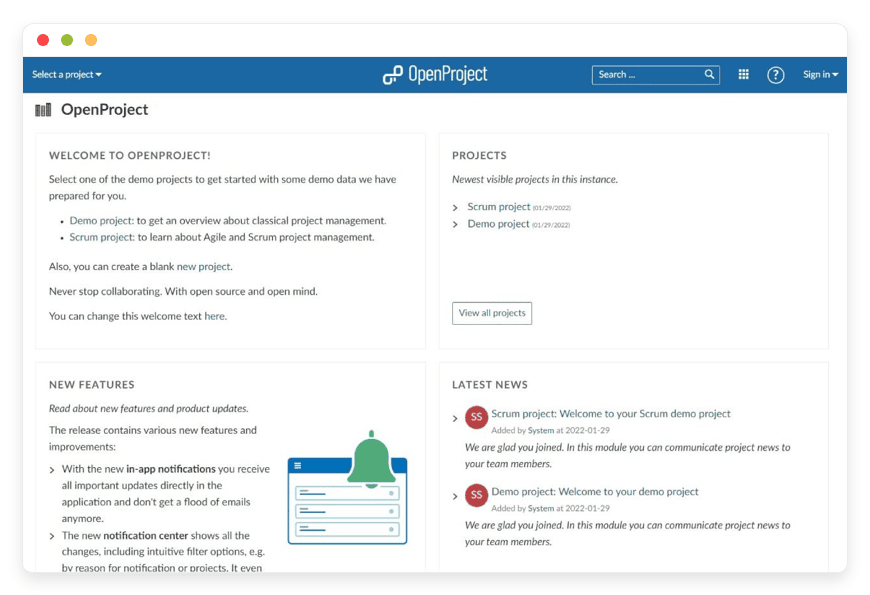
OpenProject — the enterprise-grade open-source PM
The Linux Foundation, Siemens, Deutsche Bahn, Greenpeace, Fraunhofer, Charité, AMG, and the City of Cologne run OpenProject. So does any team that wants classic project management with Gantt and milestone planning, agile boards with Scrum/Kanban and sprints (the 17.3 release in April 2026 added serious upgrades to the Backlog module), time tracking with cost reporting and budgeting, workload visualization through the Team Planner, and Project Portfolio Management — all in one product, no Enterprise tier required.
License: GNU GPL v3. Stars: 15,014 on github.com/opf/openproject. Standards supported include PRINCE2, SAFe, PM², and OKR. Atlassian's announced sunset of Jira Data Center by March 2029 has positioned OpenProject as the leading open-source Jira migration destination for teams that want to keep their PM data self-controlled.
On managed OpenProject hosting, the floor is €9 per month per instance.
Patching on the upstream release cadence, daily off-site backups, monitoring, and support from a named engineer included.
No per-seat fees.
Best for: teams of 10–200 that want classic + agile + portfolio management without paying Enterprise prices.
Sweet spot: a 15-person consultancy or in-house team running 4–8 concurrent client projects, where someone needs to see the workload across all of them on a Gantt and a workload board, and where a Monday Enterprise quote would land north of $300 per month for the same coverage.
Taiga — Scrum-native for product teams
Taiga is the open-source product Scrum/Kanban tool. Backlog grooming, sprint planning with EPICS and sub-tasks, estimation tools, sprint task boards with swim lanes, burndown charts at both the project and the sprint level — all out of the box, all built around the way agile teams actually work. The Kanban mode is feature-complete on its own: swim lanes, WIP limits, customization, zoom levels, user-story archive. Teams switch between Scrum and Kanban modes without losing data.
License: MPL 2.0 (back-end) / AGPL-3.0 (front-end). Built by Kaleidos Open Source S.L. Available in 20+ languages. Used by digital agencies, consultancies, and product teams that find Jira heavy and Trello shallow.
On managed Taiga for product teams, the floor is €9 per month per instance.
Best for: cross-functional product teams of 5–30 doing real Scrum, scrum-but, or Kanban.
The tool actually understands sprint mechanics — generic PM tools mimic them and then pretend.
Sweet spot: a SaaS product team that runs 2-week sprints with a clear backlog ritual and would otherwise pay Jira Software prices ($7.75–$15.25 per user per month at writing) to get the same scrum primitives.
Leantime — strategy and PM for non-PMs
Leantime built itself around a question most PM tools ignore: what's the goal, and how do today's tasks ladder up to it? Goals → Milestones → Tasks is the structure. A personal "My Work" dashboard pulls every assigned task across every project into one place. Whiteboards handle mind-mapping and wireframing. AI prioritization sorts the to-do list against the team's stated goals. Project Blueprints scope new initiatives. Time blocking schedules work against an iCal feed. Retrospectives, idea management, embedded docs, status reports, and time tracking round out the platform.
License: AGPLv3. Stars: 9,700+ on github.com/Leantime/leantime. Users include Fraunhofer, Linksys, Techstars, Harvard, and UNC Charlotte. Latest stable: v3.7.3 (March 2026). Designed with ADHD, dyslexia, and autism in mind — the cognitive overhead stays low.
On managed Leantime for strategic PM, the floor is €9 per month per instance.
Best for: small business owners, freelancers, digital consultancies, and any team where the person running projects isn't a trained project manager.
Sweet spot: a 6-person studio juggling 8 client retainers plus 2 internal initiatives, where the owner needs strategic clarity at the goals level and the team needs day-to-day kanban without learning a sprint cadence.
Redmine — the workhorse for engineering teams
Redmine has been around since 2006. It's not pretty by 2026 standards, and it doesn't need to be. Issue tracking with custom fields and per-project workflows, multiple project support with hierarchical structure, role-based access control with granular permissions, Gantt and calendar views, per-project wiki, per-project forums, time tracking, deep SCM integration with Git, SVN, Mercurial, Bazaar, and CVS, email-to-issue ingest, and LDAP authentication. Solid, stable, predictable. The team's release pace stays steady: 6.1.2, 6.0.9, and 5.1.12 all shipped together on 2026-03-16.
License: GNU GPL v2. Stars on the canonical GitHub mirror at github.com/redmine/redmine: 5,942. Written in Ruby on Rails. Canonical home: redmine.org, with the Subversion repository at svn.redmine.org.
Managed Redmine hosting at €9 per month per instance suits engineering teams that want a workhorse issue tracker tied to their Git history, without the polish (or per-seat price) of Jira.
Best for: dev shops of 5–50 that value stability and SCM hooks over glossy UI.
Sweet spot: an in-house engineering team supporting an established product, where the workflow is bug → ticket → branch → review → merge → release, and where the team's relationship with their PM tool is measured in decades rather than redesign cycles.
Redmine doesn't change much from year to year, and that's the feature.
Comparison table — Monday Pro vs the four open-source heavyweights
Pricing reflects Monday's annual plan (monthly billing runs 18% higher).
DANIAN's row is flat at €9 per app per month, regardless of seat count. Sources: monday.com/pricing, openproject.org, taiga.io, leantime.io, redmine.org. Verified 2026-05-19.
| Tool | Cost @ 10 seats / month | Hosted on DANIAN | GitHub stars | Self-hostable | Switching effort |
|---|---|---|---|---|---|
| Monday Work Management Pro | $190 ($2,280/year) | — | n/a (proprietary) | No | Baseline |
| OpenProject | — | €9 flat | 15,014 | Yes | Medium |
| Taiga | — | €9 flat | ~830 (back-end) | Yes | Low–Medium |
| Leantime | — | €9 flat | ~9,700 | Yes | Low |
| Redmine | — | €9 flat | 5,942 | Yes | Medium |
The math: at five seats, Monday Pro is $95 per month. The same workload on managed OpenProject is €9 per month flat — and stays €9 when the team grows to ten, fifteen, twenty-five. The break-even point is two seats. Past that, every additional seat is pure savings, redirected to actual work.
Three-year picture, comparing Monday Pro at a steady 10 seats versus managed open-source PM at 1 app: $190 × 36 months = $6,840 on Monday, versus €9 × 36 months = €324 on DANIAN. Same Gantt, same time tracking, same team-visibility. The $6,500 gap pays for half a junior hire, an annual offsite, or three years of every other SaaS the team actually uses. The numbers compound in the customer's favor, not the platform's.
What Monday actually does better
Three honest concessions. First: Monday's interface is genuinely one of the most polished in the category. Drag-and-drop board editing, in-line video walkthroughs, the on-boarding flow — Monday spent eight figures making those feel effortless. Open-source PM tools historically optimize for function over polish, and the gap is real.
Second: Monday's template marketplace and integrations ecosystem are large. 200+ templates, native connectors to every common SaaS, the AI Agent layer. A small marketing team that wants a campaign-tracking board with HubSpot integration ready in twenty minutes will move faster on Monday than on any of the four open-source tools. The trade is locked-in templates vs. a more flexible base — both are real choices.
Third: Monday carries the formal security paperwork that some buyers require from their vendors at the corporate level. Open-source PM hosted with a smaller managed provider serves a different buyer — one whose budget is smaller, whose seat count is growing, and whose data-ownership concerns weigh heavier than the formal security paperwork. Both buyers exist; the math just lands differently.
How to pick — 3 questions to ask yourself
1. Do you need workload management or resource planning today?
If yes, Monday gates this behind Enterprise (opaque pricing, contact-sales). OpenProject ships it as the Team Planner and Project Portfolio Management in the Community edition — free to self-host, €9 per month on managed hosting. If the team doesn't need it now, the other three open-source tools all cover the basics — pick on the next two questions.
2. How does your team actually work — kanban, scrum, classic PM, or strategic OKRs?
Pure Kanban with light task management: any of the four works. Real Scrum with sprints, burndowns, and story-point estimation: Taiga is built for this, and OpenProject covers it well too. Classic PM with Gantt, milestones, and dependencies: OpenProject or Redmine. Strategic PM with goals → milestones → tasks for a non-PM owner: Leantime is the only one that frames the work this way out of the box. Picking against the team's actual cadence matters more than picking against the feature list.
3. Who runs the server — you, your developer, or someone else?
If the team has a developer in-house who enjoys patching, backups, and on-call work, self-hosting is genuinely cheaper. A 2 vCPU / 4 GB production VPS at around $24 per month, plus $5 per month for off-site backup, plus monitoring, plus 2–4 hours of sysadmin time per month, gets the team running. Total cost: roughly $44 in infrastructure plus €120–240 in time, every month, every month, every month.
If the team doesn't have that person — or that person has better things to do — managed hosting at €9 per app per month is the unfussy answer. No DevOps, no patching schedule, no on-call rotation, real human support when something breaks. The €9 buys the customer's time back, not just the server.
Spin up managed open-source PM in minutes
Pick the app, pick the region (21 datacenter locations across six continents), start a 7-day free trial — no credit card.
The app activates with patching, daily off-site backups, monitoring, and 24/7 email and ticket support already in place.
Resource upgrades require explicit consent; no silent overages.
Start with managed OpenProject hosting, or skip ahead to the FAQ for the migration questions buyers ask first.
FAQ
Will my Monday data migrate to OpenProject?
Partially. OpenProject's import tooling reads CSV exports of tasks, statuses, custom fields, and timelines. Comments, file attachments, dashboard configurations, and automation rules need manual rebuild. Most teams plan a one-week parallel run — keep Monday read-only while OpenProject takes over the active workload. A short export-import migration session usually takes 4–8 hours of admin time, less if the workspace is clean.
Is Leantime really for non-project managers, or is that marketing?
It's the design choice. Leantime starts with a goal, not a task list. The goal carries milestones; the milestones carry tasks. A small business owner who doesn't think in "epics" and "user stories" can plan a product launch in Leantime without learning agile vocabulary first. The trade-off is that hardcore Scrum teams will prefer Taiga or OpenProject's backlog tools for daily sprint mechanics.
Can a 25-person team run on Redmine without a sysadmin?
On managed Redmine hosting, yes. The hosting provider handles patching, backups, version upgrades, plugin compatibility, SMTP, DNS, and TLS certificates. The team handles Redmine admin: creating projects, assigning roles, configuring workflows, tweaking issue trackers. That's project-management admin work, not sysadmin work — usually 1–2 hours per week of someone's time, often the same person who would have run Monday.
What does "€9 per app per month" actually cover on DANIAN?
The full lifecycle of one app instance: hardware, security patching on the upstream open-source release cadence, daily off-site backups, monitoring, 24/7 email and ticket support with a named engineer, SMTP, DNS, and TLS certificates. Resource upgrades require explicit customer consent — no silent overages. The 7-day free trial requires no credit card, and data export is available on demand.
Which of these is closest to Monday's look and feel?
Honestly: none of them. Monday's interface is one of the most polished in the category, and open-source PM tools historically optimize for function over visual design. The closest in terms of modern, board-first UI is Taiga. OpenProject is functional and clear, less playful. Leantime feels more like a personal productivity tool with team features added. Redmine is the most utilitarian. If pixel-perfect interface is the deal-breaker, staying on Monday makes sense; if features and pricing matter more, the trade is usually worth it.
When does it make more sense to stay on Monday Pro?
Three honest cases. First: the team is under five seats and likely to stay there — per-seat math hasn't bitten yet. Second: the team specifically needs Monday's marketplace of pre-built templates and integrations and doesn't have time to set up equivalents. Third: a customer, a partner, or an internal reviewer requires the formal security paperwork Monday has at the corporate level. If any of those describes the team, the price premium buys real things. If none of them do, the open-source path saves real money.
OpenProject vs Redmine — which one should I choose in 2026?
OpenProject was forked from Redmine in 2011 and modernised everything Redmine kept lean. Pick OpenProject for a 2026-era interface, native Gantt and agile boards, Team Planner workload visualization, and Project Portfolio Management out of the box. Pick Redmine for stability above polish, deep SCM integration with Git, SVN, Mercurial, Bazaar, and CVS, a low resource footprint, and a workflow that hasn't materially changed in years. A 10-person consultancy juggling client projects usually lands on OpenProject. A long-running engineering team tied to a single repo and a stable issue taxonomy usually lands on Redmine. Both ship on managed hosting at €9 per month.
What is the best open-source Jira Data Center alternative now that Atlassian is sunsetting it?
OpenProject is the most direct match. Atlassian stops new Jira Data Center subscriptions on March 30, 2026, with full end-of-life on March 28, 2029, and OpenProject shipped an official Jira migrator in March 2026. The data model — projects, work packages, statuses, custom fields, users, attachments — maps cleanly. For agile-first teams, Taiga covers the Scrum primitives Jira Software ships. For lighter engineering shops, Redmine handles the issue-tracker plus SCM workflow without the operational overhead. None of the three has Jira's marketplace breadth, but the migration buys back data ownership and removes the per-seat compound.
Are OpenProject, Taiga, Leantime, or Redmine good enough to replace Asana, ClickUp, or Notion?
For the planning, tracking, and reporting work an Asana or ClickUp customer actually does day to day, yes. OpenProject covers Asana-grade timeline and portfolio work. Taiga matches ClickUp's agile features for product teams. Leantime fills the Notion-style goals-plus-tasks-plus-docs overlap for non-PM owners. Where open-source loses: interface polish, template marketplaces, mobile experience, and the casual onboarding flow proprietary tools spend millions on. Where open-source wins: data ownership, flat pricing that doesn't compound with team size, no feature gating behind enterprise tiers, and the freedom to export and move hosts on demand. The deal-breaker is rarely features. It's usually whether the team values the cost-and-ownership trade enough to live with the polish gap.
How does flat-rate managed hosting compare to per-seat pricing for a 25-person team?
At 25 seats on Monday Work Management Pro, the math is $19 × 25 = $475 per month, or $5,700 per year on the annual plan. Monthly billing runs about 18% higher. The same workload on managed OpenProject hosting is €9 per month flat — €108 per year — regardless of seat count. The break-even versus Monday Pro arrives at the second seat. From there on, every added person is free on the managed open-source side and another $19 to $228 per year on Monday. Scale the team to 50 and the gap is $11,400 versus €108. The flat-rate model decouples team size from infrastructure cost.
Do OpenProject, Taiga, Leantime, and Redmine have mobile apps?
Honest answer: limited. OpenProject ships responsive web that works on a phone browser plus a community iOS/Android app that covers the basics. Taiga has a mobile-friendly web interface and community apps of varying quality. Leantime is responsive web only — no first-party native app. Redmine has multiple community apps (Easy Redmine Mobile, Redmica, RedminePM) with different feature coverage. If a polished native iOS/Android app is mandatory, Monday's app is genuinely better. If field workers and execs mostly need read access and quick status updates, the responsive web experience works.
How do these tools integrate with Slack, Microsoft Teams, GitHub, and GitLab?
OpenProject has first-party GitHub, GitLab, Nextcloud, and OneDrive integrations plus an official Slack plugin (rudimentary — notifications, not two-way). Teams integration is community-built. Taiga ships first-party GitHub, GitLab, Bitbucket, Mattermost, and Slack integrations with webhook support both ways. Leantime has a small but growing set: Slack notifications, Mattermost, and an active webhook system that pairs cleanly with n8n or Zapier for everything else. Redmine has the widest plugin ecosystem of the four. Slack, Discord, Mattermost, and Rocket.Chat all run through redmine_messenger, and Git, SVN, Mercurial, and Bazaar are linked at the repository level by default. For automation glue, n8n is the open-source-native pairing — and DANIAN hosts it at €9 per month, same price band.
What happens to my data if DANIAN (or any managed open-source host) shuts down?
The customer keeps the data and the software. Database dumps, attached files, and configuration exports are available on demand from the dashboard. Because OpenProject is GPL v3, Taiga is MPL 2.0 / AGPL-3.0, Leantime is AGPLv3, and Redmine is GPL v2, the same software the customer was running can be moved to another managed host, a self-hosted server, or a different platform in under a day. The dependency is on the open-source project, not on DANIAN. That's the structural difference from Monday — where the data is portable on paper but the platform isn't.
Do these tools support SSO (SAML, OIDC, Google Workspace, Microsoft Entra)?
OpenProject supports SAML and OpenID Connect natively in the Community edition plus LDAP. Redmine handles LDAP out of the box and SAML via the redmine_saml plugin; OIDC is available through community plugins. Taiga supports OAuth (Google, GitHub, GitLab, Microsoft) and LDAP via plugin. Leantime supports Google and Microsoft OAuth plus LDAP through its OIDC plugin. Across the four tools, a team running Google Workspace or Microsoft Entra can wire up single sign-on without paying for an enterprise tier — which is what Monday gates behind its top plan.
How do I back up and restore a self-hosted project management tool?
Three components need backing up: the application database (PostgreSQL or MySQL), the uploaded files directory, and the configuration. The standard pattern is a nightly pg_dump or mysqldump, a tarball of the attachments directory, the config files, and a copy of both to off-site storage. Restoration is the reverse: spin up the same software version, load the database dump, restore the attachments directory, drop in the configuration, restart the service. On managed hosting, the operator handles all of this — daily off-site backups, weekly restoration tests, version-pinned restores. On self-hosted, plan for 2–4 hours of initial setup and 30 minutes per month of verification work. The discipline matters more than the tooling.
Which tool has the best Gantt charts, reporting, and resource management?
Gantt: OpenProject leads — interactive timelines, dependencies, baseline comparison, critical path. Redmine has basic Gantt out of the box; the Redmine Agile and Redmine Resources plugins add the polish. Taiga's Gantt support is weak — Scrum is the design centre. Leantime has a clean roadmap view but not classic Gantt. Reporting: OpenProject wins again with cost reports, time reports, and portfolio rollups. Leantime ships strong goal-progress and OKR reporting. Redmine has spreadsheet-like custom queries. Taiga focuses on burndown and velocity at the sprint level. Resource and capacity management: only OpenProject ships this in Community edition through Team Planner. Monday gates the equivalent behind Enterprise. For a team that needs all three categories without per-seat creep, OpenProject is the clean pick.
How long does it take to onboard a 15-person team onto these tools?
Leantime: under a day for a non-PM team. The goals-milestones-tasks structure mirrors how people already think. OpenProject: 3–5 days. The work-package taxonomy and custom-type system reward a planned setup, and the team needs 2–3 hours of training to use the Gantt and Team Planner views. Taiga: 1–2 days for a team already familiar with Scrum or Kanban; longer if the team is new to sprint mechanics. Redmine: 1–2 weeks unless a modern theme and a clean default workflow are pre-installed. The interface still reads as 2012 by default. Managed hosting compresses the timeline because the tooling is ready on day one — no install or upgrade overhead.
Can clients and external collaborators access these tools without buying full seats?
Yes, on all four. OpenProject offers placeholder users and read-only viewer roles at no per-seat cost — useful for client portfolio visibility. Taiga supports public-by-default projects, which works for open-source-style transparency. Redmine has a built-in anonymous role and granular per-project permissions, so external reviewers can comment without an account. Leantime has client roles designed for agency workflows — separate access scoped to specific projects. None of the four charges per viewer, which is the structural difference from Monday's free-viewer cap.
What's the API and automation story — can I build custom workflows like Monday's automations?
All four tools expose REST APIs and webhooks. OpenProject has a full REST API v3 with documented endpoints for work packages, projects, time entries, and users. Redmine's REST API covers issues, projects, time entries, and wiki; webhook support comes via plugin. Taiga's API is well-documented and used by its own front-end. Leantime has a REST API plus a webhook system that pairs cleanly with automation tools. For Monday-style automation logic — "when status changes to X, notify Y and create Z" — n8n is the open-source-native pairing. The two-tool combination (PM plus n8n) replaces most Monday automation use cases at €18 per month flat.
How many languages do these tools support — and is the documentation translated?
Redmine ships in 50+ languages through community contributions. Leantime is available in 40+ languages. OpenProject covers 30+. Taiga supports 20+. Documentation translation varies — Redmine and OpenProject have the broadest official documentation in English, German, French, and Spanish, with community translations for the rest. For teams that don't run primarily in English, this is often the deciding factor against US-built proprietary tools that ship in five languages and call it international.
What are the realistic performance and scalability limits — at what team size do these tools break?
Real numbers from production deployments: OpenProject runs comfortably on 4 GB RAM for around 100 users and scales to 1,000+ with PostgreSQL tuning and a faster server. Siemens and Deutsche Bahn run it at enterprise scale. Redmine handles 50,000+ issues without trouble; performance degrades above that without database indexing and caching tuning. Taiga works well for teams of a few hundred; larger deployments need horizontal scaling. Leantime is tested in production at around 500 users. For the audience of this post — 5 to 50 seats — none of the four hits a scalability wall. The hardware floor is more about backup volume and concurrent uploads than user count.
What to do this week
Pick one of the four based on the three questions above. Start a 7-day free trial at €9 per month — no credit card, deploy in minutes. Run a real project on it for five days. Compare with Monday side-by-side. By day six, the picture is usually clear.
The five-day test matters more than any feature comparison on a vendor page. Real workloads expose what a tool is and isn't. The Monday Pro buyer who watches their team file 40 tickets, run 12 sprint events, log 80 hours, and produce a portfolio rollup on managed open-source PM in a week has the answer they need — no Powerpoint deck required.
If the open-source path is the right one, the math is on the team's side.
Five seats: $95 versus €9. Ten seats: $190 versus €9. Twenty-five seats: $475 versus €9.
The numbers do the persuasion.
Try Leantime for strategic PM · or compare Taiga for product teams · or start with managed OpenProject hosting.