Open-source alternatives to Intercom in 2026
Open-source alternatives to Intercom in 2026 - Chatwoot, FreeScout, and Typebot
TL;DR
- Intercom now bills in two parts: a per-seat fee from $29 to $132 a seat each month, plus $0.99 every time its Fin AI resolves a conversation.
- A four- or five-agent team handling about 1,000 conversations a month, with Fin switched on, lands near $900 to $1,000 a month.
- Chatwoot is the open-source live-chat and shared-inbox platform that covers the same work: website chat, email, WhatsApp, Instagram, Messenger, and SMS in one place.
- The difference is the meter. A managed Chatwoot instance on DANIAN is €9 a month, flat, whatever the seat count or conversation volume.
- Pair it with FreeScout for heavier email ticketing or Typebot for pre-chat bot flows, and you have replaced an Intercom suite with software you control.
Why teams are auditing Intercom in 2026
Intercom's price has two moving parts in 2026. You pay a per-seat fee — $29 to $132 a seat each month, depending on plan — and then $0.99 every time its Fin AI agent resolves a conversation. For a team with real volume, the second number is the one that hurts.
The per-seat plans are Essential at $29 a seat, Advanced at $85, and Expert at $132, each billed annually. Paid monthly the figures rise to $39, $99, and $139. Every plan includes live chat and inbound email; the AI sits on top.
Fin is where the model changed. Intercom now calls a billable event an outcome — a resolution the customer confirms or stops replying to, or a procedure Fin runs that ends in a handoff. Each one costs $0.99, charged at most once per conversation. Per-seat pricing scales with headcount. Per-resolution pricing scales with success: the better Fin works, the more you pay.
The add-ons stack on top. A $99 analytics pack, a $99 proactive-messaging pack, and pay-as-you-go charges for email, SMS, and WhatsApp campaigns all bill separately. Fin can also run standalone on another help desk for $0.99 an outcome, with a 50-outcome monthly minimum — but the per-resolution meter is the same either way.
The math is easy to run. Take four agents on the Advanced plan handling about 1,000 conversations a month. Intercom's own case studies put Fin's resolution rate between 42 and 50 percent — Linktree reported 42 percent, Robin reported 50 percent. Call it 45 percent.
| Line item | Monthly cost |
|---|---|
| Four Advanced seats ($85 × 4, billed annually) | $340 |
| Fin AI: 450 resolutions × $0.99 (45% of 1,000) | $446 |
| Copilot for four agents ($29 each) | $116 |
| Intercom total | ≈ $902 |
| Managed Chatwoot on DANIAN | €9 |
On the Expert plan the seat line alone is $528, and the total clears $970 before any add-on. Add the $99 analytics pack or $99 proactive-messaging pack and the bill climbs further. The product works. The invoice is the problem, and it is the renewal conversation a lot of support leads are having this year.
The meter only tilts further with volume. Double the conversations to 2,000 a month and Fin alone is about $890 at the same 45 percent rate, before a single seat is counted. That is the structural worry with usage pricing: the line item that grows fastest is the one tied to how well the tool does its job. Success and spend move together, and there is no ceiling you set yourself.
What “alternative” actually means here
“Alternative to Intercom” can mean three different things, and they are not equal. You can move to a cheaper hosted help desk, you can self-host an open-source one, or you can have someone run the open-source one for you. Each solves a different part of the problem.
Path one — a cheaper SaaS. Switching to a lower-priced hosted tool trims the per-seat line but keeps the model. You still rent the software, you still sit inside someone else's pricing decisions, and the meter can still change at renewal. This moves the cost; it does not change who is in control.
Path two — self-host it yourself. The open-source tools below cost nothing to license. You run them on your own server — a production-class VPS at around $24 a month is the realistic floor for the recommended specs. Then you own the rest: PostgreSQL, Redis, object storage, security patches, backups, uptime, and the upgrade you run at 11pm when a release ships. For a team with someone who enjoys that work, this is a good path.
Path three — managed open-source. Someone else runs the open-source software on infrastructure you can point to, and you use it. This is what DANIAN does: a Chatwoot instance for €9 a month in the region you choose, patched, backed up, and monitored, with a named person when something breaks. You get the open-source software and the data ownership without the server.
The rest of this piece is about path two and path three, because path one just relocates the problem.
The shortlist
Three open-source tools cover what most teams use Intercom for. Chatwoot is the core replacement — live chat and a shared inbox across every channel. FreeScout handles heavy email ticketing. Typebot builds the pre-chat flows that qualify a visitor before a human picks up.
Chatwoot — the live-chat and shared-inbox core
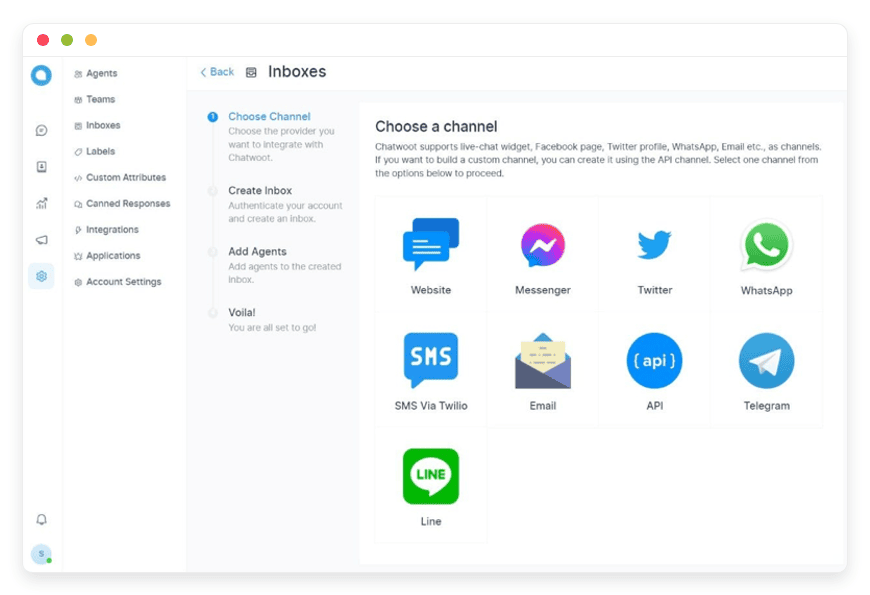
Chatwoot is the open-source customer-engagement platform that maps most directly onto Intercom. It runs website live chat, a shared team inbox, and conversations from WhatsApp, Instagram, Facebook Messenger, SMS, Telegram, and email — all in one place. It carries 27,700 stars on GitHub and ships under the MIT license.
Chatwoot Inc started the project in 2017; it is backed by Y Combinator and Goat Capital. The codebase has 320 contributors and 5,890 commits, with releases landing on a steady cadence — the latest, version 4.11.2, shipped in March 2026. It replaces the everyday Intercom workflow: an agent sees every channel in one inbox, assigns conversations, uses canned responses and private notes, runs automation rules, and reports on the team.
The channel point matters for cost. On Intercom, WhatsApp and SMS are usage-billed channels that sit on top of your seats. In self-hosted Chatwoot, every channel is part of the platform — connect a WhatsApp number or an Instagram account and there is no per-message markup from the help desk.
Beyond the inbox, Chatwoot covers the pieces a support team expects: CSAT surveys, a built-in help center for self-service articles, macros for repeatable multi-step actions, contact and company records, teams with agent-capacity routing, and native iOS and Android apps. The feature set is built around the support workflow, not bolted onto a marketing tool.
Chatwoot also ships its own AI layer, Captain. It has two halves: an assistant that answers customers from your help-center content and past conversations, and a copilot that drafts replies and summarises threads for agents. Captain runs on a model key you control. It is not as polished as Fin — independent reviews put it behind Fin while closing perhaps half the gap on common questions — and Chatwoot does not claim otherwise. The difference that matters for the invoice is the billing model: a flat platform cost, not $0.99 on every resolved conversation.
DANIAN runs managed Chatwoot hosting at €9/month in the region you choose.
Best for teams that want Intercom's day-to-day inbox without per-seat or per-resolution billing.
FreeScout — when email tickets are the real job
FreeScout is a lightweight open-source help desk and shared mailbox. If your support is mostly email — a single support address that several people answer — FreeScout is the cleaner fit. It is built in PHP, runs on modest hardware, and sets no limit on users, tickets, or mailboxes.
It covers shared inboxes, ticket assignment, canned replies, and a full customer history, with a module ecosystem for extras. It carries roughly 4,300 GitHub stars and ships under the AGPL-3.0 license. It is the closest open-source match to a Help Scout or Zendesk-style email desk, rather than to Intercom's live-chat-first design.
Many teams run Chatwoot for live and social channels and FreeScout for the email queue, because email threads behave differently from chat.
You can pair it with managed FreeScout for email tickets on the same €9 flat price.
Best for teams whose support is email-led, or who want a dedicated mailbox tool alongside Chatwoot's chat.
Typebot — pre-chat flows and lead qualification
Typebot is an open-source chatbot and conversational-form builder. It is not a help desk; it is the layer in front of one. You build a flow in a drag-and-drop editor, embed it on your site, and use it to qualify a visitor, route a request, or collect details before a human joins.
It handles the job Intercom bundles as bots and custom flows: ask a few questions, branch on the answers, hand off to a person or a system. It integrates directly with Chatwoot, plus OpenAI, Google Sheets, and Stripe. It carries around 9,900 GitHub stars; the code now ships under a Functional Source License.
A Typebot flow on the website can collect a visitor's name, plan, and reason for contact, then open a Chatwoot conversation with that context already attached. The agent starts informed instead of asking the same three questions. It also works as a deflection layer: answer the common questions in the flow itself, and only open a conversation when the visitor needs a person.
That keeps simple questions out of the inbox without charging you for an AI resolution.
Best for teams that want bot-driven qualification without paying per answer.
The tools at a glance
Here is the shortlist against the parts of Intercom each one replaces, with license, project size, and what running it costs. Chatwoot is the core; FreeScout and Typebot are the email and bot pieces you add when you need them. All three carry one flat €9 price on DANIAN.
| Tool | Replaces in Intercom | License | Stars | Managed (DANIAN) | Self-host |
|---|---|---|---|---|---|
| Chatwoot | Live chat, shared inbox, multi-channel, bots, AI assist | MIT | 27,700 | €9/mo | VPS + PostgreSQL + Redis + object storage; you patch and back up |
| FreeScout | Email ticketing and shared mailbox | AGPL-3.0 | 27,700 | €9/mo | PHP + MySQL; lighter, still self-managed |
| Typebot | Bots, pre-chat flows, lead qualification | Functional Source License | ~9,900 | €9/mo | Node stack + database; you host the builder |
Against an Intercom bill that runs into the high hundreds once Fin is metering resolutions, each of these is one flat €9 a month on DANIAN — or your own server time if you self-host.
Is Chatwoot production-ready?
Yes, by the measures that matter for a tool you would run a business on. Chatwoot is MIT-licensed, actively maintained, and used by more than 15,000 organisations. The project is eight years old, funded, and shipping releases on a steady cadence rather than coasting.
The maintenance signals are concrete: 320 contributors, 5,890 commits, and 137 releases to date, with version 4.11.2 landing in March 2026. The core is MIT, one of the most permissive open-source licenses — you can read the code, modify it, and move your instance elsewhere. Premium features such as Captain AI, single sign-on, and SLA policies sit behind a paid Chatwoot tier, which is the open-core model the project funds itself with.
The requirements are ordinary: a Linux server with PostgreSQL, and Redis, starting around 4GB of RAM. The honest caveat is that “production-ready” is not the same as “drop-in identical to Intercom.” Intercom's reporting, proactive messaging, and Fin's AI maturity are ahead. What Chatwoot gives you is the core support workflow, the channels, and the source code — on a cost base that does not move when your volume does.
What Intercom still does better
Switching has real costs, and pretending otherwise would not survive a week of using both tools. Intercom is a mature, heavily funded product, and on a few axes it is clearly ahead. Naming them is the honest way to decide whether the trade is worth it for your team.
Fin's AI is the biggest gap. Fin has years of tuning behind it and a documented resolution range of 42 to 50 percent in Intercom's own case studies. Captain has not matched that, and Chatwoot does not pretend it has. If your support model leans hard on automated deflection at high volume, that maturity gap is the thing to weigh most carefully.
Reporting runs deeper. Intercom's dashboards — conversation trends, CX scores, agent-performance views, SLA tracking — are richer and more polished out of the box than Chatwoot's. A team that lives in support analytics will feel the difference and may need to add a reporting layer on the Chatwoot side.
Proactive messaging is a full suite. Product tours, checklists, targeted in-app messages, and survey series are part of the Intercom product. Chatwoot's focus is the inbox, not in-product onboarding, so a team that depends on in-app messaging is replacing more than a help desk.
Support comes with a guarantee. Intercom sells professional support with service-level agreements. Chatwoot's Community Edition is supported through Discord and GitHub; a response-time guarantee is what you buy with a paid tier or a managed host. On DANIAN that guarantee is the named human who comes with the €9 plan.
The honest read: a high-volume team that depends on mature AI deflection and rich proactive messaging, with the budget to match, may still be right to stay on Intercom. For most small teams, the inbox, the channels, and the flat cost are the trade that makes sense.
How to pick
Three questions sort most teams onto the right path. They are about your headcount, the channels your customers actually use, and whether anyone on your side wants to run a server. Answer those three honestly and the choice between Intercom, self-hosting, and managed Chatwoot usually makes itself.
- How many agents, and is the team growing? Intercom's seat fees run from $29 to $132 a seat. Three agents today and six next year doubles the per-seat line while the work does not. A flat €9 instance does not care how many agents log in, so the more seats you add, the wider the gap.
- Do you live in WhatsApp, Instagram, or SMS? Intercom treats those as usage-billed channels on top of your seats. If a meaningful share of your conversations arrive there, that usage adds up every month. Chatwoot includes every channel in the platform, so a WhatsApp-heavy team often sees the biggest saving.
- Do you have someone to run a server? With an engineer who is happy to own PostgreSQL, backups, and the patch cycle, self-hosting Chatwoot on a $24 VPS is a real option and the software is free. Without one — and most small teams do not have one — managed hosting is the point. DANIAN runs the instance so no one on your team has to.
Moving off Intercom without downtime
You do not have to flip a switch and hope. The low-risk path is to run Chatwoot beside Intercom for two or three weeks, move one channel at a time, and keep Intercom live until the new setup has handled real conversations. The change stays invisible to your customers.
Export your history first. Pull your conversation and contact data out of Intercom through its export and keep it as your record. Chatwoot stores new conversations in its own PostgreSQL database, so from day one your history is yours. Contacts come into Chatwoot by CSV or its API.
Start with one channel. Point your website chat widget, or a single inbox, at Chatwoot first. Leave WhatsApp, email, and the rest on Intercom until the first channel is steady. One channel proves the setup without putting your whole support operation on a new tool overnight.
Rebuild the team setup. Add agents, create teams, and recreate your canned responses and automation rules. Chatwoot's inbox model maps closely to Intercom's, so the muscle memory transfers quickly. If you want AI deflection, point Captain at your help-center articles and past conversations so it answers from your own material.
Cut over when you are ready. Once the first channel has handled live conversations without surprises, move the rest, keep Intercom for a final overlap week, then cancel. The flat €9 instance is already running, so there is no second invoice waiting on the other side of the move.
Questions teams ask
How much does Intercom cost in 2026?
Intercom charges per seat — Essential at $29, Advanced at $85, and Expert at $132 a seat each month, billed annually. On top of that, its Fin AI costs $0.99 per resolved conversation, and packs for analytics and proactive messaging are $99 each. A busy team can clear $900 a month.
What is Intercom Fin, and how is it priced?
Fin is Intercom's AI agent. It answers customers automatically and costs $0.99 per outcome — a resolution the customer accepts or stops replying to, or a procedure that hands off to a human. It is charged once per conversation, and it stacks on top of your per-seat fees.
Why is a managed Chatwoot instance cheaper if I still pay for hosting?
Intercom charges per seat and then $0.99 every time Fin resolves a conversation. A managed Chatwoot instance is one flat €9 a month, whatever your seat count or volume. The math turns the moment you add agents or your conversation count climbs into the thousands.
Is Chatwoot cheaper than Intercom?
At most scales, yes. A managed Chatwoot instance is €9 a month, flat. Intercom bills per seat plus $0.99 per Fin resolution plus add-ons, so a four-agent team handling 1,000 conversations a month lands near $900. The gap widens as you add agents or volume.
How much does it cost to self-host Chatwoot?
The software is free under the MIT license. You provide a production-class VPS — around $24 a month for the recommended specs — plus PostgreSQL, Redis, object storage, and your time for patching, backups, and monitoring. Or DANIAN runs the whole instance for €9 a month.
What is Chatwoot?
Chatwoot is an open-source customer-engagement platform — live chat, a shared team inbox, and multi-channel support in one place. It is an alternative to Intercom, Zendesk, and Salesforce Service Cloud, ships under the MIT license, and carries 27,700 GitHub stars. You can self-host it or have it managed.
Is Chatwoot really free?
The core is MIT-licensed and free to self-host — no license fee, no seat cap. You provide the server, or DANIAN runs it for €9 a month. Premium features such as Captain AI, single sign-on, and SLA policies sit behind a paid Chatwoot tier, which is how the open-core project funds itself.
Is Chatwoot cloud or self-hosted?
Both. There is a free Community edition you self-host under the MIT license, and a paid Chatwoot Cloud if you want the company to run it. DANIAN sits in between: the open-source build, managed on infrastructure in the region you choose, for a flat €9 a month.
What is the difference between Chatwoot Community and the paid tiers?
Community is the free, MIT-licensed core — the inbox, every channel, and automation. The paid tiers add Captain AI, single sign-on, SLA policies, custom branding, and agent-capacity controls. It is an open-core model: the everyday support workflow is free, and the extras fund the project.
Which channels does Chatwoot support?
Website live chat, email, WhatsApp, Instagram, Facebook Messenger, SMS, Telegram, and an API channel, all in one inbox. On Intercom, WhatsApp and SMS are usage-billed extras. In self-hosted Chatwoot every channel is part of the platform, with no per-message markup.
Does Chatwoot support WhatsApp?
Yes, WhatsApp is a native channel, alongside Instagram, Facebook Messenger, SMS, and Telegram. On Intercom those channels are usage-billed on top of your seats; in self-hosted Chatwoot they are part of the platform. A WhatsApp-heavy team often sees the biggest saving by switching.
Does Chatwoot have a chatbot or AI agent?
Yes. Captain is Chatwoot's built-in AI — an assistant that answers customers from your help-center content, and a copilot that drafts agent replies. For richer flows, Typebot adds drag-and-drop chatbots that qualify visitors before a human joins. Both run without a per-resolution charge.
Is Captain AI as good as Intercom's Fin?
No, and Chatwoot does not claim it is. Intercom's case studies put Fin's resolution rate at 42 to 50 percent, and Fin is the more mature agent. Independent reviews place Captain behind it while closing roughly half the gap on common questions. The structural win is flat cost, not a per-resolution meter.
Can Chatwoot replace Zendesk or Salesforce too?
Yes. Chatwoot positions itself as an alternative to Intercom, Zendesk, and Salesforce Service Cloud, and the shared inbox, ticketing, and multi-channel support map onto all three. If your support is email-led, pairing Chatwoot with FreeScout covers the ticketing side as well.
Is Chatwoot secure?
Chatwoot is open-source, so the code is open to inspection rather than a black box. On DANIAN your instance runs isolated, with its own database that only you and the people you invite can reach. We patch it on a regular cadence and back it up daily, off-site.
What does DANIAN include for €9 a month?
The server, security patching, daily off-site backups, monitoring, SMTP and DNS setup, and 24/7 support from a named human who can make config changes for you. There is no per-seat fee and no per-resolution charge — the €9 is the whole bill for one app.
What happens to my data if I leave?
The data is yours. Chatwoot stores conversations in your own PostgreSQL database; export them over SFTP or take a backup on request. Because the software is open-source, there is no proprietary format to escape and no vendor holding your history.
Can I migrate my data from Intercom to Chatwoot?
Yes. Export your conversation and contact data from Intercom and keep it as your record. Contacts import into Chatwoot by CSV or its API, and new conversations land in your own database from day one. The low-risk path is to run both tools in parallel during the move.
How long does it take to switch from Intercom to Chatwoot?
Plan for a two- to three-week parallel run rather than an overnight cutover. Point one channel at Chatwoot first — your website widget or a single inbox — keep Intercom live until it is steady, then move the rest. Customers never see the change.
Can I just run this myself instead of paying DANIAN?
Yes. Chatwoot self-hosts on a production-class VPS, around $24 a month, with PostgreSQL, and Redis. If you have someone to patch, back up, and monitor it, that path is genuinely fine. DANIAN is for teams who would rather not own that work.
Who should stay on Intercom instead of switching?
A high-volume team that leans hard on automated AI deflection and rich proactive messaging — product tours, in-app campaigns, deep reporting — and has the budget for it. Fin is more mature than Captain today. For most small teams, the flat cost and the channels are the better trade.
What to do this week
If Intercom's renewal is coming and the Fin line is the reason, you do not have to decide blind. You can run the alternative alongside it for a fortnight, compare the two on your own conversations, and keep Intercom live until you are sure. Here is the order that works.
Start a Chatwoot instance and point one channel at it — your website chat widget, or a single inbox.
DANIAN lets you start a 7-day free trial with no card, so the test costs nothing but time.
Run it in parallel with Intercom for two weeks, and watch how the shared inbox feels, how the channels behave, and whether Captain handles your common questions well enough.
Then add up what Intercom would bill you next year — seats plus Fin resolutions plus any add-ons — and set it against €9 a month. For most teams past a few agents, the comparison answers itself. The software is open-source and the data is yours either way. The only question is whether you want to run the server, or have someone run it for you.
Sources
Intercom pricing — https://www.intercom.com/pricing
Fin AI Agent pricing — https://fin.ai/pricing
Fin AI Agent outcomes (what counts as a resolution) — https://www.intercom.com/help/en/articles/8205718-fin-ai-agent-outcomes
Chatwoot — https://www.chatwoot.com/
Chatwoot on GitHub — https://github.com/chatwoot/chatwoot
Chatwoot self-hosted pricing — https://www.chatwoot.com/pricing/self-hosted-plans