Open-source Feedly alternatives in 2026
Open-source alternatives to Feedly in 2026 — FreshRSS and Miniflux for a reading feed you own
TL;DR
- Feedly still has a free tier, but search, notes, and highlights now sit behind Pro at $6.99/month, and the Leo AI tools sit behind Pro+ at $12.99/month.
- FreshRSS (15k GitHub stars, AGPL-3.0) is the feature-rich pick: extensions, multi-user accounts, and mobile-app support through the Google Reader API.
- Miniflux (8.9k stars, Apache-2.0) is the minimalist pick: a single fast binary that strips trackers and tuning parameters from every article.
- Both import your Feedly feeds from a standard OPML file, so the switch keeps your sources and folders intact.
- We run either one for €9/month flat — no per-source cap, no AI upsell, and the feeds and reading history stay yours.
Why people are leaving Feedly in 2026
Feedly's free plan still works, but it caps you at 100 sources and three feeds, with no search and no AI. The features long-time readers lean on now sit behind two paid tiers: Pro at $6.99/month for search and highlights, and Pro+ at $12.99/month for the Leo AI tools.
The split is deliberate. Feedly Pro is the manual-workflow tier. Feedly Pro+ is the AI tier, and it is where Leo's article prioritisation, the RSS Builder, AI feeds, and newsletter slots live. A reader who wants full-text search across a thousand sources pays $6.99 a month, or $72 a year. A reader who wants the AI layer pays $12.99 a month, or $99 a year.
None of that is unreasonable for a polished product. The friction is structural. Each year the useful parts of a feed reader drift a little further up the paid tiers, and the price is per account, not something you control. The Enterprise tier starts at $1,600 a month, aimed at market-intelligence teams rather than individual readers — a signal of where the product's attention now sits.
There is history here. Most Feedly accounts date back to 2013, when Google Reader shut down and readers needed a new home. Feedly absorbed that wave and grew past 15 million users. Many of those readers have since watched the same feature set get parcelled across Free, Pro, and Pro+. Pro+ caps even paying users at 2,500 sources. The reader did not change; the pricing around it did.
The deeper issue is ownership. Your feeds, your read history, and your saved articles live on Feedly's servers under Feedly's terms. If the pricing changes again, or a feature you rely on moves up a tier, you adjust. RSS was designed to be portable. A growing number of readers want a reader that reflects that.
What "alternative" means in practice
An open-source RSS reader replaces Feedly's software, not Feedly's hosting. You still need somewhere to run it. There are three honest routes: run it yourself on a small server, let the project host it for a few dollars, or have a managed host run it for you for a flat monthly fee.
Self-hosting is the purest version. FreshRSS is light enough to run on a Raspberry Pi 1 with 150 feeds; Miniflux uses a few megabytes of memory even with hundreds of feeds. The software is nearly free. The cost is the upkeep: PHP or PostgreSQL updates, certificate renewal, off-site backups, and the occasional 2am restore. Even on a production-class VPS at around $24 a month, the rent is the small part. The time is the rest. If you run servers for a living, or you enjoy it, this is a fine path.
The project-hosted route is the simplest cheap option. Miniflux sells a hosted instance for $15 a year, run by its own maintainer. You get the reader without the server, and your money supports the project directly. There is no phone support and no other apps alongside it — which is exactly right for a reader who wants one tidy feed and nothing else.
The managed route sits between the two. Someone runs the server, patches the software, takes the backups, and answers when something breaks — and you pay a flat monthly fee. This is the route we run at DANIAN. It suits the reader who wants the ownership of open-source without the maintenance, and who often runs a few other apps in the same place.
A cheaper commercial reader is the fourth option, worth naming plainly. If you only want a hosted reader and do not care whose servers it runs on, other paid readers undercut Feedly. They are still closed products on someone else's terms. That is the trade the open-source route is built to avoid.
The shortlist
Three open-source readers cover almost every Feedly use case in 2026. FreshRSS is the feature-rich, extensible option. Miniflux is the minimalist, privacy-first option. Tiny Tiny RSS is the power-user's tinkering platform. The first two are the ones most readers should start with, and we run both for €9 a month.
FreshRSS — the feature-rich, extensible reader
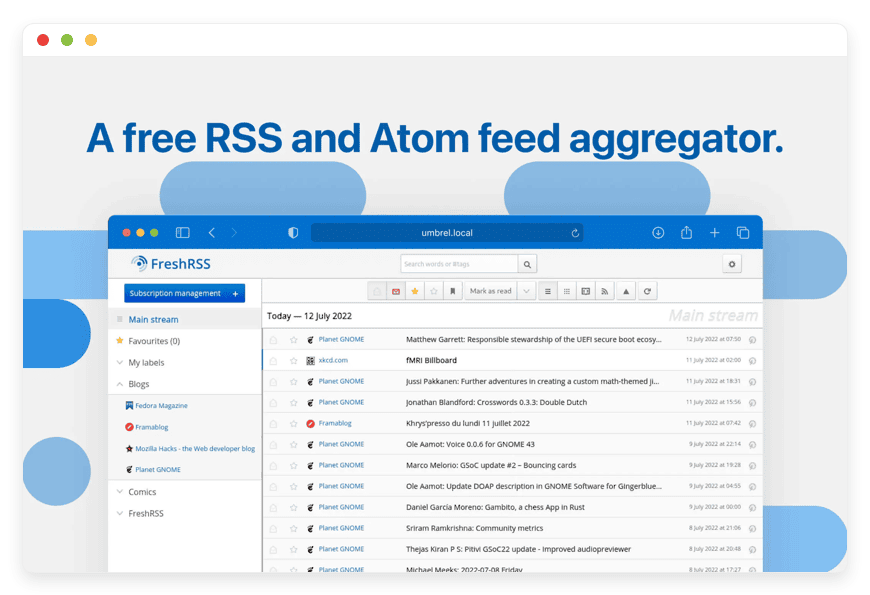
FreshRSS is a self-hosted aggregator with 15,000 GitHub stars, released under the GNU AGPL-3.0 licence. It is multi-user, so a household or a small team can share one instance with separate accounts and an anonymous read-only mode. It speaks the Google Reader API and the Fever API, which means it works with most third-party reader apps — Reeder, NetNewsWire, Capy Reader — on phones and desktops.
Two features set it apart. It supports extensions for tuning behaviour, and it can scrape sites that publish no feed at all, using XPath rules. WebSub support means compatible sources push new posts the moment they appear rather than waiting for a poll. It stores feeds in PostgreSQL, SQLite, MariaDB, or MySQL, and supports OpenID Connect alongside standard logins — useful if you already run single sign-on. The project ships a new release every two or three months; the latest, 1.29.0, landed in May 2026. For a reader replacing Feedly Pro's heavier workflow, FreshRSS is the closest match.
We run managed FreshRSS hosting for €9 a month.
Best for: readers who want depth and shared accounts.
Miniflux — the minimalist, privacy-first reader
Miniflux is a single Go binary with 8,900 GitHub stars, released under the permissive Apache-2.0 licence. It is deliberately minimal: a fast, distraction-free interface, full-text search powered by PostgreSQL, and almost no configuration to get wrong. It reads Atom, RSS, and JSON Feed, and it works with existing mobile apps through the same Fever and Google Reader APIs that FreshRSS supports.
Privacy is its defining trait. Miniflux removes pixel trackers, strips tracking parameters such as utm_source and fbclid from every link, proxies media to block third-party tracking, and runs no telemetry or advertising of its own. It can fetch the full text of articles that only publish a summary. It filters items with regular expressions and signs you in with passkeys instead of a password. It connects to more than twenty-five services, including read-later tools and notification systems, so it slots into a wider workflow without bloat. The latest release, 2.2.17, shipped in February 2026.
We run managed Miniflux hosting for €9 a month.
Best for: readers who want speed and strong privacy hygiene.
Tiny Tiny RSS — the power-user's tinkering platform
Tiny Tiny RSS is the veteran of the group, first released in 2005 and still developed under the GPL-3.0 licence. It is a PHP application with a deep plugin system, custom themes, and the ability to generate a feed from any view inside it — useful for piping articles into other tools. For a reader who wants to bend their setup to an exact shape, it offers the most surface area.
It also asks the most of you. The project supports Docker as its main install path, and treats other methods as best-effort. Its development is opinionated, and newcomers sometimes find the community blunt. It is a strong choice if you are technical and enjoy configuration. It is a harder starting point than FreshRSS or Miniflux for most people leaving Feedly.
We can add Tiny Tiny RSS to a managed plan on request.
The three readers at a glance
All three are free, open-source, and self-hostable, and all three import OPML. They differ in philosophy: FreshRSS optimises for features, Miniflux for minimalism and privacy, and Tiny Tiny RSS for configurability. The table below sets the differences side by side.
| Reader | Licence | GitHub stars | Built with | Best for | Managed by DANIAN |
|---|---|---|---|---|---|
| FreshRSS | AGPL-3.0 | ~15,000 | PHP | Feature depth, extensions, shared accounts | €9/month |
| Miniflux | Apache-2.0 | ~8,900 | Go | Minimalism, privacy, speed | €9/month |
| Tiny Tiny RSS | GPL-3.0 | rolling release | PHP | Configurability, plugins, full control | €9/month |
Stars are a rough proxy for community size, not quality. All three are mature and actively maintained. The right pick depends on how much you want to tinker, not on which has the bigger number.
One thing the three share matters more than their differences: all of them can speak the Google Reader or Fever API, and all of them read and write OPML. Your phone app keeps working whichever you choose, and moving between them later is a file export away. The choice is low-stakes by design.
What a managed open-source reader costs against Feedly
Feedly bills per account, and the price rises as you move up its tiers: $6.99 a month for Pro, $12.99 a month for Pro+.
A managed open-source reader on DANIAN is €9 a month, flat, with no per-source cap and no AI upsell. The difference is not only price; it is who owns the data.
| Feature | Feedly Free | Feedly Pro | Feedly Pro+ | Managed FreshRSS or Miniflux |
|---|---|---|---|---|
| Price (monthly) | $0 | $6.99 | $12.99 | €9 |
| Sources | 100 | 1,000 | 2,500 | No fixed cap |
| Full-text search | No | Yes | Yes | Yes |
| AI features | No | No | Leo AI | No |
| You own the data | No | No | No | Yes |
| Human support included | — | — | — | Yes |
The price gap is real but not the headline. Feedly Pro+ at $12.99 a month is about €12; DANIAN is €9. The larger difference is structural. On Feedly you rent a feature set that can move between tiers. On a managed open-source reader you run the actual software, on a server in the region you choose, and you can export everything and walk away whenever you like. The €9 covers the hardware, the patching, the daily off-site backups, the monitoring, and support with a named person.
That last line is the real comparison. Feedly's price buys software you do not host. The €9 buys software you do host, run by someone else, upkeep and support included. For a reader who would otherwise spend an evening a month on backups and updates, the trade is clear.
Moving your feeds with OPML
Feedly exports your subscriptions as an OPML file — a standard list of every feed and folder you follow. Both FreshRSS and Miniflux import that file directly. The move takes a few minutes, and you keep your sources and folder structure intact. One caveat: OPML carries feeds, not saved articles.
To export from Feedly, open the web app and go to feedly.com/i/opml, then download the OPML file. The export works only on the web, not in the mobile app. The file lists every source and category in your account in a portable XML format.
To import, open FreshRSS or Miniflux, find the OPML import option in settings, and upload the file. Your feeds and folders appear, and the reader starts polling them. Give it a few minutes to pull the first batch, then confirm the feeds you care about are fetching new items. From there you can clean up the list, retag, and carry on reading.
The honest caveat: OPML moves your feed subscriptions and their folders. It does not move your Feedly Boards or your Read Later articles, which live in Feedly's own format. If you have saved articles you want to keep, export or revisit those before you close the account. For the feeds themselves — the part that makes a reader a reader — the migration is clean.
What you don't get
An open-source reader gives you a clean, owned reading workflow. It does not replicate Feedly's AI layer or its team features. Leo's article prioritisation, the AI feeds, shared team Boards, and the $1,600-a-month market-intelligence product have no direct equivalent in FreshRSS or Miniflux. This matters for some readers.
If Leo's prioritisation is central to how you read — if you rely on AI to surface the few important items from a noisy feed — neither FreshRSS nor Miniflux will feel the same. They are reading tools, not recommendation engines. Some readers pair them with their own summarising tools through integrations, but that is a build, not a built-in.
Team intelligence is the other gap. Feedly's higher tiers are aimed at security and market-research teams tracking topics across thousands of sources, with shared boards and collaboration. That is a different product from a personal reader, and the open-source options do not try to be it. If that is your use case, Feedly's Enterprise tier is the honest fit.
For the common case — a person or a small team who wants to follow a few hundred feeds, read them on any device, and own the result — FreshRSS and Miniflux cover it well. The point of switching is a reader you control, not a copy of every Feedly feature.
How to pick: three questions
The choice between FreshRSS and Miniflux comes down to three questions about how you read. Answer them and the right reader is usually obvious. Tiny Tiny RSS enters only if your answer to the third question is a firm yes.
- Do you want depth or simplicity? If you want extensions, shared accounts, and feeds from sites with no RSS, choose FreshRSS. If you want a fast, quiet reader with nothing to configure, choose Miniflux.
- How much does privacy hygiene matter? Both are private, but Miniflux goes further — stripping trackers and tuning parameters from every article by default. If that is a priority, it tips the balance.
- Do you want to tinker? If configuring plugins and themes is the fun part for you, Tiny Tiny RSS gives you the most room. If you would rather just read, it is more than you need.
There is no wrong answer, and switching later is cheap — the OPML file moves between all three.
Pricing
DANIAN runs FreshRSS or Miniflux for €9 a month per instance, across 21 datacenter locations, with no per-seat fees and no per-source cap. The €9 covers hardware, security patching, daily off-site backups, monitoring, and support. There is a 7-day free trial, and no card is required to start.
The price is flat. It does not climb as you add feeds, and resources change only with your explicit consent. Card failed? We wait. We don't delete your data. You can export your feeds over OPML at any time and leave; the software is open-source, and the data is yours.
If you want to see how it runs before you commit, start a 7-day trial — no card needed.
Frequently asked questions
What is the best open-source alternative to Feedly?
For most people, FreshRSS or Miniflux. FreshRSS is the feature-rich pick: extensions, shared accounts, and feeds from sites with no RSS. Miniflux is the minimalist pick: fast, private, and almost nothing to configure. Both import your Feedly feeds over OPML. We run either one for €9 a month.
FreshRSS vs Miniflux: which one should I pick?
Choose FreshRSS for depth — extensions, multiple accounts, and feeds scraped from sites without RSS. Choose Miniflux for a fast, quiet reader that strips trackers and needs no tuning. Both speak the Google Reader and Fever APIs, so your phone app works either way. Switching later is one OPML export.
Which open-source RSS reader is easiest for beginners?
Miniflux. It is a single binary with a clean interface and almost nothing to configure. You add feeds, import your OPML, and read. FreshRSS is approachable too, but it offers more to set up. For a first self-hosted reader that simply works, Miniflux is the gentler start.
Is FreshRSS or Miniflux better for privacy?
Miniflux goes further by default. It removes pixel trackers, strips parameters like utm_source and fbclid from links, proxies media, and runs no telemetry or ads. FreshRSS is private too, but Miniflux treats tracker removal as a core feature. If privacy hygiene is the priority, Miniflux is the stronger default.
Is FreshRSS or Miniflux really free?
Yes. Both are open-source — FreshRSS under AGPL-3.0, Miniflux under Apache-2.0 — and free to download and run yourself. What costs money is hosting: the server, the upkeep, and the support. DANIAN's €9 a month covers that managed hosting, not the software, which stays free and yours.
How much does it cost to replace Feedly?
The software is free; you pay only for hosting. Self-hosting runs from about $24 a month on a small server. The project's own hosted Miniflux is $15 a year. We run FreshRSS or Miniflux for €9 a month, with support and backups included. For comparison, Feedly Pro is $6.99 and Pro+ is $12.99 a month.
Is €9 a month worth it for a managed RSS reader?
It depends on your time. The reader is free, and self-hosting is cheap if you enjoy server upkeep. The €9 buys someone else handling updates, certificates, daily off-site backups, monitoring, and support. If an evening a month of maintenance is worth more than €9 to you, it pays for itself.
How is this different from running it on my own VPS?
On your own server, you handle PHP and PostgreSQL updates, certificate renewal, backups, and the 2am fix when a feed poll breaks something. On DANIAN, we run all of that for €9 a month and answer when you need us. If you enjoy server upkeep, self-hosting is a good path. If you would rather read, we run it.
Do I need technical skills to use a managed reader?
No. On a managed plan, we handle the server, the updates, the backups, and the security patches. You log in, import your Feedly OPML, and read. There is no command line and nothing to maintain. The open-source software stays yours; the operational work is ours, for €9 a month.
Can I move my Feedly feeds without losing them?
Yes. Feedly exports your subscriptions as an OPML file from feedly.com/i/opml on the web. FreshRSS and Miniflux both import OPML directly, keeping your feeds and folders. The one thing OPML does not carry is your saved Boards and Read Later articles, so export those separately if you need them.
How long does switching from Feedly take?
A few minutes for the feeds. You export an OPML file from Feedly on the web. You import it into FreshRSS or Miniflux, and your sources and folders appear. Give the reader a short while to fetch the first batch. Saved Boards and Read Later articles are separate, so export those first.
Is there a limit on how many feeds I can add?
Not on a managed DANIAN plan — there is no fixed source cap. Feedly limits you by tier: 100 sources on Free, 1,000 on Pro, and 2,500 on Pro+. FreshRSS and Miniflux both scale to thousands of feeds on modest hardware. You add what you need, and the €9 price stays flat.
Will an open-source reader work with my phone's RSS app?
Usually, yes. FreshRSS and Miniflux both support the Google Reader and Fever APIs, which most mobile reader apps speak. Apps such as Reeder, NetNewsWire, and Capy Reader can connect to your instance and sync. You read on your phone; the feeds live on your own server.
Can a family or small team share one reader?
Yes, with FreshRSS. It is multi-user, so each person gets a separate account on one instance, plus an anonymous read-only mode for shared feeds. Miniflux is built for a single user per instance. For a household or small team that wants individual accounts, FreshRSS is the one to choose.
Can these readers show full articles instead of summaries?
Yes. Many sites publish only a short summary in their feed. FreshRSS and Miniflux can both fetch the full article text on demand, so you read the whole piece inside the reader. Miniflux uses a readability engine; FreshRSS offers it through article actions. No more clicking out to every link.
Can I follow a website that has no RSS feed?
Yes, with FreshRSS. It can scrape pages using XPath rules and turn them into a feed, so a site with no RSS still lands in your reader. Miniflux focuses on standard feeds rather than scraping. If you follow sources that never published a feed, FreshRSS is built for it.
Can I follow podcasts and YouTube channels?
Yes. Podcasts and YouTube channels both expose standard feeds, and FreshRSS and Miniflux read any RSS, Atom, or JSON feed. New episodes and videos appear alongside your articles. Miniflux can proxy media to limit third-party tracking. One reader then covers your news, your shows, and your videos in one place.
What about Feedly's Leo AI features?
Neither FreshRSS nor Miniflux includes an AI prioritisation layer like Leo. They are reading tools, not recommendation engines. If AI triage is central to how you read, that gap is real. If you mostly want to follow feeds and own your data, you will not miss it — and you avoid the Pro+ price.
Do FreshRSS and Miniflux show ads or track me?
No. Both are open-source and run only for you, with no advertising and no analytics sold on. Miniflux goes further, stripping third-party trackers from the articles you read. There is no business model built on your attention. The reader's only job is to show you your feeds.
Can I leave and take my data with me?
Yes, any time. Your feeds export as OPML, and because the reader is open-source, there is no lock-in to escape. Daily off-site backups keep your reading history safe while you stay. The app is yours; we operate it for you, and you can move it elsewhere whenever you choose.
Will I lose my feeds if DANIAN stops operating?
No. The reader is open-source, and your feeds export as a standard OPML file at any time. Because nothing about it is proprietary, you can move the same FreshRSS or Miniflux setup to another host or your own server. We keep daily off-site backups while you are with us, and the data stays yours.
Conclusion — what to do this week
If Feedly's tiers no longer fit how you read, the move is straightforward. Export your OPML this week, pick FreshRSS for depth or Miniflux for minimalism, and import your feeds. You can self-host it, or have it run for €9 a month with support and backups included.
Start small. Export your feeds from Feedly, spin up one reader on a 7-day trial, and import the OPML. Read in it for a week on your phone and your laptop. If it fits, keep it; if it does not, the OPML moves on with you. The decision is reversible, and the software is yours either way.
For most readers leaving Feedly, FreshRSS or Miniflux on a managed plan is the shortest path to a feed you own — without the upkeep and without the per-tier creep.