Reselling managed Chatwoot to clients in 2026
How agencies resell managed Chatwoot in 2026 without becoming a hosting company
The short version
- The model is one line: host one Chatwoot instance per client at €9 a month, sell it at €30–60, and keep the client relationship yourself.
- Chatwoot’s Community edition is MIT-licensed and has no per-agent cap when it is hosted for you. The per-seat math that makes Intercom expensive never starts.
- A five-seat client on Intercom can pay around $690 a month once Fin AI resolutions stack on top of seats. The same live chat, hosted, retails for a fraction of that.
- At 20 client instances, the recurring margin is roughly €420–1,020 a month, before your support time.
- The honest catch: a central control plane and full agent-dashboard white-label are not in the product today. This post marks exactly where that line sits.
Why live chat is worth reselling in 2026
Live chat used to be a flat monthly tool. In 2026 it is a metered one. Intercom charges per seat and adds $0.99 for every conversation its Fin AI resolves. For a small business with steady volume, the bill grows with traffic, not headcount. That client is the one who asks you to find something cheaper.
Start with the headline price, because it hides the real one. Intercom’s pricing puts the Essential plan at $29 per seat per month on annual billing, or $39 monthly. Advanced is $85 per seat, and Expert is $132. Those are the appetiser numbers.
The main course is Fin, Intercom’s AI agent. It costs $0.99 per resolution, on every plan, on top of seats. A resolution counts whenever Fin answers and the customer leaves without asking for a human — even when the customer simply stops replying.
Put numbers on it. A five-seat team on Essential with 1,000 conversations a month, at a 50% Fin resolution rate, pays $195 in seats and $495 in Fin fees. That is about $690 a month, and it rises with every busy week.
The bill gets steeper at scale. Eight agents on the Advanced plan, resolving roughly 2,100 conversations a month with Fin, run about $2,960 — close to $35,500 a year, before WhatsApp or proactive-messaging add-ons.
Most small-business clients never modelled that. They saw $29 a seat and signed. The renewal invoice is where the per-resolution line finally lands, and that is your opening.
On the other side of the trade is Chatwoot. It is an open-source customer-conversation platform — a shared inbox for live chat, email, and social messages — with more than 22,000 stars on GitHub. Its core is MIT-licensed, which matters more than it sounds.
When you host the Community edition, there is no per-agent cap. A client can put their whole team in the inbox without the seat counter that drives Intercom’s bill. You are selling the same job — live chat a client’s customers can use — without the metering.
There is a second reason beyond price. When a client’s live chat runs on open-source software you host, the conversation history is theirs to keep and export, not locked inside an account they rent by the seat. If they ever leave you, the data leaves with them. That sounds like a risk and works as a trust-builder: clients commit faster to a tool they could walk away from than to one that holds their history.
The agency math, in plain numbers
The model is simple to price. You pay €9 per Chatwoot instance per month at wholesale. You sell each instance to a client at €30–60, depending on the support you wrap around it. The difference is recurring margin, and it compounds with every client you add to the same playbook.
Here is the margin at four account counts, before your own time. The wholesale cost is €9 per client. The retail range runs from €30 at the lean end to €60 at the supported end.
| Client instances | Margin/mo at €30 retail | Margin/mo at €60 retail |
|---|---|---|
| 5 | €105 | €255 |
| 10 | €210 | €510 |
| 20 | €420 | €1,020 |
| 40 | €840 | €2,040 |
These are gross numbers, and gross numbers mislead if you stop there. Subtract your support time honestly. A clean Chatwoot instance needs little once it is live — a widget tweak, a new agent, the odd “why won’t the WhatsApp number connect” question.
Budget one to two hours a month per active client in the first quarter, then less as you build playbooks. At a €30 retail price, two support hours can erase the month’s margin on that account. At €60 with a setup fee, you have room.
The lesson is not that the model fails. It is that you price for the support you give, and you start with five to ten clients, not fifty. Margin you can defend beats margin you can only put in a deck.
The predictability is the quiet advantage, and it runs both ways. Your cost per client stays €9 in a slow month and a busy one, so a client’s traffic spike never lifts your bill the way a metered plan lifts theirs. You can quote a client a flat monthly price with a straight face, because yours is flat too. Flat cost in, flat price out — that alignment is what makes the line easy to sell and easier to keep.
→ See managed Chatwoot at €9 a month
What white-label actually requires — and what you get today
White-label is not one feature. It is three: a domain that reads as the client’s, branding their customers see, and billing that runs through you. Two of those are straightforward on managed Chatwoot today. The third has a real limit, and pretending otherwise would cost you trust the first time a client noticed.
Start with what works. Each client instance runs on a custom domain you choose — chat.theirbrand.com, not a shared subdomain. We point the DNS and issue the certificate, and the client sees their own address.
The customer-facing chat widget is customisable in the Community edition. You set the colours, the position, the launcher icon, the company name, and the pre-chat form. It speaks 25-plus languages out of the box. To a website visitor, the widget reads as the client’s, not as a third-party tool.
Per-client isolation is real, not cosmetic. Every client gets a separate Chatwoot instance in its own hardened container, with its own database and storage. One client’s conversations are never in another client’s inbox. That is the part most DIY multi-tenant setups get wrong.
Now the limit, stated plainly. Removing the Chatwoot name from the agent-facing dashboard — the back end your team logs into — is an Enterprise Edition feature. It lives in Chatwoot’s separate commercial directory, under a licence you buy from Chatwoot, not from a host.
So the honest picture is this. A client’s customers see the client’s brand on the widget and the domain. The client’s staff, logging into the back end, may still see the Chatwoot name unless you license its enterprise tier directly. Most end-clients never open the back end and never notice. Some agencies will care, and they should know before they sell.
Captain, Chatwoot’s AI reply layer, is also gated to paid tiers, so it is not part of a hosted Community instance. If a client wants AI-drafted replies, that is a paid-Chatwoot conversation, not a hosting one.
The managed setup, and where it still has gaps
Our job is the part you do not want to own: the server, the patching, the backups, the upgrades, and the chat window at 2am when something breaks. Your job is the client relationship and the invoice. The seam between those two is where this works — and where two gaps still sit.
For each client you onboard, we deploy one Chatwoot instance at €9 a month. We patch it, back it up off-site daily, monitor it, and answer when it needs attention. You do not touch a Linux box, a database, or a Redis queue — the layer the self-hosting docs spell out is ours to run.
You keep the client relationship end to end. You set the retail price, you send the invoice, and you own the renewal. We never contact your client or appear on their bill. The wholesale line is between you and us.
The first gap is the control plane. Today, each client instance is managed on its own, not from a single agency dashboard that lists them all. At five to thirty clients this is a spreadsheet and a routine. Past that, it is a real constraint, and you should hear that now rather than discover it at client sixty.
The second gap is billing automation. There is no built-in pass-through that bills your client through us and splits the margin. You run your own billing — your Stripe, your invoicing tool — and pay us €9 wholesale per instance. Most agencies prefer owning billing anyway; a few want it wired in, and that is not wired in yet.
We would rather you know both gaps before you commit than after. If a central control plane or automated client billing is a hard requirement, the honest move is a conversation, not a feature promise we have not shipped.
→ Sign up for our Partner program
The client-comms stack that resells together
Chatwoot rarely sells alone. A client who wants live chat usually wants email tickets next, and then a way to follow up with the leads chat produces. Three open-source apps cover that arc, each at the same €9 wholesale, each a separate recurring line you can mark up.
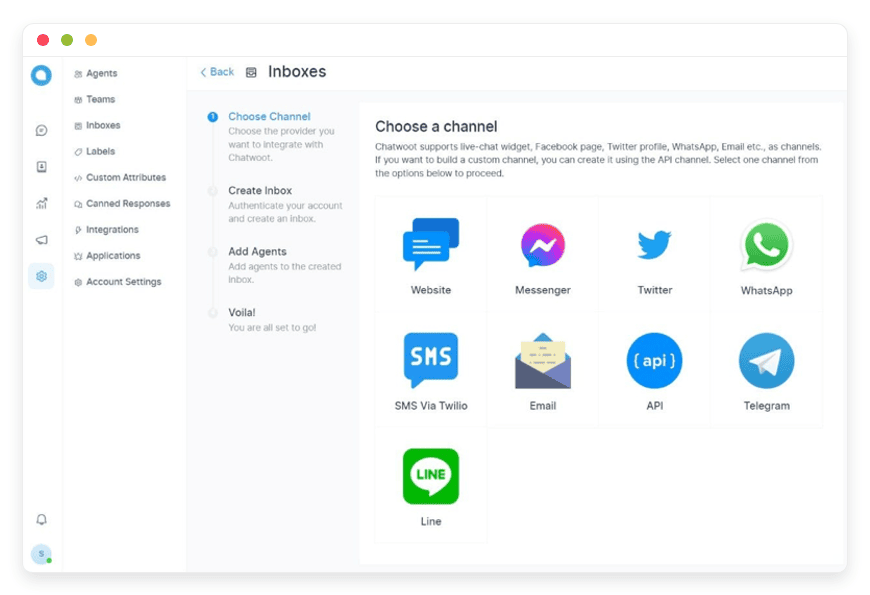
Chatwoot is the front door. It catches live chat from the website plus WhatsApp, Instagram, Facebook Messenger, Telegram, and SMS in one inbox. For a client fielding questions across channels, consolidating them is the sale. Each connected channel is another reason the instance is hard to cancel.
FreeScout is the email half. It is an open-source shared-inbox helpdesk — where support email becomes tracked tickets instead of a shared mailbox nobody owns. A client who has outgrown a personal inbox but balks at per-agent helpdesk pricing is the fit. Host it at €9, retail it beside Chatwoot, and you cover both live and asynchronous support.
Mautic closes the loop. When Chatwoot captures a lead in a conversation, that contact is worth a follow-up sequence rather than a forgotten transcript. Mautic is open-source marketing automation — email campaigns, segments, and triggers — and it turns a chat into a nurture flow. For an agency already running campaigns for clients, it is a natural third line.
Priced together, the three are three €9 wholesale instances and three retail lines. A client on all three at €40 each is €120 of retail against €27 of wholesale — €93 of monthly margin from one account, recurring, before your time.
Run that across a book of clients and it adds up. Fifteen clients on Chatwoot alone at €40 retail is €600 of recurring revenue against €135 of wholesale. Layer FreeScout and Mautic onto even a third of them, and the same fifteen accounts carry a second and third recurring line without a single new logo.
→ Pair Chatwoot with FreeScout for email tickets on the same €9 floor
How to price the line without leaving margin on the table
The €9 floor is fixed; your retail is not. Most agencies underprice managed apps because they anchor to the wholesale cost instead of the value the client gets. Price the outcome — a live-chat line the client does not have to run — and wrap a setup fee around the first month.
First, charge a setup fee. Connecting channels, styling the widget, and writing the first canned replies is real work, and it is worth €150–400 once. The fee also filters tyre-kickers and covers your heaviest support month, which is the first one.
Second, prefer annual prepay. A client who pays for twelve months up front churns less and frees your cash. Offer two months off for paying annually, and your effective retail still clears the €9 wholesale with margin to spare.
Third, tier by channels, not by seats. Resist copying the per-seat model you are helping the client escape. Price a base tier for website chat, then a higher tier once WhatsApp, Instagram, and SMS are connected. The upsell writes itself as the client adds channels.
What you avoid is the race to €15 a month. At that price a single support question turns the account unprofitable, and you have taught the client the line is a commodity. Sell the outcome and the relationship, and the price holds.
One framing keeps the price honest: you are not selling hosting, you are selling a managed line. Anyone can rent a server, and few clients want to. What they pay for is that the chat works on Monday, the upgrade lands without them noticing, and a person answers when it does not. Name that in the proposal. Managed live chat, monitored and patched, with a person behind it reads as a service, and a service carries a service price — not a hosting markup a client can shop on spec.
When this works — and when it doesn’t
This model fits a specific kind of agency and frustrates another. The difference is not size; it is what you want to own. If you want a flat-cost line you can mark up and a relationship you keep, it fits. If you want a turnkey reseller platform that runs itself, it does not yet.
It works when you manage roughly five to forty client accounts and want recurring revenue you control. A flat €9 wholesale you mark up three to six times is easier to reason about than reselling someone else’s per-seat tier and reconciling it every month.
It works when you are comfortable owning the billing relationship. Your invoice, your markup, your renewal, your retention. That is control, not overhead — the client stays yours, not a partner program’s.
It works when “good enough” branding clears the bar. A custom domain and a customised widget cover what a client’s customers see. If the client never needs the Chatwoot name stripped from the back end, you are done.
It does not work when you need one screen to manage eighty instances today. That control plane is not in the product yet, and a workaround at that scale gets thin.
It does not work when fully removable back-end branding is non-negotiable and you will not license Chatwoot’s enterprise tier directly. That is a Chatwoot licensing line, and hosting does not move it.
It does not work when you want a hosting partner to run your client billing for you. You would be bolting that on yourself for now.
Frequently asked questions
What is Chatwoot, and what is it used for?
Chatwoot is an open-source customer-conversation platform. It gives a business one shared inbox for live website chat, email, and social messages. Agencies use it to give clients a branded live-chat tool without paying per-seat SaaS prices. For a reseller, it is a single app you host once and sell to many clients.
Is Chatwoot free and open source?
The core is. Chatwoot’s Community edition is MIT-licensed and free to self-host, with no per-agent cap. A separate enterprise tier, licensed from Chatwoot, adds features like full back-end white-label and an AI reply layer. When we host the Community edition for you, you pay €9 per instance. That is the managed-service price, not a software licence.
What’s the difference between Chatwoot’s Community and Enterprise editions?
Community is the free, MIT-licensed core, and it is production-ready for live chat across every channel. Enterprise is a separate paid tier from Chatwoot. It adds full agent-dashboard white-label, single sign-on, and the Captain AI reply layer. A hosted Community instance covers what most clients need. If a client wants the back-end name removed or AI-drafted replies, that is an enterprise-licence conversation with Chatwoot.
What channels can a client connect in Chatwoot?
All the common ones, in a single inbox. Each client instance handles live website chat, email, WhatsApp, Instagram, Facebook Messenger, Telegram, and SMS. A client can run every channel their customers use without juggling separate tools. Consolidating those channels into one inbox is usually the reason a client switches.
Does Chatwoot include an AI chatbot?
Not in the hosted Community edition. Chatwoot’s AI layer, called Captain, is gated to its paid enterprise tier. It is not part of a €9 managed Community instance. If a client wants AI-drafted replies or an AI agent, that is a paid-Chatwoot conversation. The Community edition still gives a full human-staffed inbox across every channel.
Is managed Chatwoot a good alternative to Intercom for clients?
For many small businesses, yes. Chatwoot covers the core job: live chat plus email and social messages in one inbox. It does that without Intercom’s per-seat and per-resolution metering. The gap is Intercom’s mature AI agent; Chatwoot’s AI lives behind a paid tier. If a client values predictable cost and channel coverage over a built-in AI agent, hosted Chatwoot fits well.
How does managed Chatwoot’s price compare to Intercom’s?
It is a flat fee against a metered bill. Intercom charges per seat and adds $0.99 for every conversation its Fin AI resolves. The cost climbs with traffic, not headcount. A five-seat client with steady volume can reach around $690 a month. The same live chat, hosted on Chatwoot, is €9 wholesale per instance — what you mark up and sell is your call.
Why not just self-host Chatwoot myself?
You can — the software is free. Self-hosting means running and securing a Linux server, a PostgreSQL database, a Redis queue, and object storage. You also own the patching, the backups, and the upgrades. For one client that is a side project; for twenty it becomes ongoing operations work. Managed hosting at €9 per instance turns that into a line item, so your time stays on clients.
Can I remove the Chatwoot branding completely?
Partly. You can fully brand the customer-facing widget — colours, logo, company name — and run it on a client’s own domain. Removing the Chatwoot name from the agent dashboard your team logs into is a Chatwoot Enterprise Edition feature, licensed from Chatwoot directly, not something a host provides.
Do I need a sysadmin to resell this?
No. We run the server, the database, the patching, the backups, and the upgrades, and we answer when an instance needs attention. Your work is client-side: setting the widget, connecting a channel, adding agents. The Linux and Redis layer stays with us.
Can I set my own retail prices when reselling?
Yes. You pay €9 wholesale per instance and set whatever retail price the value supports. Most agencies land between €30 and €60 a month per client, plus a one-off setup fee. We never see or cap your retail price; the margin is yours to keep.
How do I bill my clients?
Through your own billing. You set a retail price, invoice the client, and own the renewal; we bill you €9 wholesale per instance separately. There is no automated pass-through that splits the margin for you today, so plan to run client billing on your existing tool.
How many clients do I need for reselling to be worth it?
Fewer than most expect. At €40 retail against €9 wholesale, ten clients is about €310 a month in recurring margin, before your time. The model rewards starting small and adding clients to the same playbook. Five to forty client instances is the range where the economics and the support load both stay comfortable.
Can each client get their own WhatsApp and Instagram?
Yes. Each client’s instance connects its own WhatsApp number, Instagram account, Facebook Page, Telegram, and SMS, all into that client’s single inbox. Channels are configured per instance, so one client’s connections never touch another’s. Added channels also make the line harder to cancel.
Can I run multiple clients from separate, isolated instances?
Yes, and separate is the default. Every client gets their own Chatwoot instance in its own hardened container, with its own database and storage. One client’s conversations are never in another client’s inbox. The trade-off today is that there is no single dashboard listing every instance at once; you manage them individually.
Where is my client’s chat data stored?
In the datacenter region you choose. We run instances across 21 datacenter locations. You can host a client’s data in the region that suits them. Each instance keeps its data in its own database and storage, separate from every other client. You pick the location at setup, and the data stays there.
Who owns the customer data in a client’s Chatwoot?
The client does. Because the platform is open-source and hosted for them, the conversation history belongs to the client. It is not locked inside a SaaS vendor’s account. It can be exported if they ever move on. That portability is a selling point. A client signs faster for a tool they can leave with their data intact.
What happens if a client’s instance breaks at 2am?
You message us and a named person replies, not a queue. We monitor every instance and usually catch problems before a client sees impact. If something does break, the fix is ours to make — your support surface is the app’s settings, not the infrastructure beneath it.
Can I migrate a client from Intercom to Chatwoot?
Mostly, yes — with one caveat worth stating. Agents, channels, and the widget set up without fuss on a new Chatwoot instance, so the client is live quickly. Full conversation-history import from Intercom is rarely clean. Most agencies treat the switch as a fresh start, keeping the old tool read-only for a short overlap. For live chat going forward, the move is straightforward.
What if I’d rather refer clients than host for them?
Then do that. If you want no operational exposure, becoming a chat vendor’s partner and taking referral commission is the cleaner path. We would rather say so than sell you a model you will resent. This post is for agencies that want the margin and the relationship, and accept the support that comes with both.
What’s the catch with reselling managed Chatwoot?
Two honest gaps, stated up front. There is no single control plane that lists every client instance on one screen. Past roughly thirty clients, managing them one by one gets harder. There is also no automated billing pass-through. You run client billing on your own tool and pay €9 wholesale per instance. Neither blocks the model at agency scale, but you should know both before you sell, not after.
What to do this week
You do not need a reseller program to test this. You need one client and one instance. Deploy a single Chatwoot on a seven-day trial, brand it, point a subdomain at it, and put a price on it. The model is either real for your book of clients or it is not, and one account tells you within a week.
Pick the client most likely to feel an Intercom or per-seat live-chat invoice. Deploy one Chatwoot instance, set the widget to their colours and name, and connect the one channel they use most — usually the website or WhatsApp.
Point chat.theirbrand.com at it and confirm the certificate. Then price it: a setup fee plus €30–60 a month is a fair starting retail, given what you wrap around it. Send a real invoice, not a quote.
Watch the first month. Count the support minutes the instance costs you, not the minutes you feared. That number, multiplied across the clients you would add, is the only forecast that matters.
If the math holds for your clients, add the second instance, then the third, and let the margin compound. If it does not, you have spent a week and €9 to learn it — the cheapest market research an agency can buy.
A named person answers, not a queue, and we would rather field a hard question about the gaps than win a sale that unravels. The model is honest about its limits on purpose. That is what keeps the margin worth holding.
Sources
- Chatwoot — features, channels, and editions. https://www.chatwoot.com/
- Chatwoot on GitHub — MIT-licensed core, enterprise directory, 22,000+ stars. https://github.com/chatwoot/chatwoot
- Intercom pricing — per-seat tiers and Fin AI at $0.99 per resolution. https://www.intercom.com/pricing
- Chatwoot self-hosting documentation — server requirements and editions. https://developers.chatwoot.com/introduction