Open-source Mailchimp alternatives in 2026
TL;DR
- Mailchimp Standard hits roughly $270/month at 25,000 contacts before any add-on. The Free plan was cut to 250 contacts and 500 sends in January 2026. Legacy users got an 11–13% price increase notice in April.
- Mautic is the dominant open-source marketing automation platform — full feature parity with Mailchimp Standard, 9,200+ GitHub stars, GPL-3.0, used by more than 200,000 organisations worldwide.
- The model shift that matters: open-source decouples contact storage from send cost. Mailchimp bills you per contact, including unsubscribed ones. Self-hosted bills you per email actually sent.
- A worked example: 25,000 contacts × 4 sends/month = 100,000 emails. On Amazon SES that's about $10 in send fees. Add a Mautic instance and you replace a $270/month bill with roughly $20.
- Managed Mautic at DANIAN is €9/month per instance, daily backups and support included; you still choose the SMTP provider for high-volume sending.
Why people are leaving Mailchimp in 2026
The leaving trigger is rarely a single feature. It's the bill at renewal.
Mailchimp's price ladder is steep, and 2026 made it steeper. Essentials starts at $13/month for 500 contacts. At 5,000 contacts it's $75/month. At 50,000 it's $270/month. Standard, the tier most growing teams land on, opens at $20/month, hits $100 at 5,000 contacts, $135 at 10,000, and roughly $270 at 25,000. Premium starts at $350/month and doesn't offer a contact tier below 10,000 — meaning a 2,000-contact account on Premium still pays the $350 floor.
Three changes since January 2026 turned a slow squeeze into a switch trigger.
The Free plan was cut from 500 contacts and 1,000 monthly sends down to 250 contacts and 500 sends, with a 250/day cap. Multi-step automations require Standard ($20/month minimum) since the Classic Automation Builder was deprecated in June 2025. And in April 2026, Mailchimp notified legacy users — accounts created before May 2019 — of an 11–13% price hike taking effect on their next billing cycle.
There's also a structural billing detail that catches teams off guard. Unsubscribed and non-subscribed contacts count toward your plan total until you manually archive them. A list of 5,000 active subscribers with 2,000 unsubscribed contacts pays the 7,000-contact tier. Most teams discover this on the invoice, not in the docs.
Transactional email is a separate product (Mandrill), billed in blocks of 25,000 emails at $20 per block. A team running order confirmations, password resets, and marketing campaigns ends up paying for two Mailchimp products, not one. The total monthly cost on the invoice is often 30–50% above the headline marketing-plan price.
The buyers who switch tend to share one trait: they hit a list-size price jump and looked at the math. At 5,000 contacts you pay Mailchimp $100/month. At 25,000 you pay $270. Sending volume didn't change, the price did. Open-source marketing-automation tools invert that pricing logic — storage is free, sending is metered.
Source: mailchimp.com/pricing/marketing, verified May 2026.
What "alternative" actually means here
"Alternative to Mailchimp" splits cleanly into three paths, and conflating them is how people make bad decisions.
Path A — Cheaper SaaS (Brevo, MailerLite, ConvertKit, Sender, Mailsoftly). Same operational model, lower per-contact tier. Useful if Mailchimp's pricing is the only friction and you don't want to change architectures. You still rent the platform and the deliverability infrastructure together.
Path B — Self-hosted open-source. You run the app on your own infrastructure. License is free. Storage cost is whatever your server costs. Sending is decoupled — you wire the app to an SMTP provider (Amazon SES, Postmark, SendGrid, Sparkpost, or your own relay) and pay per email actually sent. The trade-off: you're responsible for upgrades, security patches, cron jobs, deliverability tuning, bounce handling, and the SMTP relationship.
Path C — Managed open-source. Someone else runs the app for you. You get the open-source feature set without the operational burden. The provider handles patching, backups, monitoring, and uptime. You still own the data and choose the SMTP provider for higher send volumes. This is the path most small businesses want when they say "I'd like to leave Mailchimp" — they don't want the platform tax, but they also don't want a third headcount.
For this post we focus on Paths B and C — the open-source side of the answer.
One more framing point. Mailchimp Standard's $20/month base price bundles automation, list storage, and SMTP send capacity into one number. When you move to open-source, you split that into three line items: the app (free if you run it yourself, €9/month managed), the host (covered in €9 if managed, around $24/month for a production-class VPS otherwise), and the SMTP provider (~$0.10 per 1,000 emails on SES at the cheapest, $1–$2 per 1,000 on a deliverability-tuned provider like Postmark).
The per-contact tax goes away. The per-send cost shows up. For most senders, the total is one-third to one-tenth of Mailchimp at equivalent scale.
The shortlist
Mautic
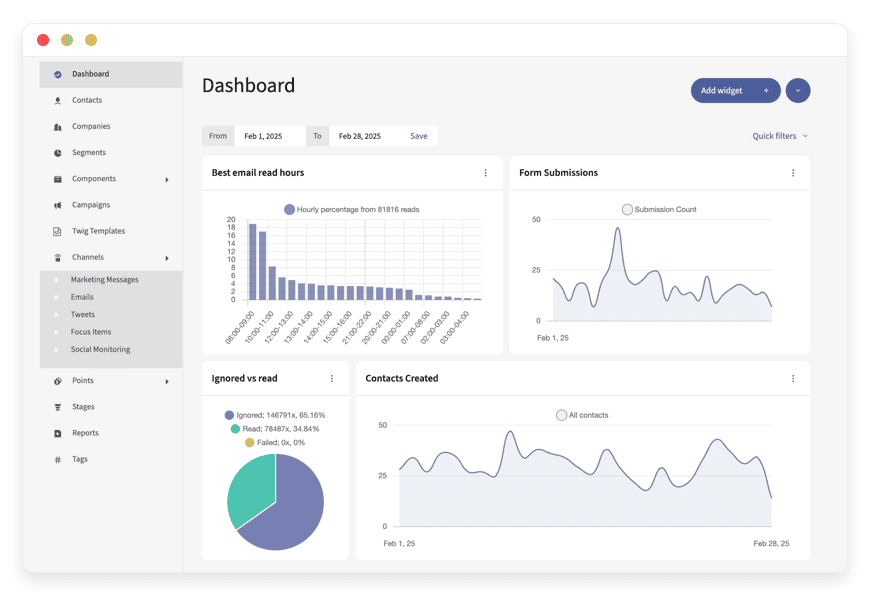
Mautic is the world's largest open-source marketing automation project. Full feature set: drip campaigns, lead scoring, multi-channel automations, dynamic segments, landing pages, forms, A/B testing, and a REST API. License is GPL-3.0. The project has 9,200+ GitHub stars, 3,100+ forks, 1,000+ community volunteers, and is used by more than 200,000 organisations. Founded in 2014 by David Hurley, it's now community-stewarded under the Open Source Collective.
The feature parity with Mailchimp Standard and HubSpot Marketing Hub is close to one-for-one. If you can build a multi-step automation in Mailchimp, you can build it in Mautic — branching logic, wait steps, event triggers, contact-property updates, lead scoring tied to behaviour. The campaign canvas is a drag-and-drop visual builder; segments update on a cron schedule, not in real time, which is the architectural detail most new self-hosters trip on.
Out-of-the-box deliverability is a question of which SMTP provider you point Mautic at, not of the app itself. Most production setups use Amazon SES for cost, Postmark for premium inbox placement, or SendGrid as a mid-market default. Mautic itself doesn't try to be an ESP — it leans on whatever SMTP relay you wire up.
Mautic's official documentation lists the requirements: PHP 8.1+, MySQL 5.7+ or MariaDB 10.3+, web server (Apache or Nginx), cron scheduling for segment updates and campaign triggers. The cron part trips up new self-hosters: if mautic:segments:update, mautic:campaigns:update, and mautic:campaigns:trigger aren't running on schedule, your campaigns stop firing. A managed plan removes that operational surface entirely.
Where Mautic gets you: it's free, you own the data, and the per-send cost is whatever SMTP rate you negotiate. Where Mautic doesn't get you: the learning curve is real (Mailchimp ships better defaults), and out-of-box performance softens past 100,000 contacts without database tuning, caching, and queue workers. Teams sending to large lists run dedicated workers and a tuned MySQL instance; the documentation covers it, but it's an ops task most marketers don't want to own.
Best for: small businesses and agencies replacing Mailchimp Standard or Premium, willing to invest a few hours learning the campaign builder.
DANIAN price: €9/month for a managed Mautic hosting instance — patching, daily off-site backups, monitoring, and support included.
Switching effort: medium-high. Export Mailchimp lists as CSV; rebuild automations; warm the SMTP relationship.
Sources: mautic.org, github.com/mautic/mautic, docs.mautic.org.
Listmonk
Listmonk is a high-performance, single-binary newsletter and mailing-list manager written in Go. It does one thing: send to lists, fast. No automation flows, no lead scoring, no landing pages. If your use of Mailchimp is basically "send a weekly newsletter to a segmented list," Listmonk is the right shape. License is AGPL-3.0. The project has roughly 16,000 GitHub stars and active development on a quarterly release cadence.
The architecture is intentionally minimal: a Go binary, a Postgres database, and an SMTP relay you bring yourself. Performance is the headline — Listmonk handles millions of subscribers comfortably on modest hardware, which is why it shows up in self-hosted setups serving very large newsletter audiences. The admin UI is clean and fast; the templating engine is straightforward; campaign analytics are basic but sufficient for newsletter-only workflows.
A note on positioning: Listmonk is not currently in DANIAN's managed catalog. If you want managed open-source newsletter sending, Mautic (above) is the catalog answer. If your team has the operational appetite to run Listmonk directly, treat it as a Path-B self-host option — install on a production-class VPS, point it at an SMTP relay, set up backups, and budget about an hour a month for upgrades.
Best for: technical teams sending high-volume newsletters who don't need automation.
Path: self-host only (no DANIAN managed plan today).
Switching effort: medium — list import is easy, but you build the SMTP, monitoring, and backup pieces yourself.
phpList
phpList is the longest-running open-source newsletter platform — founded in 2000, AGPL-3.0, used by more than 750,000 organisations historically. It handles list management, segmentation, bounce processing, click tracking, and templating. The interface dates the project visibly, and active development has slowed compared with Mautic and Listmonk, but the core functionality is still serviceable.
If you arrived here from a Mailchimp Essentials-shaped use case — newsletter to a single list, occasional broadcast, no automations — phpList covers it. The reason most teams pick Mautic or Listmonk first is that phpList's UI is harder to learn for someone migrating from a modern SaaS, and the plugin ecosystem is sparser. Documentation is thorough but reads like documentation from 2010.
Best for: organisations with an existing phpList footprint, or teams who specifically want the longest-lived OSS option.
Path: self-host only (not in DANIAN's managed catalog).
Switching effort: medium-high — the learning curve on the UI is steeper than the others.
Comparison table
| Tool | Mailchimp tier replaced | License | GitHub stars | Where it runs | Switching effort |
|---|---|---|---|---|---|
| Mautic | Standard / Premium (automation) | GPL-3.0 | 9.2k | DANIAN managed (€9/mo) or self-host | Medium-high |
| Listmonk | Essentials / Standard (newsletter) | AGPL-3.0 | 16k | Self-host only (Path B) | Medium |
| phpList | Essentials (list management) | AGPL-3.0 | 1k+ | Self-host only (Path B) | Medium-high |
| Mailchimp Standard | — | Proprietary | n/a | SaaS | n/a (baseline) |
Send volume is paid separately on every open-source path. Mailchimp bundles send capacity into the per-contact price.
Where the contact tax actually goes
The persuasive part of the open-source case isn't the license; it's the cost-model shift. Mailchimp's pricing treats every contact as a recurring billable unit, whether you mail them or not. Open-source platforms treat the contact as free storage and charge you only when an email actually goes out.
Three SMTP providers cover most production setups, at different price-quality points:
- Amazon SES — $0.10 per 1,000 outbound emails. Pay-as-you-go, no monthly minimum. New accounts get 3,000 free message charges per month for 12 months. The cheapest credible option, but you're responsible for IP warm-up, bounce handling, and reputation management.
- Postmark — about $15/month for 10,000 emails, scaling to roughly $1.25 per 1,000 emails at higher tiers. Reputation-focused, used by teams that prioritise inbox placement over per-email price.
- SendGrid Essentials — about $20/month for 50,000 emails on the entry plan. Mid-market default with broad integration coverage.
Source: aws.amazon.com/ses/pricing (verified May 2026).
A worked example at the trigger scale. Take a team with 25,000 contacts sending four campaigns a month. That's 100,000 emails per month:
| Path | Monthly cost |
|---|---|
| Mailchimp Standard at 25,000 contacts | ~$270 |
| Managed Mautic on DANIAN + Amazon SES (100K emails) | €9 + $10 ≈ $20 |
| Managed Mautic on DANIAN + Postmark (100K emails) | €9 + ~$125 ≈ $135 |
| Self-host Mautic on a $24 production-class VPS + SES | $24 + $10 = $34 (plus 1–2 hrs/month operational time) |
The cheapest path replaces a $270 bill with about $20. The premium-deliverability path replaces it with about $135. Even the path that pays for Postmark's deliverability is half the Mailchimp price at the same scale.
For lower-volume senders, DANIAN's €9 includes basic SMTP capacity sufficient for small lists and transactional sends. Once you cross into bulk-marketing volume, point Mautic at your SMTP provider of choice — that's the architecture every serious self-hosted setup uses, and it's how the cost stays linear with what you actually send.
The sub-$10 figure for 100,000 emails on Amazon SES surprises most people the first time they see it. The math is straightforward: 100,000 × $0.0001 = $10. The provider absorbs no contact tax because there are no contacts being stored on their side. The same scale on Mailchimp pays for the storage of contacts you may never email again, plus the included send capacity you may not use, bundled into one number.
One honest caveat. The split cost model trades a single invoice for two. Some teams genuinely prefer the all-inclusive Mailchimp bill because it removes a vendor relationship from their stack. If reducing vendor surface matters more than reducing total cost, Mailchimp's pricing is a feature, not a bug. For most senders past 5,000 contacts the math wins anyway.
How to pick — three questions
1. Do you need automation, or just newsletter sending?
If your workflow is "send to a segmented list on a schedule," Listmonk is the cleanest fit and Mautic is overkill. If you run drip campaigns, behaviour-triggered sequences, lead scoring, or sales-and-marketing handoffs, Mautic is the only credible answer in this shortlist. The other tools don't try to compete on automation. Picking Mautic when you only need newsletter sending leaves you maintaining a complex app for a simple use case; picking Listmonk when you actually need automation leaves you rebuilding what Mautic gives you for free.
2. Do you want to run it yourself, or have someone run it?
The self-host path is realistic for a team with at least one person who's comfortable on the command line, willing to handle PHP and database upgrades, and ready to maintain the SMTP relationship. The managed path is for teams who want the open-source cost advantage without taking on operations work they didn't sign up for. Be honest about which one fits the team you have today, not the team you wish you had — picking self-host when nobody on the team wants to be on call is how outages happen.
3. Where will sending volume land in 12 months?
If you're under 5,000 contacts and 20,000 emails/month, Mailchimp's price isn't yet painful and the migration cost may not be worth it. If you're at 25,000+ contacts and sending weekly, the price difference compounds quickly. The break-even on the migration time tends to land somewhere between the 10,000 and 25,000 contact mark, depending on how complex your automations are. For teams projecting strong list growth, switching at 10,000 contacts and absorbing the learning curve early is usually better than waiting until 50,000 makes the migration twice as painful.
FAQ
Mailchimp pricing and 2026 changes
Why is Mailchimp more expensive in 2026 than two years ago?
Two compounding changes. The base price ladder shifted up in late 2024, then again in April 2026. Legacy users got an 11–13% increase notice this April. January 2026 cut the Free plan from 500 contacts to 250. More accounts sit on paid tiers as a result. The same workload now costs 20–30% more than two years ago.
Did Mailchimp shrink the free plan in 2026?
Yes, in January 2026. The Free plan dropped from 500 contacts to 250 and from 1,000 monthly sends to 500. There is now a 250-email daily cap. Multi-step automations had already been gated to Standard since June 2025, when the Classic Automation Builder was deprecated. For most active newsletter operators, the Free tier no longer covers real use.
Do unsubscribed contacts count toward your Mailchimp bill?
Yes, until you archive them manually. Unsubscribed and non-subscribed contacts stay in your plan total. A list with 5,000 active subscribers and 2,000 unsubscribed contacts pays the 7,000-contact tier. Most teams discover this on the invoice, not in the documentation. Open-source platforms bill on email volume sent. Unsubscribes stop costing money the moment they happen.
What is Mandrill and does my Mailchimp plan include it?
Mandrill is Mailchimp's transactional email product — order confirmations, password resets, receipts. It is billed separately at $20 per block of 25,000 emails. A team running both marketing campaigns and transactional sends pays for two Mailchimp products, not one. Combined invoices often run 30–50% above the headline marketing-plan price.
Open-source platforms — Mautic, Listmonk, phpList
Is Mautic really free?
Yes — the software is GPL-3.0, free to download and use. Your costs are infrastructure (hosting or a managed plan), SMTP sending fees, and your time for setup and maintenance. There are no per-contact license fees regardless of list size, and no feature gating between a "community" and "enterprise" edition.
What's the difference between Listmonk and Mautic?
Listmonk is a high-performance newsletter sender; Mautic is a full marketing-automation suite. If you replace Mailchimp Essentials, Listmonk is enough. If you replace Mailchimp Standard or Premium with their automation features, you need Mautic. The wrong choice means months of frustration on either side.
Does DANIAN host Listmonk?
Not currently. Listmonk is the natural sibling on the newsletter side, but it's not in the managed catalog at the moment. The managed answer on DANIAN today is Mautic for full automation, or Path-B self-host for Listmonk if your team has the operational appetite. Catalog requests get added on a 1–7 day cycle for active customers.
Is Mautic still actively maintained in 2026?
Yes. The 5.x release line ships regular updates. The GitHub repository carries 9,200+ stars and 3,100+ forks. The project is stewarded by the Open Source Collective with more than 1,000 community volunteers. Release cadence is quarterly, security advisories are timely, and active issues see triage within days. More than 200,000 organisations run it in production.
Does Mautic support double opt-in and consent tracking?
Yes. Mautic ships double opt-in forms, granular consent fields, per-contact subscription preferences, and automatic suppression lists. Unsubscribes are one-click and one-table — no manual archival to stop billing, because there is no per-contact billing. The "do not contact" handling is configurable per channel (email, SMS, web push) rather than a single global flag.
What are Mautic's server requirements?
PHP 8.1 or newer, MySQL 5.7+ or MariaDB 10.3+, a web server (Apache or Nginx), and cron scheduling. The cron part trips up new self-hosters. Three jobs (segments-update, campaigns-update, campaigns-trigger) must run on a tight schedule. If they don't, campaigns silently stop firing. Managed plans handle this; the docs cover it for self-hosters.
How does Mautic compare to HubSpot Marketing Hub?
Close on features, far apart on price. Mautic covers most of HubSpot Marketing Hub Professional's automation: drip campaigns, lead scoring, multi-channel journeys, landing pages, A/B testing. HubSpot Marketing Hub Professional starts around $890/month for 2,000 contacts. Mautic carries no per-contact tax at all. HubSpot brings polished defaults and a deep app marketplace; Mautic needs more setup.
Email economics — SMTP, deliverability, and cost
What about deliverability — won't my emails go to spam?
Deliverability lives at the SMTP layer, not the marketing-platform layer. A correctly configured Postmark or Amazon SES with proper SPF, DKIM, and DMARC records performs comparably to Mailchimp's shared infrastructure. The work shifts from "trust the platform" to "configure the SMTP relationship" — about a day of one-time work, plus ongoing list hygiene to keep bounce rates low.
Can I keep using my current SMTP provider?
Yes. Mautic, Listmonk, and phpList all support generic SMTP relays, so whichever ESP you already pay (SES, Postmark, SendGrid, Mailgun, or another) plugs in via standard SMTP credentials. The migration doesn't force a new vendor relationship on top of the platform change.
How much does Amazon SES charge per email?
$0.10 per 1,000 emails sent, with no monthly minimum and no contact-list fee. The first 3,000 emails per month are free for the account's first 12 months. Sending 100,000 emails costs $10. Sending 1 million costs $100. There is no charge for the list itself — SES bills only on outbound send volume.
Should I use Postmark or Amazon SES for Mautic?
Postmark for inbox placement, Amazon SES for cost. Postmark runs around $15 per 10,000 emails. Deliverability is industry-leading and bounce diagnostics are detailed. It's worth it for transactional or premium newsletter sending. SES is roughly 12× cheaper per email. It is adequate for marketing campaigns once your sending domain has warmed reputation. Many setups use both, splitting by message type.
What's the total monthly cost for 50,000 contacts on managed Mautic?
Around €9 for the Mautic instance plus your SMTP send fees. Four campaigns per month to 50,000 contacts is 200,000 emails. On Amazon SES that's $20. On Postmark, roughly $250. On SendGrid Essentials, around $40. Total monthly cost lands between €27 and €234. Mailchimp Standard at 25,000 contacts is already $270/month flat regardless of whether you send. At 50,000 contacts the Mailchimp bill is higher again.
Are there hidden costs in self-hosting email marketing?
Three to budget for. First, your time. Initial setup is 4–8 hours; ongoing maintenance runs 1–2 hours per month. Second, deliverability work. SPF, DKIM, DMARC, and dedicated IP warming take a day of focused work upfront. Third, infrastructure failure. Without daily backups and patching, a self-hosted instance is one disk failure away from a hard recovery. A managed plan absorbs the second and third items for €9/month.
Migration and IP warming
How long does migration take?
For a single list with simple campaigns, half a day. For 5,000–10,000 contacts with welcome series and a few automations, one to three days of focused work. Export your Mailchimp lists as CSV; import them into Mautic; rebuild the automation flows by hand. Test sends to a seed list before cutting over to the full list.
Can I import my Mailchimp templates and segments into Mautic?
Lists yes, templates partially, segments by rebuild. Export your Mailchimp lists as CSV. Mautic imports them cleanly with field mapping. Templates copy across via raw HTML export, then need re-templating in Mautic's editor — the syntax differs. Segments and automations rebuild by hand because the logic models differ. Most teams use the migration as a chance to simplify, not lift-and-shift.
How do I warm up a new sending IP for Mautic?
Start with 50 emails per day to your most engaged contacts. Double every 2–3 days for two weeks, capped at your monthly send target. Send only to recipients who opened or clicked recently in Mailchimp. Never to a cold list during warm-up. Authenticate first with SPF, DKIM, and DMARC. Postmark and SendGrid include warming guides; Amazon SES requires manual ramping.
Managed Mautic on DANIAN
What if I want to leave DANIAN later?
You can. The Mautic instance and database are yours; daily backups are downloadable; contacts and campaigns export cleanly. Open-source means no lock-in by design — DANIAN's role is to operate the instance, not to gate access to it.
What does €9/month actually cover at DANIAN?
One Mautic instance with 1 vCPU, 1 GB RAM, 30 GB storage, and 1,000 GB monthly traffic. Daily off-site backups, security patching, 24/7 email and ticket support, and a region of your choice across 21 datacenter locations on six continents. SMTP send volume above the included low-volume cap routes through your chosen provider. We will not upgrade your resources or charge you without your explicit consent. Card failed? We wait — we don't delete your data.
What happens if a campaign breaks overnight on managed Mautic?
Daily off-site backups roll back the instance to the last working state. Chat and email support cover 24/7. Typical response is under an hour for blocking issues. We will not silently upgrade your plan to fix a resource exhaustion problem. We tell you what's happening and what it would cost first. Card failed during recovery? We wait. We don't delete your data.
Conclusion — what to do this week
The case for leaving Mailchimp in 2026 isn't ideological. It's arithmetic. At 25,000 contacts the bill is about $270/month and headed up. Open-source platforms with a metered SMTP provider land between $20 and $135 for the same workload.
Three concrete steps.
First, run the math on your own list. Multiply your contact count by your monthly send frequency. That's your email volume. Price it at $0.10 per 1,000 on Amazon SES or $1.25 per 1,000 on Postmark. Compare with your current Mailchimp bill. If the gap is over $1,000/year, migration usually pays back inside a quarter.
Second, decide path. Self-host on a production-class VPS if you have an engineer with capacity. Start a 7-day Mautic trial on DANIAN if you'd rather have someone else run the instance. Both paths preserve the per-send economics; only the operational burden differs. The decision is about where the operational time goes, not whether the cost math works.
Third, do a small test before cutting over. Move one list segment — your least valuable, in case something breaks — to the new stack, run a full campaign cycle, verify deliverability and tracking, then migrate the rest. The teams that regret migrations are the ones who cut over everything at once and discover a deliverability issue with no fallback.
See DANIAN pricing for the per-app cost and what's included.