Open-source Airtable alternatives in 2026
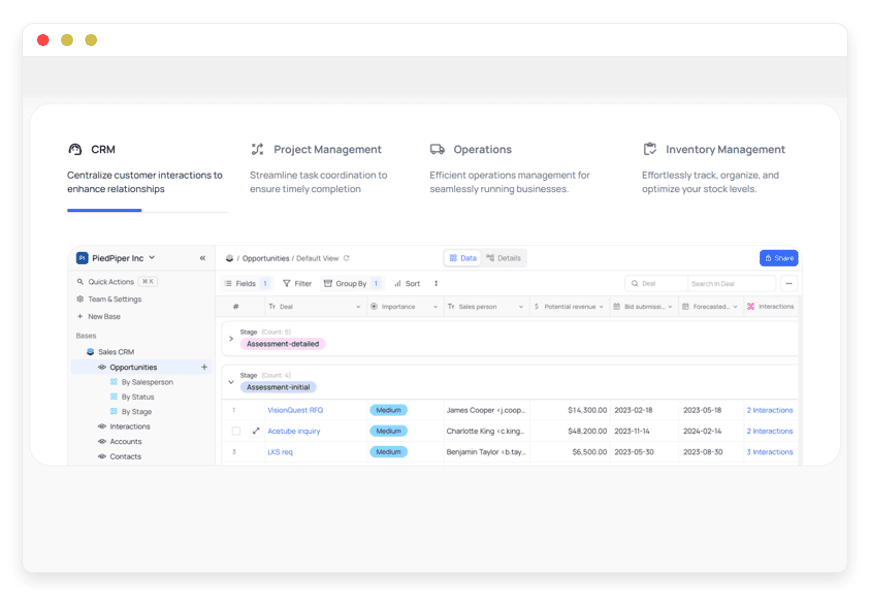
Open-source alternatives to Airtable in 2026
NocoDB, Baserow, Directus, PocketBase compared
TL;DR
- Five seats on Airtable Team list at $24/seat = $120/month; the same workload on DANIAN-managed open-source runs €9/app/month with no per-seat creep.
- Four credible open-source alternatives in 2026: NocoDB, Baserow, Directus, PocketBase.
- NocoDB is the closest visual clone. Baserow is the friendliest non-technical UI. Directus is data-first. PocketBase is a single-binary MVP backend.
- Airtable still wins on polished Interface Designer and mature Automations. We say so plainly below.
- DANIAN runs all four on a 7-day free trial; no card required to start.
Why people are leaving Airtable in 2026
The trigger is almost always the same. A team hits Airtable's 1,000-row Free-tier cap, looks at the Team plan, and runs the math. Team is listed at $24/seat/month. Five edit-permission users equals $120/month. Ten equals $240/month. That cost rises with every new collaborator, not with how much data you store.
The Airtable pricing page confirms the per-seat model directly. The FAQ on airtable.com/pricing states that on Team or Business plans, "you will be charged for all users who have edit permissions for at least one base in the workspace." Read-only viewers stay free. Anyone who can change a record is billable.
Business sits at $54/seat/month. Enterprise Scale is custom. The free plan keeps the 1,000-record-per-base cap, and Airtable's own FAQ notes you cannot add more records or attachments once you hit it. Your data stays readable. New writes do not.
None of this is hidden. It is simply structured to favour Airtable's revenue model rather than the operator's cost ceiling. For a five-person operations team tracking inventory, content calendars, or CRM, the per-seat math gets uncomfortable fast.
The second trigger is data ownership. Airtable holds your records in its own format. Exports work, but workflows, automations, and Interface views do not portably leave the platform. For teams that want their database under their own roof — same data, same schema, no per-seat tax — the open-source side has matured into a real option.
That is the conversation this post answers. Four named projects, what each one actually does well, where Airtable still wins, and what the cost math looks like once you stop paying per seat. Start a 7-day DANIAN trial if you want to skip ahead and try one.
What "alternative" actually means here
Three different paths can replace Airtable, and they are not interchangeable. Choosing the wrong one wastes a quarter. We frame each honestly before naming apps.
Path 1: a cheaper SaaS clone. Smartsheet, Notion databases, Coda, and similar tools sit in adjacent territory. They cut the per-seat bill on the margin, but the underlying model is identical: someone else holds your data, charges per user, and ships features on their schedule. You moved providers. You did not change the structural problem.
Path 2: self-host an open-source project on your own VPS. A 2 vCPU / 4 GB production-class VPS at around $24/month plus $5 backup and $15 monitoring lands at about $44/month in raw infrastructure. The hidden cost is operator time — patching, certificate renewals, database backups, restoring after a failed update, and rotating disk space when storage fills. Estimate €60 to €240/month in operational hours depending on how new this is to you. Tools like Coolify make Path 2 considerably easier, but they do not remove the responsibility.
Path 3: managed open-source. A third party runs the container, patches the OS, takes the backups, monitors uptime, and rotates secrets. DANIAN charges €9/app/month for this. That base price covers 1 vCPU and RAM, 30 GB storage, 1000 GB traffic, 24/7 support by email and tickets, and full lifecycle management of the app — security updates, backups, monitoring, DNS, and SMTP. Customers choose the region per app from 21 datacenter locations across six continents. We will not upgrade your resources or charge you without explicit consent.
Path 3 trades the freedom of root-level access for the cost predictability of a flat per-app fee. It is the right path if you want the data-ownership benefits of open-source without paying for them with weekend maintenance.
The shortlist — four apps worth comparing
These four were chosen because they are mature, actively maintained in 2026, and cover different parts of Airtable's surface area. Each capsule gives the license, GitHub star count as of May 2026, who builds it, the DANIAN price, and a one-line best-fit.
NocoDB — the closest visual clone
NocoDB is the project that looks most like Airtable when you open it. Grid, Gallery, Kanban, Form, and Calendar views are all present.
It connects to MySQL, PostgreSQL, SQLite, MariaDB, or MSSQL and turns any of them into a no-code interface.
License is AGPLv3, with a recently introduced Sustainable Use License covering commercial-reseller terms.
GitHub stars: 63k as of May 2026.
Built by the NocoDB team led by Naveen Jain.
DANIAN runs managed NocoDB hosting at €9/app/month.
Best for: teams who want Airtable's UI without Airtable's bill.
Baserow — the friendliest non-technical UI
Baserow is the most polished end-user experience in the set.
Real-time collaboration, drag-and-drop tables, a no-code application builder, and an AI assistant ("Kuma") on the managed tier.
Stack is Django, Vue.js, and PostgreSQL. License is MIT Expat for the Open Source Edition; advanced features sit under a proprietary add-on license.
GitHub stars: 4.8k on the new official repo (the project migrated from GitLab in late 2025, so historic star counts do not carry over).
Built by Baserow B.V. in the Netherlands.
DANIAN runs managed Baserow hosting at €9/app/month.
Best for: teams where most users have never opened a terminal.
Directus — data-first, API-first, doubles as a headless CMS
Directus is the only project in this list that explicitly does not try to be Airtable.
It is a real-time API and admin app that layers on top of any SQL database — Postgres, MySQL, SQLite, OracleDB, CockroachDB, MariaDB, MSSQL.
License is BSL 1.1 with a free-use grant under $5M total finances; per the April 2026 directus.io blog post, v12 transitions to the Monospace Sustainable Core License (MSCL) with similar free thresholds.
GitHub stars: ~35.2k.
Built by Monospace Inc.
DANIAN runs Directus for headless CMS workloads at €9/app/month.
Best for: teams with at least one developer who want a database plus an API plus a CMS in one place.
PocketBase — single-binary backend for MVPs
PocketBase is the smallest moving target of the four.
A single Go executable runs an embedded SQLite database, real-time subscriptions, OAuth2 authentication, file storage, and an admin UI.
License is MIT, no strings attached. GitHub stars: ~58.3k.
Maintained by Gani Georgiev.
The project is pre-v1.0.0, and the maintainer is direct that full backward compatibility is not guaranteed until v1.0.0 ships.
DANIAN runs PocketBase at €9/app/month.
Best for: early-stage product backends where you want auth, storage, and a database without standing up three separate services.
How the four compare side by side
The table below shows the per-month math at 10 Airtable Team seats, the DANIAN managed equivalent, current GitHub star counts as a community-strength proxy, self-hosting effort on a low-to-high scale, and a one-line fit per project.
Airtable figures use the $24/seat Team-tier reference from the Airtable pricing page; the DANIAN figure is the flat base €9/app/month.
| App | Cost at 10 Airtable Team seats | DANIAN managed price | GitHub stars (May 2026) | Self-host effort | Best fit |
|---|---|---|---|---|---|
| NocoDB | $240/month on Airtable | €9/app/month | ~63k | Medium | Airtable visual parity |
| Baserow | $240/month on Airtable | €9/app/month | ~4.8k (post-migration) | Medium | Non-technical operator UX |
| Directus | $240/month on Airtable | €9/app/month | ~35.2k | Medium-High | API-first, headless CMS |
| PocketBase | $240/month on Airtable | €9/app/month | ~58.3k | Low | MVP product backend |
At ten edit-permission seats, the gap is $240/month on Airtable versus €9/app/month on DANIAN.
Even running two of these apps in parallel — say NocoDB for operations and PocketBase for a customer-facing app — the managed-OSS bill stays at €18/month. See per-app pricing here.
How to pick — three questions
The four projects are not ranked. They serve different jobs, and the right choice depends on who is using the tool day-to-day and how much developer time you can spend on it. Three honest questions narrow the field faster than any feature matrix, and they map cleanly to the four apps once you answer them.
1. Do you need real-time collaboration UI parity, or just the database?
If your team currently lives inside Airtable views all day — sharing grids, filtering with collaborators in real time, building Forms for non-technical input — you want NocoDB or Baserow. Both replicate the spreadsheet-database hybrid that Airtable made famous. NocoDB matches Airtable's visual language more closely. Baserow's UI is more modern and a little easier on first-time users.
If what you actually need is a database with an admin panel and an API — and the "collaboration" happens through dashboards, internal tools, or a frontend app you build separately — Directus or PocketBase is the better path. Directus when you have a developer. PocketBase when you want the entire backend in one binary.
2. Do you have any developer time, or is everyone non-technical?
Baserow assumes nobody on the team writes code. The interface, the application builder, the automation editor — all are drag-and-drop. NocoDB is similar but exposes a bit more of the SQL layer in advanced features. Both reward operators who are comfortable in spreadsheets.
Directus and PocketBase assume at least one developer in the room. Directus' admin UI is approachable, but the value lands when someone is consuming the REST or GraphQL API from a frontend. PocketBase ships SDKs for JavaScript and Dart and expects to be embedded in an app. Picking these without a developer leaves most of the value on the table.
3. Are you replacing Airtable's database, or also its workflow automation?
This question matters and it does not have a comfortable answer. Airtable's Automations are mature. Multi-step triggers, conditional logic, integrations with Slack, Google Drive, Salesforce, Jira, and dozens more — the marketplace is real and it works.
NocoDB and Baserow have webhooks and basic automation builders. They do not match Airtable's depth here. If your Airtable workload is heavy on Automations rather than the database itself, you should plan to pair the OSS database with a separate workflow runner — n8n, for example — rather than expect a one-to-one swap. DANIAN runs n8n at the same €9/app/month flat fee, which gets you the database plus the workflow engine for €18/month total.
Where Airtable still wins
This section exists because the post would be dishonest without it. Airtable did not win the no-code database market on price. It won on polish. Interface Designer lets non-technical operators build clean, branded internal tools in an afternoon. The Automations editor has years of integration depth that the OSS projects do not match. The marketplace of extensions, templates, and customer stories is large and active.
The four open-source alternatives in this post replace Airtable's database layer credibly. They do not yet replace Interface Designer at the same level of polish, and they do not match the breadth of Airtable's integration marketplace. If your team's centre of gravity is in those layers — not the database — Airtable may still be the right tool, and paying $120/month at five seats is a reasonable price for it. Honest broker rule: cost is not the only axis.
FAQ
Can I export my Airtable data into one of these tools?
Yes. Airtable supports CSV export per view, and the API exposes full base structure. NocoDB has an Airtable-import tool built in, which handles tables, fields, and views directly. Baserow imports CSV and JSON. Directus and PocketBase accept SQL or CSV imports through their admin UIs. Plan for some field-type cleanup on either side.
Which of these is closest to Airtable visually and behaviourally?
NocoDB. It is the project that most explicitly aims at Airtable's UI, with Grid, Gallery, Kanban, Form, and Calendar views laid out similarly. Baserow is the next closest and has a more modern design language. Directus and PocketBase are not trying to be Airtable visually; they replace the database and API layer rather than the spreadsheet-style frontend.
Do I need to know SQL to use these?
No for NocoDB and Baserow — both are explicitly no-code in everyday use, and you can build, filter, and link tables through the UI. Directus exposes more of the schema and rewards users who understand relational databases. PocketBase is developer-facing by design; the admin UI is approachable, but the value comes from the SDK and the API rather than the dashboard.
What does "managed" mean — what is actually included at €9/month?
DANIAN's €9/app/month includes 1 vCPU and RAM, 30 GB storage, 1000 GB traffic, 24/7 support by email and tickets, and full lifecycle management of the app: security patches, OS updates, backups, monitoring, DNS, SMTP, and encryption at the volume level. We do not upgrade your resources or charge you without explicit consent. The dashboard exposes a per-container terminal and file manager scoped to the app.
Can I host this myself instead?
Yes — all four projects ship Docker images and are documented for self-hosting. A reasonable reference setup is a 2 vCPU / 4 GB production-class VPS at around $24/month, plus $5/month for backups and $15/month for monitoring. The honest number is operator time: budget €60 to €240/month of hours for patching, restores, and incident response. Coolify makes the DIY path considerably less painful.
What happens to my data if I want to leave DANIAN?
You take it. Each app's underlying database (Postgres, MySQL, or SQLite depending on the project) is yours, and DANIAN provides full database dumps and file exports on request. Open-source licensing means you can stand the same container up anywhere — your laptop, a VPS, another managed provider. No proprietary format, no export tax. The opentechhub.io analysis of PocketBase notes data portability is one of its strongest properties, and that logic applies across the set.
Which open-source Airtable alternative is best for non-technical teams?
Baserow. The UI is drag-and-drop, real-time collaboration is built in, and the application builder lets you ship internal tools without code. NocoDB is a close second and looks more like Airtable visually. Directus and PocketBase assume at least one developer on the team.
Is NocoDB free?
Yes. NocoDB is licensed under AGPLv3 with a Sustainable Use License covering commercial-reseller terms. You can self-host any version at no cost. NocoDB Cloud is paid; DANIAN runs managed NocoDB at €9/app/month flat with full lifecycle management — security, updates, backups, monitoring — included.
What is the main difference between NocoDB and Baserow?
NocoDB looks more like Airtable and connects to any existing SQL database (MySQL, Postgres, SQLite, MariaDB, MSSQL). Baserow ships its own PostgreSQL backend and prioritises a polished no-code UI with an application builder. Pick NocoDB for Airtable visual parity. Pick Baserow for non-technical end users.
Does Baserow have real-time collaboration like Airtable?
Yes. Baserow supports real-time multi-user editing on tables and views — changes appear immediately for other users. Comments and row activity feed are also live. NocoDB has similar real-time features in current releases. Directus has live API updates but a less spreadsheet-centric collaboration model.
Can Directus replace Strapi as a headless CMS?
Yes, for most workloads. Directus offers similar content modelling, REST and GraphQL APIs, role-based access control, and an admin UI. Key differences: Directus is database-agnostic and writes to your existing SQL schema; Strapi creates its own schema. License terms differ — Directus uses BSL 1.1 with a free-use grant.
Is PocketBase production-ready in 2026?
PocketBase is widely used in production but remains pre-v1.0.0. Maintainer Gani Georgiev states full backward compatibility is not guaranteed until v1.0.0 ships. For MVPs and small-to-medium production apps, it works well. For larger workloads needing long-term API stability, factor in possible migration work at the v1 release.
How many rows can NocoDB handle compared to Airtable's 1,000-row Free cap?
NocoDB has no built-in row cap — limits come from the underlying database. A modest production-class VPS comfortably handles hundreds of thousands of rows. On DANIAN's base €9/app/month plan with 30 GB storage, that translates to several million records depending on column count and attachment size.
Do these tools have automation features like Airtable's Automations?
Partially. NocoDB and Baserow have webhooks and basic automation builders, but neither matches Airtable's depth of pre-built integrations. The honest fix is pairing the database with a workflow engine like n8n, which DANIAN also runs at €9/app/month. Database plus workflow runner totals €18/app/month.
What databases does NocoDB support?
NocoDB connects to MySQL, PostgreSQL, SQLite, MariaDB, and MSSQL. You can point it at an existing production database or use the embedded SQLite for new projects. This multi-database support is one of NocoDB's main differentiators — most Airtable alternatives lock you into a single backend.
Does Baserow have an API?
Yes. Baserow ships a full REST API and database tokens for programmatic access. Webhooks are also supported. You can build automations, connect external tools, or treat Baserow as a backend for a frontend app. The API is documented per-database from the Baserow admin UI.
How long does migrating from Airtable to NocoDB take?
For a typical workspace with 5 to 10 tables, expect 30 to 90 minutes using NocoDB's built-in Airtable importer. The importer carries over tables, fields, views, and most relationships. Plan extra time for cleaning up field-type mismatches (linked records, formulas), and re-creating any automations or Interface views manually.
Which open-source Airtable alternative has the largest community?
By GitHub stars in May 2026, NocoDB leads at 63k, PocketBase follows at ~58.3k, Directus at ~35.2k, and Baserow at 4.8k on the new official repo (the project migrated from GitLab in late 2025). All four have active maintainers shipping regular releases.
Can I build customer-facing apps with PocketBase?
Yes. PocketBase ships built-in authentication (email/password and OAuth2), file storage, real-time subscriptions, and SDKs for JavaScript and Dart. Many production mobile and web apps run PocketBase as their entire backend. The single-binary deployment makes it easy to host; the pre-v1.0.0 status is the main caveat.
Does Directus support file uploads and digital asset management?
Yes. Directus includes a full file library with image transformations, metadata management, folder organisation, and access permissions. It can store files locally or in S3-compatible object storage. This is one reason teams choose Directus over Strapi for content-heavy projects — DAM is included rather than as an add-on.
Are there open-source Airtable alternatives with AI features built in?
Baserow has the most integrated AI features in 2026 — its assistant Kuma is available on cloud and helps with formulas, queries, and table design. NocoDB has AI-assisted formula generation. Directus added AI extensions via its marketplace. None match Airtable's AI-app builder depth yet, but the gap is narrowing fast.
What to do this week
Three concrete actions, in order of effort. None of them require a credit card, and none of them require a long evaluation cycle. The point is to test one real workload against one real candidate so the decision sits on evidence rather than feature lists. The math you ran in section one should make the priority obvious.
First, run the cost math against your real seat count. Pull your Airtable workspace seat list. Multiply by $24 (Team) or $54 (Business). That is your annualised exit incentive. If the answer is under $50/month, stay where you are — the switching cost is not worth it. If it is $100/month and climbing, the rest of this post is for you.
Second, pick one app from the shortlist based on the three questions above — not on the GitHub star count, which is a poor proxy for fit. NocoDB or Baserow for spreadsheet-replacement work. Directus for API-first or headless CMS work. PocketBase for an MVP backend.
Third, spin it up on a 7-day DANIAN trial and import one real base. Not a toy schema — your actual operations table or content calendar. The trial does not ask for a card, and we will not auto-charge at the end. Spin up NocoDB on DANIAN in a few clicks and see whether the database half of Airtable's value carries over for you. If it does, the per-seat creep stops being your problem.