
Managed Matrix + Element Hosting: The Definitive Guide
TLDR: The Quick Answer
If you need a communication platform that guarantees privacy, connects with other networks, and belongs entirely to you, Managed Matrix + Element Hosting is the solution. Here is why this stack is superior:
Absolute Privacy: Default End-to-End Encryption (E2EE) means even the server admin cannot read your messages.
Universal Connectivity: "Federation" allows you to talk to users on other servers seamlessly, just like email.
Bridge the Gaps: Connect Slack, Discord, Telegram, and IRC channels into one single interface.
Sovereign Infrastructure: You control the history, the access rules, and the uptime.
Zero-Headache Management: We handle the Synapse configuration, the PostgreSQL database tuning, and the DNS setups.
Immediate Access: No compiling, no Docker compose files. You get a live environment instantly.
Introduction
The modern digital workspace is fractured. You likely have Slack for internal team chat, Discord for community management, WhatsApp for quick client updates, and maybe even Microsoft Teams for formal meetings. You are juggling half a dozen applications, each serving as a "walled garden." These platforms hold your conversations hostage within their proprietary servers. You cannot migrate your history easily, you cannot customize the features, and you certainly cannot verify who is reading your data on the backend.
It creates "notification fatigue" and security anxiety.
Matrix, paired with the Element client, offers the only viable exit strategy from this ecosystem. It provides a standardized, open network for real-time communication that rivals the features of the big players while respecting your right to privacy.
However, the barrier to entry is technical. Running a Matrix homeserver (usually Synapse) is not a "set it and forget it" task. It requires a deep understanding of server administration. You must manage PostgreSQL databases, configure reverse proxies, handle certificate renewals for federation, and set up TURN servers for VoIP reliability. If you misconfigure your homeserver.yaml file, you risk isolating your team from the rest of the network or, worse, exposing your metadata.
At DANIAN, we remove this friction. We provide the invisible infrastructure that powers your conversation. We keep the servers running, the databases optimized, and the security patches applied, so you can focus on what matters: communicating with your team.
What is Matrix + Element?
To understand the value here, you must distinguish the protocol from the application.
Matrix is an open standard for real-time communication. Think of it as the HTTP of chat. Just as you don't need the same web browser as your friend to view their website, you don't need to be on the same server to chat with them on Matrix. It supports Instant Messaging, VoIP (Voice over IP), and IoT (Internet of Things) signaling. It is decentralized, meaning there is no single point of failure and no central authority monitoring the network.
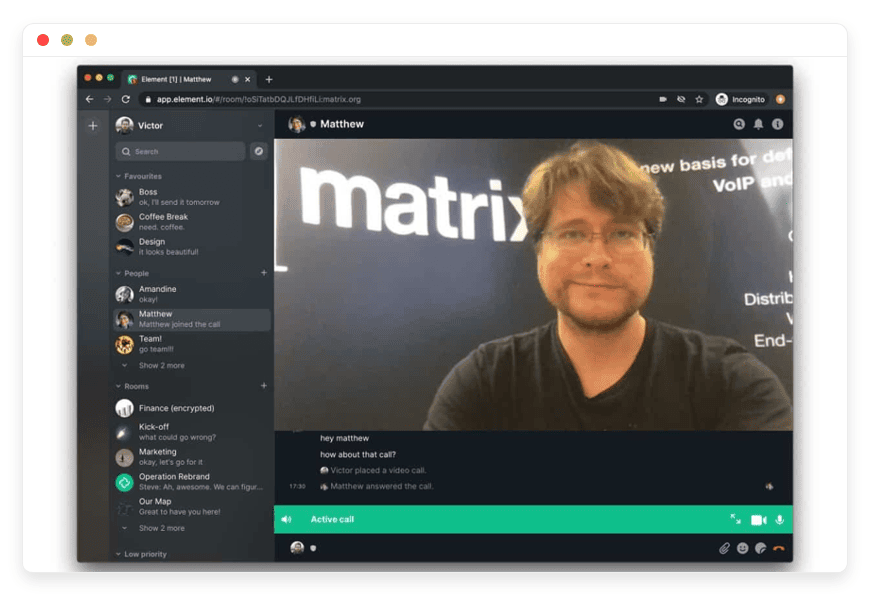
Element is the premier client used to access this network. Formerly known as Riot, Element provides the polished, modern interface users expect. It offers a rich experience with file sharing, read receipts, typing notifications, and widgets. While Matrix is the engine under the hood, Element is the dashboard you interact with every day.
Why is it trending?
We are witnessing a shift toward "Digital Sovereignty." Governments, defense contractors, and privacy-conscious enterprises are realizing that relying on US-based cloud giants for critical infrastructure is a strategic risk. Matrix + Element is trending because it is currently the only mature, feature-rich platform that allows an organization to completely separate its communication infrastructure from big tech surveillance while maintaining modern usability.
Why Choose Matrix + Element?
The decision to choose Hosting Matrix + Element is usually driven by a requirement for three things: Security, Interoperability, and Permanence.
When you use a platform like Discord or Slack, you are renting space. If they decide to ban your account, or if they suffer an outage, your communication lines are cut. With Matrix, the architecture is resilient. If the main matrix.org server goes down, your private homeserver continues to function for your internal users without a hiccup.
Furthermore, the "Open" nature of the protocol allows for permissionless innovation. You are not waiting for a vendor to release a feature. If you need a custom integration—say, a bot that pulls production metrics from your factory floor and posts them to a secure room—you can build it using the Matrix API without asking anyone for API keys or paying for an "Enterprise" tier.
Key Features of Matrix + Element
When you switch to a managed environment, you unlock the full potential of the software. Here is a deep dive into the features that make this stack indispensable for serious organizations.
End-to-End Encryption (E2EE)
This is not "optional" privacy; this is privacy by design. Matrix uses the Olm and Megolm cryptographic ratchets (similar to the Signal protocol).
How it works: When you send a message, it is encrypted on your device. It travels across the server network as unreadable ciphertext. It is only decrypted when it reaches the recipient's device.
The Benefit: Even if a hacker gains root access to your Matrix server—or if a government issues a warrant for your data—the content of your messages remains mathematically inaccessible. Only the participants in the room hold the keys.
Cross-Signing: Element makes this usable with "Cross-Signing." You verify your own devices, so you don't have to manually verify every single person you talk to, balancing high security with high usability.
Federation
Federation is the killer feature that proprietary apps cannot offer. It works exactly like email.
The Concept: A user on user@yourcompany.com can start a chat with partner@client-server.com. The messages are replicated across both servers.
Resilience: Because the conversation history is shared across the participating servers, there is no single point of failure. If one server goes offline, the other servers in the room retain the history.
Sovereignty: You can blacklist specific servers you don't want to talk to, or you can run a "closed federation" where your server only talks to a specific whitelist of partners.
Spaces
As organizations grow, a flat list of chat rooms becomes unmanageable. Element introduced Spaces to solve this.
The Hierarchy: Spaces allow you to group rooms and people together. You can have a "Company Space," and inside that, you can have a "Marketing Space" and an "Engineering Space."
Discoverability: New employees can join the "Company Space" and immediately see a directory of all relevant rooms they are allowed to join, without needing to be manually invited to twenty different channels.
Role-Based Access: You can manage permissions at the Space level, cascading admin rights down to the rooms contained within.
Bridges
Your team probably uses tools they refuse to give up. Matrix shines here. Through "bridges," you can connect Matrix rooms to other networks like IRC, Slack, Discord, Telegram, and even Signal or WhatsApp.
Puppeting: Advanced bridges allow for "puppeting," where your Matrix account acts as if it were you on the other platform. You type in Element, and it appears in Slack as your Slack user, not a bot.
The Workflow: This creates a "Single Pane of Glass." You can stay in your secure Element interface while your marketing team stays in Twitter DMs or Discord, and your developers stay in IRC. All messages flow into your Matrix room centrally.
Widgets and Integrations
Element is not just for text; it is a dashboard for collaboration.
Embedded Apps: You can embed web applications directly into a chat room as a Widget.
Examples: You can pin a Jitsi video conference to the top of the room, embed a shared Etherpad for real-time document editing, or display a Grafana dashboard.
Custom Workflows: This turns a chat room into a workspace. You don't just talk about the document; you edit the document inside the chat room.
Voice and Video Conferencing
Element integrates seamless VoIP calls.
1-on-1: Direct calls are peer-to-peer and encrypted, offering high fidelity without server lag.
Group Calls: For larger meetings, Element typically integrates with Jitsi or utilizes native Matrix Call (Element Call) which supports scalable video conferencing.
Screen Sharing: Full support for screen sharing makes it a viable replacement for Zoom or Google Meet for internal standups.
Granular Access Control
You have total control over who enters a room.
Room History Visibility: You can configure a room so that new members can see the history (useful for onboarding) or only see messages sent after they joined (useful for sensitive projects).
Power Levels: Matrix uses a 0-100 power level system. You can define exactly what power level is required to ban users, delete messages, pin content, or upgrade other users. This is far more flexible than the binary "Admin vs. User" roles found in other apps.
Solutions per Industry
Different sectors use Managed Matrix + Element Hosting to solve specific, high-stakes operational headaches.
Government and Public Sector
Public institutions are under immense pressure to keep data within their borders. Using a cloud service hosted in a foreign country often violates data residency laws.
The Solution: A managed Matrix instance ensures that the communication infrastructure is physically located where you need it. By using a private federation, government agencies can securely communicate with one another (inter-agency) without the data ever traversing the public internet or touching commercial servers. France's "Tchap" messenger is the prime example, securing communications for civil servants nationwide.
Software Development Agencies
Dev shops often struggle with tool fragmentation. Developers live in GitHub and the terminal, Project Managers live in Jira, and Clients live in email.
The Solution: Matrix acts as the central nervous system. Using webhooks, an agency can pipe GitHub commits, CI/CD build statuses (from Jenkins or GitLab), and Jira ticket updates into specific project rooms. Bridges allow the agency to invite clients (who might use Slack or MS Teams) into a shared channel without forcing the client to install Element. The developers get to stay in their preferred environment, and the client feels responsive service.
Healthcare and NGOs
These organizations handle Highly Sensitive Data (PHI) and often operate in hostile environments where internet is spotted or surveillance is high.
The Solution: Matrix provides a secure line of communication that resists censorship and snooping. For healthcare, the ability to share patient data (files, images) within an E2EE room ensures patient confidentiality is maintained. For NGOs, the decentralized nature means that even if a regime blocks the main matrix.org domain, a private NGO server can still function and route messages through alternative paths or proxies.
Education and Universities
Universities are massive, federated entities by nature. Different departments (Computer Science vs. Humanities) often run their own IT shadows.
The Solution: Matrix aligns perfectly with the academic structure. The Engineering department can host its own homeserver, and the Arts department can host theirs. Through federation, a student in Engineering can chat with a professor in Arts seamlessly. Furthermore, Matrix supports the preservation of knowledge. Unlike Slack, which deletes message history on free tiers, a university-hosted Matrix server preserves research discussions and academic collaboration indefinitely.
Financial Services and FinTech
In finance, "auditability" and "walls" are critical. Traders cannot talk to analysts; external advisors cannot see internal strategy.
The Solution: Matrix's granular permission system allows compliance officers to set strict rules on who can invite whom. "Wall of Silence" policies can be enforced technically by restricting federation to whitelisted domains only. If a deal is happening, a secure room can be spun up where files are shared with E2EE protection, ensuring that insider information never leaks to the server logs or third-party cloud providers.
Journalism and Activism
Protecting sources is the primary directive for investigative journalism. Standard communication channels are easily tapped.
The Solution: Journalists use Matrix to communicate with sources anonymously. Because Matrix supports Tor and can be accessed via obscure homeservers, it protects the identity of the whistleblower. The burn-after-reading settings and the ability to verify devices ensure that the journalist knows exactly who they are talking to, preventing "Man in the Middle" attacks.
Legal Firms
Lawyers trade in confidentiality. Sharing privileged documents via email is a security risk, and consumer chat apps are not compliant with client privilege standards.
The Solution: A dedicated Matrix instance allows a law firm to create a "Client Room" for each case. They can invite the client into this secure space. All documents, strategies, and conversations are encrypted. When the case is closed, the room can be archived or cryptographically deleted, ensuring that no residue of the sensitive data remains accessible.
Matrix + Element vs. Other Softwares
How does this stack compare to the proprietary giants?
| Feature | Matrix + Element | Slack / MS Teams | Discord |
| Protocol | Open Standard (Matrix) | Closed / Proprietary | Closed / Proprietary |
| Encryption | End-to-End (Default) | Server-Side / Optional | Transport Only (mostly) |
| Network | Decentralized (Federated) | Centralized Silo | Centralized Silo |
| Data Control | You control the database | Vendor controls the database | Vendor sells/mines data |
| Interoperability | Native Bridging | Limited Integrations | Limited Integrations |
| User Identity | Global (one ID, many servers) | Per Workspace | Global (one platform) |
| Offline Access | Robust Sync | Limited | Limited |
| Cost Scaling | Predictable Server Costs | Per-User Licensing Fees | Free (Data is the product) |
The critical difference lies in the business model. Slack and Teams charge per user. As your organization grows, your bill grows linearly. With Managed Matrix, you are paying for the infrastructure resources (CPU/RAM). You can have 100 users or 1000 users; if your text volume is efficient, your costs remain stable. You are not penalized for growth.
Use Cases and Applications
The "War Room" for Incident Response
When a server goes down or a security breach is detected, you need an out-of-band communication channel immediately. You cannot use your internal email if the email server is hacked.
The Workflow: You launch a dedicated Matrix room on DANIAN. You invite your internal security team and external forensic contractors via federation. The room is E2EE. You upload logs, share screenshots, and coordinate the fix. Once the incident is resolved, you have an immutable, timestamped log of every action taken, which is crucial for the post-mortem report.
The Open Source Community Hub
If you maintain a software project, you want to be accessible to your users, but you don't want to manage their accounts.
The Workflow: You host a public Space for your project. Users from anywhere in the Matrix network (using matrix.org, mozilla.org, or their own personal servers) can join your support rooms. You don't have to manage their passwords or personal data. They show up, ask questions, you answer, and the community grows organically without you acting as a user database administrator.
Cross-Organizational Research Consortium
Imagine a consortium of five different research hospitals working on a cure. They cannot all merge their IT systems into one Active Directory.
The Workflow: Each hospital runs its own Matrix node. They create a shared Space for the research project. Doctors from Hospital A chat with researchers from Hospital B. The data regarding Hospital A's patients never leaves Hospital A's control, yet the collaboration is fluid. This is the power of federated sovereignty.
The "Family Shield"
Tech-savvy families are moving away from Facebook Messenger and WhatsApp to protect their children's data privacy.
The Workflow: A family runs a small Matrix instance. They create a secure space for family chat, photo sharing, and location coordination. They bridge a "Shopping List" bot into the chat. They have peace of mind knowing that their personal photos and conversations are not being scanned for ad targeting by a social media giant.
How DANIAN Helps
At DANIAN, we position ourselves as the "Quiet Enabler." We handle the mess; you get the glory. Self-hosting Matrix involves managing Synapse (the resource-heavy homeserver), a PostgreSQL database, a TURN server for VoIP, a reverse proxy, and ongoing certificate management. It is complex, fragile if not maintained, and resource-intensive.
Here is how we solve that:
Fully Managed: We handle the hosting. Our team manages everything from the initial provisioning to regular updates, security patches, and performance monitoring. Your software is always optimized without you having to lift a finger.
Backup & Monitoring: We configure automated daily backups, stored securely off-site. We also provide one-click restore capabilities, ensuring your conversation history is safe. If you accidentally delete a critical configuration, we can roll you back.
SSL & Firewall: Secure by default. With cybersecurity threats on the rise, we take security seriously. From automated Let's Encrypt updates to proactive monitoring and custom firewalls, we make sure your environment is secure 24/7. We handle the complex federation certificates so you don't have to.
Updates: The Matrix protocol evolves fast. We apply security patches and new versions of Synapse and Element without your intervention, keeping you compatible with the rest of the global network.
24/7 Monitoring: Issues are detected and often resolved before you notice. We watch the server load, the RAM usage of the Synapse process, and the database latency so you don't have to.
Guaranteed Performance: Downtime can be detrimental to your business. With our scalable infrastructure, we ensure consistent performance even as your user base grows and your message history expands into the gigabytes.
7-Day Free Trial: There is no risk. You can validate that this solution fits your workflow before committing.
Less setup, more collaboration. Affordable from the start. Real help when you need it.
How to Get Started
Getting your own secure communication HQ is simple. You do not need to hire a DevOps engineer.
Sign Up: Visit danian.co and create your account.
Select Matrix: Choose the Matrix + Element stack from our application catalog.
Launch: Relax while DANIAN initializes your homeserver, configures the database, and secures the connection.
Connect: Open your new Element URL, sign in your admin account, and start inviting your team.
FAQ
Q: Do I need a separate server for Element and Matrix?
A: Typically, yes. Matrix is the server-side software (Synapse), and Element is the web client. They are distinct pieces of software. At DANIAN, we bundle them together in a single deployment so they work instantly out of the box, configured to talk to each other.
Q: Can I talk to people who use a different Matrix server, like matrix.org?
A: Yes! This is called federation. As long as you have federation enabled (which we support), you can communicate with anyone on the global Matrix network. You are not an island; you are part of the archipelago.
Q: Is it difficult to migrate from Slack to Matrix?
A: It requires a cultural shift more than a technical one. The features are similar (channels, DMs, threads), but the concepts of encryption and "verifying sessions" add a layer of security that users need to learn. Technically, bridges can help ease the transition by running both side-by-side.
Q: What happens if I stop paying for hosting?
A: Unlike proprietary SaaS where your data is locked, with Matrix, you can export your data. However, if the server is spun down, the account handles hosted on that server will cease to function, and they will stop receiving messages from the federation.
Q: Does it support video conferencing?
A: Yes. Element has built-in support for voice and video calls. For larger group calls, it utilizes Jitsi or Element Call. We ensure your instance is configured to handle the signaling required for these calls to connect reliably.
Q: Why is "Synapse" mentioned so often?
A: Synapse is the name of the specific server software implementation of the Matrix protocol that we host. It is the "reference implementation" maintained by the core Matrix team. It is the brain of your operation.
Q: Can I use my own domain name?
A: Absolutely. You can (and should) use your own domain (e.g., chat.yourcompany.com) so that your user handles look professional (e.g., @john:yourcompany.com) rather than generic.
Conclusion
The era of trusting your internal communications to big tech "black boxes" is ending. We have seen too many data leaks, too many arbitrary bans, and too many price hikes. Matrix + Element represents the future of secure, sovereign, and flexible communication. It combines the ease of use of consumer apps with the rigid security standards required by governments and defense sectors.
Don't let the technical complexity of self-hosting stop you from owning your communication. Let us handle the infrastructure so you can handle the conversation.


