After X API cuts — Mastodon and Pixelfed in 2026
After X's API cuts: what small communities chose in 2026
TL;DR
- X ended free access to its developer API in February 2023, and meaningful read access now starts at around $200 a month — the change that broke the third-party tools small communities and newsrooms depended on.
- Most of the migration is practical, not political: when the schedulers, bots, and apps built on the API stop working or stop being affordable, communities look for somewhere they own.
- Mastodon (microblogging), Pixelfed (photo sharing), and HumHub (a private community network) cover most of what people leave X for. All three are open-source and run for €9 per app per month on managed hosting.
- A Mastodon server is a node in a network, not a private copy of Twitter. Federation is a new mental model, and it comes with moderation decisions that managed hosting does not make for you.
- Pixelfed storage is the line item that moves your bill: the €9 plan includes 30 GB, and photos are heavy. Estimate it before you commit.
What changed with X's API — and what didn't
In February 2023, X ended free access to its developer API with about a week of notice.
The tiers that replaced it start at around $200 a month for basic read access, with higher tiers running into the thousands.
Posting by hand on X still works; programmatic access is what changed.
The detail matters because the access did not vanish in one step. X announced the new pricing in March 2023 and deprecated the older tiers within thirty days. The basic tier launched at $100 a month and later moved to $200. In August 2025, X removed the ability to like and follow through the free tier. By late 2025 the platform was testing a usage-based model on top of the fixed tiers.
None of this stops a person from logging in and posting. It stops the software. Third-party clients, cross-posting tools, scheduling apps, alert bots, and research scripts all read or write through the API, and the API is now a paid product with caps. For a company with a developer-relations budget, that is a line item. For a community, it is often a wall.
This article stays on that event — the access and pricing changes — and what people did next. It is not about X's ownership or politics. The buying trigger here is a broken toolchain and a bill, and that is what the rest of the page is about.
Why the API matters to small communities and small media
A small newsroom or a 50-person association rarely used the API directly. It used the tools built on it: schedulers, cross-posters, headline bots, archiving scripts, and third-party apps. When read access starts at around $200 a month, those tools either break or stop being worth it. That is the trigger.
Look at who that hits. A regional newsroom that auto-posted headlines and pulled reader replies into a dashboard. A football club that ran a match-day score bot. A research group monitoring a public-health hashtag. A fan community that cross-posted from a forum. None of them had $200 a month earmarked for read access, and most of them ran the integration on a volunteer's evening, not a vendor contract.
There is also a quieter cost. Communities that ran on X built up years of posts, replies, and reader history inside a system they did not control, reachable only through tooling that now has a price. Moving to software you host puts that history on infrastructure you can back up and export. It does not recover what is locked in X, but it stops the next few years of your archive from sitting behind someone else's paywall.
The honest version of the story is unglamorous. Few of these groups left over principle. They left because the thing they had built stopped working, and rebuilding it on a paid tier cost more than the activity was worth. When that happens, the next question is simple: where can we run our own presence and not have the rug pulled again?
That question points at software you host yourself, on infrastructure you control, talking over an open protocol that no single company prices. For text and conversation, that means the Fediverse. For a private members' space, it means a self-hosted community network. The three apps below are where most of these communities landed.
Federation is a different mental model
A Mastodon server is not a private copy of Twitter. It is one node in a larger network. Your members get accounts on your server, and they can follow people on thousands of other servers through a shared protocol called ActivityPub. You run a node and join a network at the same time.
This is the part that trips people up, so it is worth slowing down. On X, there was one company, one set of rules, and one address. On the Fediverse, there are many servers, each with its own operator and its own rules, and they all speak the same protocol. Someone on your server can follow and reply to someone on a server in another country running different software. The network is the set of servers that agree to talk to each other.
Two consequences follow, and both are real work rather than features. First, you choose who you federate with. Most servers talk to most other servers by default, but you can block — defederate from — servers whose behaviour you do not want reaching your members. Second, you set your own content rules and enforce them. There is no platform trust-and-safety team behind you. The decisions, and the time they take, are yours.
That is not a reason to avoid it. Plenty of newsrooms, clubs, and NGOs run a single shared server for their members and find the moderation load manageable at their size. It is a reason to plan for it. Running a Mastodon server is closer to running a small forum than to opening a social-media account, and the mental shift is the hardest part of the move — harder than the hosting.
The three apps worth knowing
Three open-source apps cover most of what small communities leave X for. Mastodon is microblogging, the closest shape to Twitter. Pixelfed is photo sharing, the shape of Instagram. HumHub is a private community network with no public federation. All three are AGPL-licensed and run for €9 per app per month on managed hosting.
| App | Replaces | Federated? | Price | Best for |
|---|---|---|---|---|
| Mastodon | Twitter / X | Yes | €9/mo | A public, microblog-style presence |
| Pixelfed | Yes | €9/mo | A visual or photography community | |
| HumHub | Private groups | No | €9/mo | A members-only space, no public feed |
Mastodon — federated microblogging
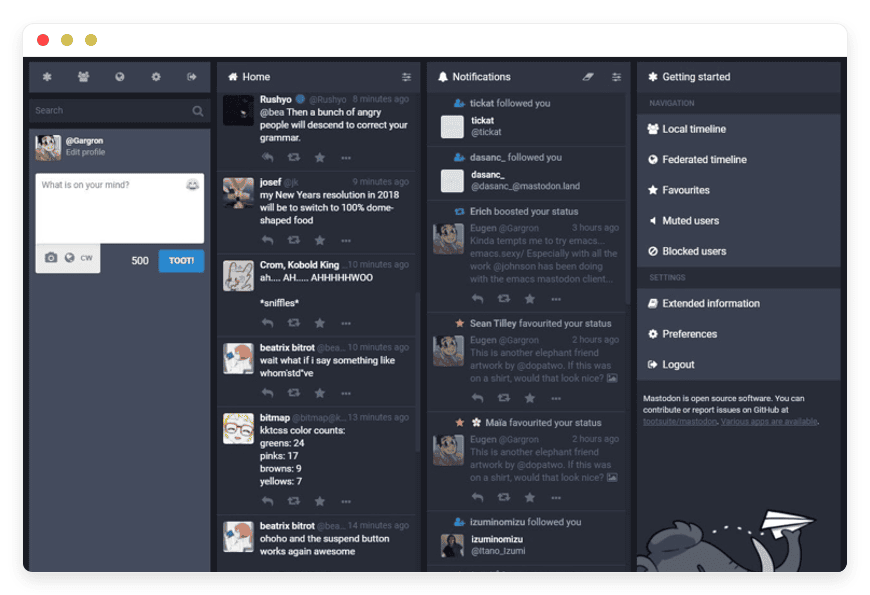
Mastodon is a microblogging server licensed under AGPLv3, first released in 2016 by Eugen Rochko and now maintained by the non-profit Mastodon gGmbH. It speaks ActivityPub. It is the closest shape to a Twitter-style timeline, and the default choice for a community that wants a public presence.
Mastodon fits a newsroom, a club, or an advocacy group that wants its own address and its own rules but still wants to reach the wider conversation. It ships in more than 90 languages, so a mixed-language community is well served. Your members post to your server; the rest of the Fediverse can follow them.
If you want this run for you — patched, backed up, and monitored — see our managed Mastodon hosting page.
Start a 7-day trial of managed Mastodon hosting — €9 a month, no card.
Pixelfed — federated photo sharing
Pixelfed is a photo-sharing server in the shape of Instagram, licensed under AGPL-3.0 and built with PHP and Laravel. It was started in 2018 by Daniel Supernault and has roughly 7,000 stars on GitHub. It also speaks ActivityPub, so a Pixelfed account and a Mastodon account can follow each other across the network. Feeds are chronological, with no engagement ranking.
Pixelfed suits a visual community: a photography collective, a cultural institution sharing its archive, a small brand that lived on Instagram. The one thing to plan for is storage, because images are far heavier than text. The next section shows the math.
To run it managed, with federated photo sharing handled for you, see our managed Pixelfed for federated photo sharing page.
Try managed Pixelfed for federated photo sharing for seven days.
HumHub — a private community network
HumHub is a community-network platform licensed under AGPLv3, written in PHP on the Yii framework and maintained by HumHub GmbH in Germany. It organises people into Spaces — rooms for departments, projects, or interest groups — with profiles, posts, and a module system to extend it. Unlike Mastodon and Pixelfed, HumHub does not federate. It is a self-contained, members-only network.
HumHub fits a community that wants the opposite of a public feed: an association, a club, or an organisation that needs an internal space its members log into, with no public posting and no federation to manage.
If a walled garden is what you want, see our HumHub for closed communities page.
Set up HumHub for a closed community on a 7-day trial.
The Pixelfed storage question
The €9 plan includes 30 GB of storage. Above that, storage is €0.50 per GB per month. Text is cheap to store; photos are not. For Pixelfed, storage is the line item that moves your bill, so it is worth estimating before you commit. The math below uses about 5 MB per stored photo.
That 5 MB figure is a working assumption, not a fixed number. It covers a typical smartphone JPEG plus the smaller thumbnail and display versions Pixelfed generates for each upload. A web-optimised feed runs lighter; a photography-led feed of full-resolution images runs much heavier. Estimate yours from the kind of images your community actually posts.
| Photos stored | Approx. data | Over the 30 GB base | Monthly total |
|---|---|---|---|
| 1,000 (≈5 MB each) | ≈5 GB | 0 GB — within base | €9 |
| 10,000 (≈5 MB each) | ≈50 GB | 20 GB | €19 |
| 10,000 (≈10 MB each) | ≈100 GB | 70 GB | €44 |
The pattern is clear. At a thousand photos you are inside the included 30 GB and pay the €9 base. At ten thousand typical photos you are about 20 GB over, which adds €10 in storage for €19 a month. A photography-led instance at ten thousand full-resolution photos can reach 100 GB, which adds €35 for about €44 a month. The base price barely moves; storage does. That is the honest shape of a Pixelfed bill, and it is the same arithmetic whoever runs the server.
Moving your audience
There is no button that copies your X followers to a new server. The realistic plan is to rebuild, not transfer: announce your new handle where your audience still sees you, pin it everywhere, and give people a few weeks to follow you across. The accounts that matter usually make the jump.
Inside the Fediverse, the picture improves. Mastodon lets a member export the list of accounts they follow and import it on another server, and it supports profile redirects so a moved account points followers to its new home. That helps when you move between Mastodon servers — not when you first arrive from X. For the move off X, treat it as a fresh start with a head start: your audience already knows your name.
For a newsroom or a club, the practical version is a short crossover. Keep posting your new handle on X while it still reaches people, put it in your email footer and on your site, and give regulars time to follow you across. The drive-by numbers will not all come, and for most small communities that trade is acceptable.
What managed hosting does — and what stays your job
Managed hosting takes the infrastructure off your plate. We patch the software monthly, monitor it around the clock, back it up daily off-site, and run the mail and DNS plumbing. What it does not do is make your moderation calls. Running a Mastodon server still means deciding your content rules and your federation policy.
Here is the split, stated plainly. We handle the parts that are the same for every server: provisioning, security updates, daily off-site backups, uptime monitoring, SMTP so your notification emails arrive, DNS, and a named human when something breaks. You pick the region for your app from 21 datacenter locations across six continents. Your operational time on the infrastructure is zero hours a month.
What stays on your side is everything specific to your community. You write the content rules. You decide which servers to federate with and which to block. You handle reports from your members and the judgement calls behind them. If a legal obligation applies to your community, meeting it is your responsibility, not the host's. Managed hosting handles the running of the software; it does not handle the running of the community.
We say this directly because the alternative is a quiet disappointment later. A managed Mastodon server is not a hands-off social account. It is your node, with your rules, kept online by us. That division is the right one for most small communities, but only if you know where the line sits before you sign up.
When to self-host instead
Managed hosting is not the right answer for everyone. If you have a developer in-house, enjoy being on call, and want full control of the box, self-hosting is a real option. A production-class VPS runs about $24 a month before your time. A home server costs more once you count electricity and backups.
The do-it-yourself path is genuinely good for the right operator. A 2 vCPU, 4 GB production-class VPS is about $24 a month, plus roughly $5 for object-storage backups and $15 for monitoring — call it $44 a month in infrastructure. Then add your time: a few hours to set it up and one to two hours a month for patching, certificate renewal, and backup checks. Tools like Coolify or YunoHost on that VPS make the self-host path much smoother if you are comfortable owning it. If your time is free to you and you like this work, it is the cheapest route in cash.
A home server is the other end. A business-grade box such as a Synology DS923+ or an HP ProLiant ML30 Gen10 amortises to roughly €18 to €55 a month, on top of €17 to €32 in electricity, €40 to €80 for business internet with a static IP, and €10 to €20 for off-site backup — a backup on the same machine is not a backup. Add a couple of hours of work a month and the effective cost lands somewhere between €210 and €667 a month, most of it your time. It makes sense if total physical control is the point and you have the room and the static IP.
Managed hosting is €9 per app per month with zero operational hours, and at the scales above it is the lowest-cash option once your time has any value. But the honest answer is that the federation hobbyist running a personal instance on a home lab was never the buyer for a €9 plan, and that is fine. Pick the path that matches how you value your weekends.
FAQ
A few questions come up every time a community plans this move. The short version: Mastodon and Pixelfed join the open network, HumHub stays private, and managed hosting covers the running of the software but not the decisions about your community. The answers below are operational guidance, not legal advice.
Is Mastodon a drop-in Twitter replacement?
No, and it helps to expect that. Mastodon gives you a familiar timeline of posts and replies, but it runs as your own server inside a wider network rather than one central platform. The interface is close; the model underneath is different, and the difference is mostly about rules and moderation being yours.
Do my members need accounts somewhere on the Fediverse, or just on my server?
Just on your server. Your members sign up on your Mastodon or Pixelfed instance, the same way they would on any site. From that one account they can follow and reply to people on other servers across the network. They do not need a second account anywhere else.
What does it cost to run Mastodon or Pixelfed with DANIAN?
The base is €9 per app per month, which includes 30 GB of storage and full management. Mastodon is text-heavy and usually stays inside that storage. Pixelfed is image-heavy, so storage above 30 GB is €0.50 per GB per month — see the storage table above for the math at 1,000 and 10,000 photos.
Does managed hosting handle moderation for me?
No. We keep the server patched, backed up, and online, but we do not write your content rules, action member reports, or set your federation policy. Those decisions belong to whoever runs the community. Managed hosting handles infrastructure, not policy, and that line does not move.
Can Pixelfed and Mastodon talk to each other?
Yes. Both speak ActivityPub, the protocol behind the Fediverse, so a Pixelfed account can follow a Mastodon account and the other way around. A photo posted on your Pixelfed server can appear in the timeline of someone following it from a Mastodon server, even though the two run different software.
What if I just want to run this myself?
That is reasonable if you have the skills and the time. A production-class VPS at about $24 a month with Coolify or YunoHost is a solid self-host path, and a home server gives you full physical control. You take on the patching, backups, and on-call in exchange.
What is the Fediverse, in plain terms?
The Fediverse is a network of independent social servers that all speak a shared protocol called ActivityPub. Instead of one company running everything, thousands of separate servers connect and let their users follow each other. Mastodon and Pixelfed are two kinds of server on that network.
Mastodon or Pixelfed — which one do I need?
Pick by what your community posts. If it is mostly text, links, and conversation, that is Mastodon, the Twitter-shaped option. If it is mostly images — a photography group, a cultural archive, a visual brand — that is Pixelfed, the Instagram shape. Both cost €9 a month and federate with each other.
Can I use my own domain name for my server?
Yes. Your Mastodon or Pixelfed server runs on a domain or subdomain you choose, such as social.yourgroup.org, and your members get handles on it. You point a DNS record at the server during setup. We handle the DNS plumbing and the certificate so the address resolves and stays valid.
Can I move my data to another host or off DANIAN later?
Yes. The software is open-source and the data is yours. We run daily off-site backups and you can request an export, so you can move your instance to another host or to your own server. Managed hosting operates the app for you; it does not lock the data in.
Will my Mastodon server keep working if DANIAN has an outage?
We monitor every server around the clock, back it up daily off-site, and post incidents on a public status page. Federation also adds resilience: posts your members already sent have copied out to other servers across the network, so the wider conversation does not vanish during a short outage.
How many members can one Mastodon server hold?
A single €9 Mastodon server comfortably runs a club, a newsroom, or an association of dozens to a few hundred active members on the included resources. Mastodon scales much further on larger setups. If your community outgrows the base plan, resource upgrades are available, and we never raise them without your consent.
Can I move between Mastodon servers without losing my followers?
Within the Fediverse, yes. Mastodon lets a member export the accounts they follow and import them on a new server, and it supports a profile redirect that points your old handle at the new one so followers move across. That mechanism works server-to-server; it does not pull followers in from X.
Do I need to know how to code to run a managed Mastodon server?
No. On the €9 managed plan we handle the parts that need a terminal: provisioning, updates, backups, mail, and DNS. You work in Mastodon's normal admin screens to set your rules and manage members. Running it yourself on a VPS is the path that needs comfort with the command line.
What is defederation, and when would I use it?
Defederation is blocking another server so its posts and accounts cannot reach your members. Most servers talk to most others by default. You defederate when another server's behaviour — spam, harassment, content you will not host — is something you want kept off your instance. The choice, and the call, are yours.
Is Mastodon free, and what is the €9 for?
Mastodon itself is free, open-source software under the AGPLv3 licence. The €9 a month is not for the software; it is for running it: the server, security updates, daily off-site backups, monitoring, mail, DNS, and a human engineer. You are paying for the operation, not a licence.
Can a business or newsroom use Mastodon, or is it only for hobbyists?
Businesses, newsrooms, clubs, and NGOs all run Mastodon. A newsroom can post headlines from its own handle, a club can run a members' space, and an advocacy group can reach the wider network on its own terms. The €9 managed plan exists specifically for organisations that want it run for them.
How is HumHub different from Mastodon and Pixelfed?
HumHub is a private, members-only network with no public federation, organised into Spaces for departments or groups. Mastodon and Pixelfed are public and federated — they connect outward to the wider network. Choose HumHub when you want a closed internal space; choose the other two when you want a public presence.
What happens to my old posts and followers on X when I move?
They stay on X. There is no tool that copies your X followers or post history to a Mastodon server, so treat the move as a fresh start with a head start: your audience already knows your name. Announce your new handle where your X audience still sees it and rebuild from there.
Does my server's content get used to train AI models?
That is set by the server you run, not by us. On your own instance you control the robots rules and the federation settings that govern who can fetch your posts. Managed hosting runs the infrastructure and does not mine your members' content; the policy choices about reach and indexing stay with you.
What does it cost to run more than one of these apps?
Each app is its own €9 a month. A community running a Mastodon server and a Pixelfed server pays €18, plus any Pixelfed storage over the included 30 GB. There is no bundle discount and no per-seat charge; the price is per app, so the bill is easy to predict as you add them.
What to do this week
You do not need to plan a year of strategy to start. Pick the shape that matches how your community talks: a microblog, a photo feed, or a private space. Estimate your storage if photos are involved. Then either start a seven-day trial or stand up a VPS if you are the do-it-yourself type.
Concretely: if you want a public, Twitter-shaped presence in the open network, that is Mastodon. If your community is visual, that is Pixelfed, and you should estimate storage from how many photos you expect. If you want a private members' space with no public federation, that is HumHub. Decide your federation stance and your basic content rules early, because those are the parts only you can set.
We will keep the server patched, backed up, and online, and we will tell you plainly where our job ends and yours begins. We will not make your community's policy calls for you, and we will not pretend a federated server is a hands-off account. Start a 7-day trial when you have picked your shape, or spin up a VPS if running it yourself is the part you enjoy.
Sources
- X Developer Platform — X API products: https://docs.x.com/x-api/getting-started/pricing
- Mastodon — official project site: https://joinmastodon.org/
- Mastodon — source repository: https://github.com/mastodon/mastodon
- Pixelfed — official project site: https://pixelfed.org/
- Pixelfed — source repository: https://github.com/pixelfed/pixelfed
This article is operational guidance, not legal advice. Running a community server means making your own moderation and content decisions and meeting any legal obligations that apply to you.